Connect with us

Business

Hong Kong tops global IPO charts for the first time since 2019 for total funds raised, overtaking New York’s stock exchanges


Published

on


Hong Kong has reclaimed its spot at the top of global IPO charts for total funds raised—a position it last held in 2019. (This figure reflects the capital injected by investors during an IPO, and represents the difference in a company’s valuation pre- and post-IPO.)

In 2025, global IPO markets raised $158.4 billion across 1,227 deals, reflecting an 18% rise in funds raised, according to an outlook report by consulting firm KPMG

The Hong Kong stock exchange (HKEX) led the way, raising a total of HKD272.1 billion ($34.3 billion) in funds. This was a 210% increase from 2024, when it raised HKD88 billion ($11.3 billion). 

The New York and NASDAQ stock exchanges ranked 2nd and 3rd, raising a total of $20.3 billion and $19.2 billion respectively, the KPMG report found. 

According to the firm’s analysts, Hong Kong’s surge in IPO fundraising was driven by a record number of A+H listings—dual listings allowing companies to trade shares on both mainland Chinese stock exchanges (A-shares) and the HKEX (H-shares). They are especially popular among Chinese companies looking to Hong Kong’s market for the first leg of their global expansion.

As of Dec. 7, Hong Kong achieved an all-time high of more than 300 active IPO applications—including 92 active A+H listing applicants—and KPMG’s analysts believe that this upward trend will continue into 2026.

“Key global IPO markets have trended upwards in 2025 with Hong Kong’s threefold increase in funds raised, making it the largest single contributor to the global IPO market’s recovery, and reaffirming its status as a leading international financial center,” wrote Paul Lau, a partner and the head of capital markets and professional practice at KPMG China, in their outlook report.

Among Hong Kong’s active IPO applications, the lion’s share is from companies in the technology, media, and telecommunications sector—which made up 39% of applications.

The healthcare and life sciences sector came in second, constituting 21% of IPO applications. The industrial sector was a close third, with 18% of active applications.

A few blockbuster IPOs debuted on the HKEX this year, including China’s largest bubble-tea chain, Mixue, which raised $444 million, and AI firm Pony AI, which raised $860 million.

Chinese battery giant CATL also boasted a strong Hong Kong debut, raising $4.6 billion from investors—one of the world’s largest listings in 2025. 

KPMG’s Lau adds that in the next year he expects the pace of AI-related listings in the HKEX to accelerate, as the technology matures and is adopted more widely across different industries.

High-performing IPO markets

After the Hong Kong and U.S. stock exchanges was the National stock exchange of India, which came in fourth place, after raising $18.5 billion in funds. This was a drop from the $20.3 billion it accrued in 2024, which previously earned it the first place spot.

The Shanghai stock exchange maintained its position as the fifth most lucrative IPO market globally, raising $13.2 billion in 2025—up from $10.6 billion in 2024.

Additionally, the A-share market—mainland China’s stock market—posted steady gains in 2025, KPMG’s market watchers added, with positive growth projected to continue in the coming year.

“The 15th five-year plan (China’s national roadmap) deepens the reform for China’s capital markets, with inclusiveness and coordinated investment and financing at the core of market reforms,” wrote Irene Chu, a partner at KPMG, who also oversees the new economy and life sciences sector for the Hong Kong market. 

“As these strategic priorities take hold, we expect the authorities to prioritize and sustain their efforts to foster steady, high-quality growth in the A-share market for years to come,” she added.


Source link

Continue Reading

Business

Down Arrow Button Icon

Published

on


The oldest baby boomers — once the vanguard of an American youth that revolutionized U.S. culture and politics — turn 80 in 2026.

The generation that twirled the first plastic hula hoops and dressed up the first Barbie dolls, embraced the TV ageblissed out at Woodstock and protested the Vietnam War — the cohort that didn’t trust anyone over age 30 — now is contributing to the overall aging of America.

Boomers becoming octogenarians in 2026 include actor Henry Winkler and baseball Hall of Famer Reggie Jackson, singers Cher and Dolly Parton and presidents Donald TrumpGeorge W. Bush and Bill Clinton.

The aging and shrinking youth of America

America’s population swelled with around 76 million births from 1946 to 1964, a spike magnified by couples reuniting after World War Two and enjoying postwar prosperity.

Boomers were better educated and richer than previous generations, and they helped grow a consumer-driven economy. In their youth, they pushed for social change through the Civil Rights Movement, the women’s rights movement and efforts to end the Vietnam War.

“We had rock ‘n’ roll. We were the first generation to get out and demonstrate in the streets. We were the first generation, that was, you know, a socially conscious generation,” said Diane West, a metro Atlanta resident who turns 80 in January. “Our parents played by the rules. We didn’t necessarily play by the rules, and there were lots of us.”

As they got older they became known as the “me” generation, a pejorative term coined by writer Tom Wolfe to reflect what some regarded as their self-absorption and consumerism.

“The thing about baby boomers is they’ve always had a spotlight on them, no matter what age they were,” Brookings demographer William Frey said. “They were a big generation, but they also did important things.”

By the end of this decade, all baby boomers will be 65 and older, and the number of people 80 and over will double in 20 years, Frey said.

The share of senior citizens in the U.S. population is projected to grow from 18.7% in 2025 to nearly 23% by 2050, while children under 18 decline from almost 21% to a projected 18.4%.

Without any immigration, the U.S. population will start shrinking in five years. That’s when deaths will surpass births, according to projections from the Congressional Budget Office, which were revised in September to account for the Trump administration’s immigration crackdown. Population growth comes from immigration as well as births outpacing deaths.

The aging of America is being compounded by longer lives due to better health care and lower birth rates.

The projected average U.S. life expectancy at birth rises from 78.9 years in 2025 to 82.2 years in 2055, according to the CBO. And since the Great Recession in 2008, when the fertility rate was 2.08, around the 2.1 rate needed for children to numerically replace their parents, it has been on a steady decline, hitting 1.6 in 2025.

Younger generations miss boomer milestones

Women are having fewer children because they are better educated, they’re delaying marriage to focus on careers and they’re having their first child at a later age. Unaffordable housing, poor access to child care and the growing expenses of child-rearing also add up to fewer kids.

University of New Hampshire senior demographer Kenneth Johnson estimates that the result has been 11.8 million fewer births, compared to what might have been had the fertility rate stayed at Great Recession levels.

“I was young when I had kids. I mean that’s what we did — we got out of college, we got married and we had babies,” said West, who has two daughters, a stepdaughter and six grandchildren. “My kids got married in their 30s, so it’s very different.”

A recent Census Bureau study showed that 21st century young adults in the U.S. haven’t been adulting like baby boomers did. In 1975, almost half of 25-to-34-year-olds had moved out of their parents’ home, landed jobs, gotten married and had kids. By the early 2020s, less than a quarter of U.S. adults had hit these milestones.

West, whose 21-year-old grandson lives with her, understands why: They lack the prospects her generation enjoyed. Her grandson, Paul Quirk, said it comes down to financial instability.

“They were able to buy a lot of things, a lot cheaper,” Quirk said.

All of her grandchildren are frustrated by the economy, West added.

“You have to get three roommates in order to afford a place,” she said. “When we got out of college, we had a job waiting for us. And now, people who have master’s degrees are going to work fast food while they look for a real job.”

Implications for the economy

The aging of America could constrain economic growth. With fewer workers paying taxes, Social Security and Medicare will be under more pressure. About 34 seniors have been supported by every 100 workers in 2025, but that ratio grows to 50 seniors per 100 working-age people in about 30 years, according to estimates released last year by the White House.

When West launched her career in employee benefits and retirement planning in 1973, each 100 workers supported 20 or fewer retirees, by some calculations.

Vice President JD Vance and Tesla CEO Elon Musk are among those pushing for an increase in fertility. Vance has suggested giving parents more voting power, according to their numbers of children, or following the example of Hungary’s Viktor Orbán in giving low-interest loans to married parents and tax exemptions to women who have four children or more.

Frey said programs that incentivize fertility among U.S. women hardly ever work, so funding should support pre-kindergarten and paid family leave.

“I think the best you can do for people who do want to have kids is to make it easier and less expensive to have them and raise them,” he said. “Those things may not bring up the fertility rate as much as people would like, but at least the kids who are being born will have a better chance of succeeding.”

___

Emilie Megnien in Atlanta contributed to this report.


Source link

Continue Reading

Business

U.S. GDP growth is being kept alive by AI spending ‘with no guaranteed return’: Deutsche Bank
Published

on


We will get a new estimate of Q3 U.S. GDP growth today. The consensus among analysts is for a rise of 3.2% year-on-year. That’s pretty decent growth. No wonder then, that the S&P 500 ticked up another 0.88% yesterday, to come within half a percentage point of its all-time high, and futures this morning are marginally up too. Traders seem to be pretty happy about where the U.S. economy is going.

But some analysts are starting to worry about how much of that growth is concentrated in AI.

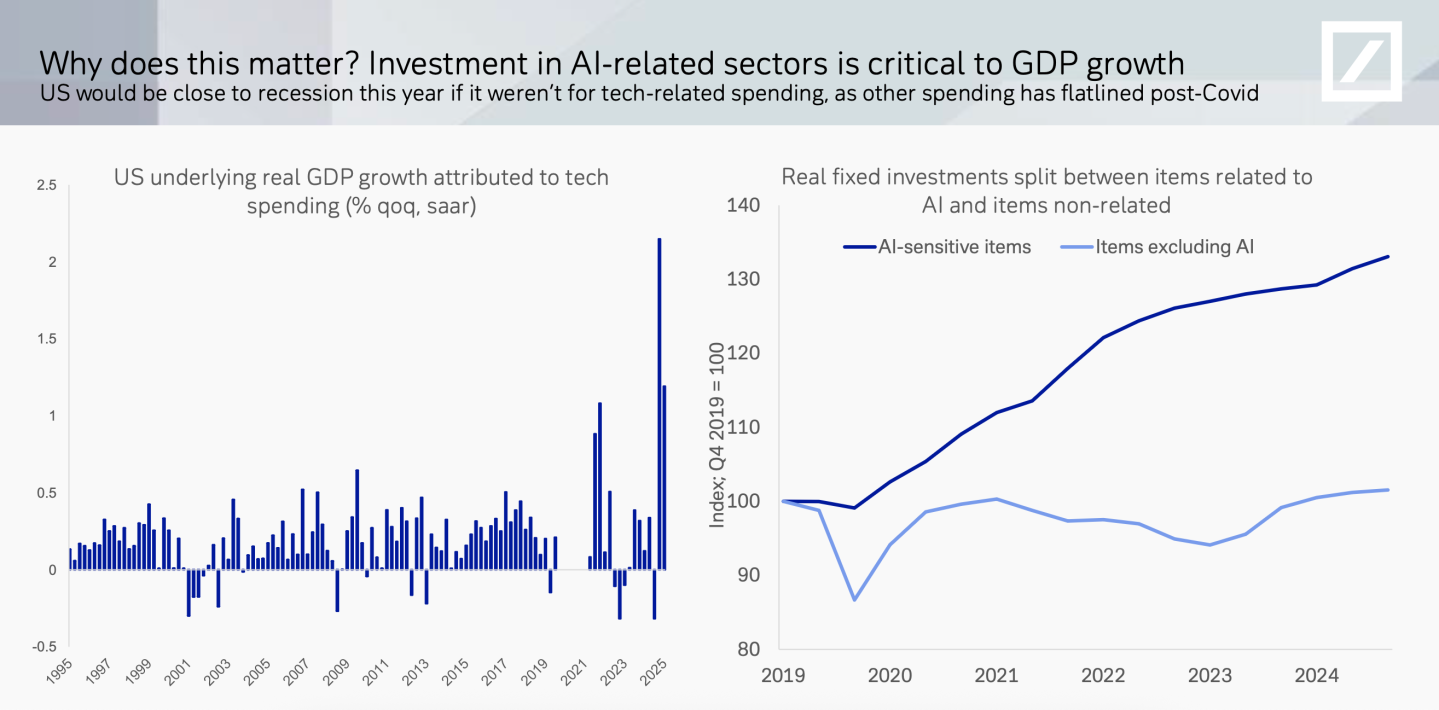
A recent note from Pantheon Macroeconomics said that private fixed investment—a measure of how much companies are spending—”is rising only due to AI-related spending.” Analyst Oliver Allen published a chart this morning showing that all other private fixed investment is actually in decline:

“Capex intentions remain depressed, suggesting investment outside of AI-linked sectors remains weak,” he told clients in a note seen by Fortune.

Deutsche Bank said much the same thing in a recent note discussing whether AI was a bubble. “Investment in AI-related sectors is critical to GDP growth [and the] U.S. would be close to recession this year if it weren’t for tech-related spending, as other spending has flatlined post-Covid,” analysts Adrian Cox and Stefan Abrudan wrote.
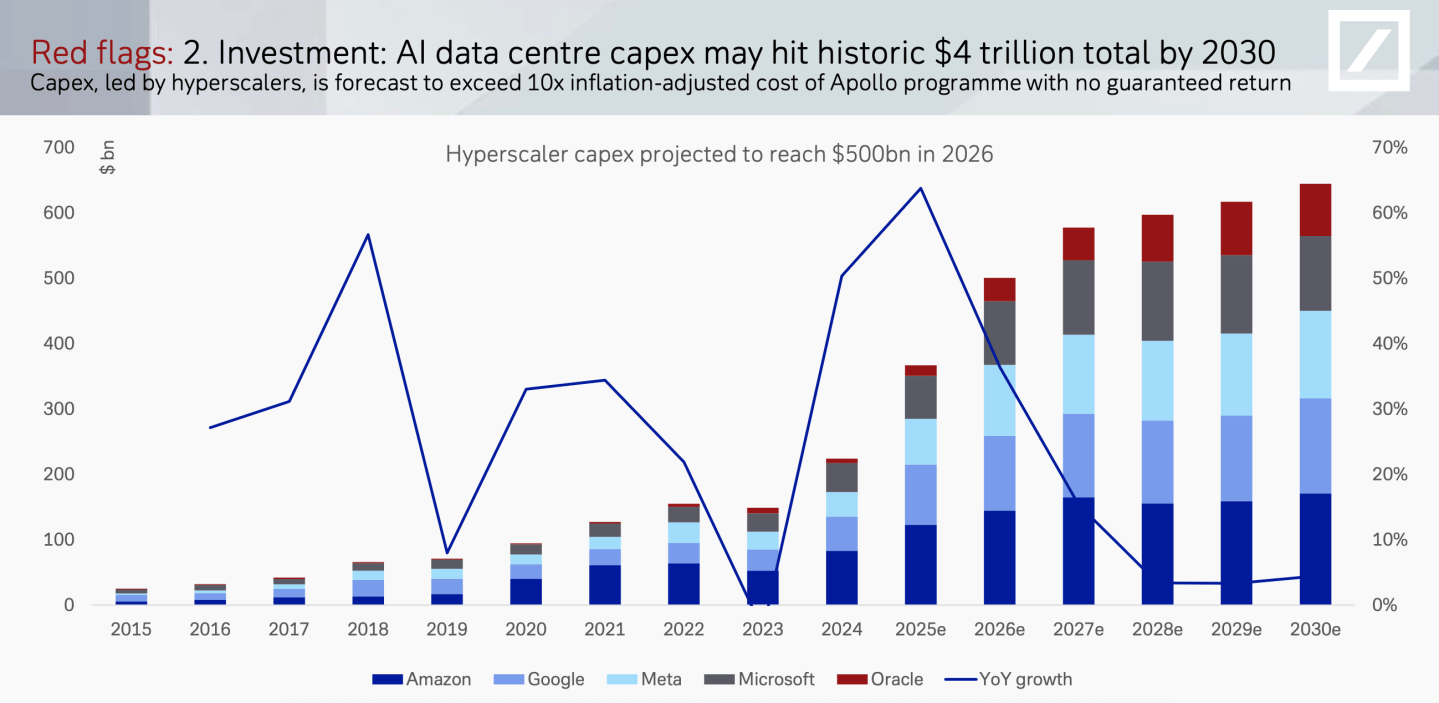
The scale of capital expenditure (capex) investment going into AI is gargantuan. Bank of America’s Justin Post and Nitin Bansal estimate that AI capex from just five “hyperscalers” (Alphabet, Meta, Microsoft, Amazon, and Oracle) will total $399 billion this year and rise to over $600 billion in the years to come.
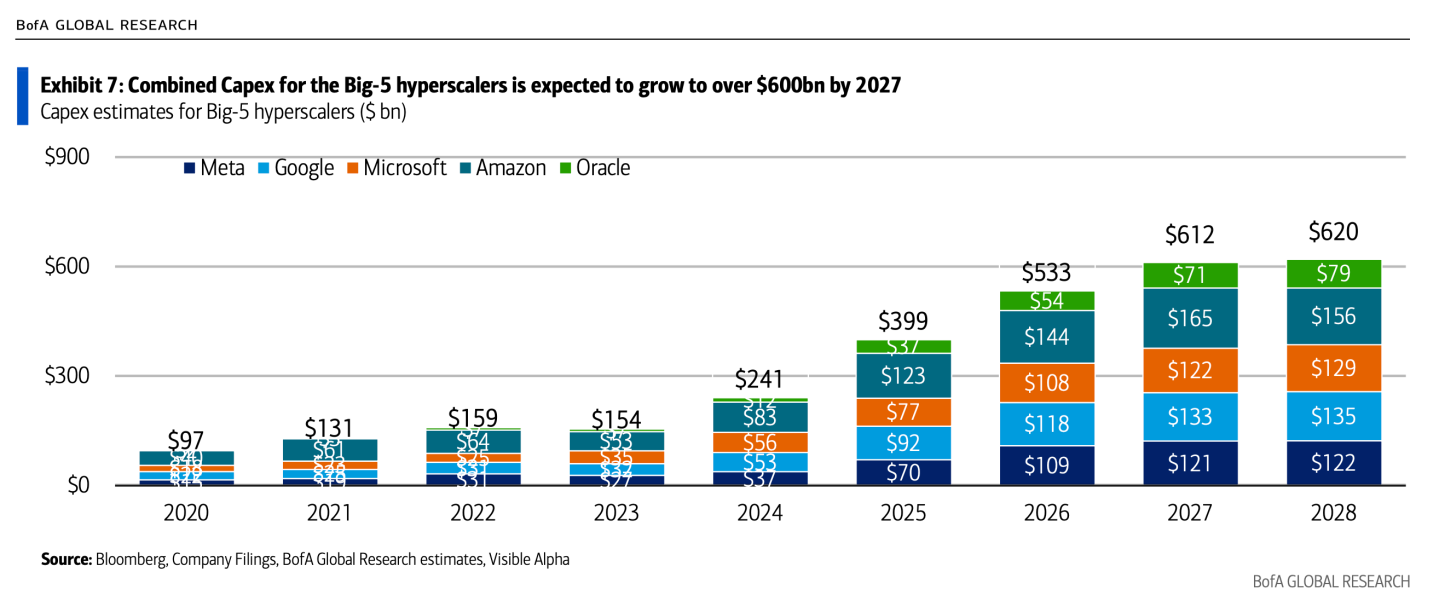
Increasingly, that AI capex will likely be funded by debt. The big tech companies have such healthy cashflow and robust balance sheets that it’s easy for most of them to add debt without harming their bottom lines, BofA says.

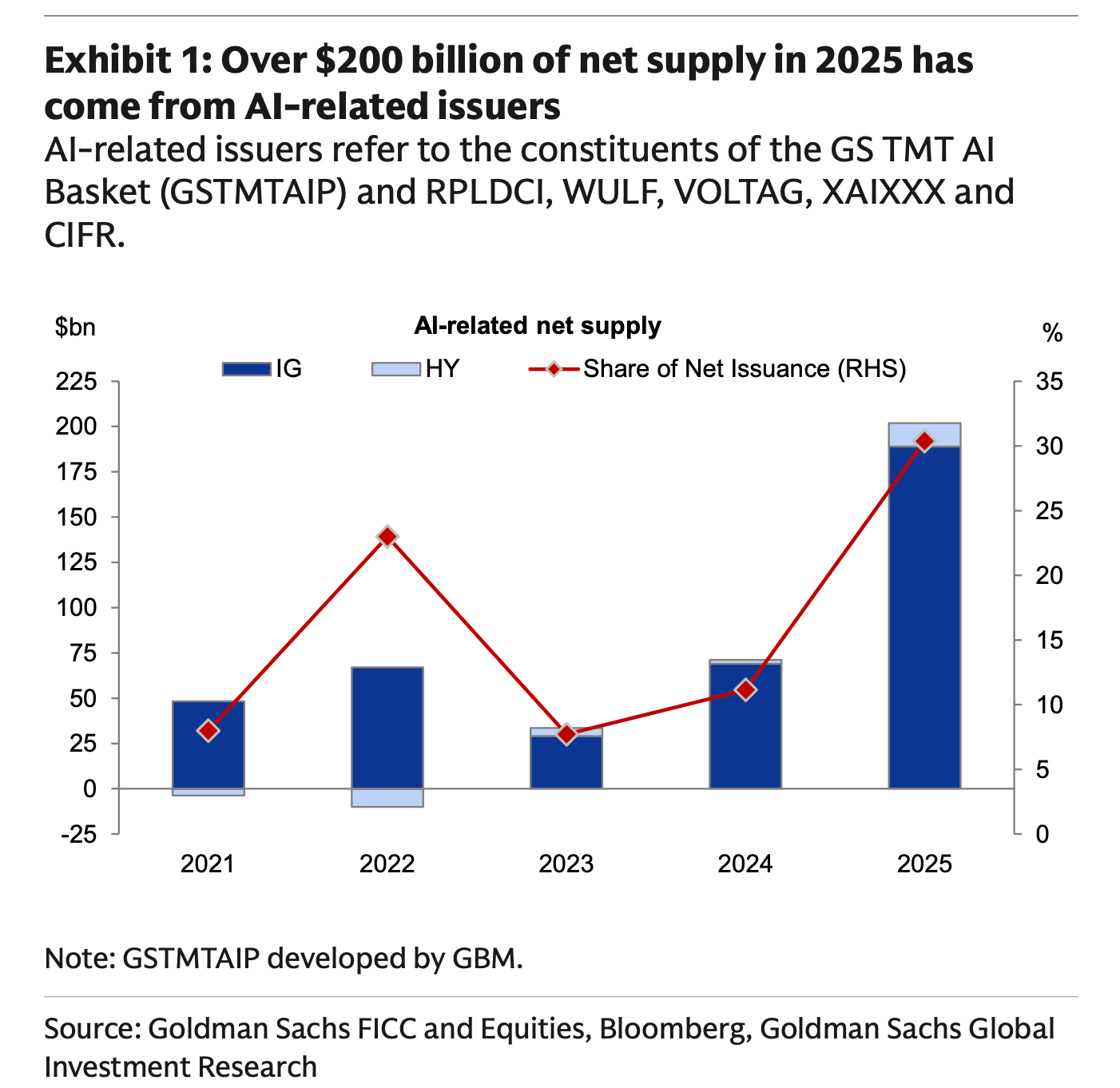
That debt is already breaking records. “Net supply [of new debt] from AI-related issuers in the USD credit market has crossed $200 billion in 2025, more than doubling last year’s total,” Spencer Rogers and his colleagues at Goldman Sachs told clients recently. “30% of USD credit net supply this year is AI-related.” He expects that number to go higher next year.
BofA says the companies are chasing $1 trillion in incremental revenues over the next five years. About $500 billion of that from cloud services; $400 billion in extra digital advertising spending; and $200 billion from AI subscriptions from both consumers and businesses. 

“Historically (2021-24), each dollar of capex helped generate an average of $0.90 incremental revenue and $0.42 of incremental EBITDA in the following year,” they wrote.

Let’s hope they are right. Because according to Deutsche Bank, hyperscalers will spend a cumulative $4 trillion on AI data centers through 2030—more than the U.S. government’s moon-landing program in the 1960s: “10x [the] inflation-adjusted cost of Apollo programme with no guaranteed return.”
Here’s a snapshot of the markets ahead of the opening bell in New York this morning:

  • S&P 500 futures are up marginally this morning. The last session closed up 0.64%. 
  • STOXX Europe 600 was up 0.18% in early trading. 
  • The U.K.’s FTSE 100 was flat in early trading. 
  • Japan’s Nikkei 225 was flat. 
  • China’s CSI 300 was up 0.2%. 
  • The South Korea KOSPI was up 0.28%. 
  • India’s NIFTY 50 was flat. 
  • Bitcoin sunk to $87K.
Join us at the Fortune Workplace Innovation Summit May 19–20, 2026, in Atlanta. The next era of workplace innovation is here—and the old playbook is being rewritten. At this exclusive, high-energy event, the world’s most innovative leaders will convene to explore how AI, humanity, and strategy converge to redefine, again, the future of work. Register now.


Source link

Continue Reading

Business

AI is reshaping banking—but not causing a jobs wipeout

Published

on


Good morning. An AI-fueled takeover of finance jobs doesn’t appear imminent, experts say.

My Fortune colleague Emma Burleigh takes a deep dive into this topic in her new report, “Is AI really killing finance and banking jobs? Experts say Wall Street’s layoffs may be more hype than takeover—for now.” For example, despite Wall Street’s headline-grabbing layoffs this year, overall headcount across banking and finance has remained relatively stable.

“I think the general [headcount] trend in the banking industry over the last decade is stable to slightly declining,” Pim Hilbers, a managing director working with banking and talent at BCG, told Burleigh. “I don’t see that changing anytime soon. That doesn’t mean that everybody just stays in their job for life. I think we see a lot more mobility than we saw in the past.”

Burleigh writes about the banking sector: “So far, America’s largest financial institutions haven’t been making deep workforce cuts. Bank of America employed just four fewer workers at the end of the third quarter this year, compared to 2024. In that same time period, JPMorgan saw its headcount climb by 2,000 employees, and more than a third of the new staffers were brought onto corporate operations. Even Goldman Sachs, which implemented multiple rounds of layoffs this year, employed 48,300 this September—around 1,800 staffers higher than the year before.

“Banks aren’t ready to shed staffers just yet; experts tell Fortune they’re pulling back on headcount growth for as long as possible, leaning on AI efficiency gains until they’re forced to add more humans to payroll. They predict this sluggish period of hiring could last for years.” Although AI isn’t replacing bankers just yet, there could be trouble on the horizon for marketers and accountants. You can read the complete report here

Regarding banking, AI is also reshaping competitive advantage, a recent BCG report finds. Predictive, generative, and agentic AI are redefining the foundations of scale, efficiency, and customer experience. Banks must anchor AI strategy in business strategy. And “winning institutions” focus on where AI will deliver real returns, not just on deploying more technology, according to BCG.

Sheryl Estrada
sheryl.estrada@fortune.com

This story was originally featured on Fortune.com


Source link

Continue Reading

Trending

Copyright © Miami Select.