Hong Kong-based NCFHK invests in Portugal’s textile sector
By
Portugal Textil
Translated by
Nazia BIBI KEENOO
Published
July 1, 2025
Hong Kong-based outerwear specialist NCFHK is expanding its European footprint through increased production in Portugal, where it tripled turnover in 2024 and aims to localize 30% of its global manufacturing within three years.
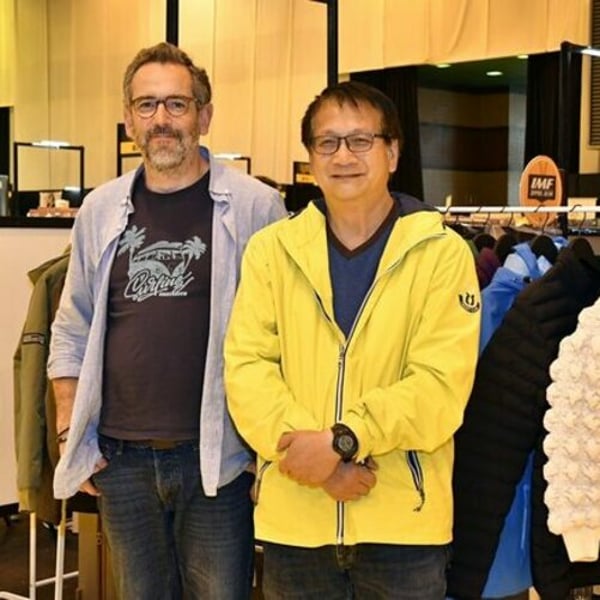
Miguel Ferreira, sales director, and Thomas Leung, founder of the company
Founded nearly two decades ago, NCFHK—specialized in outerwear—has established a growing presence in Portugal over the last four years, operating a partner factory in Famalicão and an in-house atelier in Viana do Castelo for collection development and prototyping.
Currently, approximately 10% of NCFHK’s production takes place in Portugal, with the remaining 90% based in Bangladesh—the country where the company relocated its manufacturing after several years of operating its own facilities in China. The initial move to Portugal was intended to establish a sales office focused on Southern Europe. “But over time, we realized that we could produce on the European continent because we wanted to gain more market share,” explains Miguel Ferreira, NCFHK’s sales director.
The company’s medium-term goal is for Portugal to represent 30% of its global production. “Made in Portugal is about sustainability, speed, and flexibility. Flexibility is not easy in Bangladesh. It’s a country that relies heavily on textiles—much more than Portugal. Around 80% of Bangladesh’s GDP comes from textile exports. To make it work, you need to feed the machine quickly and at scale, which suits a specific kind of customer,” Ferreira adds.
To achieve the 30% target, NCFHK plans to optimize its production processes and invest in specialized technologies, including ultrasonic and feather-filling equipment. “It’s machinery we’re already familiar with and currently use in Bangladesh—equipment we intend to bring to Portugal because it boosts productivity, increases production capacity, and enhances responsiveness, without relying heavily on manual labor, which would further drive up costs,” explains Miguel Ferreira.
In 2024, NCFHK tripled its turnover in Portugal, growing from €250,000 to €750,000. The first quarter of 2025 already points to an even stronger performance.
Internationally, Europe remains NCFHK’s primary market, but the company is seeing increasing interest from regions such as Canada, the United States, and the Middle East, where it is beginning to gain visibility. Although the Middle East is a market where “they are willing to pay and invest in technology that nobody else has,” it remains “very nascent, because it’s a difficult market to enter. We need partners and consultants working with us to help us get there because it’s not a liquid market. In other words, I can’t just pack a suitcase and go knocking on doors the way I do in Northern Europe. It takes more diplomatic work—let’s call it that,” says Miguel Ferreira.
Innovation and obstacles
NCFHK is also exploring opportunities in the defense sector, though it acknowledges the market’s demanding technical standards and certification requirements. “We’re still in the prototyping phase, not least because it’s a more complex market—highly technical and subject to strict regulations. So everything must be certified and executed with precision,” says the sales director.
Among the company’s latest innovations, Miguel Ferreira points to developing materials sourced outside Portugal, such as “a fabric made from coffee beans in Taiwan that is waterproof without any kind of treatment.” While large-scale production has yet to begin, initial testing is underway with the goal of “producing in Portugal and delivering to brands,” and the first pieces are expected to launch later this year.
However, the shortage of skilled labor continues to pose a significant challenge for NCFHK’s operations in Portugal. The company advocates for streamlining immigration processes to better align with the sector’s needs. “We’re waiting for this green lane for immigrants to really take effect, because we have people ready to come to Portugal to work and enjoy better working and living conditions. That would help the national economy in every aspect. But we haven’t succeeded yet, because many bureaucratic blockages prevent it,” concludes Miguel Ferreira.