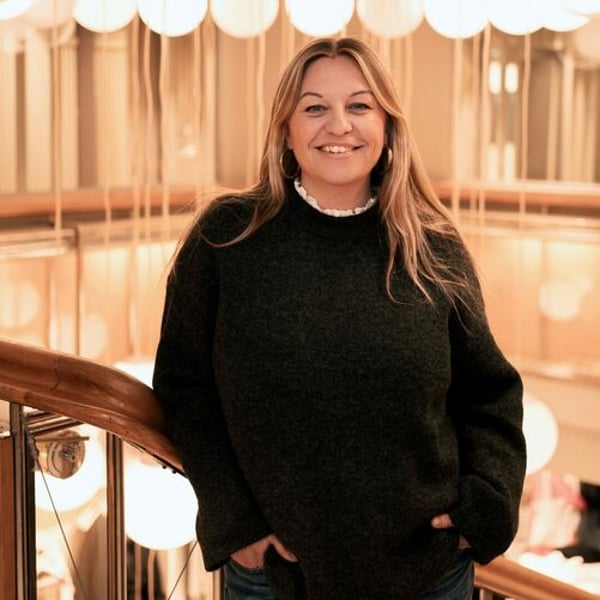
“Holding Shein to account has proved difficult,” says Nelly Group’s Helena Karlinder-Östlundh
Published
December 12, 2025
It’s a familiar David versus Goliath tale: the Nelly Group has filed a lawsuit against the Chinese giant Shein for copyright infringement. Earlier this month, the Swedish Patent and Market Court ruled that an Irish Shein subsidiary had used unauthorised copies of the Swedish online retailer’s images, but it acquitted two other subsidiaries of similar allegations. With the appeal, Nelly now wants to clarify how responsibility is apportioned within the Shein Group and examine the proportionality of the judgment. In an interview with FashionNetwork.com, CEO Helena Karlinder-Östlundh discusses her legal rationale and the boundaries of fair competition in e-commerce.
Continuing to take on Shein as CEO of the Nelly Group: Helena Karlinder-Östlundh. – Maverick Gutarra
FashionNetwork.com: Ms Karlinder-Östlundh, you’re the talk of the fashion industry because of Nelly Group’s copyright lawsuits against Shein. Have you ever regretted taking legal action?
Helena Karlinder-Östlundh: Not at all. Shein illegally used our copyrighted images and published them on its website as though they were its own. When we brought this to its attention, it disputed our ownership of the images and refused to give assurances that it would not happen again. The litigation has been both costly and time-consuming for us, but we believe it is important to pursue it. Holding Shein to account has proved difficult, and if non-European e-commerce providers can simply flout our laws like this, it undermines any sense of a level playing field in our market.
FNW: What has been your most important insight as CEO in this case so far?
HKÖ: Based on our experience to date, Shein appears to be doing everything it can to make accountability for its actions as difficult as possible. For instance, it has established a corporate structure with several companies responsible for different aspects of its operations in Sweden. As a result, we first had to invest significant time and resources to understand which company was responsible for which element, and therefore which aspects of the infringement each could be held liable for.
FNW: The other side showed little willingness to acknowledge wrongdoing, right?
HKÖ: Throughout the proceedings, Shein denied any wrongdoing- until shortly before the main hearing, when it changed its position and admitted the infringement, but claimed that only one of its companies was responsible. That gives me the impression that its multi-entity structure is a deliberate strategy to deter others from pursuing action over similar infringements.
FNW: How upset were you that the Swedish Patent and Market Court ordered you to pay Shein’s legal fees?
HKÖ: Owing to the way the judgment was worded, we were ordered to pay part of Shein’s legal fees- an amount that ultimately exceeded our own legal costs. To be honest, I was very surprised by this outcome. I had expected a clear verdict: either Shein violated our rights or not. The judgment explicitly states that all three of Shein’s legal entities contributed to the infringement and that it would not have been possible without the involvement of all three. Nevertheless, only one of these legal entities was held fully accountable and faced consequences. That did not- and still does not- make sense to me.
FNW: That does indeed sound like a contradiction in terms.
HKÖ: If such a judgment is possible at all, there is a structural flaw in the legal framework. This weakness must be remedied so that European retailers can be confident that non-European companies will also follow the same laws and face the same consequences in the event of infringements.
FNW: What is the next step in the case? What would you like to achieve by 2026? How do you think the whole thing should end?
HKÖ: We have filed an application for leave to appeal and are currently waiting for a decision before the appeal process can begin. We carefully weighed our options before deciding to appeal, fully aware that this could ultimately lead to additional costs for us. However, we firmly believe that this is an issue that European politicians and legislators need to take seriously. Current EU regulations, such as the Digital Services Act, focus primarily on consumer protection- which is important and should definitely be a top priority.
FNW: What do you think should be the next step?
HKÖ: To strengthen competition safeguards and ensure that all retailers operating in the European market follow the same rules, with a clear and effective procedure to restrict market access when those rules are not observed.
This article is an automatic translation. Click here to read the original article.