Connect with us

Business

Here’s how the Federal Reserve funds itself, including renovations, without taxpayer dollars

Published

on


The Federal Reserve’s funding has come under scrutiny as the White House attacks the $2.5 billion headquarters renovation for cost overruns.

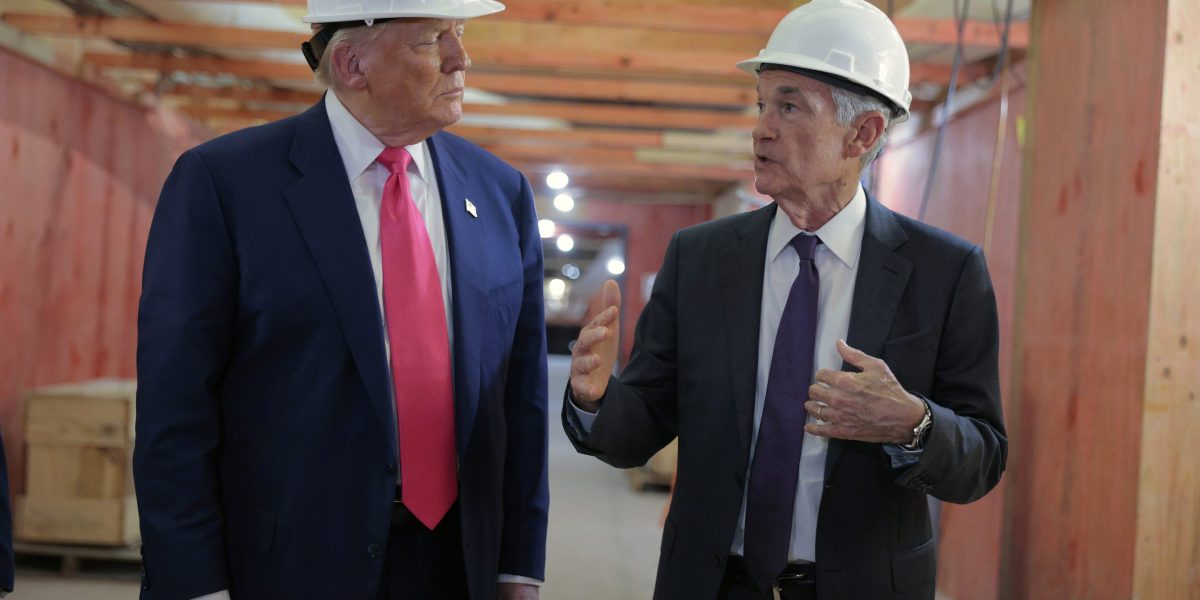
That controversy was underscored on Thursday, when President Donald Trump and Fed Chairman Jerome Powell disagreed over the cost during a visit to the central bank. Trump’s allies have suggested the project could be grounds for ousting Powell, but the president has said he would not fire him, though Trump continues to demand lower rates.

Unlike the Pentagon and a new weapons system that has blown through its budget, the Fed and its operations are funded differently.

While the Defense Department and other executive branches receive money from Congress, the Fed is self-funded, largely via interest income from government securities it holds.

That means no taxpayer dollars have been appropriated for Fed operations — including building projects like the headquarters renovation.

Most of the Fed’s income comes from assets such as Treasury bonds and mortgage-backed securities that sit on the central bank’s balance sheet and earn interest.

That balance sheet exploded in size during the Great Financial Crisis and COVID-19 pandemic as the Fed bought trillions of dollars of bonds to prop up the economy.

Other sources of income include interest on foreign currency investments held by the Fed; fees for services like check clearing, funds transfers, and clearinghouse operations provided to depository institutions; and interest on loans to depository institutions. 

To be sure, the Fed’s mission isn’t to maximize its earnings from trading securities. Instead, it has a dual mandate of stable prices and maximum employment. Buying and selling assets is only a means for achieving those ends.

Meanwhile, the Fed also has costs, including interest payments on reserve balances, interest payments on securities sold via repurchase agreements, and operational costs like payroll and its buildings. Costs go up when the Fed hikes interest rates like it did in 2022 and 2023 to tamp down inflation.

When income exceeds those costs, the Fed hands over the surplus to the Treasury Department. In fact, in the decade before COVID, the Fed sent about $1 trillion to the Treasury.

When the Fed’s costs exceed its income, the central bank creates an IOU known as a “deferred asset” to pay for operations. As interest rates rose, the Fed’s deferred asset grew from $133 billion in 2023 to nearly $216 billion in 2024. As of Wednesday, it was $236.6 billion.

Once rates come down further and income tops losses again, the Fed will pay back the deferred asset and then resume giving the Treasury any excess earnings.

“In conclusion, tighter monetary policy to rein in inflation has resulted in a reduction of net income for the Fed,” the St. Louis Fed said in a 2023 explainer. “This does not mean that the Treasury has to recapitalize the Fed, but rather that the Fed records a negative liability in the form of a deferred asset. This deferred asset accumulates until the Fed sees positive net income, which should happen once interest rates on the long-duration assets it owns start exceeding the interest paid on bank reserves and reverse repo facilities.”


Source link

Continue Reading

Business

Mario Gabelli signals support for Paramount in Warner fight

Published

on


Money manager Mario Gabelli said it’s “highly likely” he will tender his clients’ Warner Bros. Discovery Inc. shares to Paramount Skydance Corp. in an effort to spark a bidding war for the film and TV company. 

In an interview, Gabelli said Paramount will ultimately have to increase its $30-a-share bid for Warner Bros. and that Netflix Inc. will also likely counter with a higher offer. Saying he supports the Paramount tender is a way of signaling he prefers more competition for the company.

“We’re in the early rounds,” Gabelli said. “Round five of a nine-round challenge.”

Warner Bros. shares were up 3.8% to $28.26 at the close in New York on Tuesday.

The longtime media investor attended Paramount’s presentation at a UBS conference on Tuesday and walked away impressed. Management “did a very good job” addressing potential regulatory challenges including at the state level, he said.

Gabelli’s firm and funds hold almost 5.7 million Warner Bros. shares, according to data compiled by Bloomberg, worth about $160 million based on Tuesday’s closing price. He also owns shares in Paramount and Netflix.

Warner Bros. agreed last week to sell its streaming and studios businesses, including HBO, to Netflix for $27.75 a share in cash and stock. Paramount on Monday went public with an all-cash tender offer for Warner Bros. and has been looking to convince investors its bid is better.

Gabelli plans to tender because the “terms of trade favor Paramount,” including an all-cash proposal that doesn’t rely on publicly traded stock or the spinoff of Warner Bros.’ cable networks, as Netflix’s offer does. 

Gabelli wouldn’t say which company was a better fit for Warner Bros.

“I don’t like to endorse things,” he said. “That’s why you play that card (a tender offer). It’s Texas hold ’em.”

On Tuesday, Gabelli’s company said in a regulatory filing it purchased more shares of the cinema and hotel company Marcus Corp.

Movie theater chains, which have been battered by tepid ticket sales and the threat of cutbacks in Hollywood releases, are a buy, Gabelli said. Paramount winning Warner Bros. would be “clearly better” for theaters because management believes in traditional film releases. 


Source link

Continue Reading

Business

Pluck eyebrows. Avoid surveillance cameras: Luigi Mangione’s to-do list as he tried to avoid arrest revealed in court

Published

on


Pluck eyebrows. Buy less conspicuous shoes. Take a bus or a train west toward Cincinnati and St. Louis. Move around late at night. Stay away from surveillance cameras.

A to-do list and travel plans found during Luigi Mangione’s arrest and revealed in court this week shed new light on the steps he may have taken — or planned to take — to avoid capture after UnitedHealthcare CEO Brian Thompson’s killing last year.

“Keep momentum, FBI slower overnight,” said one note. “Change hat, shoes, pluck eyebrows,” said another.

The notes, including a hand-drawn map and tactics for surviving on the lam, were shown on Monday at a pretrial hearing as Mangione’s bid to prevent prosecutors from using evidence seized during his Dec. 9, 2024, arrest at a McDonald’s in Altoona, Pennsylvania.

Excerpts of body-worn camera footage of the arrest, previously unseen by the press or the public, were released on Tuesday.

Police said they discovered the notes in Mangione’s backpack, along with a 9 mm handgun that prosecutors said matches the one used to kill Thompson five days earlier; a loaded gun magazine and silencer; and a notebook in similar handwriting which he purportedly described his intent to “wack” a health insurance executive.

Mangione’s lawyers haven’t disputed the authenticity of the notes or the provenance of the gun, pocket knife, fake ID, driver’s license, passport, credit cards, AirPods, protein bar, travel toothpaste, flash drives and other items seized from him and his backpack.

But they argue that anything found in the bag should be barred because police didn’t have a search warrant and lacked the grounds to justify a warrantless search. Prosecutors contend the search was legal — officers said they were checking for a bomb — and that police eventually obtained a warrant.

The notes, along with other evidence highlighted at the pretrial hearing, underscore that Mangione’s stop in Altoona, a city of about 44,000 people about 230 miles (370 kilometers) west of Manhattan, was only meant to be temporary.

One note said to check for “red eyes” from Pittsburgh to Columbus, Ohio or part way to Cincinnati (“get off early,” it reads). The map drawn below shows lines linking those cities, as well as other possible destinations, including Detroit, Indianapolis and St. Louis.

Thompson, 50, was killed as he walked to a Manhattan hotel for his company’s investor conference on Dec. 4, 2024. Surveillance video showed a masked gunman shooting him from behind and then fleeing the area. Over the next hours and days, police released photos of a suspect — first showing him in a mask and hooded coat and then his face and thick eyebrows.

Mangione, 27, has pleaded not guilty to state and federal murder charges. The pretrial hearing, which resumes for a sixth day on Thursday, applies only to the state case. His lawyers are making a similar push to exclude the evidence from his federal case, where prosecutors are seeking the death penalty.

Among the notes revealed this week was one with a heading “12/5” and a starred entry that said: “buy black shoes (white stripes too distinctive).”

Another, also written in to-do list style, suggested spending more than three hours away from surveillance cameras and using different modes of transportation to “Break CAM continuity” and avoid tracking. Below that, it said: “check reports for current situation,” a possible reference to news reports about the search for Thompson’s killer.

According to prosecutors, Mangione fled to Newark, New Jersey, immediately after the shooting and took a train to Philadelphia. Among the evidence shown at the pretrial hearing was a Philadelphia transit pass purchased at 1:06 p.m. — a little more than six hours after the shooting — and a ticket for a Greyhound bus, booked under the name Sam Dawson, leaving Philadelphia at 6:30 p.m. and arriving in Pittsburgh at 11:55 p.m.

A note with the heading “12/8” lists a number of tasks, including an apparent trip to Best Buy to purchase a digital camera and accessories, “hot meal + water bottles,” and “trash bag(s).” Under “12/9,” the day of Mangione’s arrest, the note lists tasks including “Sheetz,” an Altoona-based convenience store chain, “masks” and “AAA bats.” Under “Future TO DO,” it listed “intel checkin” and “survival kit.”

Mangione had a Sheetz hoagie in his backpack when he was arrested, along with a loaf of Italian bread from a local deli, according to police officers testifying Monday and Tuesday. It had been raining, and the bag and items inside it were wet, the officers said. They were heard on body-worn camera footage played in court theorizing that Mangione had gotten soaked walking from the city’s bus station.

Police responded to the McDonald’s after a manager called 911 to relay concerns from customers who thought that Mangione, eating breakfast in a back corner, resembled the man wanted for killing Thompson. On the call, played in court, the manager could be heard saying that because Mangione was wearing a medical mask, she could only see his eyebrows and that she searched online for a photo of the suspect for comparison.

Altoona Police Officer Stephen Fox testified on Tuesday that Mangione, the Ivy League-educated scion of a wealthy Maryland family, expressed concern for the 911 caller’s wellbeing. Fox said Mangione asked if police had planned on releasing her name, which they didn’t. The officer recalled him saying: “It would be bad for her” and “there would be a lot of people that would be upset.”

At another point, Fox said, a shackled Mangione stumbled while trying to keep up with the brisk-moving officer. Fox said he apologized and said, “I forgot you were shackled.”

He said Mangione responded: “It’s OK, I’m going to have to get used to it.”


Source link

Continue Reading

Business

MacKenzie Scott’s $7 billion year: Philanthropist reveals inspiration for monumental giving

Published

on


It’s official—we finally have a total figure for MacKenzie Scott’s donations this year: an eye-popping $7.2 billion. That brings the billionaire philanthropist’s total gifts since 2020 to $26 billion and more than 2,700 gifts. This squarely places Scott among the most generous philanthropists, alongside fellow billionaires Bill Gates, Melinda French Gates, and Warren Buffett—all of whom announced major giving plans this year.

“This dollar total will likely be reported in the news, but any dollar amount is a vanishingly tiny fraction of the personal expressions of care being shared into communities this year,” Scott wrote in an essay published Tuesday. “To use just one year in the United States as an example, the total donated to US charities of all kinds in 2020 was $471 billion, nearly a third of it in increments of less than $5,000.”

This year, the philanthropist, novelist, and ex-wife of Amazon founder Jeff Bezos made donations to more than 180 organizations, many of which were focused on DEI, education, disaster recovery, and humanitarian causes.

Her largest disclosed donations this year, according to her organization Yield Giving, include:

  • Blackfeet Community College: $80 million
  • Projeto Saúde e Alegria: $80 million
  • Filantropía Puerto Rico: $80 million
  • Thurgood Marshall College Fund: $70 million
  • HSF: $70 million
  • UNCF (United Negro College Fund): $70 million
  • Prairie View A&M University: $63 million
  • North Carolina Agricultural and Technical State University: $63 million
  • California State University, Northridge: $63 million
  • Morgan State University; $63 million
  • Howard University: $63 million

Scott’s giving style

Many of these gifts were the largest single donations ever received by the respective organizations. And many have gone to organizations working on issues that have experienced major cuts from the Trump administration—namely a $60 million donation to the Center for Disaster Philanthropy this fall. The gift came after the Trump administration’s cuts to the Federal Emergency Management Agency (FEMA)—an organization Americans rely on for help during and after hurricanes, wildfires, tornadoes, and floods.

“All sectors of society—public, private, and social—share responsibility for helping communities thrive after a disaster,” CDP president and CEO Patricia McIlreavy told Fortune. “Philanthropy plays a critical role in providing communities with resources to rebuild stronger, but it cannot—and should not—replace government and its essential responsibilities.”

But what makes Scott’s philanthropic efforts so impactful is her giving style. Scott makes unrestricted gifts, meaning the organizations can use the donations however they choose to do so.

“She practices trust-based philanthropy,” Anne Marie Dougherty, CEO of the Bob Woodruff Foundation, told Fortune.

The veterans-focused Bob Woodruff Foundation has received two gifts from Scott: a $15 million gift in 2022, and a subsequent $20 million donation this fall. The $15 million gift was the largest in history at the time for the organization, which is almost two decades old now—founded the same year military reporter Bob Woodruff was severely injured by a roadside bomb in Iraq. It was cofounded by Woodruff and his family to provide support for injured service members, veterans, and their families.

Noni Ramos, CEO of Housing Trust Silicon Valley, also previously toldFortune that Scott’s donations are “unlike traditional funding processes,” which typically involve lengthy applications, specific restrictions, and reporting requirements. 

“Her style empowers organizations like ours to determine how best to direct funds quickly and innovatively to address pressing issues,” Ramos said. Her organization received a $30 million donation from Scott in 2024.

In fact, some say Scott’s philanthropic style is so transformative it could change giving for years to come. 

“At a moment when philanthropy is deciding its role in shaping our future, [her gifts point] to a path forward in the second half of this defining decade,” Melanie Allen, co-director of Hive Fund, said in a statement. The climate- and gender-justice-focused Hive Fund received part of a $140 million gift to climate-focused organizations, also including Equity Fund and The Solutions project. 

“As federal climate commitments are rolled back and public funding becomes increasingly uncertain, frontline climate leaders are met with growing challenges but with fewer resources to enact innovative, locally responsive solutions,” Gloria Walton, CEO of The Solutions Project, added. “I hope this is just the beginning of an urgently-needed infusion of investment.”

Why Scott donates so much money

Although Scott had a career writing novels before her marriage to Bezos, the vast majority of her wealth came as the result of her 2019 divorce from the world’s fifth-richest man. During their marriage, Scott played a key role in Amazon’s founding and early operations, including helping with business plans and contracts. She received roughly a 4% stake in Amazon upon their divorce—a cut equivalent to roughly 139 million shares at the time. 

She’s since reduced her Amazon stake by about 42% by selling or donating about 58 million shares. Still, Scott is worth about $40 billion today despite having donated more than $27 billion to charitable organizations through her foundation Yield Giving, which she founded in 2022.

Her proclivity for giving began in college when she witnessed two major acts of generosity: Her dentist offered her free dental work when he saw her securing a broken tooth with denture glue, and her college roommate who loaned her $1,000 when she saw her crying about nearly having to drop out during her sophomore year.

“It is these ripple effects that make imagining the power of any of our own acts of kindness impossible,” Scott wrote in the Dec. 9 essay. “The potential of peaceful, non-transactional contribution has long been underestimated, often on the basis that it is not financially self-sustaining, or that some of its benefits are hard to track. But what if these imagined liabilities are actually assets?”

What’s more, Scott also says giving just feels good.

“Generosity and kindness engage the same pleasure centers in the brain as sex, food, and receiving gifts, and they improve our health and long-term happiness as well,” she said.


Source link

Continue Reading

Trending

Copyright © Miami Select.