
Politics
Gov. DeSantis names 2 members to Disney World’s governing board


Gov. Ron DeSantis has appointed two members to Disney World’s governing board that the state notoriously took over in 2023.
DeSantis has named banker Matt Ravenscroft and lawyer David Woods to the Central Florida Tourism Oversight District (CFTOD).
“Ravenscroft is the Executive Vice President and Director of Sunrise Bank in Orlando,” DeSantis said in a press release to announce the choices. “Previously, he served as a Senior Vice President of Old Florida Bank, United Heritage Bank, and Citrus Bank. Ravenscroft earned his bachelor’s degree from the University of Central Florida.”
Woods works at Woods & Woods, P.A., DeSantis highlighted.
“His practice areas include real estate, wills, trusts, and estates,” DeSantis said. “Woods earned his bachelor’s degree in communication and media studies from Florida State University and his juris doctor from St. Thomas University.”
Their appointments are subject to Senate confirmation.
The CFTOD oversees the largely behind-the-scenes side of Disney World — roads, infrastructure and emergency services that respond when guests are hurt or sick.
The special district, however, was thrown into the national media limelight in 2023 during the infamous DeSantis-Disney feud.
Then-Disney CEO Bob Chapek hesitatingly spoke out against Florida’s Parental Rights in Education Act, which critics called the “Don’t Say Gay” law.
What came next was a wave of backlash among Florida Republicans.

The Legislature passed a 2023 law that gave DeSantis the power to appoint members onto the CFTOD, which had formerly been called the Reedy Creek Improvement District.
Previously, Disney had largely controlled its own governing board. DeSantis said it was inappropriate for The Mouse to have such an advantage above the other theme park operators in Orlando.
These days, the CFTOD is no longer in the headlines.
CFTOD Administrator Stephanie Kopelousos — DeSantis’ former Senior Advisor and the Director of Legislative Affairs — handles day-to-day operations. But the public fight against Disney and Republicans has died down. In a sign of a healed relationship, DeSantis appointed Disney World President Jeff Vahle to a high-profile University of Central Florida Trustee position last year.
Politics
Nick DiCeglie bill that aims to fix unintended consequences of hurricane recovery law flies through committee

A bill proposed by Republican Sen. Nick DiCeglie meant to right the wrongs brought by 2025 legislation (SB 180) has cleared its first committee stop.
SB 840, sponsored by DiCeglie of Pinellas County, would scale back the unintended consequences of SB 180, which was designed to prevent local governments from slowing rebuilding efforts after hurricanes.
But broad language in that law has instead been used to block unrelated comprehensive plan changes and development decisions well beyond storm-damaged areas. The matter pushed a group of cities and counties across the state to file a joint lawsuit against the state.
The Senate Committee on Community Affairs voted Tuesday to report SB 840 favorably after limited discussion.
“As we were going through the legislative process there were provisions, 18 and 28, of Senate Bill 180 that had the term ‘burdensome and restrictive,’ and it was such a broad term that unfortunately we’ve seen across the state in many cases a paralyzation of local governments just trying to execute and advance some changes through their comprehensive plan,” DiCeglie said.
SB 840 would reduce the affected area from 100 miles to 50 miles from a hurricane’s track. DiCeglie said overlapping storms during the 2024 hurricane season effectively placed nearly the entire state under post-storm land use restrictions, prompting the change.
“That 100-mile radius ultimately impacted almost every inch of the state,” DiCeglie said.
The bill would also shorten the duration of SB 180 restrictions tied to Hurricanes Debby, Helene and Milton. Under SB 840, those provisions would expire on June 30, instead of remaining in effect through late 2027, as currently scheduled.
SB 840 would maintain a one-year prohibition on local governments imposing moratoriums or adopting more restrictive land use regulations that would delay rebuilding, but limits those restrictions to property that was actually damaged by a hurricane and requires documentation of storm-related damage.
The bill would allow local governments to continue certain actions after a storm, including planning decisions required by state or federal law, work in areas of critical state concern, and projects related to drinking water, sewer, stormwater and flood protection.

Committee members asked limited questions, focusing on the reduced geographic scope and the bill’s changes to SB 180’s expiration dates. Several Senators praised the bill as a necessary response to concerns raised by local governments since. No speakers appeared in opposition, and the Florida Association of Counties signaled support for the measure.
DiCeglie emphasized that SB 840 is intended to preserve the original intent of SB 180 while addressing its unintended consequences. The committee unanimously approved SB 840, advancing the bill to the Senate Judiciary Committee as lawmakers have officially reconvened for the 2026 Legislative Session.
“This will ensure that regardless if a storm hits, communities within areas of critical state concern will be able to move forward with comprehensive planning decisions,” DiCeglie said.
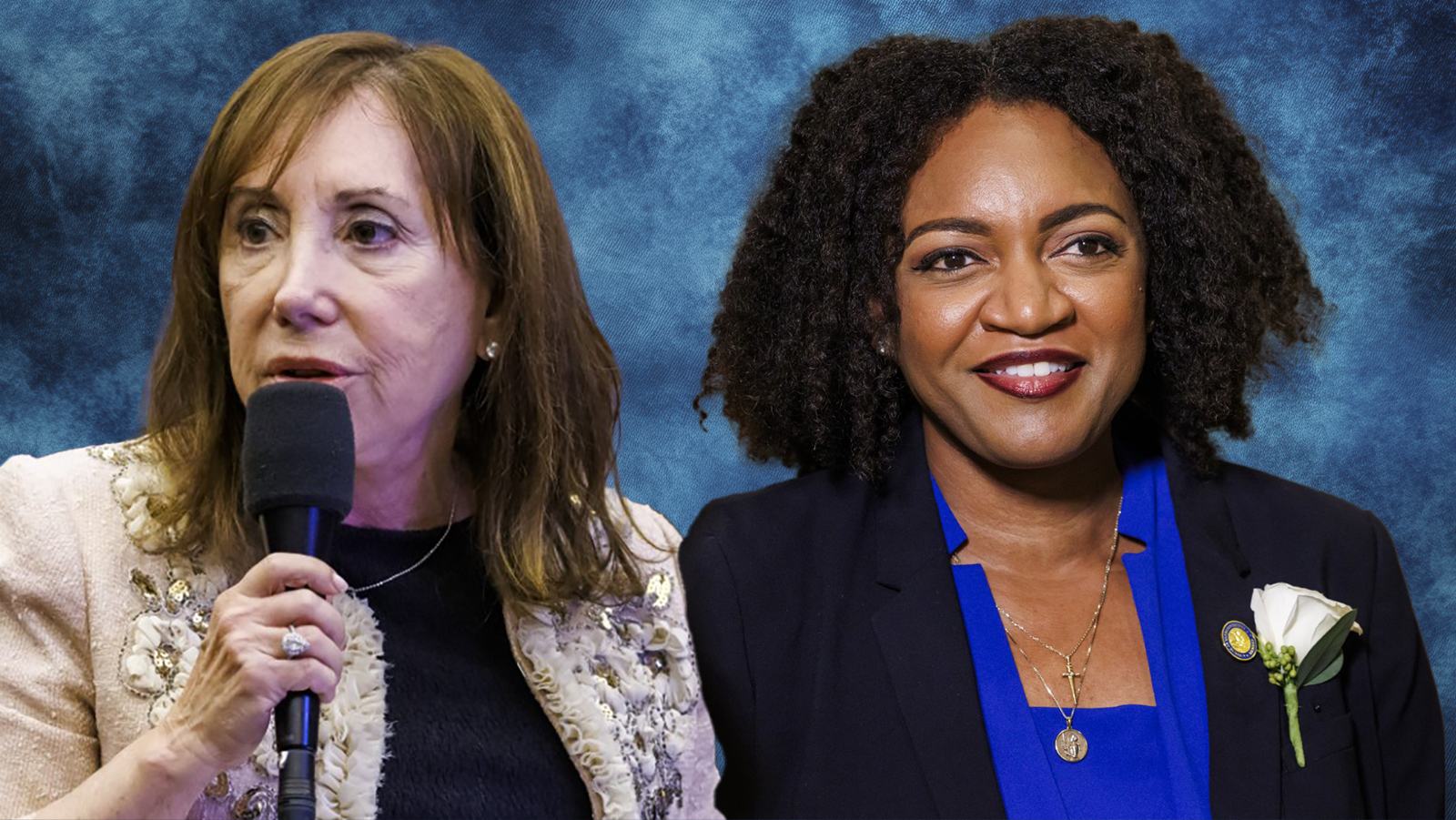
Florida Democrats criticized Gov. Ron DeSantis’ State of the State address, saying he carries a legacy of misplaced priorities into his final year in office.
Democratic leaders argued that DeSantis’ portrayal of Florida’s condition does not align with the financial pressures facing residents — particularly rising housing and insurance costs — and amounted to a retread of his “greatest hits” without outlining a clear vision for the year ahead.
In an official video response, Senate Democratic Leader Lori Berman said DeSantis remains “completely out of touch with reality,” arguing that Floridians have seen costs rise across the board while the administration has focused on politics and patronage. She accused the Governor of prioritizing political ambition over governing, saying his leadership has left Florida “less affordable and more corrupt.”
In his State of the State address, DeSantis painted Florida as a national model for economic growth, fiscal restraint and conservative governance, arguing the state has delivered results where other states have faltered.
He acknowledged rising property taxes and housing pressures, but argued those challenges stem largely from local government decisions and called for property tax relief.
DeSantis said recent legislative actions have helped stabilize insurance markets, while also emphasizing his administration’s record on immigration enforcement, public safety and cultural issues. He defended policies targeting diversity, equity and inclusion programs and pandemic-era restrictions and warned against the unchecked influence of artificial intelligence.
House Democratic Leader Fentrice Driskell said the address was overwhelmingly retrospective, focused more on defending and celebrating past actions than laying out a governing agenda for the coming Session.
“I didn’t hear too many new ideas; it sounded like he was dredging up some of his greatest hits,” she said.
“I never expected to hear about the time of COVID; there were so many quotes and weird historical references. It was kind of hard to keep track. I just expected more from the Governor’s last State of the State address.”
She pointed to what she described as a disconnect between the Governor’s rhetoric and everyday realities, arguing that Floridians continue to face underfunded schools, rising grocery and utility bills, congested roads and expensive health care.

Driskell also criticized DeSantis for attacking local government spending while proposing a 2026 budget that is roughly $24 billion larger than his first budget, calling it further evidence that the administration’s priorities are misaligned.
Berman echoed that criticism, arguing that the Governor’s focus on property tax cuts misses the core affordability problem facing homeowners and renters alike. She said lowering insurance costs would deliver more direct relief without hollowing out local services.
“We heard in his press conference this week that he said insurance is solved and that rates are going down, but we know Florida is twice the national average and rates going down, even 8% or 10%, are not solving the issue,” Berman said.
“We don’t think the Legislature has done enough on insurance and we’re going to continue to push. When you lower insurance rates you put money in people’s pockets directly, and that’s what we think should be the answer, not this property tax issue.”
Both Berman and Driskell highlighted Democratic proposals aimed at affordability that may not see the light of day during a Session likely to be dominated by Republican calls for property tax cuts — a move they argue will not provide meaningful relief.
Those proposals include a national insurance compact to spread hurricane risk, the Housing Options Made For Everyone (HOME) Act to preserve affordable housing and reduce costs for first-time homebuyers, and efforts to rein in wasteful or politically connected state spending.
“For eight years, he’s been focused on culture wars, grabbing headlines and an ever-growing list of grievances meant to keep people distracted and angry so that we don’t notice that Florida is becoming too expensive for too many Floridians,” Driskell said. “That’s his legacy: division, meanness and a growing affordability crisis.”
The two Democratic leaders also criticized DeSantis for pursuing a mid-decade redistricting effort, calling it a partisan gerrymander that violates Florida’s Fair Districts Amendments and undermines voters’ ability to choose their representatives.
Driskell criticized the Governor’s rhetoric on immigration and said the public lacks transparency to evaluate enforcement claims. She pointed to heightened national tensions and referenced a recent incident where an Immigration and Customs Enforcement agent shot and killed an American in Minneapolis, arguing that political escalation has gone too far and underscoring the need for accountability and restraint.
Driskell also challenged DeSantis’ portrayal of progress on education and public safety, arguing that many Floridians are still grappling with underfunded schools and other realities like rising utility and grocery bills, congested roads and costly health care that were largely absent from the Governor’s address.
Both leaders said the speech reinforced their view that DeSantis’ final year agenda is more focused on defending his political record and positioning himself nationally than on outlining solutions for Florida’s affordability crisis. With Republicans controlling the governor’s office and both chambers of the Legislature, they said the responsibility for delivering relief — or failing to do so — rests squarely on their shoulders.
“There is absolutely no excuse,” Driskell said. “Any failures in this Legislative Session, it’s on them.”
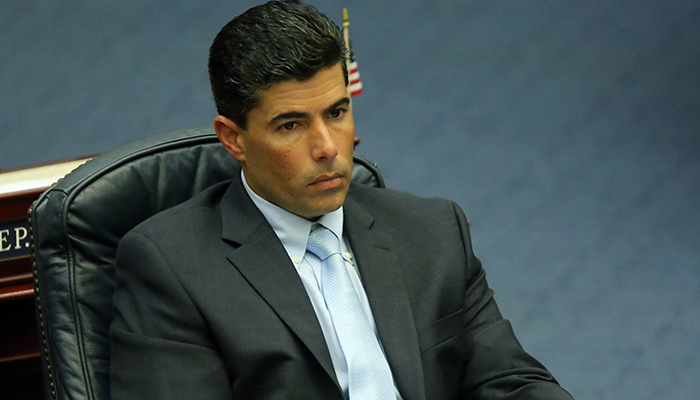
Gov. Ron DeSantis has declined to renominate his once loyal ally, former House Speaker José Oliva, to an influential state Board that oversees Florida’s public university system.
In a press release sent out just before his State of the State address started Tuesday, DeSantis named four new appointments and two reappointments to the State University System’s Board of Governors (BOG). Missing in the press release was any mention of Oliva, whose prior term ended Jan. 6.
Oliva was a DeSantis defender who had even been rumored to be on DeSantis’ list of Lieutenant Governor choices before DeSantis picked Jay Collins.
But Oliva clashed with DeSantis as the BOG voted on a new Chair in November.
The BOG elected Alan Levine as Chair instead of allowing Brian Lamb to remain for a third term. Influential University of Florida Board of Trustees Chair Mori Hosseini, a DeSantis supporter, had been pushing for Lamb. Hosseini had also loudly backed UF hiring Santa Ono as President, but the BOG rejected Ono’s bid in June.
“Insiders say DeSantis’ office lobbied the Board of Governors in November to block anyone who voted against Ono from ascending to board leadership. Oliva ended up nominating Alan Levine, then the vice chair, to be chair — bucking the governor’s demands,” Miami Herald reporter Garrett Shanley wrote on X.
The new members of the BOG, subject to Florida Senate approval, will be: Ashley Lukis, Michael Okaty, Keith Perry and Nick Sinatra. Ashley Bell Barnett and Charles Lydecker were also reappointed.
One of the new Board members is a former state lawmaker. Another has ties to national politics.
Perry, now President and Owner of Perry Roofing Contractors, previously was a Senator representing Senate Districts 8 and 9 as well as a Representative for House Districts 21 and 22.
Sinatra, founder of Sinatra and Company, was the Associate Political Director for The White House under President George W. Bush.

Meanwhile, DeSantis said “Lukis is a Shareholder at GrayRobinson, P.A., where she represents public entities and private clients alike in complex state, federal, and administrative litigation.”
Okaty “is a Partner at Foley & Lardner, LLP,” DeSantis said, who “was recognized as the 2023 Lawyer of the Year in business organizations law by The Best Lawyers in America.”


‘Hybrid creep’ is the latest trick bosses are using to get workers back in the office

Chloe Kim Confirms She Tore Labrum, Will Still Compete in Olympics

Nick DiCeglie bill that aims to fix unintended consequences of hurricane recovery law flies through committee
-

 Politics8 years ago
Congress rolls out ‘Better Deal,’ new economic agenda
-
Entertainment8 years ago
New Season 8 Walking Dead trailer flashes forward in time
-
Politics8 years ago
Poll: Virginia governor’s race in dead heat
-
Politics8 years ago
Illinois’ financial crisis could bring the state to a halt
-
Entertainment8 years ago
The final 6 ‘Game of Thrones’ episodes might feel like a full season
-
Entertainment8 years ago
Meet Superman’s grandfather in new trailer for Krypton
-
Business8 years ago
6 Stunning new co-working spaces around the globe
-
Tech8 years ago
Hulu hires Google marketing veteran Kelly Campbell as CMO