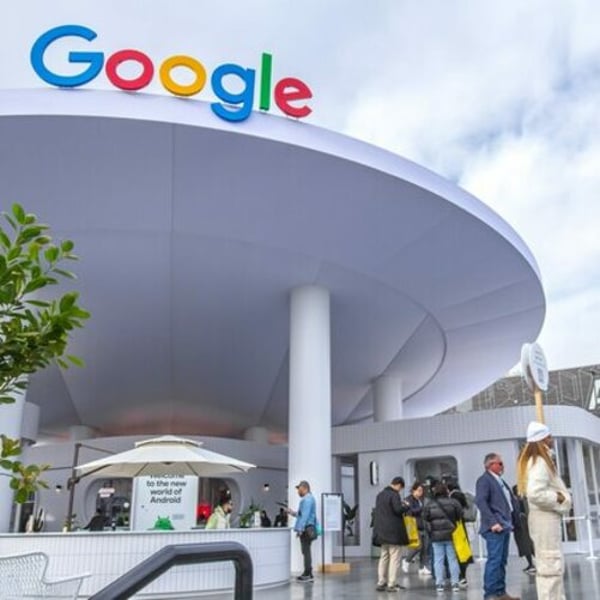
At the NRF trade show in New York, Google unveiled its Universal Commerce Protocol (UCP), an open standard designed to streamline interactions between AI and merchants. Backed by a coalition of industry players spanning Shopify to Zalando, the protocol aims to shape the era of ‘agentic commerce’, in which virtual assistants steer the buying journey from search through to payment.
Shutterstock
Google’s aim is to establish a common language for the sector and, in the process, preserve its strategic position in e-commerce. The UCP is designed to serve as a universal infrastructure, enabling AI-powered ‘agents’ (personal assistants) to carry out complex tasks- from product sourcing to after-sales service- without running up against platform-specific technical barriers.
This standardisation is designed to ensure compatibility with existing protocols (A2A, AP2…) and promises ‘total interoperability’- a pledge of instant compatibility intended to guarantee a ‘frictionless’ dialogue between AI and retailers.
To avoid the pitfalls of a closed solution, Google has opted for an industry alliance. The protocol has been co-developed with leading players such as Shopify, Etsy, Walmart and Wayfair. The coalition also includes major payment providers (Stripe, Visa, Adyen) and international retailers including Best Buy and Zalando, helping to secure initial adoption of the standard across the entire value chain.
Conversion-focused agents
For brands, this framework unlocks new levers for transactional performance. Its flagship feature is the ‘Business Agent,’ a virtual salesperson capable of conversing with consumers directly in search results, adopting the brand’s tone of voice to advise or answer questions. Google is also introducing ‘Direct Offers,’ enabling brands to surface exclusive, real-time discounts within Google’s interface to convert hesitant buyers.
For customers, it is now possible to complete an order directly from the Gemini app (Google’s consumer AI) or within Google’s interface itself, without being redirected to a third-party site. Payment relies on secure data from Google Wallet (and soon PayPal), while the retailer handles fulfilment. This level of fluidity now requires sellers to significantly enrich their data in Merchant Center to remain visible to these new algorithmic intermediaries.
This deployment comes three months after OpenAI, ChatGPT’s parent company, launched its Instant Check-Out feature. This enables Internet users to purchase products on third-party sites without ever leaving ChatGPT. At a time when consumers are increasingly turning to AI for their product searches, Google could find in the UCP a key to defending the position of ‘arbiter of commerce’ conferred on it by its mastery of SEO.
This article is an automatic translation. Click here to read the original article.
Premium and luxury second-hand platform Vestiaire Collective has parted ways with co-founder and president Fanny Moizant. Of the leadership trio assembled in 2019 with managing director Maximilian Bittner and fashion director Sophie Hersan, only the latter remains- the last co-founder still in post at the company. This changing of the guard raises questions about the strategy of Bernard Osta, who recently took the helm and plans to harness AI and marketing to strengthen the platform’s position.
Fanny Moizant, Sophie Hersan and Maximilian Bittner, the management trio that operated from 2019 to 2025 – Vestiaire Collective
Vestiaire Collective does not publish its figures. Its revenue was estimated at around €414 million for 2024. Operating in more than 70 countries, the platform claims 30,000 new listings per day and around 23 million members.
This shift in governance comes as the clothing sector undergoes a transition of its own. With demand slowing as consumers redirect spending to other categories, industry players are seeking to adapt. Vestiaire Collective must also contend with an online sales model which, after years of strong growth in the West, is no longer insulated from fluctuations in consumer spending.
Consumer spending, after a health crisis, an energy crisis, the invasion of Ukraine, and worsening geopolitical tensions, is now showing its limits even in the luxury market. This is a segment in which Vestiaire Collective has historically built a strong position against other second-hand fashion players, but where the ubiquitous Vinted is now seeking to compete with dedicated features.
“Vestiaire Collective has established itself as the benchmark marketplace in the highly attractive second-hand luxury fashion sector,” said Bernard Osta upon his appointment. “Together, we will continue to transform fashion by giving a second life to the most coveted pieces, in the service of a more sustainable model.”
A study by the French Federation of Circular Fashion (FMC) estimated last year that the European second-hand fashion market would grow by 8.5% per year to reach €26 billion in 2030, compared with €15.9 billion in 2024. These gains will, more than ever, have to be captured from the new-goods market, underpinned by significant investment in technology and communications.
AI and marketing
Like many marketplaces, the French company is betting heavily on artificial intelligence, both to rationalise costs- at a time when investors are closely scrutinising return on investment (ROI)- and to streamline its processes, as AI tools are now capable of purchasing on third-party sites on behalf of customers.
Bernard Osta, Managing Director of Vestiaire Collective – Vestiaire Collective
It is a pivot to AI that Vestiaire Collective has already been preparing. At the end of 2024, the company announced its first two AI-powered features, focused on search and recommendations.
But the move towards AI was marked above all by the hiring of Stacia Carr, previously vice president of Fashion Customer Experience at Zalando, where she led engineering and applied sciences. Another heavyweight, Jim Freeman, a US tech figure with stints at Amazon and Zalando, has also joined the board.
“With the rise of AI, we have an extraordinary opportunity to accelerate our product roadmap, offer a more engaging customer experience and gain market share,” says Bernard Osta, whose company now sets out a “vast product roadmap powered by AI to improve the experience of buyers and sellers at an accelerated pace.”
International campaigns
The company also intends to boost its profile, and address a relative lack of brand awareness versus other second-hand players such as Lithuania’s Vinted and France’s Leboncoin. To this end, campaigns have been announced targeting Europe and the US as well as Asia-Pacific (APAC), under the leadership of Samina Virk, who took over as marketing director last July.
On the financial side, the company last raised €178 million in 2021, followed by a €75 million debt refinancing subsequently. Around €3.5 million was also raised via crowdfunding in 2024.
Against its Lithuanian competitor, Vestiaire Collective fully intends to defend its premium and luxury positioning. And perhaps revive an IPO project which, despite the support of minority shareholder Kering, has yet to come to fruition.
This article is an automatic translation. Click here to read the original article.
The Perfume Shop was up against tough year-ago comparisons when it came to its Christmas 2025 sales performance. So how did the retailer, which is a portfolio mate of Superdrug in the AS Watson empire, do? Very well, considering Christmas 2024 was deemed its “busiest ever”.
Carolina Herrera Good Girl EdP
Total sales last month delivered 1.6% year-on-year growth while selling over 1.58 million bottles of fragrance between 30 November and 24 December, the equivalent of more than 63,000 bottles a day, it noted, up 6% on a year ago.
The hottest brands? “Timeless icons”, such as Dior Sauvage, Carolina Herrera Good Girl and Chanel Coco Mademoiselle, led the fine fragrance category. Launches such as Carolina Herrera La Bomba and Prada Paradigme were also among the strongest performers of the season.
The Perfume Shop said this year’s shopping behaviours “reflected a more intentional approach to Christmas spending”.
It explained: “[While we] saw online searches begin in September, customers timed their purchases around those major deal moments they knew were worth waiting for. Interest peaked around Black Friday and again from mid-December, culminating between the 14th and 20th of December, becoming the retailer’s strongest week of the season”.
It added: “The classic last-minute rush also played a starring role”, as 23 December became the single biggest in-store trading day.
It also noted that throughout the season, shoppers “continued their shift away from multi-product promotions and instead responded best to simple price drops on single bottles or sets, a trend that has been consistent across 2025”.
Gift sets also delivered “another standout year” with overall sales increasing 4% on last year, while online demand for sets surged 62% during the peak Christmas period.
Across the full year, sets represented 16.8% of total sales, up from 15.7% in 2024, “a clear sign that customers still consider them one of the most reliable gifting choices”.
Personalisation was “another major success story”, from engraved bottles to personalised ribbons and gift messages, customers embraced bespoke touches more than ever”. Here, online personalisation services “rose significantly,” with December up 23.74% year-on-year. Individual services also saw strong growth, including 50,000 gift wraps (+84.6% on-year), 54,000 personalised ribbons (+106.8%), 21,000 engraved bottles and 3,500 custom gift messages introduced in November.
Meanwhile, Click & Collect services remained “a key part of the Christmas countdown, while Next Day Delivery again proved essential for last-minute gifting and the partnership with Deliveroo for last minute deliveries”, it added.
Camper announces the departure of its creative director, Achilles Ion Gabriel. The designer, who has been with the Mallorcan company since 2019, will step down from the creative helm of both the main brand and its more experimental line, CamperLab. As the Balearic footwear company reported on Tuesday, the last collections developed under his leadership will be for spring/ summer 2027 and will be presented at the beginning of next December.
Camper announces the departure of its creative director, Achilles Ion Gabriel. – Camper
“Achilles has played a key role in strengthening Camper’s contemporary identity and in the evolution of CamperLab, which has gone from being a footwear brand to a fashion brand,” said Miguel Fluxà, CEO of Camper. “His vision and leadership have contributed significantly to the evolution of both brands. We are grateful for his contribution and proud of what we have achieved together, and we wish him all the best in his future endeavours,” the executive added.
The company said that, following the designer’s departure, the in-house team will assume the creative direction of the two labels, “ensuring the continued development of both brands going forward.”
“I am deeply grateful to Camper and CamperLab for the trust they have placed in me over the years. I would also like to thank our customers and consumers for their loyalty,” said Achilles Ion Gabriel. The Finnish-born designer assumed the role of creative director at CamperLab in 2019 with the mission of transforming a footwear-focused brand into a fashion label with a full catalogue; a year later, he also took on the same position at the flagship brand, Camper.
Founded in 1975 by the Fluxà family on the Balearic island of Mallorca, Camper is now a global footwear company. It operates a commercial network of around 350 of its own stores and is present in more than 2,500 multi-brand points of sale across around 50 markets. According to its latest available financial data, in the 2023 financial year it achieved a turnover of 225 million euros.