Connect with us

Business

Google is winning the Big Tech AI race as its stock posts 68% gain

Published

on


Investing in Big Tech companies used to be simple and straightforward. You could simply scoop up a basket of the five Internet giants—Apple, Amazon, Microsoft, Meta and Google’s parent firm Alphabet—and count on them to outperform the market. Their share price didn’t move strictly in tandem, but you could expect a close sector-wide correlation. Now, in the AI era, all that’s gone out the window.

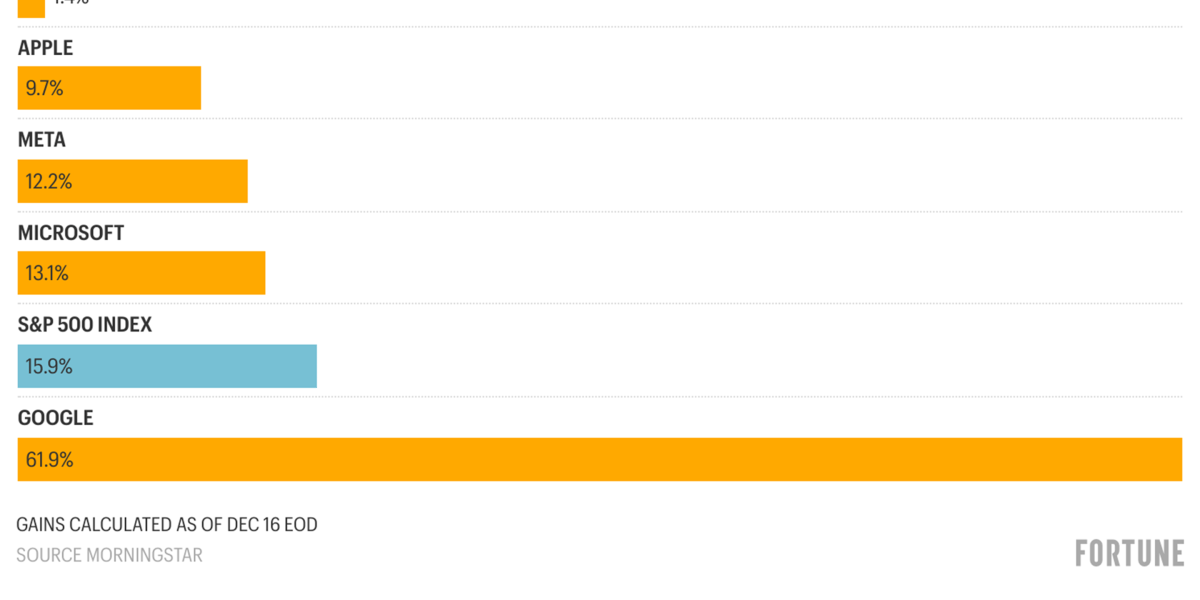
Looking at the share performance of the Big 5 this year, it’s hard to believe these companies are in the same category. Three of the group are lagging slightly behind the overall S&P 500 index, which is on track for a roughly 16% gain this year. The group—Microsoft, Apple and Meta—is instead pacing at around 13%, 12% and 10% respectively. A fourth, one-time market darling Amazon, is floundering far behind with a miserable 1% gain. Then there is Google, whose current gains of around 62% make it one of the best performing stocks of 2025.

This wild divergence among the biggest of the Big Tech players is directly tied to how well they are faring in artificial intelligence. In the last two years, AI has become an overriding fixation for investors, and led all five companies to spend eye-popping sums on talent and infrastructure. Google, though, appears to be the only one that has parlayed its investment into a winning business strategy. This raises the question of how exactly the search giant pulled this off, and whether any of the four laggards can do the same—and deliver a similar win for their suffering shareholders.

Google’s AI flywheel

Google’s AI-fueled stock gains are impressive, especially in light of its early misfires with the technology. The most notable of these came in February of 2024 when, in an attempt to pull even with the capabilities of OpenAI’s wildly popular ChatGPT, Google rebooted its first mediocre AI chatbot, Bard, and launched a rebranded, multimodal AI under the new Gemini name. The new product’s error-filled results and blatant political biases—including the depiction of Nazis as people of color—led investors to punish Google stock, and worry that the company’s leadership had already lost the AI race.

That narrative soon changed, however, when Google took Gemini back to the shop for a deep overhaul, and released vastly improved versions in the second half of last year. Meanwhile, the company has integrated AI features almost seamlessly into its core search product, while creating buzz around new products like image-generating service Nano Banana, which debuted this summer.

These launches have helped boost its share price, but are just one part of a broader AI success story. The reason Google is pulling away is because the company is tapping into various AI strengths, and building a broader flywheel that is generating a constant series of improvements.

For starters, the search giant has a powerful research lab in the form of Google DeepMind that has helped it build a model to compete with the likes of OpenAI. It also has its own in-house cloud service, Google Cloud, which provides the infrastructure to satisfy the insatiable energy and compute demands of running a scaled AI service. Critically, its infrastructure stack also includes its in-house AI chips, called Tensor Processing Units, meaning Google doesn’t have to compete in the global scramble for Nvidia chips. Meanwhile, TPUs are no second-rate technology. The latest version of the chip, known as Ironwood, is the TPU’s seventh iteration, and is being sought out by other leading AI players.

All of this means Google is singularly positioned among its Big Tech rivals to excel in AI technology and know-how. At the same time, its recent performance has allayed fears that broadening its AI offerings meant cannibalizing revenue from its core search business. Instead, Google is showing that AI can be accretive, even allowing the company to charge advertisers more on the ground that clicks tied to tools like AI Overview reflect a high search intent.

Even better for the company, it has numerous products where it can test and fine-tune its AI offerings, including YouTube, Maps and its core search product. And while not known as an enterprise company, products like Google Docs, Sheets and Gmail mean it has millions of opportunities to test out AI in the workplace. Finally, Google has a strong foothold in the devices sector—where many think the future fight for AI dominance will play out—thanks to Pixel phones and long involvement in the Android operating system.

All of Google’s Big Tech rivals, meanwhile, lack some or most of the components making up its AI flywheel. But the story of Silicon Valley is one of constant disruption, meaning any of the other firms still has a shot to build or buy their way back into the lead. 

Can the rest of the Big Tech 5 catch up?

The value of Big Tech firms is, like any company, determined by multiple factors. Still, the relatively poor performance of shares in Amazon, Apple, Microsoft and Meta appears to be entirely a function of their failing to show big returns on their massive AI investments.

Amazon, the worst of the laggards by far, does have one obvious attribute that makes it a contender: its industry-leading AWS cloud, which means the firm is well positioned to run AI operations at scale. Unfortunately, the Seattle firm is falling far short on other fronts.

In the case of chips, Amazon has been producing its own, known as Trainium, for some time in order to reduce reliance on Nvidia. The chips, however, appear far from best in class—an assessment reflected in the decision of Amazon’s close partner, Anthropic, to deploy Google’s chips as well. 

On the LLM front, Amazon has its own models, but has also invested $8 billion in Anthropic, reflecting its ongoing need to build strategic capacity to keep up with other big AI players. Meanwhile, Amazon has few options when it comes to deploying the AI expertise it acquires. Shopping, which is the company’s bread-and-butter, is just one narrow application in a far broader field, while Amazon’s Alexa and Echo devices have nowhere near the reach of numerous Google products. At the same time, Amazon has not made the most of the device opportunities it does have; reviews of its new AI-branded AIexa+ have been lukewarm.

Then there is Meta, which is the second worst stock performer of the Big 5 this year, despite flashing early promise in AI. That potential has been most prominent in the company’s family of open source Llama models, which Meta is deploying across its various properties, including Facebook, WhatsApp and Instagram. The most recent versions of Llama, however, have failed to keep up with rivals’ newer models, even as the company is spending eye-watering amounts of money to poach prominent AI researchers.

Less encouraging for Meta’s AI efforts are its lack of a cloud and limited in-house chip capacity, which has led it to turn to Google as a supplier. And while its huge social media footprint is a natural distribution platform, tech observers note that Meta has already deployed AI extensively to boost ad performance—and that it may have already reaped most of the significant gains on this front. Worse, according to the New York Times, the splashy new hires have created internal company friction between the researchers who want to push the bounds of AI science, and company executives who want to see concrete financial gains.

As for Microsoft, the Big Tech firm that has come closest among the laggards in keeping pace with the S&P 500, it has the same cloud advantage as Amazon and Google. It is also a relatively early mover in the AI field, thanks to its large investment in OpenAI and early ties to the startup. Lately, though, the tie-up between Microsoft and OpenAI’s Sam Altman has been strained, which could complicate the software giant’s future path.

Unlike its arch-rival Google, Microsoft is not known for its chip prowess and has largely relied on Nvidia GPUs over its in-house chips. And while the company has a huge distribution footprint—think Office, Bing, LinkedIn and more—it has failed to rack up early wins. That includes in the enterprise sector, which Microsoft traditionally dominates, but where its CoPilot AI tool has failed to impress.

Finally, there is Apple, whose AI record has been sparse and disappointing. This is perhaps surprising given the iPhone maker’s extensive hardware expertise, and long experience with cloud services. Apple, however, faces distinct challenges from other Big Tech firms. Those include making privacy a core part of its brand appeal. This may appeal to consumers, but it’s also not conducive to the sort of massive data-gobbling that goes with building large AI models.

Two potential game-changers for investors

The growing perception that Google is pulling away with the AI game is reflected both in vibes and in the company’s share price. At the same time, there is another key metric that suggests the stock price could go higher still.

Namely, the P/E ratio—a metric that has long been useful in determining whether a company is over-valued—is currently around 30 for Google. That is around the same level as Meta and Amazon, and significantly lower than that of Microsoft and Apple, which means the market may not have yet baked in the possibility of Google translating its AI performance into revenue growth.

Even as Google is enjoying front-of-the-pack status among its longtime Internet peers, there are two developments that could significantly shake up the AI race in Big Tech.

The first is one of its rivals carrying out a major acquisition to boost their standing in AI, and more effectively take on Google. This may be easier said than done, however, since there are relatively few big AI startups left on the board. The most tempting target may be Anthropic, but its valuation has grown so large that it may be too big even for a Big Tech firm to swallow.

The other factor that could shake up the AI race is shifting consumer behavior. There is wide speculation that people will come to embrace new ways to interact with AI, including through new types of wearable or embedded devices. Startups like Friend are selling AI pendants, and Meta is making a major bet on Ray-Ban style glasses with built-in AI screens.

Sales of these wearable AI devices, however, have been modest at best and it’s not clear they will ever fully catch on. Instead, it’s not hard to imagine consumers choosing to stick with their phones and watches for the foreseeable AI future, until a new paradigm emerges—perhaps one involving internal chips and biometrics.

The upshot is that the contours of the AI economy are still emerging, and that new technologies and companies will arrive to serve it en masse. Until then, however, the companies at the core of Big Tech will continue to have a big AI presence—especially Google.


Source link

Continue Reading

Business

After GOP fights about antisemitism, JD Vance rejects ‘purity tests’

Published

on


Vice President JD Vance said Sunday the conservative movement should be open to everyone as long as they “love America,” declining to condemn a streak of antisemitism that has divided the Republican Party and roiled the opening days of Turning Point USA’s annual convention.

After a long weekend of debates about whether the movement should exclude figures such as bigoted podcaster Nick Fuentes, Vance came down firmly against “purity tests.”

“I didn’t bring a list of conservatives to denounce or to de-platform,” Vance said during the convention’s closing speech.

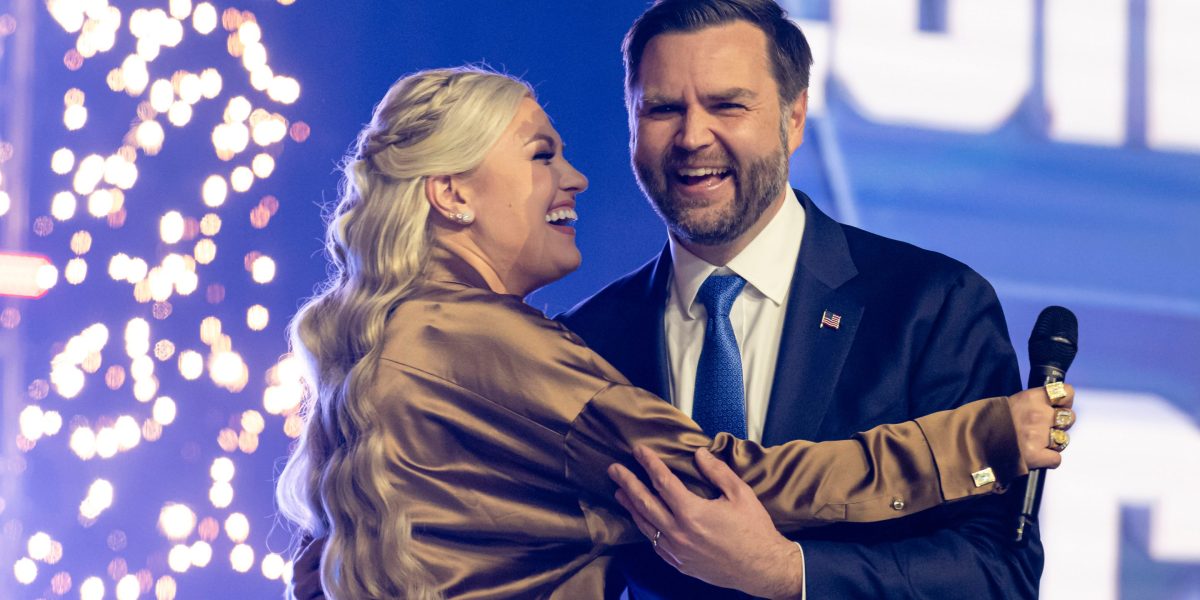
Turning Point leader Erika Kirk, who took the helm after the assassination of her husband, Charlie Kirk, has endorsed Vance as a potential successor to President Donald Trump, a helpful nod from an influential group with an army of volunteers.

But the tension on display at the four-day gathering foreshadowed the treacherous political waters that Vance, or anyone else who seeks the next Republican presidential nomination, will need to navigate in the coming years. Top voices in the “Make America Great Again” movement are jockeying for influence as Republicans begin considering a future without Trump, and there is no clear path to holding his coalition together.

Defining a post-Trump GOP

The Republican Party’s identity has been intertwined with Trump for a decade, but he’s constitutionally ineligible to run for reelection despite his musings about serving a third term. Tucker Carlson said people are wondering, “who gets the machinery when the president exits the scene?”

So far, it looks like settling that question will come with a lot of fighting among conservatives. The Turning Point conference featured arguments about antisemitism, Israel and environmental regulations, not to mention rivalries between leading commentators.

Ben Shapiro, co-founder of the conservative media outlet Daily Wire, used his speech on the conference’s opening night to denounce “charlatans who claim to speak in the name of principle but actually traffic in conspiracism and dishonesty.”

“These people are frauds and they are grifters and they do not deserve your time,” Shapiro said. He specifically called out Carlson for hosting Fuentes for a friendly interview on his podcast.

Carlson brushed off the criticism when he took the stage barely an hour later, and he said the idea of a Republican “civil war” was “totally fake.”

“There are people who are mad at JD Vance, and they’re stirring up a lot of this in order to make sure he doesn’t get the nomination,” he said. Carlson described Vance as “the one person” who subscribes to the “core idea of the Trump coalition,” which Carlson said was “America first.”

Turning Point spokesperson Andrew Kolvet framed the discord as a healthy debate about the future of the movement, an uncomfortable but necessary process of finding consensus.

“We’re not hive-minded commies,” he wrote on social media. “Let it play out.”

If you love America, you’re welcome in the movement, Vance says

Vance acknowledged the controversies that dominated the Turning Point conference, but he did not define any boundaries for the conservative movement besides patriotism.

“We don’t care if you’re white or black, rich or poor, young or old, rural or urban, controversial or a little bit boring, or somewhere in between,” he said.

Vance didn’t name anyone, but his comments came in the midst of an increasingly contentious debate over whether the right should give a platform to commentators espousing antisemitic views, particularly Fuentes, whose followers see themselves as working to preserve America’s white, Christian identity. Fuentes has a growing audience, as does top-rated podcaster Candace Owens, who routinely shares antisemitic conspiracy theories.

“We have far more important work to do than canceling each other,” he said.

Vance ticked off what he said were the accomplishments of the administration as it approaches the one-year mark, noting its efforts at the border and on the economy. He emphasized efforts to end diversity, equity and inclusion policies, drawing applause by saying they had been relegated to the “dustbin of history.”

“In the United States of America, you don’t have to apologize for being white anymore,” he said.

Vance also said the U.S. “always will be a Christian nation,” adding that “Christianity is America’s creed, the shared moral language from the Revolution to the Civil War and beyond.”

Those comments resonated with Isaiah White-Diller, an 18 year-old from Yuma, Arizona, who said he would support Vance if he runs for president.

“I have my right to be Christian here, I have my right to say whatever I want,” White-Diller said.

Turning Point backs Vance for president

Vance hasn’t disclosed his future plans, but Erika Kirk said Thursday that Turning Point wanted Vance “elected for 48 in the most resounding way possible.” The next president will be the 48th in U.S. history.

Turning Point is a major force on the right, with a nationwide volunteer network that can be especially helpful in early primary states, when candidates rely on grassroots energy to build momentum. In a surprise appearance, rapper Nicki Minaj spoke effusively about Trump and Vance.

Vance was close with Charlie Kirk, and they supported each other over the years. After Kirk’s assassination on a college campus in Utah, the vice president flew out on Air Force Two to collect Kirk’s remains and bring them home to Arizona. The vice president helped uniformed service members carry the casket to the plane.

Emily Meck, 18, from Pine City, New York, said she appreciated Vance making space for a wide variety of views.

“We are free-thinkers, we’re going to have these disagreements, we’re going to have our own thoughts,” Meck said.

Trump has spoken highly of both Vance and Secretary of State Marco Rubio as potential successors, even suggesting they could form a future Republican ticket. Rubio has said he would support Vance.

Asked in August whether Vance was the “heir apparent,” Trump said “most likely.”

“It’s too early, obviously, to talk about it, but certainly he’s doing a great job, and he would be probably favorite at this point,” he said.


Source link

Continue Reading

Business

Tariff refunds are unlikely because that would be ‘very complicated,’ Hassett says

Published

on


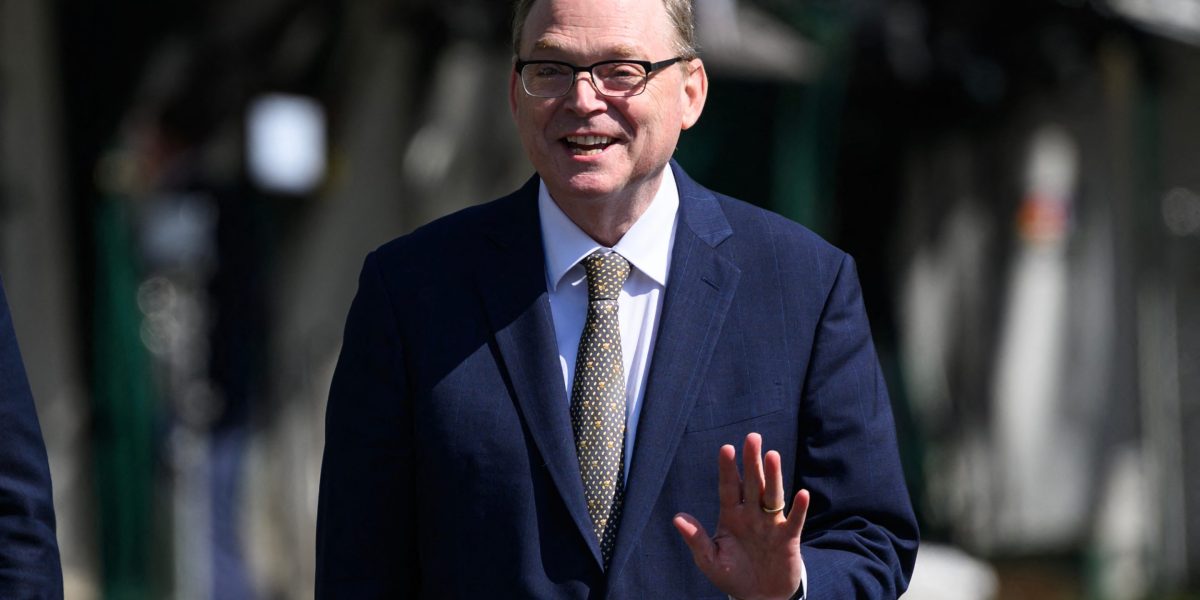
National Economic Council Director Kevin Hassett offered more of a practical reason than a legal argument on the future of President Donald Trump’s global tariffs.

Lower courts have ruled that the so-called reciprocal tariffs invoked under the International Emergency Economic Powers Act are illegal, though the Supreme Court will have a final say.

In an interview on CBS News’ Face the Nation on Sunday, Hassett predicted that the justices will rule in the White House’s favor.

“And I also think that if they didn’t find with us, that it’s going to be pretty unlikely that they’re going to call for widespread refunds, because it would be an administrative problem to get those refunds out to there,” he added, explaining that whoever made the actual tariff payment would be in line to get a refund.

That’s as Trump has vowed that foreign countries would pay the tariffs, though importers in the U.S. have been footing the bill with many companies passing along at least a portion of the costs to consumers.

Hassett said the eventual payer of a tariff “depends on elasticities of supply and demand,” while noting Chinese companies have slashed their prices to offset tariff costs.

“But the people who pay the tariff, if there is a refund, the people who actually paid for the good, the importer, in most cases, they’re the ones who would be the first line of defense for refunding the tariff,” he said. “But I really, really don’t think that’s going to happen, it’d be very complicated. And then that person would be responsible for allocating the tariff refund to the appropriate folks.”

Hassett added, “Yes, it is a mess, and that’s why I think the Supreme Court wouldn’t do it.”

Trade experts have pointed out that the federal government already issues millions of refunds every year for income taxes, suggesting tariff refunds wouldn’t be so daunting.

Through late September, about $90 billion of the $174 billion in tariff revenue generated up to then came from the IEEPA duties.

Meanwhile, companies are already positioning themselves to get their money back in the event the Supreme Court strikes down the tariffs.

Late last month, Costco filed a lawsuit in the U.S. Court of International Trade, joining dozens of other companies suing over the IEEPA duties.

The warehouse club chain said it needed to go to court due to the uncertainty that refunds will be guaranteed if the Supreme Court rules the tariffs are illegal.

Wall Street expects that to happen as justices largely seemed skeptical of the Trump administration when they heard arguments for the case.

But other tariffs invoked under separate laws would be unaffected by a Supreme Court decision, and fresh tariffs could be imposed to replace the IEEPA levies.

In a recent interview with the Wall Street Journal, Trump warned that if the Supreme Court strikes down his global tariffs, his alternatives are not as “nimble, not as quick.”

 “I can do other things, but it’s not as fast. It’s not as good for national security,” he added. 


Source link

Continue Reading

Business

Waymos froze, blocked traffic during San Francisco power outage

Published

on


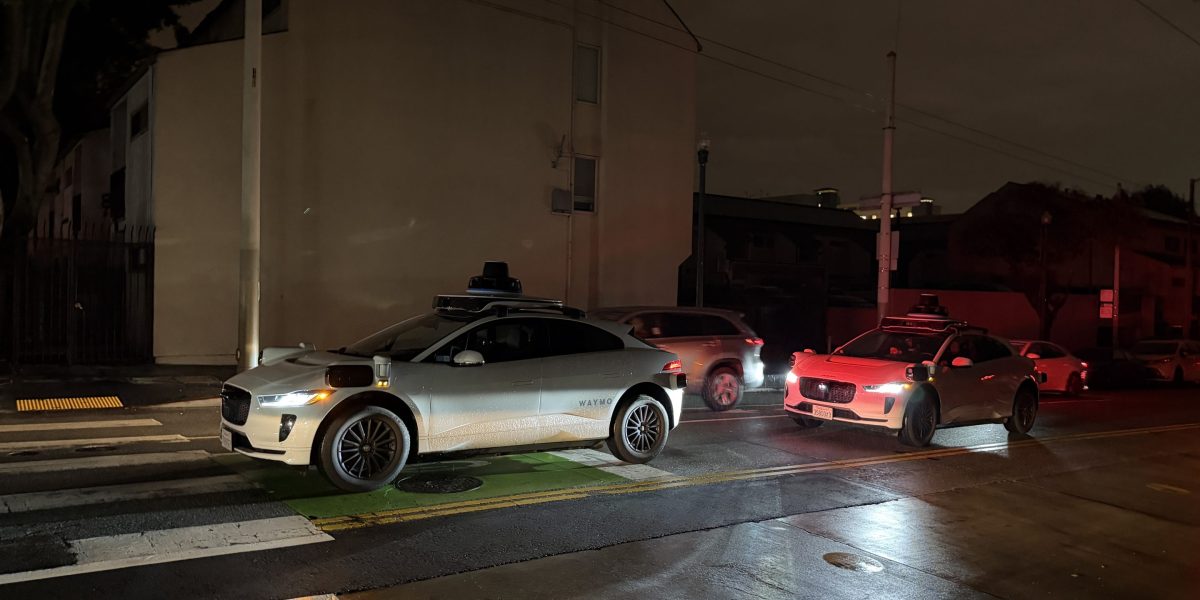
Waymo’s driverless ride services were a high-profile victim of a power outage that affected large swaths of San Francisco, with cars freezing mid-ride across the city and disrupting traffic.

After traffic lights went dark at major intersections Saturday, social media videos showed multiple cars stopped in the middle of the street with their hazard lights flashing.

The power failures, which at one point affected 130,000 customers, closed stores and disrupted transit during the busy holiday shopping period — including many Waymo cars, Alphabet Inc.’s self-driving taxi service. 

Michele Riva, 30, was going home Saturday evening in a Waymo car when the outage happened. His car had kept moving when they were in a less transited area of the city, even with passengers crossing on the street, he said. He was only a minute away from his destination when the car stopped in front of a “very dense intersection” and non-working traffic lights, he said, without giving him any notice.

“I stayed in the Waymo for a couple of minutes, just to see,” said Riva, who is an engineer working in artificial intelligence. “The problem was that, at the beginning, there were a lot of people crossing the streets because there were no traffic lights. So I believe the Waymo just didn’t know what to do.”

PG&E Corp., which blamed the outage on a fire in a substation, began restoring most of the service Saturday evening. By Sunday morning, PG&E said it has restored service for 110,000 customers, but 21,000 remain without electricity. 

Riva tried contacting customer support for about three minutes while he was stuck in the immobile car, but gave up after the wait time became too long as the service was overwhelmed with other passengers’ calls. He decided to get out of the Waymo and walk the couple of blocks left to his home.

On Sunday, the Waymo app showed a notification to some customers saying the service for the Bay Area is paused, affecting at least seven cities.

“Our teams are working diligently and in close coordination with city officials, and we are hopeful to bring our services back online soon,” a Waymo spokesperson said in a statement Sunday.

Riva tried ordering another Waymo ride on Sunday before he saw the message.

“At the end of the day, I know it was an unpleasant situation for the other drivers, but I believe it really was all about safety — I believe it’s better safe than sorry,” Riva said. “I hope they will account for that in the future, because it’s truly a good service.”

Tesla Inc.’s CEO Elon Musk posted on X that his companies’ robotaxis — a direct competitor of Waymo — were “unaffected” by the power outage.


Source link

Continue Reading

Trending

Copyright © Miami Select.