Connect with us

Business

Goldman Sachs CEO: AI’s opportunity is enormous, but ‘there will be winners and losers’

Published

on


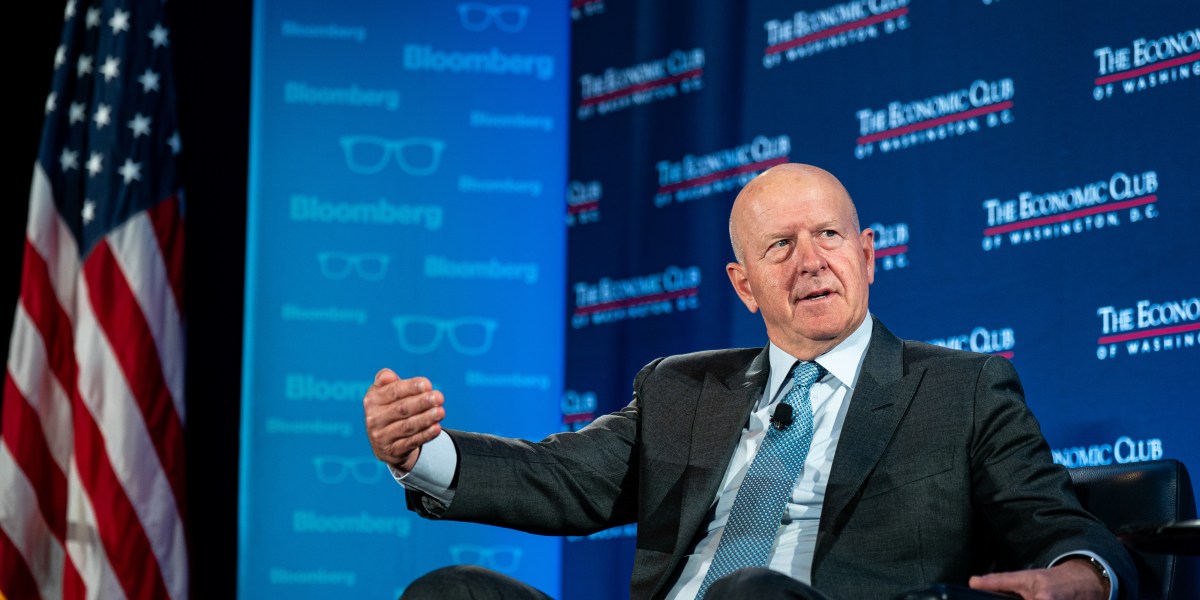
Good morning. David Solomon, chair and CEO of Goldman Sachs, leads one of the world’s most prominent investment banks and sees AI as a key growth driver, though he cautions the path ahead won’t be straightforward.

Speaking at the Economic Club of Washington, D.C., on Thursday in a conversation with Carlyle Group co-founder David Rubenstein, Solomon discussed the state of the U.S. economy, the impact of rising public debt, and the AI investment boom in front of a packed audience.

An outlook on growth

Goldman Sachs (No. 32 on the Fortune 500) reported stronger-than-expected third-quarter earnings this month, driven by robust investment banking fees and trading revenue. When Rubenstein asked Solomon whether the U.S. faces a near-term recession, Solomon offered cautious optimism.

“We’ve got a big, diverse economy,” he said. “It’s in pretty good shape at the moment. There are things we cannot see that could set it off, but I think the chance of a recession in the near term is low.” Solomon pointed to the buildout of AI infrastructure as a key force supporting growth.

“You have six or seven large companies that are going to spend $350 billion [combined] this year on AI infrastructure—that has an effect on growth,” he said. As AI becomes integrated into enterprise operations, Solomon expects meaningful productivity gains.

Turning to the country’s rising debt burden, Solomon said it will result in a “reckoning” if the economy does not grow faster. “The path out really isn’t a revenue path out,” he said. “The path out is a growth path.”

The AI boom

When Rubenstein asked whether the massive market capitalizations of major tech firms, some nearing $5 trillion, signal a potential bubble, Solomon offered a historical perspective.

“Whenever you have an acceleration in technology and people get excited about it, you see significant capital formation by new companies trying to capitalize on that opportunity,” he said. “We’ve seen this before through history.” He added, “It won’t be a straight line.” Solomon further discussed today’s AI wave.

The opportunity set with AI is “enormous,” he said. “There will be winners and losers, and it’s hard to pick them now.” A lot of the capital being deployed will not produce adequate returns—and some won’t produce any returns at all, he added.

Reflecting on past investment cycles, Solomon recalled then-Fed Chair Alan Greenspan’s famous warning about “irrational exuberance” in 1996.

“At that time, the Nasdaq was near 1,300. About three and a half years later, it rose above 5,000. Ultimately, there were adjustments and drawdowns,” Solomon said. The trend for AI investment is real, he said. “There’s real productivity—but these things never move in a straight line,” he added.

Solomon’s remarks reflect a broader theme across Wall Street: optimism about AI’s potential to drive growth, tempered by awareness that not every investor, or company, will come out ahead.

Have a good weekend.

Sheryl Estrada
sheryl.estrada@fortune.com

***Upcoming Event: Join us for our next Emerging CFO webinar, Optimizing for a Human-Machine Workforce, presented in partnership with Workday, on Nov. 13 from 11 a.m. to 12 p.m. ET.

We’ll explore how leading CFOs are rethinking the future of work in the age of agentic AI—including when to deploy AI agents to accelerate automation, how to balance ROI tradeoffs between human and digital talent, and the upskilling strategies CFOs are applying to optimize their workforces for the future.

You can register here. Email us at CFOCollaborative@Fortune.com with any questions.

Leaderboard

Fortune 500 Power Moves

Homer Bhullar was promoted to SVP and CFO at Valero Energy Corporation (No. 34), effective January 1, 2026. Bhullar will succeed Jason Fraser, who will remain as EVP and CFO until he steps down on December 31, and will retire as an employee in the first quarter of 2026. Bhullar has served as Valero’s VP of investor relations and finance since April 29, 2021. He joined Valero in 2014. 

Paul Todd was appointed CFO of Fiserv, Inc. (No. 208), effective October 31. Todd, who previously served as CFO of Global Payments, succeeds Robert Hau, who will serve as a senior advisor through the first quarter of 2026 to support a transition. Todd has been serving as a special advisor to the executive leadership team for the last several weeks.

Kevin Boone was appointed EVP and CFO of CSX (No. 301), succeeding Sean Pelkey, who has departed the company.  Boone joined CSX in 2017 and has held several key leadership roles. Most recently, he served as EVP and chief commercial officer. Boone also served as VP of corporate affairs and investor relations at CSX. 

Paul Kuehneman was appointed interim CFO and controller at Hormel Foods Corporation (No. 352), effective October 27. Kuehneman succeeds Jacinth Smiley, who is leaving the company and will be pursuing other opportunities, according to the announcement. Kuehneman has more than 30 years of business and finance experience at Hormel Foods, holding a variety of leadership roles, most recently, VP and controller.

Every Friday morning, the weekly Fortune 500 Power Moves column tracks Fortune 500 company C-suite shifts—see the most recent edition

More notable moves this week:

Mala Murthy was appointed EVP and CFO of TriNet (NYSE: TNET), a provider of human resources solutions,  effective November 28. Murthy will succeed TriNet’s current CFO, Kelly Tuminelli, who will serve as a special advisor to the CEO through March 16, 2026. Murthy most recently served as CFO of Teladoc Health. Before that, she held several senior executive positions at American Express, including CFO of its global commercial services segment. She also previously served in FP&A, treasury, and corporate development and strategy leadership positions with PepsiCo. 

Michelle Turner was appointed CFO of Teradyne, Inc. (Nasdaq: TER), a provider of automated test equipment and advanced robotics, effective November 3. Turner replaces Sanjay Mehta, who has served as Teradyne’s CFO since 2019. Turner brings 30 years of financial and strategic leadership experience. Before joining Teradyne, she was the CFO for L3Harris Technologies. Turner has also held a variety of senior financial management and leadership roles in Johnson & Johnson, BHP Billiton, Raytheon, and Honeywell.

Big Deal

For the third annual Cyber 60 list released this week, Fortune, Lightspeed Venture Partners, and AWS take a look at the most innovative cybersecurity startups creating the tools to meet threats head-on and keep businesses safe. 


The list shows just how pervasive AI has become in the field. Of the 14 new startups on the list in the “early-stage” category, just about all are focused squarely on AI. For example, products from companies like Cogent Security, 7AI, Prophet, and Dropzone AI, automate some of the routine defensive tactics that companies perform, using agents to send out alerts and escalate incident reports. 

Going deeper

Here are four Fortune weekend reads:

Crypto founders are getting very rich, very fast—again” by Jeff John Roberts

Microsoft CEO Satya Nadella says Bill Gates told him his big bet on OpenAI would be a flop: ‘Yeah, you’re going to burn this billion dollars’” by Marco Quiroz-Gutierrez

Michael Dell’s son aims to transform the home power business by selling electricity and backup battery power like a Costco membership” by Jordan Blum

Harvard professor calls out ‘lie’ of needing 8 hours of sleep a night, says it’s Industrial Era ‘nonsense’” Ashley Lutz 

Overheard

“Silicon Valley is optimizing for the wrong metric. Most people working in high-stakes  domains recognize now that AI will not take every job, but with that realization comes a  harder truth: the industry has been building autonomy when it should have been building  accountability.” 

—Joel Hron, chief technology officer at Thomson Reuters, writes in a Fortune opinion piece


Source link

Continue Reading

Business

You don’t hate AI because of genuine dislike. No, there’s a $1 billion plot by the ‘Doomer Industrial Complex’ to brainwash you, Trump’s AI czar says

Published

on


That disconnect, David Sacks insists, isn’t because AI threatens your job, privacy and the future of the economy itself. No – according to the venture-capitalist-turned-Trump-advisor, it’s all part of a $1 billion plot by what he calls the “Doomer Industrial Complex,” a shadow network of Effective Altruist billionaires bankrolled by the likes of convicted FTX founder Sam Bankman Fried  and Facebook co-founder Dustin Moskovitz. 

In an X post this week, Sacks argued that public distrust of AI isn’t organic at all — it’s manufactured. He pointed to research by tech-culture scholar Nirit Weiss-Blatt, who has spent years mapping the “AI doom” ecosystem of think tanks, nonprofits, and futurists.

Weiss-Blatt documents hundreds of groups that promote strict regulation or even moratoriums on advanced AI systems. She argues that much of the money behind those organizations can be traced to a small circle of donors in the Effective Altruism movement, including Facebook co-founder Dustin Moskovitz, Skype’s Jaan Tallinn, Ethereum creator Vitalik Buterin, and convicted FTX founder Sam Bankman-Fried.

According to Weiss-Blatt, those philanthropists have collectively poured more than $1 billion into efforts to study or mitigate “existential risk” from AI. However, she pointed at Moskovitz’s organization, Open Philanthropy, as “by far” the largest donors. 

The organization pushed back strongly on the idea that they were projecting sci-fi-esque doom and gloom scenarios.

“We believe that technology and scientific progress have drastically improved human well-being, which is why so much of our work focuses on these areas,” an Open Philanthropy spokesperson told Fortune. “AI has enormous potential to accelerate science, fuel economic growth, and expand human knowledge, but it also poses some unprecedented risks — a view shared by leaders across the political spectrum. We support thoughtful nonpartisan work to help manage those risks and realize the huge potential upsides of AI.”

But Sacks, who has close ties to Silicon Valley’s venture community and served as an early executive at PayPal, claims that funding from Open Philanthropy has done more than just warn of the risks– it’s bought a global PR campaign warning of “Godlike” AI. He cited polling showing that 83% of respondents in China view AI’s benefits as outweighing its harms — compared with just 39% in the United States — as evidence that what he calls “propaganda money” has reshaped the American debate.

Sacks has long pushed for an industry-friendly, no regulation approach to AI –and technology broadly—framed in the race to beat China. 

Sacks’ venture capital firm, Craft Ventures, did not immediately respond to a request for comment.

What is Effective Altruism?

The “propaganda money” Sacks refers to comes largely from the Effective Altruism (EA) community, a wonky group of idealists, philosophers, and tech billionaires who believe humanity’s biggest moral duty is to prevent future catastrophes, including rogue AI.

The EA movement, founded a decade ago by Oxford philosophers William MacAskill and Toby Ord, encourages donors to use data and reason to do the most good possible. 

That framework led some members to focus on “longtermism,” the idea that preventing existential risks such as pandemics, nuclear war, or rogue AI should take priority over short-term causes.

While some EA-aligned organizations advocate heavy AI regulation or even “pauses” in model development, others – like Open Philanthropy– take a more technical approach, funding alignment research at companies like OpenAI and Anthropic. The movement’s influence grew rapidly before the 2022 collapse of FTX, whose founder Bankman-Fried had been one of EA’s biggest benefactors.

Matthew Adelstein, a 21-year-old college student who has a prominent Substack on EA, notes that the landscape is far from the monolithic machine that Sacks describes. Weiss-Blatt’s own map of the “AI existential risk ecosystem” includes hundreds of separate entities — from university labs to nonprofits and blogs — that share similar language but not necessarily coordination. Yet, Weiss-Blatt deduces that though the “inflated ecosystem” is not “a grassroots movement. It’s a top down one.” 

Adelstein disagrees, noting that the reality is “more fragmented and less sinister” than Weiss-Blatt and Sacks portrays.

“Most of the fears people have about AI are not the ones the billionaires talk about,” Adelstein told Fortune. “People are worried about cheating, bias, job loss — immediate harms — rather than existential risk.”

He argues that pointing to wealthy donors misses the point entirely. 

“There are very serious risks from artificial intelligence,” he said. “Even AI developers think there’s a few-percent chance it could cause human extinction. The fact that some wealthy people agree that’s a serious risk isn’t an argument against it.”

To Adelstein, longtermism isn’t a cultish obsession with far-off futures but a pragmatic framework for triaging global risks. 

“We’re developing very advanced AI, facing serious nuclear and bio-risks, and the world isn’t prepared,” he said. “Longtermism just says we should do more to prevent those.”

He also brushed off accusations that EA has turned into a quasi-religious movement.

 “I’d like to see the cult that’s dedicated to doing altruism effectively and saving 50,000 lives a year,” he said with a laugh. “That would be some cult.”


Source link

Continue Reading

Business

Credit card companies are jacking up annual fees for airport lounges

Published

on


For every passenger trying to decide if a $17 slimy ham and cheese croissant and their phone’s 34% remaining battery will sustain them for a four-hour layover, there’s someone smugly sipping a complimentary gin and tonic in a secret luxury lounge.

Once a refuge for frequent business travelers, airport lounges are increasingly becoming more popular (and crowded) with casual travelers, encouraging some companies to create even more exclusive spaces—or raise the barrier to entry:

  • Capital One opened its largest lounge (13,500 square feet) in June at NYC’s JFK Airport, complete with Ess-a-Bagels and a designated cheesemonger (as well as classic lounge amenities, like shower suites and a cocktail bar).
  • Over half of JFK’s overall Terminal 4 lounge space has been added in the last two years.

How much would you pay for exclusivity?

The increase in global airport lounge visits in 2024 (31%) has outpaced growth in air traffic overall (10.4%) compared to the previous year. And access isn’t cheap. United charges $750 annually for individual access to its airport lounge network. Amex recently announced that the annual fee for its Platinum card—which includes the perk of lounge access—is increasing from $695 to $895. And one of the most popular travel perk cards, the Chase Sapphire Reserve, just ratcheted up its annual fee from $550 to $795.—MM

This report was originally published by Morning Brew.


Source link

Continue Reading

Business

Trump’s $2,000 tariff ‘dividends’ would cost twice as much as the revenue coming in, budget watchdog warns

Published

on


President Trump’s recent proposal to pay Americans “at least $2,000 a person” from new tariff revenue—a policy he calls “tariff dividends”—is facing sharp criticism from a budget watchdog, who calculates that the plan will actually lose twice as much money for the country as the tariffs are generating.

Writing in a weekend post on Truth Social, Trump argued that tariff revenues could be redistributed directly to individuals in the form of annual payments, with “high income people” excluded from the payouts. The idea, pitched as a way both to reward taxpayers and possibly reduce the national debt, bears a strong resemblance to the structure of the COVID-era Economic Impact Payments, according to an analysis by the nonpartisan Committee for a Responsible Federal Budget (CRFB).

But the numbers reveal a steep fiscal challenge. The CRFB estimates that distributing just a single round of $2,000 payments to Americans—calculated to match the COVID payments, which included both adults and children—would cost the federal government around $600 billion per year. By contrast, the tariffs that Trump has championed have raised about $100 billion to date and, even accounting for pending legal cases, are only projected to raise about $300 billion annually going forward.

Deficits could skyrocket

“If tariff dividends are paid annually, deficits would increase by $6 trillion over ten years,” the CRFB writes, “roughly twice as much as President Trump’s tariffs are estimated to raise over the same time period.” This means not only that the revenue from tariffs would fail to cover dividend payouts, but also that the policy would exacerbate America’s long-term fiscal challenges.

To put the numbers in perspective, if dividends were paid out on a “revenue neutral” basis—matching payouts to actual tariff revenue—the analysis estimates that payments could be made only every other year, starting in early 2027. Should the Supreme Court uphold current lower court rulings that have deemed some of Trump’s tariffs illegal, remaining tariffs would only cover the dividend payments once every seven years.

Debt implications

Beyond blowing past the revenue generated, diverting all tariff proceeds to pay these dividends would restrict the government’s ability to use tariff income for reducing deficits or paying down debt, as some administration officials have proposed. The CRFB warns that using all tariff revenue for rebates would push federal debt to 127% of Gross Domestic Product (GDP) by 2035, compared to 120% under current law. If $2,000 dividends were paid annually, that figure could jump further, reaching 134% of GDP over the same period.

Such projections come at a time when annual budget deficits are nearing $2 trillion and national debt is quickly approaching an all-time high, making fiscal discipline a top concern for watchdogs and policy analysts.

Trump’s proposal draws inspiration from pandemic-era Economic Impact Payments (EIPs), but those measures were carefully income-tested to phase out payments for individuals earning over $75,000 and joint filers over $150,000. The CRFB said its analysis used similar eligibility parameters for its cost estimate, suggesting that without strict limits, the fiscal hit could be even higher.

For this story, Fortune used generative AI to help with an initial draft. An editor verified the accuracy of the information before publishing. 


Source link

Continue Reading

Trending

Copyright © Miami Select.