Connect with us

Business

Gold hits new record and stock futures tumble as Wall Street worries over Trump’s tariff price increases

Published

on


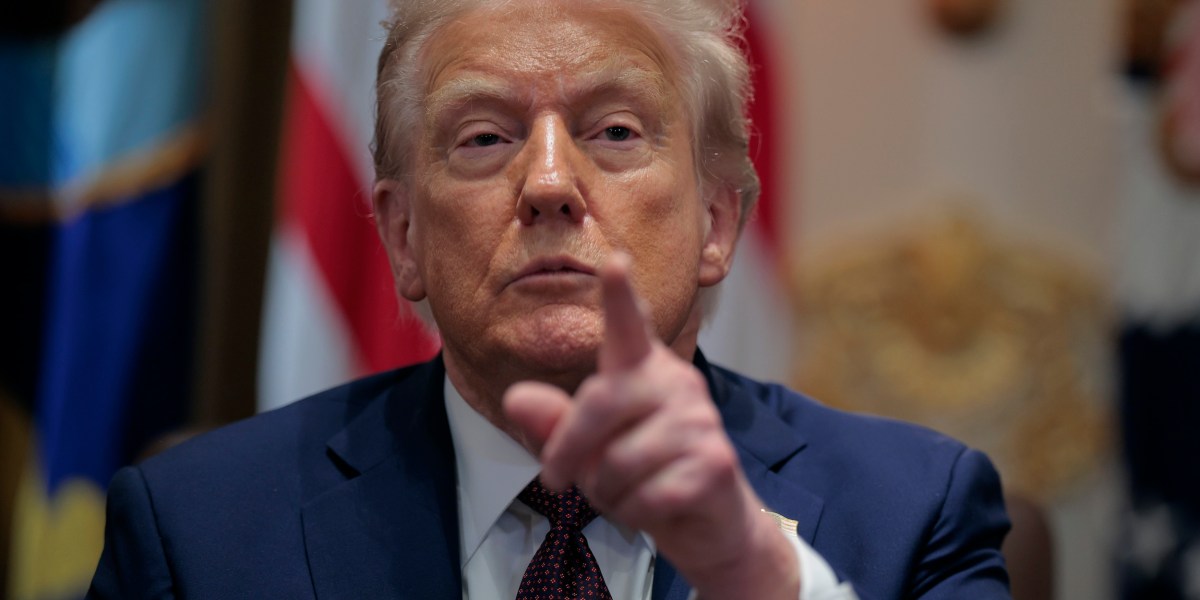
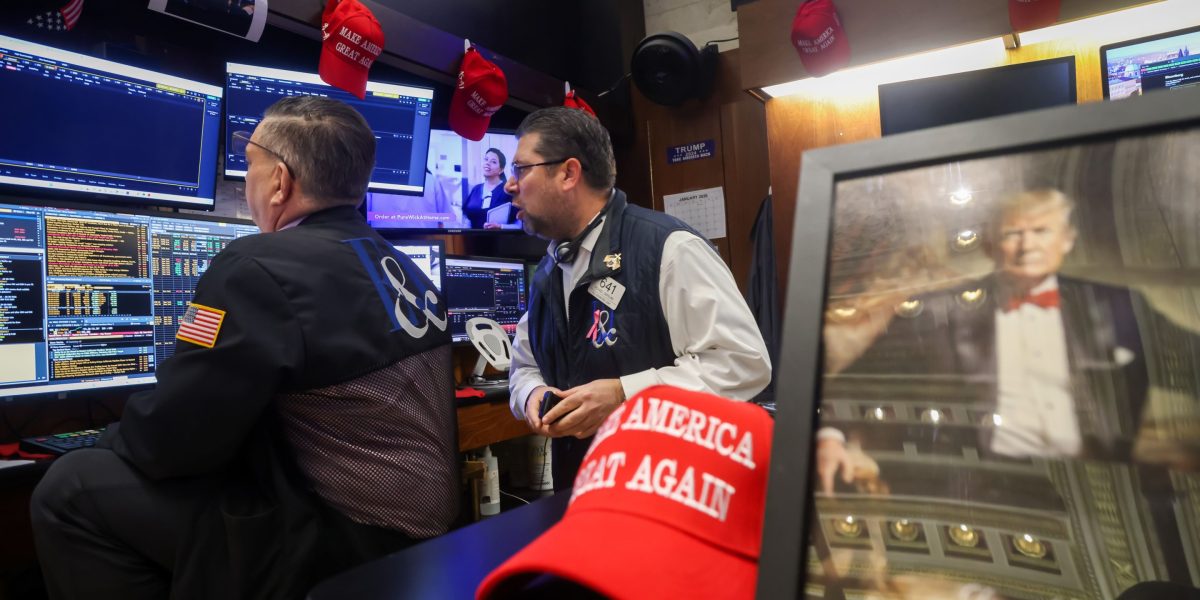
S&P 500 futures are down -0.51% this morning and futures on the Nasdaq 100 are down even more, -066%. Dow Jones futures were down -0.37%. The U.S. markets have had a three-day weekend so it’s difficult to say exactly why investors seem so skittish.

Top of the list of usual suspects is, of course, “uncertainty.” An appeals court threw out President Trump’s tariff plan last week, which the markets had finally priced-in after months of uncertainty. More uncertainty lies ahead as the U.S. Supreme Court takes the case.

And then there is Trump’s war against the Fed, in which his allies have asked the Department of Justice to conduct criminal probes of both Chairman Jerome Powell and Governor Lisa Cook. Investors are unenthusiastic about the idea of a politically driven U.S. Federal Reserve because it leads to more—you guessed it—uncertainty.

Deutsche Bank’s George Saravelos says investors have yet to move on that issue, however: “How much loss of independence is the market pricing? Surprisingly little, from our perspective,” he told clients this morning. “Long-term inflation expectations are the definitional metric of an independent central bank and these have barely moved in recent weeks. Or perhaps the market believes that even though President Trump is increasing his influence over the Fed, he remains committed to keeping inflation low even at the cost of weaker growth … To sum up, the market is currently not pricing any long-term shift in the Fed’s reaction function around inflation.”

Perhaps investors are looking at the soft data, which is signalling that tariff-driven price increases are finally being passed down to consumers, and that while consumer spending has been robust recently, they may be running out of gas. 

“80% of firms reported that they were passing cost increases from tariffs on to consumers,” Goldman Sachs told clients this morning. The bank’s research was based on the Dallas Fed’s surveys of companies. “Among those respondents, 21% reported that they have already passed through the full cost of the tariffs to customers,” Jessica Rindels and her team wrote.

The consumer isn’t in good shape to deal with those price increases, according to Samuel Tombs of Pantheon Macroeconomics.

“Real consumption rose by 0.3% in July, the most since March, but the trend still looks much weaker than last year. The annualized rate of growth in the three months to July, compared to the previous three months, was just 1.0%, well below last year’s 3.1% average,” he told clients in a note seen by Fortune.

Discretionary retail sales look like they rose in August, Tombs says, which would normally be positive news—except that growth in consumers’ after-tax income has fallen to near zero. 

“The foundations for a renewed pick-up in households’ real spending are lacking. Real after-tax income rose by just 0.2% on a three-month annualized basis in July, constrained by rising prices, slowing job growth and a drop in dividend income,” he wrote.

It’s not clear that these macro concerns are behind investors’ pessimism this morning. But it is clear that investors are pessimistic: The price of gold—usually regarded as a safe haven for nervous traders—hit another record high today. The Comex continuous contract for gold was at $3,551.80, up 1% on the day.

Here’s a snapshot of the markets globally this morning:

  • S&P 500 futures were down 0.51% this morning. The index closed down 0.64% in its last trading session.
  • STOXX Europe 600 was down 0.65% in early trading. 
  • The U.K.’s FTSE 100 was down 0.32% in early trading.
  • Japan’s Nikkei 225 was up 0.29%.
  • China’s CSI 300 was down 0.74%. 
  • The South Korea KOSPI was up 0.94%.
  • India’s Nifty 50 was flat before the end of the session.
  • Bitcoin rose to $110.6K.
Introducing the 2025 Fortune Global 500, the definitive ranking of the biggest companies in the world. Explore this year’s list.


Source link

Continue Reading

Business

AI labs like Meta, Deepseek, and Xai earned worst grades possible on an existential safety index

Published

on


A recent report card from an AI safety watchdog isn’t one that tech companies will want to stick on the fridge.

The Future of Life Institute’s latest AI safety index found that major AI labs fell short on most measures of AI responsibility, with few letter grades rising above a C. The org graded eight companies across categories like safety frameworks, risk assessment, and current harms.

Perhaps most glaring was the “existential safety” line, where companies scored Ds and Fs across the board. While many of these companies are explicitly chasing superintelligence, they lack a plan for safely managing it, according to Max Tegmark, MIT professor and president of the Future of Life Institute.

“Reviewers found this kind of jarring,” Tegmark told us.

The reviewers in question were a panel of AI academics and governance experts who examined publicly available material as well as survey responses submitted by five of the eight companies.

Anthropic, OpenAI, and GoogleDeepMind took the top three spots with an overall grade of C+ or C. Then came, in order, Elon Musk’s Xai, Z.ai, Meta, DeepSeek, and Alibaba, all of which got Ds or a D-.

Tegmark blames a lack of regulation that has meant the cutthroat competition of the AI race trumps safety precautions. California recently passed the first law that requires frontier AI companies to disclose safety information around catastrophic risks, and New York is currently within spitting distance as well. Hopes for federal legislation are dim, however.

“Companies have an incentive, even if they have the best intentions, to always rush out new products before the competitor does, as opposed to necessarily putting in a lot of time to make it safe,” Tegmark said.

In lieu of government-mandated standards, Tegmark said the industry has begun to take the group’s regularly released safety indexes more seriously; four of the five American companies now respond to its survey (Meta is the only holdout.) And companies have made some improvements over time, Tegmark said, mentioning Google’s transparency around its whistleblower policy as an example.

But real-life harms reported around issues like teen suicides that chatbots allegedly encouraged, inappropriate interactions with minors, and major cyberattacks have also raised the stakes of the discussion, he said.

“[They] have really made a lot of people realize that this isn’t the future we’re talking about—it’s now,” Tegmark said.

The Future of Life Institute recently enlisted public figures as diverse as Prince Harry and Meghan Markle, former Trump aide Steve Bannon, Apple co-founder Steve Wozniak, and rapper Will.i.am to sign a statement opposing work that could lead to superintelligence.

Tegmark said he would like to see something like “an FDA for AI where companies first have to convince experts that their models are safe before they can sell them.

“The AI industry is quite unique in that it’s the only industry in the US making powerful technology that’s less regulated than sandwiches—basically not regulated at all,” Tegmark said. “If someone says, ‘I want to open a new sandwich shop near Times Square,’ before you can sell the first sandwich, you need a health inspector to check your kitchen and make sure it’s not full of rats…If you instead say, ‘Oh no, I’m not going to sell any sandwiches. I’m just going to release superintelligence.’ OK! No need for any inspectors, no need to get any approvals for anything.”

“So the solution to this is very obvious,” Tegmark added. “You just stop this corporate welfare of giving AI companies exemptions that no other companies get.”

This report was originally published by Tech Brew.


Source link

Continue Reading

Business

Hollywood writers say Warner takeover ‘must be blocked’

Published

on


Hollywood writers, producers, directors and theater owners voiced skepticism over Netflix Inc.’s proposed $82.7 billion takeover of Warner Bros. Discovery Inc.’s studio and streaming businesses, saying it threatens to undermine their interests.

The Writers Guild of America, which announced in October it would oppose any sale of Warner Bros., reiterated that view on Friday, saying the purchase by Netflix “must be blocked.”

“The world’s largest streaming company swallowing one of its biggest competitors is what antitrust laws were designed to prevent,” the guild said in an emailed statement. “The outcome would eliminate jobs, push down wages, worsen conditions for all entertainment workers, raise prices for consumers, and reduce the volume and diversity of content for all viewers.”

The worries raised by the movie and TV industry’s biggest trade groups come against the backdrop of falling movie and TV production, slack ticket sales and steep job cuts in Hollywood. Another legacy studio, Paramount, was sold earlier this year.

Warner Bros. accounts for about a fourth of North American ticket sales — roughly $2 billion — and is being acquired by a company that has long shunned theatrical releases for its feature films. As part of the deal, Netflix co-CEO Ted Sarandos has promised Warner Bros. will continue to release moves in theaters.

“The proposed acquisition of Warner Bros. by Netflix poses an unprecedented threat to the global exhibition business,” Michael O’Leary, chief executive officer of the theatrical trade group Cinema United, said in en emailed statement Friday. “The negative impact of this acquisition will impact theaters from the biggest circuits to one-screen independents.”

The buyout of Warner Bros. by Netflix “would be a disaster,” James Cameron, the director of some of Hollywood’s highest-grossing films in history including Titanic and Avatar, said in late November on The Town, an industry-focused podcast. “Sorry Ted, but jeez. Sarandos has gone on record saying theatrical films are dead.”

On a conference call with investors Friday, Sarandos said that his company’s resistance to releasing films in cinemas was mostly tied to “the long exclusive windows, which we don’t really think are that consumer friendly.”

The company said Friday it would “maintain Warner Bros.’ current operations and build on its strengths, including theatrical releases for films.”

On the call, Sarandos reiterated that view, saying that, “right now, you should count on everything that is planned on going to the theater through Warner Bros. will continue to go to the theaters through Warner Bros.” 

Competition from online outfits like YouTube and Netflix has forced a reckoning in Hollywood, opening the door for takeovers like the Warner Bros. deal announced Friday. Media giants including Comcast Corp., parent of NBCUniversal, are unloading cable-TV networks like MS Now and USA, and steering resources into streaming. 

In an emailed note to Warner Bros. employees on Friday, Chief Executive Officer David Zaslav said the board’s decision to sell the company “reflects the realities of an industry undergoing generational change in how stories are financed, produced, distributed, and discovered.”

The Producers Guild of America said Friday its members are “rightfully concerned about Netflix’s intended acquisition of one of our industry’s most storied and meaningful studios,” while a spokesperson for the Directors Guild of America raised concerns about future pay at Warner Bros.

“We will be meeting with Netflix to outline our concerns and better understand their vision for the future of the company,” the Directors Guild said.

In September, the DGA appointed director Christopher Nolan as its president. Nolan has previously criticized Netflix’s model of releasing films exclusively online, or simultaneously in a small number of cinemas, and has said he won’t make movies for the company.

The Screen Actors Guild said Friday that the transaction “raises many serious questions about its impact on the future of the entertainment industry, and especially the human creative talent whose livelihoods and careers depend on it.”

Oscar winner Jane Fonda spoke out on Thursday before the deal was announced. 

“Consolidation at this scale would be catastrophic for an industry built on free expression, for the creative workers who power it, and for consumers who depend on a free, independent media ecosystem to understand the world,” the star of the Netflix series Grace and Frankie wrote on the Ankler industry news website.

Netflix and Warner Bros. obviously don’t see it that way. In his statement to employees, Zaslav said “the proposed combination of Warner Bros. and Netflix reflects complementary strengths, more choice and value for consumers, a stronger entertainment industry, increased opportunity for creative talent, and long-term value creation for shareholders.”


Source link

Continue Reading

Business

4 times in 7 seconds: Trump calls Somali immigrants ‘garbage’

Published

on


He said it four times in seven seconds: Somali immigrants in the United States are “garbage.”

It was no mistake. In fact, President Donald Trump’s rhetorical attacks on immigrants have been building since he said Mexico was sending “rapists” across the border during his presidential campaign announcement a decade ago. He’s also echoed rhetoric once used by Adolf Hitler and called the 54 nations of Africa “s—-hole countries.” But with one flourish closing a two-hour Cabinet meeting Tuesday, Trump amped up his anti-immigrant rhetoric even further and ditched any claim that his administration was only seeking to remove people in the U.S. illegally.

“We don’t want ‘em in our country,” Trump said five times of the nation’s 260,000 people of Somali descent. “Let ’em go back to where they came from and fix it.” The assembled Cabinet members cheered and applauded. Vice President JD Vance could be seen pumping a fist. Defense Secretary Pete Hegseth, sitting to the president’s immediate left, told Trump on-camera, “Well said.”

The two-minute finale offered a riveting display in a nation that prides itself as being founded and enriched by immigrants, alongside an ugly history of enslaving millions of them and limiting who can come in. Trump’s U.S. Immigration and Customs Enforcement raids and deportations have reignited an age-old debate — and widened the nation’s divisions — over who can be an American, with Trump telling tens of thousands of American citizens, among others, that he doesn’t want them by virtue of their family origin.

“What he has done is brought this type of language more into the everyday conversation, more into the main,” said Carl Bon Tempo, a State University of New York at Albany history professor. “He’s, in a way, legitimated this type of language that, for many Americans for a long time, was seen as outside the bounds.”

A question that cuts to the core of American identity

Some Americans have long felt that people from certain parts of the world can never really blend in. That outsider-averse sentiment has manifested during difficult periods, such as anti-Chinese fear-mongering in the late 19th century and the imprisonment of some 120,000 Japanese Americans during World War II.

Trump, reelected with more than 77 million votes last year, has launched a whole-of-government drive to limit immigration. His order to end birthright citizenship — declaring that children born to parents who are in the United States illegally or temporarily are not American citizens despite the 14th Amendment — is being considered by the Supreme Court. He has largely frozen the country’s asylum system and drastically reduced the number of refugees it is allowed to admit. And his administration this week halted immigration applications for migrants from 19 travel-ban nations.

Immigration remains a signature issue for Trump, and he has slightly higher marks on it than on his overall job approval. According to a November AP-NORC poll, roughly 4 in 10 adults — 42% — approved of how the president is handling the issue, down from about half who approved in March. And Trump has pushed his agenda with near-daily crackdowns. On Wednesday, federal agents launched an immigration sweep in New Orleans,

There are some clues that Trump uses stronger anti-immigration rhetoric than many members of his own party. A study of 200,000 speeches in Congress and 5,000 presidential communications related to immigration between 1880 and 2020 found that the “most influential” words on the subject were terms like “enforce,” “terrorism” and “policy” from 1973 through Trump’s first presidential term.

The authors wrote in the Proceedings of the National Academy of Sciences that Trump is “the first president in modern American history to express sentiment toward immigration that is more negative than the average member of his own party.” And that was before he called thousands of Somalis in the U.S. “garbage.”

The U.S. president, embattled over other developments during the Cabinet meeting and discussions between Russian President Vladimir Putin and U.S. envoys, opted for harsh talk in his jam-packed closing.

Somali Americans, he said, “come from hell” and “contribute nothing.” They do “nothing but bitch” and “their country stinks.” Then Trump turned to a familiar target. Rep. Ilhan Omar, D-Minn., an outspoken and frequent Trump critic, “is garbage,” he said. “Her friends are garbage.”

His remarks on Somalia drew shock and condemnation from Minneapolis to Mogadishu.

“My view of the U.S. and living there has changed dramatically. I never thought a president, especially in his second term, would speak so harshly,” Ibrahim Hassan Hajji, a resident of Somalia’s capital city, told The Associated Press. “Because of this, I have no plans to travel to the U.S.”

Omar called Trump’s “obsession” with her and Somali-Americans “creepy and unhealthy.”

“We are not, and I am not, someone to be intimidated,” she said, “and we are not gonna be scapegoated.”

Trump’s influence on these issues is potent

But from the highest pulpit in the world’s biggest economy, Trump has had an undeniable influence on how people regard immigrants.

“Trump specializes in pushing the boundaries of what others have done before,” said César Cuauhtémoc García Hernández, a civil rights law professor at Ohio State University. “He is far from the first politician to embrace race-baiting xenophobia. But as president of the United States, he has more impact than most.” Domestically, Trump has “remarkable loyalty” among Republicans, he added. “Internationally, he embodies an aspiration for like-minded politicians and intellectuals.”

In Britain, attitudes toward migrants have hardened in the decade since Brexit, a vote driven in part by hostility toward immigrants from Eastern Europe. Nigel Farage, leader of the hard-right Reform U.K. party, has called unauthorized migration an “invasion” and warned of looming civil disorder.

France’s Marine Le Pen and her father built their political empire on anti-immigrant language decades before Trump entered politics. But the National Rally party has softened its rhetoric to win broader support. Le Pen often casts the issue as an administrative or policy matter.

In fact, what Trump said about people from Somalia would likely be illegal in France if uttered by anyone other than a head of state, because public insults based on a group’s national origin, ethnicity, race or religion are illegal under the country’s hate speech laws. But French law grants heads of state immunity.

One lawyer expressed concerns that Trump’s words will encourage other heads of state to use similar hate speech targeting people as groups.

“Comments saying that a population stinks — coming from a foreign head of state, a top world military and economic power — that’s never happened before,” said Paris lawyer Arié Alimi, who has worked on hate speech cases. “So here we are really crossing a very, very, very important threshold in terms of expressing racist … comments.”

But the “America first” president said he isn’t worried about others think of his increasingly polarizing rhetoric on immigration.

“I hear somebody say, ‘Oh, that’s not politically correct,’” Trump said, winding up his summation Tuesday. “I don’t care. I don’t want them.”

___

Contributing to this report are Associated Press writers Will Weissert and Linley Sanders in Washington, John Leicester in Paris, Jill Lawless in London, Evelyne Musambi in Nairobi, Kenya, and Omar Faruk in Mogadishu.


Source link

Continue Reading

Trending

Copyright © Miami Select.