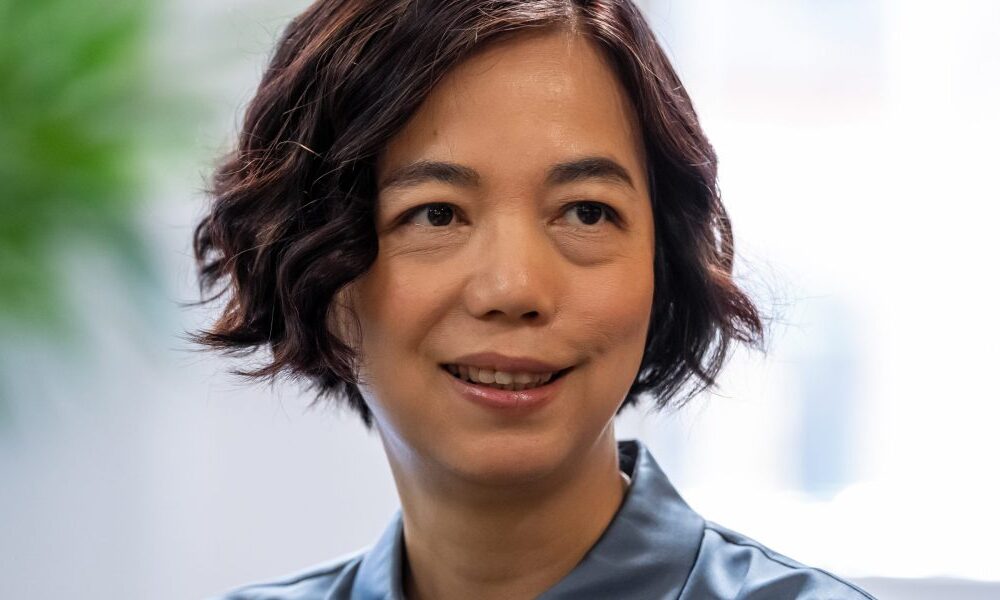
Fei-Fei Li, the computer scientist known as the “godmother of AI,” says there is no keeping artificial intelligence out of war.
“To imagine any tools we build will not enter the practice of defense and military is… hardly pragmatic and realistic,” Li told Walter Isaacson in an episode of his podcast, The Builders with Walter Isaacson, shared exclusively with Fortune ahead of its release on Tuesday, Dec. 1.
“The entire human history of war and peace uses tools from stones, rocks, to knives, to fire, to gunpowder, to airplane,” she said. “I believe it will be using AI.”
The comments mark a shift for Li, who, as chief scientist of AI at Google Cloud, said in 2018 that it was against her “principles” to work on anything she believed would weaponize AI. They also arrive as she takes on a major corporate role: on Nov. 16, AMD said it had closed its acquisition of World Labs, the startup Li co-founded, making her the chipmaker’s executive vice president and chief scientist.
“Human history is a history of war and peace,” Li said. “It’s a history of science and technology. It’s a history of storytelling and art, and it’s all true simultaneously.”
Li won’t take a side on Silicon Valley’s military debate
Isaacson asked her about the spread of drones and autonomous weapons in conflicts such as those in Ukraine and Iran. He pointed to Anduril founder Palmer Luckey, who argues that tech companies should work with the military. “Tell me what you think is dangerous, the use of this for the military or the tech people saying, ‘No, let’s withdraw from serving national security purposes,’” Isaacson asked.
“It’s also a very, very thorny issue,” Li responded, declining to take a side. “I genuinely, genuinely believe this is a very, very nuanced topic. I don’t think there is a singular answer.”
She described AI as a double-edged sword. “Sometimes we need that to defend peace. Sometimes we need to control it so we don’t actually hurt people unnecessarily,” she said. “And most times, hope we use that to create a vibrant economy. And that’s the messy reality.”
The question is live inside her former employer. Google removed a pledge to avoid weapons applications from its AI principles last year, and this spring a group of its employees urged the company’s CEO to refuse classified military AI work, The Boston Globe reported.
The Project Maven emails that defined her stance
Few people have more standing to comment on this than Li, who immigrated from China to New Jersey at 15, helped run her parents’ dry-cleaning shop, studied physics at Princeton and, as a young professor, built ImageNet. That database of millions of labeled images helped set off the deep-learning boom in 2012.
She co-founded Stanford’s Institute for Human-Centered Artificial Intelligence in 2019 and World Labs, a startup building “world models” that let machines understand and move through 3D space, in 2024. In September, AMD agreed to buy World Labs for $8.2 billion in stock, a rare AI deal between two of the industry’s most prominent women; Li now reports directly to AMD CEO Lisa Su.
Before she landed at No. 45 on Fortune’s 2026 Most Powerful Women list, she led AI research at Google Cloud and warned colleagues about weaponized AI.
In 2018, she was caught up in the backlash over Project Maven, a Pentagon contract to analyze drone footage. In internal emails reported by The New York Times, she backed the deal while urging colleagues to keep AI out of the announcement. “Avoid at ALL COSTS any mention or implication of AI,” she wrote. “Weaponized AI is probably one of the most sensitized topics of AI—if not THE most.”
In a statement to the Times at the time, she said: “It is deeply against my principles to work on any project that I think is to weaponize AI.” Google declined to renew the contract, and Li returned to Stanford later that year.
Speaking with Isaacson, she framed the military question through her work at Stanford HAI with political scientists, national security scholars and the Hoover Institution. “If we have to put a North Star… I believe most people would say peace is a North Star,” she said. “But how do we get to that North Star is actually a really, really tough question.”
Li says people, not code, will decide what AI does to jobs
Isaacson also asked whether “human-centered” AI will bring more work and dignity, or eliminate huge numbers of jobs. “TBD. I think the answer is in us,” Li said, arguing that the outcome depends on people, not code. “Even if such a piece of code exists, which it doesn’t, even if it were to exist, it’s written by humans.”
“I firmly believe it’s all of us,” she said. Teachers, doctors, artists and communities all have a say in the technology, she argued, whether through politics or their work. “I don’t want a technology that… accentuates our differences and create a worse world for us.”
Li also said researchers have a duty to engage with the public and policymakers. “I think public communication is severely lacking right now, or it’s severely skewed, that a lot of people hear about AI through the lens of fear, anxiety, instead of empowerment, encouragement, and just good information,” she said.
“At this moment, as a AI scholar, I actually don’t think ivory tower is the right symbol.”