
Fashion
Global polyester production climbs while cotton declines and viscose holds steady

Translated by
Nazia BIBI KEENOO
Published
September 22, 2025
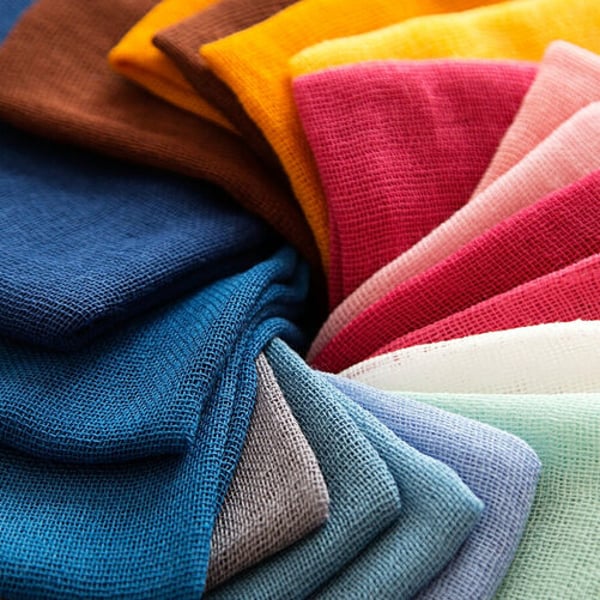
Textile Exchange‘s annual report indicates that global fibre production is expected to remain on an upward trajectory in 2024, with synthetic fibres steadily widening the gap with natural materials, while cellulosic (wood-pulp-based) fibres are expected to hold steady. The share of recycled fibres has not increased either, except in the wool market.
In 2024, the volume of fibre produced worldwide rose by 6.5% to 132 million tonnes. Synthetic fibres accounted for 69% of this total, up nine points on the 2020 level, with polyester alone accounting for 59%.
Having already reached a 57% share in 2023, polyester continued to gain ground, reaching a total of 78 million tonnes in 2024. Production of recycled polyester increased from 8.9 to 9.3 million tonnes. Polyamide (nylon), the second most-produced synthetic fibre, accounts for just 5% of global fibre production.
Whereas cotton accounted for 20% of fibre production in 2023, it fell to 19% in 2024, with 24.1 million tonnes of virgin cotton. Textile Exchange notes, however, that 34% of cotton produced is now certified to sustainability standards, compared with 28% the previous year. The share of recycled cotton remains stable at 1%, at 300,000 tonnes.

Other plant-based fibres account for 6.9 million tonnes of production. This market is dominated by jute (54%), followed by cotton fibre (26%), flax (5%), and hemp (5%). These two bast fibres, flax and hemp, thus account for 0.3% and 0.2%, respectively, of global fibre production.
Cellulosics, the third major fibre family (obtained through the chemical transformation of plant-based raw materials), maintained their market share, with viscose, acetate, lyocell, modal and cupro accounting for 6% of global fibre production, at 8.4 million tonnes (+6.4%). However, over the past year, the market share of recycled cellulosics has increased, rising from 0.7% to 1.1%, or 90,000 tonnes.
Nearly 70% of this sector’s production is now covered by the FSC (Forest Stewardship Council) and PEFC (Programme for the Endorsement of Forest Certification) forest certification programmes.
Animal fibres still account for only 1% of global fibre production, of which wool captures 0.9%, with 1.98 million tonnes of virgin wool. Within this market, the share of recycled wool has risen from 6% to 7%, with 83,000 tonnes. Cashmere (0.02%), mohair (0.004%) and alpaca (0.005%) have maintained their market shares in global fibre production.

Still within animal-derived materials, global down production rose from 626,000 to 659,000 tonnes, with ducks accounting for nearly 90%. The share of recycled down in this market is only 1%.
Although it is not a fibre, Textile Exchange does not overlook leather. Around 13.8 million tonnes were produced last year, from approximately 1.6 million animals. Global production last year comprised 9.4 million tonnes of sheep skins and 2.2 million tonnes of sheepskins. These figures are in addition to 11.5 million tonnes of goat skins and 800,000 tonnes of buffalo skins.

Excluding fibres, the report estimates global rubber production at 15 million tonnes in 2024. The share of production carried out under the FSC and PEFC forest certification programmes rose over the year from 2.9% to 3.2%.
This article is an automatic translation.
Click here to read the original article.
Copyright © 2025 FashionNetwork.com All rights reserved.
Published
December 10, 2025
From the Danube to the Limmat, Celine is expanding its presence in the Alpine region on two fronts as the year draws to a close. Hot on the heels of its opening on Vienna’s Kohlmarkt comes a new flagship boutique on Zurich’s prestigious Bahnhofstrasse. That said, Celine already had a presence in the Swiss banking metropolis, a smaller boutique on Storchengasse, which has now closed.
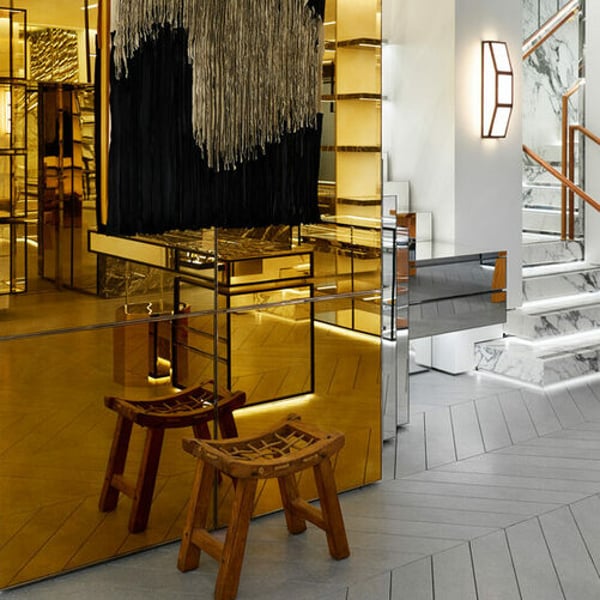
Across three floors, the store showcases the womenswear collections, Beauté, Haute Parfumerie, and its Maison line. For the interior, Celine has opted for Grigio Carnico marble paired with travertine, among other materials.
The minimalist ambience is designed to appeal to its discerning clientele, with refined natural stone, silvered mirrors, and gilded metals.
Basaltina flooring laid throughout is finished with a French-inspired chevron motif. Ultra-clear mirrors- some with an antique-gold finish- neon lighting, and polished metal provide further accents. Furnishings throughout the store and in the numerous lounge areas blend vintage and contemporary elements.
The ground floor is devoted to women’s accessories and leather goods. Fragrances and beauty products are displayed on a fragrance organ and at a dedicated beauty counter and sculptural golden cube encloses a private area.

The staircase, uniting Arabescato marble and vertical mirrors in rhythmic interplay, leads to the first floor, home to the ready-to-wear collections. At the rear, a private area offers ample space for personal shopping.
As part of the Celine Art Project, a curated selection of artworks is on display: a textile composition by Joël Andrianomearisoa, a sculptural frame by Indrikis Gelzis, and a painting by Maia Ruth Lee.
This article is an automatic translation.
Click here to read the original article.
Copyright © 2025 FashionNetwork.com All rights reserved.

Fashion
Milan Men’s Fashion Week schedules 76 events for January 2026, including 18 in-person catwalk shows
Published
December 10, 2025
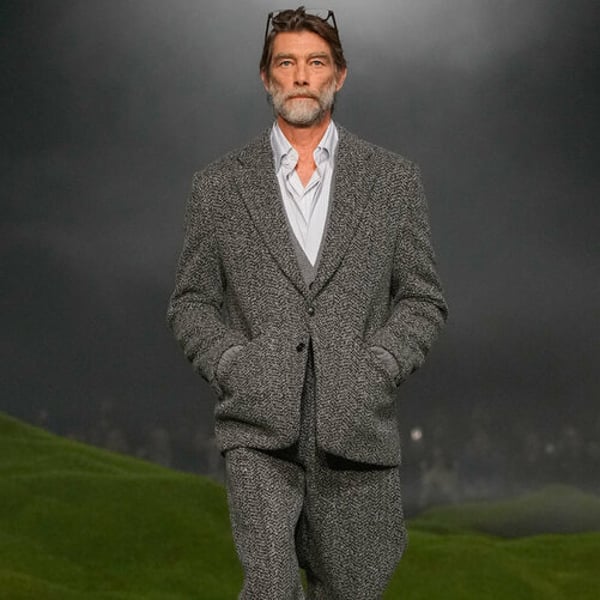
Carlo Capasa reports a 3% drop in turnover for Italy’s textile and apparel industry in 2025- a relatively contained figure given the extremely challenging economic and geopolitical backdrop. The president of CNMI unveiled the upcoming Milan Men’s Fashion Week, to be held in Milan from January 16–20, 2026, announcing 76 appointments in total: 18 physical and seven digital shows, 39 presentations, and 12 events.
Italian fashion: exports hold up in 2025, but 3,000 companies lost in three years
“We expect a decrease in turnover of only 3% for the full 2025 financial year for textiles and apparel, including accessories, because the last few months have been better than the first. Unfortunately, however, we cannot delude ourselves by looking only at the elements that drive the sector, as there are weaknesses and difficulties along the supply chain, as ICE president Matteo Zoppas has also pointed out,” explains Carlo Capasa. “A striking figure is that in 2022 we had 62,000 companies and now there are 59,000. We have lost 3,000 in three years. All together- we, the associations- with the support of the government, which is and remains fundamental, must do our utmost to overcome this phase.”
Exports amount to 87.5 billion euros, still a very high share of the total 93 billion euros in turnover. Moreover, Capasa recalls, in 2023 the shortfall in domestic consumption was 13 billion euros; now it is half that. “Unfortunately, if salaries have grown little compared to the cost of living, this weighs heavily on domestic consumption,” says the president of Camera Nazionale della Moda Italiana, adding that “imports have increased because we are importing much more from China (+11.8%), while exports have decreased because we are exporting much less to China (around -20%).”
The positive note, according to Capasa, is that US duties have been absorbed fairly well and, after an initial period of difficulty, trade relations with the US are improving. Companies are not standing still; many will present their Cruise collections in the US- Moncler, for example, will be in Aspen- as a signal of their intention to stimulate this key market.
Jewellery and eyewear, which performed strongly in recent years, have run into headwinds in 2025. Most notably, jewellery was down 4.1% in the first nine months, with eyewear down 2%. “We hope for a better result in 2026, since in the last two years we have lost 10 billion in turnover- a significant loss, also in absolute terms,” Capasa recalled.

In menswear, Italy is the world’s second-largest exporter after China, with an 8% share. “Here too, from April to August, after a negative start to the year, exports grew by 5% across all categories. The final outcome, after the first eight months were flat, is that we are at the same level as last year, so menswear has, in some respects, outperformed womenswear,” said the executive. Exports to the US were strong for menswear, outperforming other categories, rising by 9% from January to November.
Turning to Fashion Week, the communications campaign, created with the City of Milan and Yes Milano, again shines a spotlight on new talents and emblematic locations in Milan, weaving a narrative that includes collaboration with the Milan Cortina 2026 Olympic and Paralympic Winter Games. The location chosen this time is the entrance to a historic 1940s building on Via Foppa. The campaign was shot by photographer Alessandro Burzigotti, with styling by Daria Di Gennaro and the support of Stilema Studio for set design, and is enriched with objects loaned by the Olympic Museum in Lausanne. The brands involved are Ascend Beyond, Cascinelli, Federico Cina, Gams Note, Meriisi, Moarno, Mordecai, Mtl Studio, Noskra, Setchu and Viapiave33.
MFW men’s January 2026: 9 new runway shows, 7 presentation debuts
The official Milan Fashion Week menswear show calendar will feature Ralph Lauren, Domenico Orefice, and Victor Hart for the first time. Meanwhile, the digital show calendar will welcome Absent Findings, Ajabeng, Kente Gentlemen, Raimondi, State of Chaos, and Subwae as new additions. Returning to the runway calendar are Zegna and Dsquared2, whose show will be followed by a party.
As for the presentations calendar, there will be seven new brands: Bottega Bernard, Dunhill, K-Way, Plās Collective, Moarno, Sagaboi, and Stone Island, while Ferragamo returns.

The major names in Italian menswear are all confirmed. Showing (or presenting) at this Fashion Week are leading names such as Brunello Cucinelli, Prada, Giorgio Armani, Corneliani, Tod’s, Brioni, Lardini, Kiton, Mordecai, and Montecore.
MFW men’s January 2026: anniversaries and events
This edition also sees the celebration of important anniversaries: Blauer will mark its 25th anniversary, Pronounce its 10th and Marcello Pipitone–Bonola its 5th. Among the events, EA7 Emporio Armani will celebrate in store the Milan Cortina 2026 Olympic and Paralympic Games. K-Way, together with Vogue and GQ, will present ‘Montagna Milano: The Alpine Club in Town.’ The event, open to the public, will take place over three days and include panels, workshops, and après-ski experiences.
Li-Ning will then celebrate movement, culture, and the brand’s evolution in sportswear with a runway presentation of its Autumn–Winter 2026/27 Men’s and Women’s collections. Stone Island will present ‘Prototype Research_Series 09, Air Blown Lamination On Knit’ through an installation by Ken-Tonio Yamamoto featuring garments born of non-industrial research and experimentation processes.
Finally, for this edition, Fondazione Sozzani will serve as CNMI’s space during Men’s Fashion Week, with the aim of supporting and promoting the new generation of designers. Domenico Orefice and Simon Cracker will show there, while the labels Bottega Bernard, Maragno, Marcello Pipitone–Bonola, Moarno, Mtl Studio, Pecoranera, and Sagaboi will be present with a showcase.

“It will be a vibrant space where many things will happen; it will be a pleasure to spend time there, because it is a special environment,” Carlo Capasa assured about the location chosen by CNMI at Fondazione Sozzani. “Streaming and international broadcasting of the Milan Fashion Week Collection will be ensured in this edition as well,” he added. “The event will be streamed on the Milan Fashion Week platform, which will also host a section dedicated to virtual showrooms, both multi-brand and mono-brand. This is an important point, because we must always remember that Milan has the most important fair in the world, which is the citywide showroom fair- 800 showrooms with 3,000 brands, open seven months a year, that showcase and sell to the world the visions of a great many designers.”
A Fashion Week intertwined with the Milan Cortina 2026 Olympic Games
“As with every Fashion Week, Milan becomes an international crossroads of meetings, contacts and relationships that constitute that precious heritage supporting creativity, know-how and innovation recognised all over the world. A Men’s Fashion Week with events and locations that will surely make it rich and interesting and that will herald a moment we hope will be fruitful for Milan and for fashion as a whole: the Olympic Games. A union that already begins with the advertising campaign,” recalled Alessia Cappello, councillor for Economic Development and Labour Policies with responsibility for Commerce, Fashion, and Design, in her speech.
“The economic impact that the event will generate is not yet precisely known. Our research centre believes that dovetailing with the Winter Olympic Games will bring even more visitors and tourists to Milan- namely people who will be interested not only in fashion but also, and above all, in sport,” Cappello continued. “It will be a relay: Men’s Milan Fashion Week in January, the Olympics in February, women’s fashion week placed between the end of the Games and the beginning of the Paralympics. Usually the economic impact is around 80 million euros during men’s Fashion Weeks and 100 million during women’s Fashion Weeks, but we think it will be even higher this time. I also want to mention the very important synergy with Florence, with which there is a solid and fruitful relationship. Because men’s fashion week starts in Florence and ends in Milan,” concluded Alessia Cappello.
This article is an automatic translation.
Click here to read the original article.
Copyright © 2025 FashionNetwork.com All rights reserved.


Madison Beer Says She Used to Tell People She Knew She’d Die by Suicide

Celine opens flagship store in Zurich, Switzerland

Political communication scholar on how Zohran Mamdani hacked ‘slacktivism’ to appear on your phone, on your street and in your mind
-

 Politics8 years ago
Congress rolls out ‘Better Deal,’ new economic agenda
-
Entertainment8 years ago
New Season 8 Walking Dead trailer flashes forward in time
-
Politics8 years ago
Poll: Virginia governor’s race in dead heat
-
Entertainment8 years ago
The final 6 ‘Game of Thrones’ episodes might feel like a full season
-
Entertainment8 years ago
Meet Superman’s grandfather in new trailer for Krypton
-
Politics8 years ago
Illinois’ financial crisis could bring the state to a halt
-
Business8 years ago
6 Stunning new co-working spaces around the globe
-
Tech8 years ago
Hulu hires Google marketing veteran Kelly Campbell as CMO