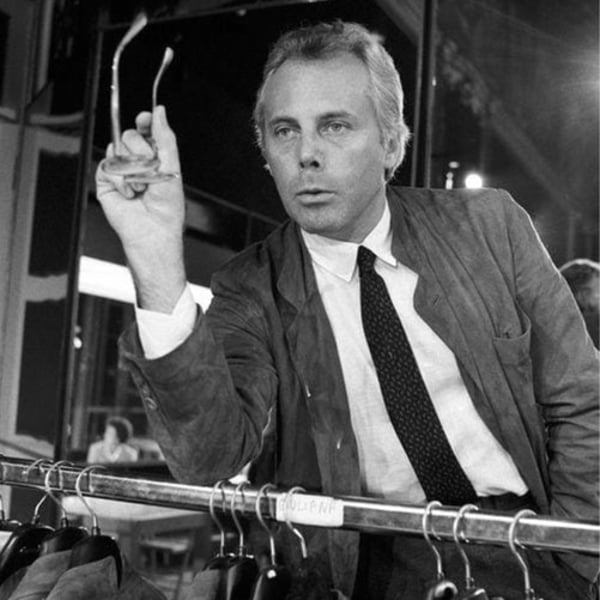
Giorgio Armani, who passed away peacefully among his family in Milan on Thursday, will be remembered as one of the greatest single Italian designers and the figure who spearheaded the remarkable renaissance of Italian fashion in the post-war era.
Giorgio Armani, celebrated for his timeless elegance and humanity. – Gruppo Armani
It’s hard to overstate the importance of Armani in fashion and design, especially following his passing, and his remarkable name recognition wherever one travels. In fact, if one were to ask a passing stranger to name a fashion designer, Giorgio Armani would be the most likely choice.
Those of us who had the honor to spend time with Armani – from Milan to New York, from Shanghai to Tokyo – were always struck by the easy grace with which he handled fame. When meeting Giorgio, Gulf sheiks placed their hands on their hearts; in Hong Kong he stopped traffic when strolling to lunch; in Milan shows movie stars and Oscar winners greeted him backstage with the deepest of bows. Once, when walking with him near the Spanish Steps in Rome, a passerby stopped him and insisted on kissing his hand. Which he gently accepted, before turning to me in a Shakespearean aside: “You know, I didn’t pay her ahead of time to do that!”
Giorgio Armani at Milan Fashion Week, presenting his Spring/Summer 2023 collection, September 22, 2022. – Reuters
Though he became enormously wealthy and famous, he wore his success with levity and grace. He spoke to young assistants, security guards or total strangers with the same avuncular tone with which he addressed heads of state. Though courtly, precise and ironic in manner, Armani could have a volcanic temper, but only when he felt his own exacting standards were not being met.
Giorgio Armani with a kitten, reflecting his love for animals and his famously softer side. “Yes, I love cats,” he told ELLE Decor. – DR
Today, it’s impossible to travel to any major city and not find some of Armani’s influence. His various elegant collections – Armani Privé, Giorgio Armani, Emporio Armani, Armani Exchange – along with his network of Armani cafés, Armani/Dolci and Armani/Casa stores all herald the blend of refined minimalism and Oriental fantasy that was his signature style.
And in an era when just about every designer sold control of their brand – Dior, Chanel, Valentino and Versace, to name a few – Armani left this life as the sole owner of his massive empire. Last year alone, Armani scored a net profit of €398 million on a turnover of €2.3 billion.
Armani Café in Dubai, one of the brand’s many lifestyle ventures alongside Armani/Dolci and Armani/Casa. – DR
Although he left his hometown of Piacenza in the early 1950s to study medicine in Milan, after completing two years of compulsory military service, he shifted his career and became a window dresser in Italy’s largest department store, La Rinascente. That early training in display and editing remained with him all his life, as I noticed on a journey with Armani to open his first hotel inside the world’s tallest building – the Burj Khalifa in Dubai in 2006. During a morning visit to an Armani café in a mall, Giorgio spent 45 minutes altering lighting, repositioning chairs, straightening waiters’ shirts and folding napkins just so.
Like a true aesthete, he devoted his life to creation, and only when he was 100 percent satisfied would he consider socializing. On another occasion, I spent a day following Giorgio when he staged his first “Armani One Night Only” in London, an outlandishly cool and huge bash to support the fight against AIDS in Africa and Bono’s charity RED. Staged inside Earl’s Court, done up like an Ibiza nightclub, with Leonardo DiCaprio, Alicia Keys, Lady Helen Taylor and Minnie Driver in the audience; Elle MacPherson and James Franco serving as MCs. After several runway shows, Beyoncé performed “Crazy in Love”; Bryan Ferry sang “Slave to Love”; and Alicia Keys and Andrea Bocelli serenaded Giorgio. But what most sticks in my mind was the night before, when Giorgio was meticulously editing the collections, and his communications director quietly reminded him he was expected at a dinner in his honor with Tony Blair. Whereupon Armani harrumphed: “Qui, sto lavorando! Here, I am working!” dismissing the very idea he might leave a job early to meet a prime minister. Forget that.
An autodidact, Armani received his first lessons in making clothes from his mother and would later name both of his fabulous superyachts Mariù in her honor. After spending a decade working his way up in fashion, Giorgio—encouraged by his partner Sergio Galeotti—first opened a design office, then launched his own brand in 1975, reportedly financed by the sale of his Volkswagen.
Giorgio Armani reviewing designs in his Milan studio during the 1970s. – DR
By October 1975, Giorgio staged his first menswear collection to immediate acclaim. It was a pivotal moment when a group of exceptionally talented Italian designers—Gianni Versace, Gianfranco Ferré, Valentino Garavani, among others—began utilizing Italy’s exceptional artisans and clothing manufacturing to challenge France’s long-time leadership in fashion. A movement where Armani was the de facto leader among some brilliant peers, often nicknamed Il Re della Moda or Imperatore Giorgio. Generally, Giorgio remained very publicly respectful of his peers, though he certainly did not like any of their clothes being mixed with his—except for the high‑octane Versace, whose dazzle seemed to offend him.
And whereas practically every designer on the planet hired an independent stylist to help create their campaigns, Armani never did, to avoid any digression from his strictest fashion vision. Giorgio’s style was always a balancing act – the perfect silhouettes of his menswear combined with the opulent delicacy of his couture.
Enamored, like most Italians, of movies, it was cinema that catapulted Armani into global prominence when he created the wardrobe of Richard Gere in the 1980 film “American Gigolo.” The famed scene of Gere tossing beautiful Armani shirts onto a bed before deciding on a suitable seductive outfit expressed a new era of modern elegance and the suddenly vital role of fashion in contemporary living. It also linked Giorgio indelibly to cinema, where he would go on to costume over 100 films—from “The Untouchables” and “The Dark Knight Rises” to “Ocean’s Thirteen” and “Inglourious Basterds.” Since “American Gigolo,” no Armani front row was complete without half a dozen movie stars joining football greats, sporting superstars and cultural icons at his shows.
Giorgio Armani fitting a gown backstage, demonstrating his meticulous attention to detail. – DR
Two decades ago in Cannes, he kindly invited me to supper on Mariù I, a beautiful boat with a black hull, pale wood paneling, and muted non‑colors—the diametric opposite of a typical superyacht. Then, when a fresh group of about a dozen people appeared after an evening screening—including the likes of Kevin Klein and Sheryl Crow—Giorgio had his three handsome chefs whip up a large bowl of simple but delicious pasta made with just olives, garlic, pepperoncino and Parmesan. Before insisting on personally serving everyone himself, something I never saw any other designer do.
For many years, he staged most of his shows in his own private show‑space in his headquarters on central Via Borgonuova, which is where I first met him as the young, freshly appointed editor‑in‑chief of Vogue Hommes in 1995. Having spent five years in Italy, I was able to converse with him in Italian. Armani spoke excellent French, though, like many pre‑war‑born Italians, his English was limited.
Giorgio Armani with FashionNetwork.com Global Editor-in-Chief Godfrey Deeny at Milan Moda Uomo, January 2025. – DR
I proudly showed off my first edition, which included a wonderful shoot by Albert Watson titled “Mafia Crooner.” Featuring a dashing Latin couple, the man looking sensational in a classic cement‑hued Armani double‑breasted jacket inside a café in Little Italy. Giorgio seemed suitably impressed and shook my hand firmly as he exited our meeting, before later finding me at the door of his palazzo, evidently irate. “Have you seen this!?” he said, showing off the shot of the crooner in his jacket. “Somebody has put an appalling Vivienne Westwood tie on my jacket! Allora?” he bristled. To which I responded, “Sorry, Signor Armani, but you know how difficult it is to control stylists.” To which he replied, placated: “Finally, an editor who knows what he is talking about!”
Later shows were staged in South Milan inside Armani/Teatro, designed by Japanese architect Tadao Ando, inside a former Nestlé chocolate factory. It is where Armani’s coffin will be set up in a funeral chamber all this weekend, open to the public. It was also the site of his last show in June, when he was too frail to take a bow, and his right‑hand man, Leo Dell’Orco, took the bow. A faithful partner to the end, who is expected to continue to guide the house with Armani’s surviving sister, nieces, and nephews.
Even into his 90s, Giorgio never slowed down. He staged another One Night Only last November with a star‑packed show inside the New York Armory, where Orlando Bloom, Liev Schreiber and Pamela Anderson posed proudly.
Giorgio Armani with models at his “One Night Only” show in New York—an emblem of his vision bridging haute couture and immersive spectacle. – Courtesy
The day before, Giorgio had unveiled yet another project— a brand‑new $400 million complex named Armani Residences on Madison Avenue. It includes three floors of retail space, two restaurants and more than a score of apartments. Giorgio reserved the penthouse for himself. In fact, many days in his final decade were spent building Armani hotels and residences, with a series of luxury towers due to open in the coming years.
Armani Residences Diriyah – DR
Giorgio’s day last November began with a personal appearance at his boutique in Bergdorf Goodman, signing copies of his book Per Amore. Outside, ten windows of the world’s most luxurious department store were customized with looks from Armani men’s and women’s collections. An elegant celebration of his historic ties with Bergdorf—the first American store to carry the Giorgio Armani men’s collection back in the 1980s. All told, yet another remarkable two days by the Italian maestro, the designer who never seemed to sleep in the city that never sleeps.
Giorgio Armani with models after a show, celebrating the effortless elegance that defined his collections. – DR
At the time, I asked Giorgio what he hoped his legacy would be, and he responded: “The legacy I hope to leave is one of dedication, respect and an eye for reality. Success in fashion comes from observing people, understanding their needs and creating clothes that meet those needs. At the heart of it, I focus on making beautiful garments. Fashion is a serious but deeply rewarding profession.”
Summing up his life—the greatest brand builder in Italian design, the hardest‑working designer I ever met, and a gentleman who left this earth a far better place than he found it.
In a very real sense, Armani became far more important than being an iconic fashion designer. The greater Italian public, and indeed an international audience, treated Giorgio like the president of Italian style and taste. His longevity and his devotion to his art made him a hallowed figure. In future years, when people come to write fresh histories of Italy, Armani will be ranked with Galileo, Leonardo Da Vinci, Michelangelo and Christopher Columbus—and deservedly so. Beyond his fashion empire, hundreds of stores, Armani Casa skyscrapers and a massive perfume business, his aesthetic has influenced the past half‑century more than any other living designer. In an era of style, he was the Doge of design.
The Imperatore has left us, and we will not see his like again.
On the runway, Armani’s vision endures, even as the Imperatore takes his final bow. – DR
Jeanne Friot: a queer manifesto to rouse Fashion Week
With her “Awake” show, Jeanne Friot literally brought her guests to their feet at the Théâtre du Rond-Point des Champs-Élysées. Making her debut on the official calendar, the French designer opened the Paris proceedings with a high-octane performance that, true to form, championed LGBTQI+ causes.
The unveiling of Jeanne Friot’s Autumn/Winter 2026 collection, blending runway and choreography conceived with choreographer Maud Le Pladec and the Ballet de Lorraine company, could not have felt more timely given recent headlines and the American president’s posturing. The thirty-something designer issued a call to wake up, with several dancers wearing T-shirts emblazoned with the slogan “It’s never too late to fight fascism“.
Beyond words, the designer opened with three powerful womenswear looks: a black tweed suit with a cropped jacket; a cocktail dress reimagined in a tartan of silver, red and purple sequins, worn by a model with gothic make-up; and a jacket-and-mini-skirt ensemble in black faux leather, heightened by a play of metal straps and buckles—one of her signatures, applied horizontally or vertically to form skirts or dresses—always nodding to the queer wardrobe.
Soon, dancers—wearing tartan catsuits paired with thigh-high boots, faux-leather mini-shorts, colourful tulle tops or black sequin hoodies—launched into breathless choreography. Then came two women in generously cut suits, one black, the other white. The two models drew closer, stared each other down, touched and kissed intensely and at length, melding like yin and yang as, all around them, the troupe ratcheted up the intensity of their stagecraft. The tableau prompted a wave of approval throughout the Parisian theatre.
Ever more exacting in her use of deadstock materials, the French designer introduced several other visually striking pieces, including a long black faux-leather coat worn over a bodysuit and teamed with metallic thigh-high boots, a houndstooth suit with a broad-shouldered jacket and micro-shorts, and an opulent dress featuring a tartan motif that unfurled from the waist into a train of colourful feathers—a true tribute to the queer community.
That community made its support unmistakable when Friot took to the stage to bow, prompting a prolonged standing ovation for a show that opened Paris Fashion Week Men’s with a bang.
Études Studio and its elegant seekers of sound
On Tuesday, for its show in the impressive Institut de Recherche et Coordination Acoustique, Études Studio staged a composition exploring the tonalities of tailoring. For this collection, christened “N°28 Résonances”, co-founders Aurélien Arbet and Jérémie Egry explained in their letter of intent that they drew inspiration from the origins of 1990s dance music and from the universe of American philosopher John Cage, who questioned the very concepts of music and silence.
To pace their mixed show in soundproofed underground spaces, the French opted for powerful music, teaming with British artist Actress, who composed the soundtrack for a show charting new horizons for Études Studio.
Of course, the brand retained its velvet jackets, hefty canvas blousons with carefully worked washes and a few hoodies (with its logo in a circle of stars on the back), faithful to its utilitarian roots. But the label introduced a compelling, reimagined tailoring proposition, with no fewer than a dozen far more formal looks—straight-cut jackets, fluid trousers and layered shirts, waistcoats and roll-neck jumpers—in black, grey or earthy tones.
Gold prospectors or sound seekers? Between Walkman headphones and cowboy hats, Études Studio refused to choose. Its earnest youths saw their wardrobe explore different material aspects—from worn-in finishes to contrasts between nylon and velvet—and a few chromatic accents, such as an intense purple puffer, or camo riffs on substantial, fuzzy knitwear in shades of green or blue, paired with long, wide scarves in matching hues. This season, the brand presented pieces in collaboration with Berlin-based Canadian artist, Jeremy Shaw.
These silhouettes were accompanied, for the first time, by leather or canvas bags bearing the brand’s logo. This leather goods range, developed in two sizes, should provide a growth driver for the independent creative label.
Valette Studio pays tribute to the New Romantics
Once again this season, Valette Studio’s fashion looked to the past. As the first day of Paris Fashion Week drew to a close, the French brand took over the Institut du Monde Arabe. In a basement room supported by large, thick stone columns, Pierre-François Valette unveiled his Autumn/Winter collection entitled “Les Nouveaux Romantiques”, born of a contemporary melancholy caused by the displacement of creation by image.
This season, Valette Studio focuses on color, frills and ruffles – Samuel Gut
Accompanied by a rock soundtrack with wild percussion, later joined by a violin, the models wore a herringbone denim trench with matching skinny jeans, a short cream dress with a shirt collar and frills that cinched the waist and framed the chest, a black leather ensemble and Louboutins, in collaboration with Louboutin on this collection.
Another dress appeared heavy yet almost bounced, covered in frills and cut from a material that looks, to the eye, like balloon rubber. Perhaps the most striking pieces were two white skirts bearing a made-up face, a watercolour rendered alternately in blue and in orange, created by Teintures de France and inspired in particular by the legendary make-up of David Bowie, the pre-eminent figure of the New Romantics. The models were sometimes adorned with silver make-up swept along the outer corners of the eyes, another nod to the stars of this early-1980s movement. At the end of the show, Pierre-François Valette was warmly applauded by the many guests as he crossed the long room to take his bows.
This article is an automatic translation. Click here to read the original article.
Catimini: a name that resonates across France’s childrenswear market. And it is poised for a revival. On January 20, French baby and childrenswear specialist CWF announced the acquisition of Catimini.
CWF takes over Catimini to position it in the premium segment – Catimini
After several turbulent seasons under the ID Kids umbrella, marked by a drastic reduction in its store network from 2023 and a suspension of operations in 2024, Catimini is changing hands. The northern French group had taken over Catimini, along with several other brands from the beleaguered Kidiliz group, in 2020 but failed to restore the brand’s profitability; despite 18 million euros in revenue (per filed accounts) in 2021 and 2022, it posted multi-million-euro losses.
In formalising the deal, without disclosing the amount, Children Worldwide Fashion said it had brought the brand’s founders, Paul and Monique Salmon, who launched the label in 1972, on board.
“Catimini was born of a free and creative vision of children’s fashion. Seeing it join CWF, in Vendée, where it took root, is an obvious choice. We share the same values of know-how, high standards and respect for the brand’s DNA, and I have no doubt about the teams’ ability to embody its codes, gestures and soul,” said Paul Salmon, who is supporting this handover, in a press release.
For CWF, the stakes are high: to restore the lustre of a house that has defined the creative wardrobe of generations of children, while integrating it into the logistical and commercial set-up that has enabled it to establish itself as a strong player on the global children’s luxury stage.
The Les Herbiers-based group built its reputation managing luxury licences (from Givenchy to Marc Jacobs and, more recently, Boss), and is now accelerating the development of its own brands. Alongside Billieblush, Catimini becomes its new in-house standard-bearer. Repositioned in the premium segment, the brand will draw on the group’s expertise as it seeks to reclaim its place in the market by reconnecting with the strongest elements of its DNA, with joyful, graphic fashion in which its signature red is set to play an important role.
CWF is also announcing a first collection for spring/summer 2027, comprising 150 styles for ages 2-14, including accessories, footwear and a gift offering for babies. This comprehensive proposition should quickly find its place within the Kids around network, the group’s multibrand concept, which already boasts 85 stores in 29 countries. The French market accounts for more than a third of the group’s revenue, with CWF Fashion reporting 210 million euros in 2024, according to filed accounts.
To mark this new chapter, CWF intends to make a statement. The group will unveil the first looks of this “new” Catimini on March 11, at a special catwalk show at the Palais de Tokyo in Paris. A deliberate choice of venue, as the site hosts numerous fashion shows during fashion weeks. A symbol of CWF’s determination to bring its premium expertise to Catimini across the board.
This article is an automatic translation. Click here to read the original article.
Nike Inc.’s top executive in Greater China, Angela Dong, is stepping down as the sportswear company looks to reverse a sales decline in the market.
Angela Dong – Nike
Dong will leave Nike on March 31, the company said in a statement. She’ll be replaced by Cathy Sparks who was previously leading the Asia Pacific and Latin America division. Nike also announced changes for the leadership of the Europe Middle East and Africa division.
The leadership changes suggest Nike is looking at a new strategy for Greater China. Chief Executive Officer Elliott Hill has recaptured some of Nike’s momentum since taking over, but China remains a key challenge, with sales plunging 17% in the latest quarter.
He said in December that China is “at the top” of the company’s list of priorities, and stressed the company needs to move faster.
Nike shares fell less than 1% in extended trading in New York. The stock fell 16% last year, the fourth consecutive annual decline.