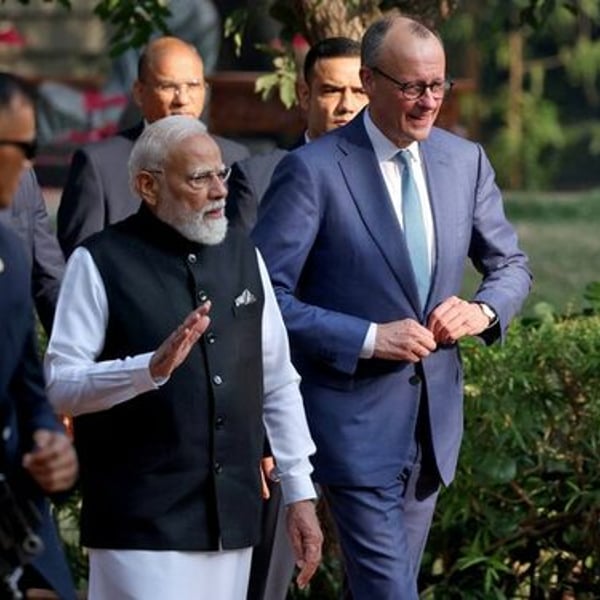
German Chancellor Friedrich Merz floated on Monday the possibility that the European Union and India could sign a landmark free trade agreement by the end of January, a move that could reshape global trade ties as protectionism rises and US-India talks remain stalled.
German Chancellor Friedrich Merz walks with India’s Prime Minister Narendra Modi during his visit to Gandhi Ashram in Ahmedabad, India, January 12, 2026 – REUTERS/Amit Dave
Top EU leaders would travel to India to seal the deal if negotiations wrap up in time, Merz told reporters in the western Indian city of Ahmedabad on Monday after meeting Indian Prime Minister Narendra Modi.
“In any case, they will take another major step forward to ensure that this free trade agreement comes into being,” Merz said during his first trip to India since becoming chancellor. European Union officials have yet to comment.
A trade deal, under discussion for years, is seen as a chance for both sides to strengthen economic ties and cut reliance on China and Russia. Bilateral trade between India and the EU totalled 120 billion euros ($140.21 billion) in 2024, making the bloc India’s biggest trading partner.
Talks have gathered pace since the US, under President Donald Trump, raised tariffs on Indian goods and pressured New Delhi to stop buying Russian oil. A separate India-US trade deal collapsed last year after a breakdown in communication between the two governments.
The EU-India pact would follow on the heels of the European Union’s recent agreement with South America’s Mercosur group and support Europe’s push to build new trade networks as global rules shift. Indian Trade Minister Piyush Goyal, speaking at a separate event in the western state of Gujarat, said an agreement was almost at its final stages.
German officials told Reuters the latest talks between Merz and Modi were “very intensive,” raising hopes for a breakthrough. The EU is pushing for steep tariff cuts on cars, medical devices, wine, spirits, and meat, along with stronger intellectual property rules, while India is seeking duty-free access for labour-intensive goods and faster recognition of its growing autos and electronics sectors.
An Indian official familiar with the talks told Reuters last month that disputes over steel, carbon levies, and market access would need further compromise. The two countries signed agreements on minerals, healthcare, and artificial intelligence during Merz’s visit.
Germany relies on India as a growing market and the German chancellor said the world is experiencing “a renaissance of unfortunate protectionism” that harms Germany and India. He did not name any countries.
While the US has imposed tariffs on trading partners, China introduced export controls on minerals used in areas such as autos, causing months of supply chain disruption last year due to the U.S.-China trade war and affecting German carmakers. Beijing also slapped restrictions on some semiconductors widely used in the car industry after the Dutch government’s decision to seize control of Chinese-owned chipmaker Nexperia.
The house of Dior has named UK actor Josh O’Connor to be its latest brand ambassador, joining soccer legend Kylian Mbappé in the brand’s style diplomatic corps.
Josh O’Connor for Dior – George Eyres
“Dior is delighted to welcome Josh O’Connor as the new ambassador for Jonathan Anderson’s collections,” the Paris-based house said in a release.
The actor had previously been a presence at several runway shows of J.W. Anderson, who was appointed overall creative director of Dior in June 2025.
O’Connor first grabbed attention and international fame with his performance as Prince Charles in hit series The Crown- for which he won a Golden Globe Award for Best Actor .
Subsequently, he has garnered critical acclaim in a variety of films, including Luca Guadagnino’s Challengers, in which he wore clothes designed by Anderson in this studied melodrama about competing players and emotions in tennis.
O’Connor has also worked with Guadagnino in an ad campaign for Aston Martin, shooting an elegiac road movie short in sun-dried Sicily.
“Josh O’Connor embodies a singular, sensitive, and undeniably modern expression of masculine elegance, perfectly in sync with the contemporary Dior style,” added Dior about the Cheltenham, England-raised thespian.
The Very Group has published its results for Q1 of FY26 (the 13 weeks to late September 2025) and they show the e-tail giant still loss-making but seeing “further improvements in profitability and a return to top-line growth compared to the same period in the prior year”.
The launch of The Very Collection in September 2025 was a key development for Very UK
It comes after what it described as “robust” results for FY25, even though they included a major pre-tax loss linked to a writedown of an inter-company loan made to the then-controlling Barclay family’s holding company as lenders prepared to take over the business.
Now owned by major lender Carlyle and reportedly up for sale, the company said that the market remains challenging but the group saw revenue growth of 2.4% to £460.8 million in Q1. At the star Very UK operation, revenue (which accounts for the bulk of the firm’s total retail sales) rose 3.7% to £406.7 million.
Growth was achieved in both Retail revenue with group sales of goods up 0.9% to £341.3 million and in Finance revenue, which jumped 5.8% to £112.9 million.
The company added that the Very UK operation saw strong results within its higher-margin Home category that rose 10.9% year on year, while its Sports offering increased 12.3% following the introduction of a number of key new brands in the second half of the previous year.
Meanwhile the Toys and Beauty category continue to perform well with 6.4% growth, of which Beauty alone saw 4.1% growth.
That said, Fashion and Sports combined declined 1% in a tough market but, as mentioned, Sports was strong. Parts of the Fashion market were buoyant as well with a 30.1% increase in casual womenswear sales, in part supported by the launch of its new own-brand offering The Very Collection in September 2025. Given that Q1 only ran until the end of that month, it looks likely that the collection will be able to contribute even more in the future.
This all led to gross profit rising to £173.4 million from £163.3 million, or a statutory gross margin rate of 37.6% up 1.3%pts.
It also said that its continued focus on cost controls contributed to a 16.3% increased in pre-exceptional EBITDA to £63.4 million.
That said, it still made a total pre-tax loss of £24.9 million, wider than the £23.1 million loss in the previous year. Similarly, the net loss of £31.4 million was larger than a loss of £23.1 million of the year before, although the company is clearly moving in the right direction on an underlying basis.
UK property giant British Land is looking for a new CEO. Simon Carter’s five-year tenure at the top oversaw the firm’s successful pivot to a retail park focus. He’s departing after an 18-year total association to head European logistics properties firm P3 Logistics Parks.
British Land’s Nugent Shopping Park, south London
His departure comes with a 12-month notice period so there’ll be no immediate hurry to sign a replacement.
Carter first joined British Land in 2004, working in several roles across Strategy, Corporate Finance and Treasury before leaving in 2015 to become CFO at Quintain Estates & Development and then Logicor. He returned to British Land as CFO in 2018 and was appointed CEO in 2020.
William Rucker, chairman, said: “I want to thank Simon for his significant contribution to British Land. During his 18 years here across two stints he has achieved a huge amount, and as CEO has positioned the business for future success with a very strong management team and an exceptional London office campus and retail park platform.”
Carter added: “British Land has been a huge part of my professional life, and it has been a privilege to work for such a fantastic business.
“The contrarian calls we made post-pandemic have positioned British Land for long-term success. There is never a perfect time to move on, but I will be leaving the business with market-leading positions in London campuses and retail parks – both of which are benefitting from strong rental growth in supply-constrained markets.”