Connect with us

Business

Gen Z is open to blue-collar work and companies need them — but both sides are missing each other

Published

on


Earlier this year, Ford CEO Jim Farley said that America needed a wake-up call. Five thousand mechanic jobs at Ford had gone unfilled. They all offered six-figure salaries—well above the average American worker’s wage—but people weren’t applying.

And Ford isn’t the only employer struggling with a shortfall of workers. For over a decade, numerous blue-collar professions—careers that include manual labor ranging from manufacturing and automotive technicians to construction—have struggled to attract young people.

The Bureau of Labor Statistics reports that more than 400,000 skilled trade jobs are currently unfilled, a gap expected to widen as demand for labor continues to grow. The Manufacturing Institute and Deloitte estimated that 3.8 million additional workers will be needed over the next decade. 

Myriam Sullivan, senior director at Jobs for the Future’s Center for Apprenticeship & Work-Based Learning, says the shortages stem from a “perfect storm,” in which an aging workforce collides with cultural stigma around the work and increased competition for specialized labor. 

However, there is some evidence that Gen Z is reconsidering the stigma around blue-collar work as a frankly brutal economy pushes them to reevaluate their options. About 78% of Americans have noticed a rising interest in trade jobs among young adults, according to a 2024 Harris Poll survey for Intuit Credit Karma. With rising tuition costs, these debt-burdened Gen Zers are interested in well-paying careers that allow them to skip a traditional four-year college education. Enrollment in vocation-focused community college has increased by 16% in this last year, according to the National Student Clearinghouse’s tracking data, which also found a 23% rise in Gen Z studying construction trades from 2022 to 2023.

But, as white-collar entry-level jobs disappear, employers and educators have failed to build credible pathways into blue-collar work—leaving high-paying roles unfilled and Gen Z shut out.

The Stigma Around Blue-Collar Work

Clinton Crawford, a 55-year-old automotive technician in Arkansas, told Fortune the system fails from the outset to support young people interested in work like his. Crawford’s high school–aged children were never presented with blue-collar work as a viable option. Instead, nearly every student was encouraged to prepare for a four-year college education. “That’s good, if that’s for you,” Crawford said, “but I don’t think it’s for everyone.”

A similar exchange took place within the household of Ford’s chief executive. At the Ford Pro Accelerate event organized by Farley this fall, with an emphasis on what Farley calls the “essential economy” and the many missing roles to fill there, he spoke with Labor Secretary Lori Chavez-DeRemer and Mike Rowe of the Mike Rowe Works Foundation. Farley told them about his son’s summertime work as a mechanic, and his plaintive statement to his parents afterward: “I don’t know why I need to go to college.” Farley said his son found those experiences under the hood of a car more worthwhile than what he believed college could offer him, and that should be welcomed. “It should be a debate.” A few months earlier, Farley told the Aspen Ideas Institute that some of his workers were taking Amazon shifts to make ends meet and he’d heard that “none of the young people want to work here.”

For Farley, the issue stems from a culture that doesn’t value blue-collar labor. A 2025 survey conducted by home services software maker Jobber found that only 7% of parents would prefer their children to pursue vocational education and related work, while a majority of Gen Z students said vocational education carries a cultural stigma compared with a college education.

“If you were to meet a doctor, or someone in a four-year program, or you were to meet someone who is in a four year program, or you met someone who was working on your car, think of the different impressions you would have of all three,” Crawford said.

The Pew Research Center found that only three in 10 blue-collar workers believe that most Americans have “a great deal” or “a fair amount” of respect for the work they do. And academics like Harvard professor Michael Sandel have also long raised concerns that the value blue-collar workers bring to the economy has not translated into how they are treated in society.

Crawford pushes back against stereotypes that frame blue-collar labor as unskilled, pointing to the intelligence required to understand the technical aspects of complex systems while translating that knowledge to customers. According to Crawford, these trades are not “for those who can’t do well.” To him, this work is deeply fulfilling, and he finds meaning in helping people get back on the road.

“I’ve been able to help someone when life has given them a bad situation.”

Limited Pathways Into Skilled Trades

Employers have struggled to build and sustain the pathways needed to meet increasing demand for skilled labor. In her role at Jobs for the Future (JFF), a national nonprofit focused on workforce development, Myriam Sullivan works with employers to build apprenticeship pipelines. She said, employers “expect people to come to work job-ready.”

“Oftentimes our conversations with employers center around, like, ‘you’re never going to find that,’” Sullivan said. “So how might we flip that and help you build the workforce that you want to see?”

JFF has found success by helping small and mid-sized firms subsidize training costs, encouraging companies to take a more active role in building the workforce they seek. The organization has also identified gaps in awareness among high school students about the pipelines available to young people interested in this work and collaborates with educators as an intermediary.

Some economists say the barriers to pursuing skilled trades remain primarily financial. Joe Mahon, director of regional outreach at the Minneapolis Fed, said he struggles with characterizations of Gen Z as lacking the work ethic or disposition to see training programs through—claims that he hears often from employers. Instead, Mahon said there is “a tremendous disconnect” between that rhetoric and what actually hinders young people from pursuing the trades.

In his conversations with workers, he said candidates may be offered as little as $11 an hour while training, prompting many to choose immediately higher-paying work instead. If workers are “being paid quite a bit less than what they’re hoping to eventually make, that can be a hard decision to make, especially if you’re cash-strapped,” Mahon said.

However, for those who can see past the stigma attached to blue-collar labor and overcome the financial hurdles, these jobs can offer a level of stability that is increasingly rare as AI disrupts the white-collar job market and reduces entry-level opportunities for young college-grads.

Kyle Knapp, a 38-year-old shop foreman in California, told Fortune that his work enabled him to earn “a great living.” He has bought a house and has been able to comfortably raise a family. The average age of a homebuyer is now 40 years old— it has become a milestone that Gen Z workers now view as nearly impossible. 

Educators and employers still face significant challenges in creating clearer pathways for young people to enter these critical and lucrative careers. But it’s an effort Crawford sees as necessary: “Everybody works in this economy together.”


Source link

Continue Reading

Business

Waymos froze, blocked traffic during San Francisco power outage

Published

on


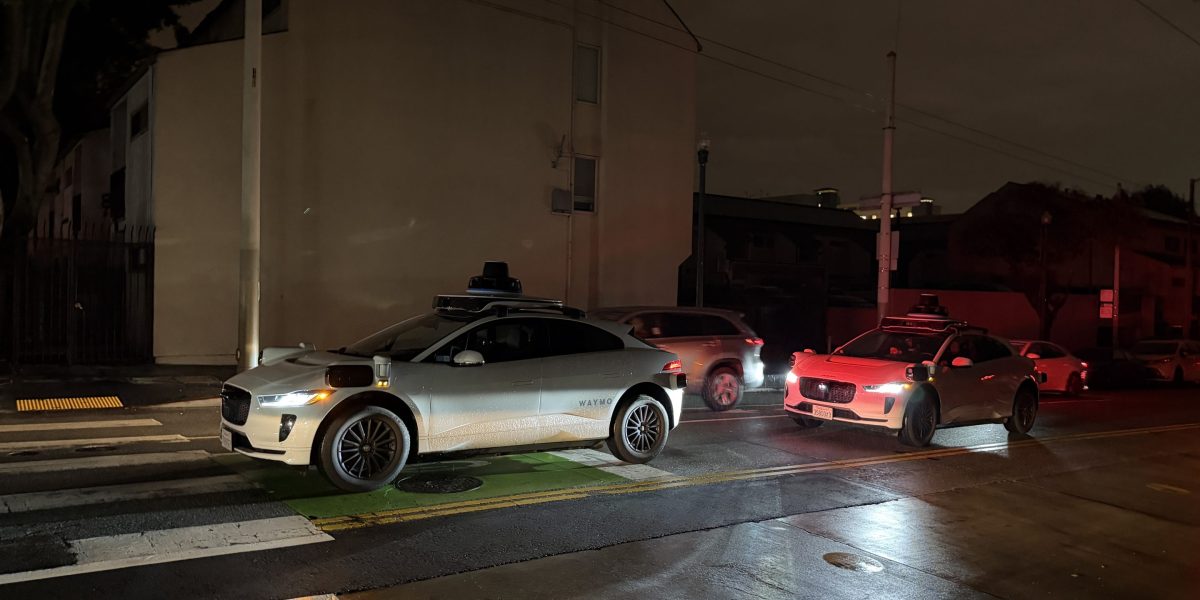
Waymo’s driverless ride services were a high-profile victim of a power outage that affected large swaths of San Francisco, with cars freezing mid-ride across the city and disrupting traffic.

After traffic lights went dark at major intersections Saturday, social media videos showed multiple cars stopped in the middle of the street with their hazard lights flashing.

The power failures, which at one point affected 130,000 customers, closed stores and disrupted transit during the busy holiday shopping period — including many Waymo cars, Alphabet Inc.’s self-driving taxi service. 

Michele Riva, 30, was going home Saturday evening in a Waymo car when the outage happened. His car had kept moving when they were in a less transited area of the city, even with passengers crossing on the street, he said. He was only a minute away from his destination when the car stopped in front of a “very dense intersection” and non-working traffic lights, he said, without giving him any notice.

“I stayed in the Waymo for a couple of minutes, just to see,” said Riva, who is an engineer working in artificial intelligence. “The problem was that, at the beginning, there were a lot of people crossing the streets because there were no traffic lights. So I believe the Waymo just didn’t know what to do.”

PG&E Corp., which blamed the outage on a fire in a substation, began restoring most of the service Saturday evening. By Sunday morning, PG&E said it has restored service for 110,000 customers, but 21,000 remain without electricity. 

Riva tried contacting customer support for about three minutes while he was stuck in the immobile car, but gave up after the wait time became too long as the service was overwhelmed with other passengers’ calls. He decided to get out of the Waymo and walk the couple of blocks left to his home.

On Sunday, the Waymo app showed a notification to some customers saying the service for the Bay Area is paused, affecting at least seven cities.

“Our teams are working diligently and in close coordination with city officials, and we are hopeful to bring our services back online soon,” a Waymo spokesperson said in a statement Sunday.

Riva tried ordering another Waymo ride on Sunday before he saw the message.

“At the end of the day, I know it was an unpleasant situation for the other drivers, but I believe it really was all about safety — I believe it’s better safe than sorry,” Riva said. “I hope they will account for that in the future, because it’s truly a good service.”

Tesla Inc.’s CEO Elon Musk posted on X that his companies’ robotaxis — a direct competitor of Waymo — were “unaffected” by the power outage.


Source link

Continue Reading

Business

Nicki Minaj calls Trump and Vance ‘role models’ for young men at Turning Point USA event

Published

on


The rap star was interviewed at Turning Point USA’s AmericaFest convention by Erika Kirk, the widow of Charlie Kirk, about her newly found support for Trump — someone she had condemned in the past — and about her actions denouncing violence against Christians in Nigeria.

The female rapper’s recent alignment with the Make America Great Again movement has caught some interest because of her past criticism of Trump even when the artist’s own political ideology had been difficult to pin down. But her appearance Sunday at the flagship event for the powerful conservative youth organization may shore up her status as a MAGA acolyte.

Minaj mocked California Gov. Gavin Newsom, referring to him as New-scum, a nickname Trump gave him. Newsom, a Democrat, has 2028 prospects. Minaj expressed admiration for the Republican president and Vance, who received an endorsement from Erika Kirk despite the fact he has not said whether he will run for president. Kirk took over as leader of Turning Point.

“This administration is full of people with heart and soul, and they make me proud of them. Our vice president, he makes me … well, I love both of them,” Minaj said. “Both of them have a very uncanny ability to be someone that you relate to.”

Minaj’s appearance included an awkward moment when, in an attempt to praise Vance’s political skills, she described him as an “assassin.”

She paused, seemingly regretting her word choice, and after Kirk appeared to wipe a tear from one of her eyes, the artist put her hand over her mouth while the crowd murmured.

“If the internet wants to clip it, who cares? I love this woman,” said Erika Kirk, who became a widow when Charlie Kirk was assassinated in September.

Last month, the rapper shared a message posted by Trump on his Truth Social network about potential actions to sanction Nigeria saying the government is failing to rein in the persecution of Christians in the West African country. Experts and residents say the violence that has long plagued Nigeria isn’t so simply explained.

“Reading this made me feel a deep sense of gratitude. We live in a country where we can freely worship God,” Minaj shared on X. She was then invited to speak at a panel at the U.S. mission to the United Nations along with U.S. Ambassador Mike Waltz and faith leaders.

Minaj said she was tired of being “pushed around,” and she said that speaking your mind with different ideas is controversial because “people are no longer using their minds.” Kirk thanked Minaj for being “courageous,” despite the backlash she is receiving from the entertainment industry for expressing support for Trump.

“I didn’t notice,” Minaj said. “We don’t even think about them.” Kirk then said “we don’t have time to. We’re too busy building, right?”

“We’re the cool kids,” Minaj said.

The Trinidadian-born rapper is best known for her hits “Super Freaky Girl,” “Anaconda” and “Starships.” She has been nominated for 12 Grammy Awards over the course of her career.

In 2018, Minaj was one of several celebrities condemning Trump’s zero-tolerance immigration policy that split more than 5,000 children from their families at the Mexico border. Back then, she shared her own story of arriving to the country at 5 years old, describing herself as an “illegal immigrant.”

“This is so scary to me. Please stop this. Can you try to imagine the terror & panic these kids feel right now?” she posted then on Instagram.

On Sunday on stage with Erika Kirk, Minaj said, “it’s OK to change your mind.”


Source link

Continue Reading

Business

OpenAI sees better margins on business sales, report says

Published

on


OpenAI has squeezed better margins out of its paid products this year, as it races to maintain its pole position in artificial intelligence, according to a report in The Information. 

The publication reported that the company improved its “compute margin,” an internal figure measuring the share of revenue after the costs of running models for paying users of its corporate and consumer products. As of October, OpenAI’s compute margins reached 70%, up from 52% at the end of 2024 and double the rate in January 2024, the publication said, citing a person familiar with the figures.  

An OpenAI spokesperson said the company didn’t release the figures and declined to comment further.

Read More: OpenAI Executives Struggle to Combat AI Spending Concerns

The ChatGPT creator set off the modern AI boom, but it has yet to show a profit, one of the main indicators for investors concerned about a bubble in the industry. Last valued at $500 billion in October, OpenAI has been searching for ways to make money to cover its high computing costs and audacious infrastructure plans. 

At the same time, the company is facing intense pressure over its spending and renewed competition. After the Gemini model from Alphabet Inc.’s Google performed better on benchmarks, OpenAI Chief Executive Officer Sam Altman called a “code red” to redirect internal resources to improve ChatGPT, and delayed progress on plans for an advertising service. 

Most people use ChatGPT’s free version. However, the company is pushing its business version and paid software features for industries like financial services and education, where it competes with Google and rival Anthropic.

The Information reported that OpenAI has better compute margins than Anthropic for paid accounts, but that Anthropic has better efficiency on server spending overall.  

OpenAI is also in early talks to raise at least $10 billion from Amazon.com Inc. and use its chips, in a deal that could value Altman’s company at north of $500 billion.

Join us at the Fortune Workplace Innovation Summit May 19–20, 2026, in Atlanta. The next era of workplace innovation is here—and the old playbook is being rewritten. At this exclusive, high-energy event, the world’s most innovative leaders will convene to explore how AI, humanity, and strategy converge to redefine, again, the future of work. Register now.


Source link

Continue Reading

Trending

Copyright © Miami Select.