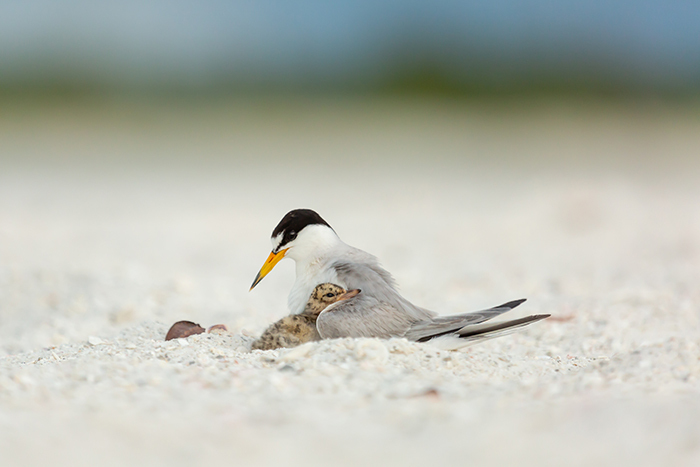
Thousands of Floridians are heading to the coast to celebrate Independence Day, and state wildlife officials want beachgoers to be careful and preserve animal habitats.
The Florida Fish and Wildlife Conservation Commission (FWC) is reminding Sunshine State Fourth of July partiers to be a “beach hero” and watch out for coastal birds and sea turtles at the shoreline. Nesting season is already underway for imperiled shorebirds, seabirds, wading birds and sea turtles throughout Florida coastal areas.
“Anyone spending time along our shorelines can help with nesting success for both sea turtles and waterbirds by giving them space, keeping beaches clean and dark, and leaving personal fireworks at home,” an FWC news release said.
Independence Day will draw even more beachgoers to the coast this year, as an extended Fourth of July Weekend is in store for most Floridians.
Summer is an extension of the critical nesting season that begins in the Spring. Florida’s iconic sea turtles are coming out of the ocean to construct their nests. Some of the most endangered sea turtles and water fowl are at their peak populations along Florida shorelines in the middle of Summer, as Fourth of July draws state residents to the water.
FWC officials have several tips for Floridians to follow in order to avoid disturbing the sensitive wildlife and their habitats. Those tips include:
— Leave fireworks to the professionals. Keep personal fireworks off the beach and attend an official event instead. The loud sounds and bright lights of personal fireworks on Florida’s beaches and waterways can significantly disorient and disrupt nesting sea turtles and shorebirds, as well as their hatchlings and chicks.
— Keep at least 50 feet away from any sea turtles to avoid causing them to leave the beach before completing the nesting process. Give hatchling sea turtles the same space to avoid disrupting their journey from the sand to the water. It is illegal to harm or disturb nesting sea turtles, their nests or eggs, or to pick up hatchlings.
— Walk around any shorebirds and seabirds nesting in shallow, hard-to-see scrapes in the sand. Their tiny eggs and chicks are well camouflaged and difficult to spot. Give beach-nesting birds at least 300 feet of space to avoid causing them to fly off.
— Stay out of posted areas. Whether on the water or on land, be on the lookout for posted shorebird or sea turtle nesting sites and watch for signs designating Critical Wildlife Areason the beach or coastal islands. These areas are closed to public access to protect high concentrations of wading birds and shorebirds while they nest and raise their chicks.

— Before heading home each day, properly dispose of all trash, fill in human-made holes in the sand, and remove all toys and beach furniture from the sand. Obstacles on the beach can entrap sea turtles or prevent them from nesting. Trash and other obstacles can also prevent sea turtle hatchlings from reaching the water when they emerge, and can entangle adult turtles, birds and other wildlife.
— Turn off lights or close curtains after dark in dwellings near the shore to ensure that nesting turtles are not disturbed or disoriented as they come ashore, and that hatchlings do not become disoriented when they emerge from their nests. Any lighting can misdirect and disturb nesting sea turtles and their hatchlings, leading them away from the ocean and toward potential danger.
— Pet owners can also help by keeping pets at home or on a short leash and far away from wildlife when taking them to pet-friendly beaches. Even friendly dogs can be seen as predators to shorebirds, which can cause them to flush and leave their eggs and chicks.
Bipartisan legislation filed this week would expand Florida’s criminal penalties for adults who involve children in acts of animal cruelty or expose them to violent offenses against animals.
Democratic Sen. Kristen Arrington and Republican Rep. Linda Chaney filed the legislation (SB 676, HB 559). The bills would add new crimes to state law that make it a third-degree felony for an adult to entice a minor to commit animal cruelty, or for an adult to commit animal cruelty in the presence of a minor.
The lawmakers cite studies that show children who witness acts of animal cruelty experience an increase in mental health issues, along with an increased likelihood of engaging in violence themselves. By addressing the cycle of abuse early on, they say children can be shielded from additional trauma caused by witnessing violence.
The proposal would also create offenses for adults who involve minors in animal fighting or baiting, and for sexual activities with animals, while also ranking the new crimes on the state’s offense severity chart and increasing penalties for certain felony offenses. If approved, the act would take effect Oct. 1, 2026.
Arrington, of Kissimmee, said the goal is to strengthen protections for both children and animals.
“Exposing children to acts of animal cruelty not only harms animals but has a profound negative impact on children’s emotional development and wellbeing” Arrington said in a statement. “This bill is meant to protect both our youth and our animals, ensuring that those who would involve minors in such heinous acts face strict consequences.”
Chaney, of St. Pete Beach, said animal crimes committed in front of children are closely linked with other forms of family violence.
“Committing animal crimes in front of minors is a serious issue that often co-occurs with other forms of family violence and can have severe, long-term traumatic effects on the children involved” Chaney said. “We must do all we can to break generational cycles of violence. This bill can do that.”
Democratic Rep. Johanna López of Orlando signed on as a prime co-sponsor.
“I’m honored to join Senator Arrington and Representative Chaney in advancing reforms that protect the safety and mental health of our minors and ensure that those who abuse our children or our pets are held accountable,” López said.
U.S. Rep. Vern Buchanan and the full Florida congressional delegation are urging President Donald Trump to keep offshore drilling away from the state’s coastlines, pressing him to maintain a moratorium he put in place in 2020.
Buchanan, co-Chair of the 30-member bipartisan delegation, joined U.S. Sen. Rick Scott and Sen. Ashley Moody in leading a letter asking Trump to uphold his executive order extending a ban on oil and gas leasing off Florida’s Gulf and east coasts through 2032.
“President Trump made the right call in 2020 when he protected Florida from offshore drilling, and we’re asking him to keep those safeguards in place,” Buchanan said. “Florida’s coastline is essential to our tourism-based economy, environment and military readiness. A single mistake offshore could cost our state billions of dollars. We cannot afford to lose even an inch of these critical protections.”
The Florida lawmakers sent the letter in response to a program proposed by the Department of the Interior’s Bureau of Ocean Energy Management, which would open part of the Eastern Gulf of America to new oil and gas drilling. The area overlaps with waters explicitly protected under Trump’s executive order.
In the letter, the delegation expressed strong opposition to any attempts to expand offshore oil and gas drilling off Florida’s coasts to protect “the incredible value Florida’s pristine coasts have to our state’s economy, environment, and military community.” They added that Trump’s 2020 action received overwhelming and bipartisan support.
Lawmakers also warn that the newly proposed leasing area falls inside the Gulf Test Range, a large military training zone used for advanced air and weapons systems testing. They describe the range as a critical national security asset.
“The Gulf Test Range remains an integral part of Department of War training to ensure mission readiness and is supported by multiple military bases in Florida’s Panhandle,” the lawmakers wrote. “Collectively, these bases employ tens of thousands of military and civilian personnel and are of critical importance to national security.”
The area is the largest multidomain military training and testing complex in the country, and the lawmakers stated that “protecting this range from encroachment, including oil exploration, is essential.” The letter says more than 50,000 jobs in the Panhandle depend directly on the military facilities tied to the range.
The delegation cites Eglin Air Force Base as a key example, noting it “supports 20,000 personnel, provides the country with $11 billion in economic impact every year, and currently boasts 123,000 square miles of water range, which would all have to be reduced in an instance of an encroachment of the Gulf Test Range.”
The delegation also points to the economic weight of Florida’s tourism industry, and its vulnerability to fallout from potential oil spills, arguing that the risks outweigh any short-term gains.
“Florida’s beaches alone generate more than $127.7 billion per year in tourism spending and support over 2.1 million tourism-related jobs,” lawmakers wrote. “Unfortunately, all these resources suffered devastating harm during the Deepwater Horizon oil spill of 2010. That disaster wiped billions of dollars from Florida’s industries and caused irreparable damage to our environment and coastal communities.”
“For these reasons, we urge you to uphold your existing moratorium and keep Florida’s coasts off the table for oil and gas leasing,” they added. “Florida’s economy, environment, and military readiness depend on this commitment.”
Every member of the Florida congressional delegation signed the letter, including Buchanan, Scott,Moodyand U.S. Reps. Aaron Bean, Gus Bilirakis, Kat Cammack, Kathy Castor, Sheila Cherfilus-McCormick, Mario Díaz-Balart, Byron Donalds, Neal Dunn, Randy Fine, Lois Frankel, Scott Franklin, Maxwell Frost, Carlos Giménez, Mike Haridopolos, Laurel Lee, Anna Paulina Luna, Brian Mast, Cory Mills, Jared Moskowitz, Jimmy Patronis, John Rutherford, María Elvira Salazar, Darren Soto, Greg Steube, Debbie Wasserman Schultz, Daniel Webster and Frederica Wilson.
As investment executive James Fishback ramps up his campaign for Governor, a review of court filings from this year shows a former employee accused him of starting a relationship with her when she was 17 and later harassing her — allegations he disputes.
In an amended petition for a protection order request filed in January, a woman named Keinah Fort is claiming Fishback “initiated a romantic relationship with (her)” in Spring 2022, while she was 17 and he was 27, and “explicitly directed” her to keep their relationship secret.
She said in the amended April filing that she joined the nonprofit Fishback founded, IncubateDebate, which runs in-person tournaments for middle and high school students, in 2021, when she was 16. Shortly thereafter, she said he “systematically cultivated a relationship with her” by increasing “opportunities for personal interaction.”
The petition described his approach as “an isolation tactic commonly employed in grooming scenarios.”
Fishback, who grew up in Broward County and now lives in Madison County, is the CEO of Azoria, a startup asset management firm he registered with the state in 2023. He is a frequent political commentator and activist but has never held public office.
He told Florida Politics by phone that Fort’s account of when they began dating and the events that preceded and followed their eventual breakup — including her accusations of stalking and cyberbullying — in the since-denied petition are “absolutely false.”
“There was no evidence entered into the record to support that allegation, and I was fully exonerated of any wrongdoing in this case,” he said.
Fort’s allegations remain uncorroborated beyond the statements she submitted in her filings.
Of note, the case centered on whether Fishback behaved in a manner that justified issuing a protective order against him, not whether he had an improper relationship with a minor.
UnderFlorida law, the age of consent is 18, though a 16- or 17-year-old may legally consent to sexual activity with an adult no older than 23. Fort’s petition did not detail the level of her and Fishback’s alleged intimacy while she was underage, and she did not respond to multiple interview requests.
In Spring 2023, after she turned 18, Fishback and Fort moved in together. Her LinkedIn page shows she worked at the time as a Program Director for Incubate Debate, though she’d later rise to Executive Director and “Lead” roles. The petition said Fort still depended financially on Fishback, since Incubate Debate would “sporadically and randomly” pay her.
Their domestic life was hardly tranquil, according to Fort, who said Fishback lost his temper, threw objects across the room and screamed at her “on multiple occasions” and once grabbed Fort by the arm, “leaving visible marks.”
Part of the amended April petition for a protective injunction Keinah Fort filed against James Fishback, her former fiancé, claiming he began a romantic relationship with her while she was still underage. A footnote in the filing states Fort “has reason to believe that she may have been a victim of a crime.” Image via Leon County Clerk.
After that last incident, Fort said Fishback “laughed without remorse and attempted to justify his behavior by stating (she) exaggerated her injuries.” Fort said Fishback also turned his aggression inward “at times,” threatening to hurt himself while pulling on his hair and slapping himself in the face. He blamed her “each time” for such actions, the petition said.
The couple were nevertheless engaged by March 2024, though not for long. They split up that September, but reconciled briefly in December, after which Fort said she “definitively terminated the relationship.” Fishback claims he was the one who called things off.
After that, she said Fishback’s “controlling behaviors escalated into stalking and cyberbullying.” He “repeatedly (contacted) her through emails, voice memos, text messages,” and communications with her family, the petition said. When she turned down his offer to drop off a gift at her Tallahassee home in early January, explaining that her family was over, Fishback allegedly asked, “Are you afraid I’ll hurt you?” and inquired whether her father had a gun before screaming, “I hate you,” at her three times.
Fishback maintains he never threatened Fort — and, notably, none of his many written communications that Fort filed with the court included any threat of physical harm — but he admitted in texts submitted as evidence and affirmed by a sworn digital forensics expert that he was “tough on (her) and (his) words were not OK.”
Evidence Fort submitted also includes hundreds of unanswered texts that Fishback allegedly sent her over several days. It also consists of a text Fort’s father sent chastising Fishback for a “petty and vindictive” X post about the breakup.
On the left, a screenshot of nearly 20 unanswered texts Fishback allegedly sent Fort in quick succession on Jan. 6, weeks before Fort filed her petition for a protection injunction. On the right, a screenshot of texts Fishback allegedly sent Fort’s parents acknowledging his X post, which he said he deleted with a promise not to write about her publicly in the future. He did not honor that promise, based on subsequent social media posts. Image via Leon County Clerk.
According to a filing by Fort, the since-deleted X post read, “I broke off my engagement to an incredible woman for one simple reason: She couldn’t be proud of anything I worked on – big or small.”
He allegedly told Fort’s mother that he would take the post down if Fort contacted him.
Fort returned to work at Incubate Debate a few days later, where she said Fishback continued to make unwanted contact.
By then, the Koch family-funded Bill of Rights Institute had acquired the nonprofit and Fort had assumed many of Fishback’s prior responsibilities there while Fishback stayed on as a contractor. Fishback said control of Incubate Debate has since reverted to him after the acquisition was “dissolved.”
Fort reported him to the company’s Human Resources Department. She said Fishback then “acquired knowledge of the specific information (she) disclosed during the meeting” before immediately and repeatedly calling her.
Fishback then resigned from his contract work, but Fort said he continued contacting her despite several emailed requests — several of which were included in court filings — that he refrain from doing so.
Copies of emails between Fishback and Fort to which multiple Incubate Debate employees were added. Image via Leon County Clerk.
Fort filed a petition for an injunction for protection against stalking and cyberstalking on Jan. 27, just under two weeks after Fishback threatened to take legal action against her if she filed “an untrue restraining order” or made “defamatory public statements” about him in an email he also sent to several Incubate Debate employees.
Judge Joshua Hawkes of the 2nd Judicial Circuit in Tallahassee denied Fort’s petition on June 20. He wrote that Fishback is “perhaps a little obsessive-compulsive, but he did not initiate contact with the petitioner directly and indirectly with no legitimate purpose.”
Hawkes described Fishback as having an “odd nature” that was “apparent during the hearing.”
“The Respondent is greatly concerned first with the business implications of the parties’ breakup, then with the potential HR complaint, and finally with the injunction itself. The Respondent would litigate his version of events with anyone and everyone and as often as possible. He litigated his entire case in response to just about every question during the hearing,” Hawkes wrote. “He is trying to defend himself and protect his business.”
Hawkes said he found neither Fishback nor Fort’s account of who ended the relationship and why credible. He also said Fort failed to sufficiently prove that Fishback’s post-relationship contacts, a not-insignificant portion of which were work-related, were cause for “substantial emotional distress to a reasonable person.”
Hawkes quoted the 2020 case Quinones-Dones v. Mascola, in which Judge Jay Cohen ruled, “Uncivil behavior or annoyance is not sufficient to obtain an injunction.”
A screenshot of a call log Fort filed showing Fishback allegedly called her 45 times in three days. Image via Leon County Clerk.
In a written statement to Florida Politics after the phone interview, Fishback reiterated his assertion that Fort had made false accusations against him as part of a wider trend that is “sadly all too common today.”
The court in Florida’s Second Judicial Circuit reviewed these egregious accusations, conducted two lengthy hearings, and fully exonerated me,” he wrote. “I have never been arrested or charged with any crime, unlike my opponent (Republican U.S. Rep.) Byron Donalds.”
While the case was ongoing, Fishback posted online about Fort. In a March 6 X post, he wrote, “Yesterday would have been my three-month wedding anniversary. I called off my engagement when I realized I couldn’t say, with certainty, that I’d want her raising my children if something happened to me. That moment hit hard.”
The moment in question: Fort telling him she didn’t think it was wrongfor a friend to let her 12-year-old son skip church. “If you don’t see eye to eye on how to raise your children, don’t walk down the aisle,” he wrote. “It’s not fair to anyone: you, her, or your future sons and daughters.”
On March 18, he wrote, “BREAKING NEWS: A District Judge has ordered me to get back together with my ex-fiancé.”
On March 25, he posted photos and a transcript of a praiseful handwritten letter he said Fort wrote to him after their breakup. Comments with the most likes included, “Did she want that to be shared with the internet? Seems kinda personal,” and “Hey James, I really think you should delete this. Some things are best left private.”
Fishback included a snippet of the letter in a June 10 court filing where he claimed Fort had made “numerous attempts to rekindle their relationship” between September and December 2024. He said that before they met, Fort had “long suffered from mental health issues, including engaging in self-harm (cutting) and diagnosed anxiety, which required her to be medicated.”
Fishback’s response to Fort’s allegations painted a picture of a young woman with a history of self-harm who grew vindictive after he called her out for false statements about the company he founded that led to a historic donation. Image via Leon County Clerk.
In October 2024, Fishback said he found Fort in his Washington, D.C., condominium with her left wrist slashed. He also said Fort left him a “fawning voicemail” for his birthday on Jan. 1, which, with four other voicemails he provided to the court, proved Fort “wanted to rekindle their relationship as recently as December 2024.”
Fishback proffered an alternative motive for Fort’s legal action: greed and competitiveness. He said that since the Bill of Rights Institute and Incubate Debate parted ways, with Fort remaining at the Bill of Rights Institute, Fort’s new employer launched its own debate organization in direct competition with Fishback’s nonprofit.
That, he argued, provided Fort “a secondary motive to pursue” the injunction.
Fishback also said Fort published false statements about the success of Incubate Debate while the organization was under her leadership at the Bill of Rights Institute, which led to it receiving an unprecedented “cash donation (that) the donor specifically referencing the false figures.”
He said the Bill of Rights Institute updated its website “at some point” between Jan. 22 and Jan. 24 to fix the figures he said Fort misrepresented so that they “comport with reality.”
Less than a week later, and days after Fort filed her petition, Fishback’s filing said, the Bill of Rights Institute “stripped control of Incubate Debate” from her and returned its control to him.
He said the “last direct contact” he had with Fort was an attempt to return a missed phone call from her on Jan. 21. A screenshot of phone call records Fort submitted to the court shows Fishback called three times.
He said he’s had “zero direct contact” with her since” then.
“Respondent testified he does not wish to speak with or see (Fort) ever again,” the filing said, “but he does wish her well, as far away from him as possible.”
Circuit Judge Joshua Hawkes’ final order on June 20. Image via Leon County Clerk.
Florida Politics contacted Fort and one of her lawyers in the case, Mozianio “Trey” Reliford III, of the Polsinelli law firm, which represents the Bill of Rights Institute. Neither responded to multiple interview requests.
Another of Fort’s lawyers, Nardo Dorsin, has since left Polsinelli and was unavailable for comment by press time.
Fishback launched his campaign for Governor on Nov. 4, pitching himself as an affordability-focused alternative to corporately compromised mainstream GOP candidates. His platform includes ending H-1B visas, which provide legal status to immigrants working in special industries, eliminating property taxes and continuing the “anti-woke” agenda of Gov. Ron DeSantis.
Other Republicans actively competing for the job include Donalds, whom President Donald Trump is backing, and former House Speaker Paul Renner.
Two high-profile Democrats, former U.S. Rep. David Jolly and ex-Orange County Mayor Jerry Demings, are also running.
DeSantis hasn’t yet weighed in on the contest, which Lt. Gov. Jay Collins has hinted at entering.
Florida Politics first flagged Fort’s protection order petition last month in a report that detailed Fishback’s various controversies.
Among them: Fishback’s calls for YouTube to re-platform White nationalist Nick Fuentes and notorious conspiracist Alex Jones and multiple lawsuits brought by Fishback’s former employer, Greenlight Capital, which accuses him of lying about his role with company — he claimed to have been “head of macro,” overseeing $100 million in gains, while Greenlight says he was a low-level research analyst — and attempting to defraud the company into donating to Incubate Debate.
Fishback has also used loaded language to describe Donald, who is Black, as a “DEI Republican” and a “slave” to donors, corporate interests and “tech bros that want to turn our state into, in his own words, a financial capital.”