Connect with us

Business

Frozen jobs data shows recession risks getting ‘uncomfortably high,’ top economist Mark Zandi says

Published

on


The U.S. job market hasn’t collapsed, but is no longer overheating, snapping back, or even cooling in a conventional sense. It’s simply stuck.

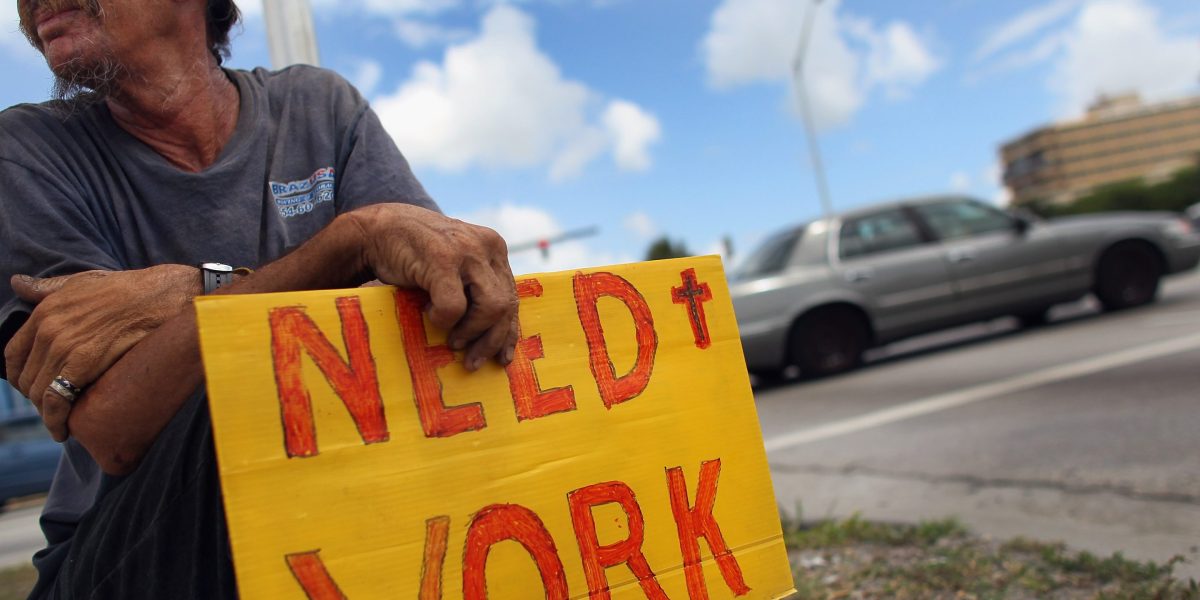
When a delayed jobs report finally dropped Tuesday, economists and investors got their first real look under the hood of the U.S. labor market, and the engine is stalled. Payroll growth was modest in November at 64,000, while October showed a net decline of roughly 105,000 jobs, and the unemployment rate rose to a four-year high of 4.6%. Payroll growth hasn’t collapsed, but it hasn’t meaningfully advanced, either. The result is a labor market that’s drifting sideways, quietly losing momentum beneath the surface.

Economists say that kind of stall is more dangerous than it looks.

“There’s just no forward motion,” Moody’s Analytics chief economist Mark Zandi told Fortune. Job gains bounce slightly from month to month, but net hiring has gone essentially nowhere this year, he said, leaving the labor market “stuck in the mud.”

That stagnation explains why unemployment has continued to rise despite weak labor-force growth. Typically, joblessness climbs when layoffs surge or hiring freezes abruptly. This time, with neither happening, the economy has instead been failing a weaker benchmark, unable to create enough jobs just to absorb even modest population growth.

The dynamic mirrors a warning from analysts at Goldman Sachs, who suggested in October that the U.S. is settling into a phase of “jobless growth” where output rises despite flat hiring. Economists David Mericle and Pierfrancesco Mei wrote that productivity has essentially been doing the job of labor, echoing a prior analysis by Bank of America Research chief U.S. equity analyst Savita Subramanian. As employers increasingly turn to AI to reduce labor costs, this stalled period might turn into a  “a potentially long-lasting headwind to labor demand,” the Goldman economists wrote. 

The unemployment rate has risen by roughly six-tenths of a percentage point since the start of the year, a move that Zandi said carries weight, even if it unfolds gradually.

“You wouldn’t see unemployment rising if labor demand were okay,” Zandi said. “This tells us demand is weak too.”

At the same time, the economy is still growing. Output continues to expand, supported by what Fed Chair Jerome Powell has called “structural productivity gains” and heavy investment in artificial intelligence, which has allowed companies to produce more without adding much headcount. That dynamic has helped keep GDP positive, but it has also masked a labor market that is no longer providing the engine of growth it once did.

One of the clearest signs of that strain appeared beneath the headline payroll numbers. The number of people working part time for economic reasons jumped by nearly 1 million in November, rising to 5.5 million, as more workers reported having their hours cut or being unable to find full-time jobs. 

Businesses are “doing everything they can to avoid laying off workers,” Zandi said, noting that trimming hours and leaning more heavily on part-time or temporary labor is often the first step when demand begins to soften. He cautioned that the size of the increase was likely overstated by data noise related to the recent government shutdown, which disrupted survey collection. Even so, the direction of the decline is consistent with a broader cooling in labor demand.

Private-sector hiring, meanwhile, remains positive but weak. November’s gains offered little reassurance, and upcoming revisions could further soften the picture. Once those adjustments are made, Zandi expects overall job creation to look even closer to flat.

“It’s not hemorrhaging,” he said. “But it’s not creating jobs, either. It’s basically going sideways.”

That kind of stall can be as risky as an outright downturn. Rising unemployment tends to weigh on confidence, and over time that pressure can bleed into consumer spending. 

“The risks of the economy going into recession are uncomfortably high,” Zandi said. 

For now, the economy has avoided that outcome, in part because the AI boom has propped up investment and boosted household wealth through higher stock prices. Harvard economist Jason Furman even recently calculated that without investment into data centers, GDP growth would have been at a near standstill in the first half of 2025. Subtract that, and the economy would have to find another driver or, as Zandi suggests, run the risk of tipping into recession.

“We’re on the edge,” Zandi said. “We haven’t gone over yet. If that boost from AI wanes, then we’ve got a problem.”

“The modest job growth alongside robust GDP growth seen recently is likely to be normal to some degree in the years ahead,” Goldman’s economists also warned in October, speculating that many currently occupied jobs don’t actually need to be filled with human workers and the real toll won’t become apparent until companies get the cover provided by a recession to reduce force en masse. “History also suggests that the full consequences of AI for the labor market might not become apparent until a recession hits.”


Source link

Continue Reading

Business

Government belatedly reveals loss of 105,000 jobs in October as full DOGE cutbacks come into view

Published

on


The United States gained a decent 64,000 jobs in November but lost 105,000 in October as federal workers departed after cutbacks by the Trump administration, the government said in delayed reports.

The unemployment rate rose to 4.6%, highest since 2021.

Both the October and November job creation numbers, released Tuesday by the Labor Department, came in late because of the 43-day federal government shutdown.

The November job gains came in higher than the 40,000 economists had forecast. The October job losses were caused by a 162,000 drop in federal workers, many of whom resigned at the end of fiscal year 2025 on Sept. 30 under pressure from billionaire Elon Musk’s purge of U.S. government payrolls.

Labor Department revisions also knocked 33,000 jobs off August and September payrolls.

Workers’ average hourly earnings rose just 0.1% from October, the smallest gain since August 2023. Compared to a year earlier, pay was up 3.5%, the lowest since May 2021.

Healthcare employers added more than 46,000 jobs in November, accounting for more than two-thirds of the 69,000 private sector jobs created last month. Construction companies added 28,000 jobs. Manufacturing shed jobs for the seventh straight month, losing 5,000 jobs in November.

Hiring has clearly lost momentum, hobbled by uncertainty over President Donald Trump’s tariffs and the lingering effects of the high interest rates the Federal Reserve engineered in 2022 and 2023 to rein in an outburst of inflation.

American companies are mostly holding onto the employees they have. But they’re reluctant to hire new ones as they struggle to assess how to use artificial intelligence and how to adjust to Trump’s unpredictable policies, especially his double-digit taxes on imports from around the world.

The uncertainty leaves jobseekers struggling to find work or even land interviews. Federal Reserve policymakers are divided over whether the labor market needs more help from lower interest rates. Their deliberations are rendered more difficult because official reports on the economy’s health are coming in late and incomplete after a 43-day government shutdown.

Labor Department revisions in September showed that the economy created 911,000 fewer jobs than originally reported in the year that ended in March. That meant that employers added an average of just 71,000 new jobs a month over that period, not the 147,000 first reported. Since March, job creation has fallen farther — to an average 35,000 a month.

The unemployment rate, though still modest by historical standards, has risen since bottoming out at a 54-year low of 3.4% in April 2023.

“The takeaway is that the labor market remains on a relatively soft footing, with employers showing little appetite to hire, but are also reluctant to fire,” Thomas Feltmate, senior economist at TD Economics, wrote in a commentary. “That said, labor demand has cooled more than supply in recent months, which is what’s behind the steady upward drift in the unemployment rate.’’

Adding to the uncertainty is the growing use of artificial intelligence and other technologies that can reduce demand for workers.

“We’ve seen a lot of the businesses that we support are stuck in that stagnant mode: ‘Are we going to hire or are we not? What can we automate? What do we need the human touch with?’’’ said Matt Hobbie, vice president of the staffing firm HealthSkil in Allentown, Pennsylvania.

“We’re in Lehigh Valley, which is a big transportation hub in eastern Pennsylvania. We’ve seen some cooling in the logistics and transportation markets, specifically because we’ve seen automation in those sectors, robotics.’’

Worries about the job market were enough to nudge the Fed into cutting its benchmark interest rate by a quarter of a percentage point last week for the third time this year.

But three Fed officials refused to go along with the move, the most dissents in six years. Some Fed officials are balking at further cuts while inflation remains above the central bank’s 2% target. Two voted to keep the rate unchanged. Stephen Miran, appointed by Trump to the Fed’s governing board in September, voted for a bigger cut – in line with what the president demands.

Tuesday’s report shows that “the labor market remains weak, but the pace of deterioration probably is too slow to spur the (Fed) to ease again in January,” Samuel Tombs, chief U.S. economist at Pantheon Macroeconimics, wrote in a commentary. The Fed holds its next policy meeting Jan. 27-28.

Because of the government shutdown, the Labor Department did not release its jobs reports for September, October and November on time.

It finally put out the September jobs report on Nov. 20, seven weeks late. It published some of the October data – including a count of the jobs created that month by businesses, nonprofits and government agencies – along with the November report Tuesday. But it did not release an unemployment rate for October because it could not calculate the number during the shutdown.


Source link

Continue Reading

Business

Trump has ‘an alcoholic’s personality, chief of staff says in wide-ranging Vanity Fair interview. She calls it a ‘hit piece’

Published

on


Susie Wiles, President Donald Trump’s understated but influential chief of staff, criticized Attorney General Pam Bondi’s handling of the Jeffrey Epstein case and broadly defended the president’s aggressive second administration in a series of interviews published Tuesday in Vanity Fair.

Wiles told the magazine in a wide-ranging, revealing series of conversations that she underestimated the scandal involving Epstein, the disgraced financier, but sharply criticized how Bondi managed the case and the public’s expectations.

After the story was published, Wiles disparaged it as a “disingenuously framed hit piece on me and the finest President, White House staff, and Cabinet in history.”

“Significant context was disregarded and much of what I, and others, said about the team and the President was left out of the story,” she wrote in a social media post. “I assume, after reading it, that this was done to paint an overwhelmingly chaotic and negative narrative about the President and our team.”

Wiles did not deny the comments that were attributed to her.

THIS IS A BREAKING NEWS UPDATE. AP’s earlier story follows below.

WASHINGTON (AP) — Susie Wiles, President Donald Trump’s understated but influential chief of staff, criticized Attorney General Pam Bondi’s handling of the Jeffrey Epstein case and broadly defended the president’s aggressive second administration in a series of interviews published Tuesday in Vanity Fair.

Wiles told the magazine in a wide-ranging, revealing series of conversations that she underestimated the scandal involving Epstein, the disgraced financier, but sharply criticized how Bondi managed the case and the public’s expectations.

She also said Trump wants to keep bombing alleged drug boats in the waters off the coast of Venezuela until that country’s leader, Nicolas Maduro, “cries uncle.”

And Wiles at one point said she and Trump had a “loose agreement” that his retribution campaign would end before the first 90 days of his second term — but it continues well beyond the three-month mark.

Trump tapped Wiles after she managed his winning 2024 campaign. She is the first woman to ever serve as White House chief of staff and is known for shunning the spotlight. It is rare for her to speak as extensively and openly as she did about the president to the magazine, which published its lengthy interview with her — and other members of the White House staff and the Cabinet. Wiles has been speaking to Vanity Fair since just before Trump took office last January.

Asked about Epstein, Wiles said hadn’t really paid attention to “whether all these rich, important men went to that nasty island and did unforgivable things to young girls.”

She said she has read the Epstein file and that Trump is “not in the file doing anything awful.” He and Epstein were friends before they had a falling out.

The Justice Department is facing a Friday deadline to release everything it has on Epstein after Trump, after objecting to the release, signed legislation requiring that the papers be made public.

Wiles criticized Bondi’s handling of the case, going back to earlier in the year when she distributed binders to a group of social media influencers that included no new information about Epstein. That led to even more calls from Trump’s base for the files to be released.

“I think she completely whiffed on appreciating that that was the very targeted group that cared about this,” Wiles said of Bondi. “First she gave them binders full of nothingness. And then she said that the witness list, or the client list, was on her desk. There is no client list, and it sure as hell wasn’t on her desk.”

Wiles, over the series of interviews, described the president behind the scenes very much as he presents himself in public: an intense figure who thinks in broad strokes yet is often not concerned with the details of process and policy. She added, though, that he has not been as angry or temperamental as is often suggested, even as she affirmed his ruthlessness and determination to achieve retribution against those he considers his political enemies.

Trump, she said, has “an alcoholic’s personality,” even though the president does not drink. But the personality trait is something she recognizes from her father, the famous sports broadcaster Pat Summerall.

“High-functioning alcoholics or alcoholics in general, their personalities are exaggerated when they drink. And so I’m a little bit of an expert in big personalities,” she said, adding that Trump has “a view that there’s nothing he can’t do. Nothing, zero, nothing.”

On Venezuela, Wiles said Trump wants to keep the pressure on Maduro.

“He wants to keep on blowing boats up until Maduro cries uncle. And people way smarter than me on that say that he will.” Her comment, though, seemed to contradict the administration’s position that the strikes are about stopping drugs and saving American lives, not regime change.

She said the administration is “very sure we know who we’re blowing up.”

The continued strikes and mounting death toll have drawn scrutiny from Congress, which has pushed back and opened investigations.

Wiles described much of her job as channeling Trump’s energy, whims and desired policy outcomes — including managing his desire for vengeance against his political opponents, anyone he blames for his 2020 electoral defeat and those who pursued criminal cases against him after his first term.

“We have a loose agreement that the score settling will end before the first 90 days are over,” Wiles said early in his administration, telling Vanity Fair that she does try to tamp down Trump’s penchant for retribution.

Later in 2025, she pushed back. “I don’t think he’s on a retribution tour,” she said, arguing he was operating on a different principle: ”‘I don’t want what happened to me to happen to somebody else.’ And so people that have done bad things need to get out of the government. In some cases, it may look like retribution. And there may be an element of that from time to time. Who would blame him? Not me.”

Asked about the prosecution of New York Attorney General Letitia James for mortgage fraud, Wiles allowed: “Well, that might be the one retribution.”

—-

Barrow reported from Atlanta.


Source link

Continue Reading

Business

You can make up to $200K working in Trump’s ‘Tech Force’—and you don’t need a degree or experience

Published

on


The Trump administration has launched an unusual new hiring initiative that marks a sharp departure from traditional government recruitment: the U.S. Tech Force, a program that requires no college degree and no minimum work experience for technology professionals willing to serve two-year stints in federal agencies. And if you get in, you can expect to make anywhere from $150,000 up to $200,000.​

The program, announced by the Office of Personnel Management on Monday, aims to recruit approximately 1,000 engineers, data scientists, and AI specialists to work on what officials describe as critical technology projects across the government. Participants, called “fellows,” will tackle assignments including AI implementation, application development, and data modernization. You can apply right here.

​“This is a clarion call,” Scott Kupor, a former managing partner at storied VC firm Andreessen Horowitz and the current director of the OPM, said in a statement. 

“If you want to help your country lead in the age of rapid technological advancement, we need you,” he continued. “Tech Force offers the chance to build and lead projects of national importance, while creating powerful career opportunities in both public service and the private sector.”

No degree necessary

What sets the Tech Force apart from most federal positions is its accessibility. According to the program’s website, candidates need not hold traditional degrees or meet minimum experience thresholds, though they must demonstrate strong technical skills through work experience, projects, or certifications. According to the Tech Force website’s FAQ section, the only “essential” skills are “strong problem-solving abilities and a passion for public service.”​

The context for this initiative is the Trump administration has been working to rebuild technical capacity after the Department of Government Efficiency (DOGE), led by Tesla CEO Elon Musk at the time, orchestrated the departure of about 260,000 government employees through buyouts, early retirements, or terminations. Among those cuts were technology-focused programs including the entire 18F digital consulting group and substantial portions of the U.S. Digital Service, which President Barack Obama established in 2014 to modernize government tech.

Tech Force fellows will serve two-year appointments at agencies including the departments of Defense, Treasury, State, and Energy, as well as the Internal Revenue Service and Centers for Medicare and Medicaid Services. Annual salaries are expected to range from $150,000 to $200,000, according to the Tech Force website, with most positions classified at the GS-13 and GS-14 levels under federal pay scales.

​Partnering with Silicon Valley

The program has secured partnerships with more than two dozen technology companies including Amazon Web Services, Meta, Microsoft, Apple, Oracle, Palantir, and Elon Musk’s xAI. These companies will provide training and mentorship to participants and have committed to considering Tech Force alumni for employment after their government service concludes. Some companies will also nominate experienced engineering managers to take leaves of absence for the two-year program.

OPM director Kupor says employees from private companies joining the program will become full-time government employees subject to ethics regulations, though they will not be required to divest stock holdings. “We certainly expect, based on all the conversations we’ve had, that the idea is they view this as a career development opportunity for those individuals,” Kupor said of the participating companies.

The program will also partner with the NobleReach Foundation, a nonprofit organization that connects technical talent with public service opportunities. NobleReach has previously placed nearly 50 STEM and business graduates in yearlong roles at federal agencies and state partners.

Applications opened Monday through federal hiring channels, with OPM conducting initial resume screenings and technical assessments before agencies make final hiring decisions. Kupor said his goal is to have the first cohort onboarded by the end of March 2026.

The program represents what OPM described as “unprecedented cross-government coordination” involving the Office of Management and Budget, General Services Administration, White House Office of Science and Technology Policy, and multiple agency leaders. In a statement, U.S. Federal CIO Gregory Barbaccia called Tech Force “America’s elite corps for the AI revolution, mobilizing the nation’s best minds to lead on digital frontlines, defend our global edge and secure our future in technological leadership.”​

Critics have questioned the timing and structure of the initiative. Max Stier, CEO of the Partnership for Public Service, a nonprofit that advocates for federal workers, told Axios “they are establishing a new program that seems to significantly overlap with the previous initiatives undertaken by USDS before this administration disbanded it.” Rob Shriver, former acting OPM director and current managing director at Democracy Forward, told Nextgov his first concern was “what are the rules that are in place to guard against conflicts of interest?” when asked about private-sector employees working on government projects while maintaining their company stock holdings.

The administration has framed the program as essential to maintaining American leadership in artificial intelligence and technology. “President Trump has made clear that securing America’s leadership in AI is the paramount national challenge of this generation,” OPM said in its announcement. The program is described as a key component of the president’s AI Action Plan, which focuses on unleashing private-sector innovation while ensuring the federal government has the technical talent needed for modernization.

For this story, Fortune journalists used generative AI as a research tool. An editor verified the accuracy of the information before publishing. 


Source link

Continue Reading

Trending

Copyright © Miami Select.