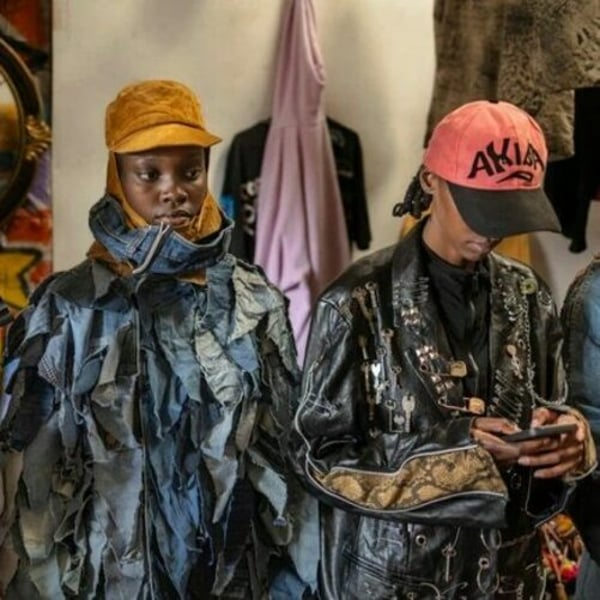
In a dusty alley in the heart of Kenya’s largest open-air market, fashion models strut down a makeshift runway in bold, upcycled outfits made from waste collected at dumpsites and market cast-offs- proof that even trash can dazzle.
Models wearing upcycled creations made from discarded garments – AFP
Every year, thousands of tonnes of used clothes from Europe, the US, and beyond make their way to Kenya. In 2023, Kenya overtook Nigeria to become Africa’s largest importer of second-hand clothing according to a study from the US-based Massachusetts Institute of Technology (MIT).
Thousands of these bales land in Gikomba market near central Nairobi where tin-roofed stalls stretch across a five-acre labyrinth, one of the city’s major economic hubs. On a sunny afternoon last week, a huge crowd gathered to watch models sashay and pivot, showcasing pieces from bales once discarded as unwearable or unsellable.
“What? They’ve upgraded our clothes,” one of the traders said with delight as he watched the show.
Gikomba Runway Edition brought together young, underground Kenyan designers and stylists for the first time, including 25-year-old “upcycling” specialist Morgan Azedy.
“I always see the environment around me dirty… I wanted to control pollution,” he told AFP as he prepared his avant-garde outfits in his single-room home before the show.
His “Kenyan Raw” collection featured streetwear denim and a gothic flair crafted entirely from recycled leather sourced from dumpsites and fashion rejects.
Kenya imported about 197,000 tonnes of second-hand clothes worth $298 million in 2023, according to the MIT study.
The Environment for Development, a global research network, estimates that around a third are unusable items that end up in landfills- mostly made from plastic-based materials like nylon and polyester that does not biodegrade.
Olwande Akoth, a designer showcasing her upcycled kimonos at the fashion show, once traded in second-hand bales but often felt disheartened by their poor quality.
“It’s just garbage… the clothes you can’t even wear, you wouldn’t even give to a beggar,” Akoth said.
The influx of second-hand clothes has employed hundreds of thousands of people across East Africa, from port handlers to traders, and provided a lot of affordable clothing. But it has also made it hard for domestic textile firms to get off the ground.
The East African Community of eight regional countries tried to impose a ban in 2016 in the hope of boosting local textile production.
But it was opposed by recycling lobbyists in the US, and Washington threatened to kick the East African nations out of a lucrative trade deal called the African Growth and Opportunity Act (AGOA) that allowed them to sell products duty-free into the US.
Kenya, Tanzania, Uganda, and others backed down. Only Rwanda held firm and was punished with a suspension from selling clothes under AGOA’s preferential rates. President Donald Trump‘s administration allowed AGOA to expire last month for the whole continent, although talks are under way to revive it.
For Azedy, the downside of the trade deals- mountains of discarded clothes piling up in dumpsites- is a treasure trove for his creative eye. Buying new fabric, he said, is simply “too expensive”.
On the runway, what was once an oversized pair of denim trousers has been transformed into a tiered, layered jacket paired with flared trousers and platform shoes. His drive for “uniqueness” in repurposed pieces earned him a place at Berlin Fashion Week last year.
Having styled several regional musicians with his collection, Azedy now dreams of taking what others consider trash to the grand stages of New York and Paris.
The Calida Group is strengthening its Board of Directors. This move aims to broaden the Board’s expertise in retail and the textile industry and to reinforce the Group’s strategic direction. The focus is on increasing efficiency in product development and brand communications for Calida and Aubade.
Chairman of the Board of Directors Felix Sulzberger regards the strengthening of the Board as a major opportunity to provide fresh impetus. – CALIDA GROUP
With this in mind, the Board of Directors intends to propose to the shareholders of the Swiss lingerie company at the Annual General Meeting on April 15, 2026 the election of Caroline Forster and Nicole Loeb as additional members.
Caroline Forster is an experienced leader and, since 2008, has served as co-CEO of the St. Gallen-based Forster Group, which operates globally. The family-owned company, with around 850 employees, produces embroidery for haute couture, prêt-à-porter, interiors, and lingerie, as well as technical textiles. She brings many years of leadership experience in both operational and strategic roles and has held various board and industry positions since 2007. She was also a member of the Executive Committee of economiesuisse until the end of 2024.
Nicole Loeb is an experienced entrepreneur and a prominent leader in Swiss retail. Since 2005, as delegate of the Board of Directors of Loeb Holding and chair of the Board of Directors of Loeb AG, she has shaped the strategic development of the long-established, independent Swiss retail company headquartered in Bern. She holds a degree in textile business management and is also active in key industry and business organisations, including as a board member of the Swiss Retail Federation and on the regional economic advisory board of the Swiss National Bank.
“I am delighted that, with Caroline Forster and Nicole Loeb, we can propose two renowned and successful entrepreneurs and leaders for election to the Board of Directors. Thanks to their proven experience in the textile industry and retail, they will provide valuable impetus for the strategic development of the Calida Group. I am convinced that, drawing on insights from their own family businesses, they will help shape our Group’s future strategic direction in a lasting way,” said Felix Sulzberger, chairman of the Board of Directors.
This article is an automatic translation. Click here to read the original article.
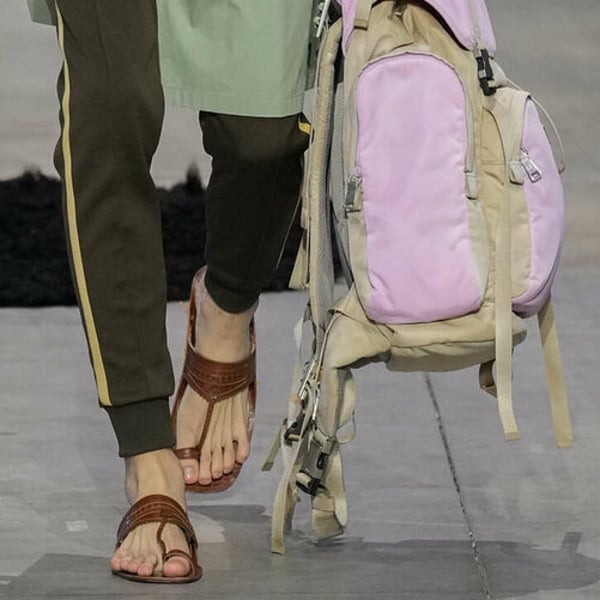
Prada will make a limited-edition collection of sandals in India inspired by the country’s traditional footwear, selling each pair at around 800 euros ($930), Prada senior executive Lorenzo Bertelli told Reuters, turning a backlash over cultural appropriation into a collaboration with Indian artisans.
The Italian luxury group plans to make 2,000 pairs of the sandals in the regions of Maharashtra and Karnataka under a deal with two state-backed bodies, blending local Indian craftsmanship with Italian technology and know-how.
“We’ll mix the original manufacturer’s standard capabilities with our manufacturing techniques,” Bertelli, who is chief marketing officer and head of corporate social responsibility, told Reuters in an interview. The collection will go on sale in February 2026 across 40 Prada stores worldwide and online, the company said. Prada faced criticism six months ago after showing sandals resembling 12th-century Indian footwear, known as Kolhapuri chappals, at a Milan show. Photos went viral, prompting outrage from Indian artisans and politicians. Prada later admitted its design drew from ancient Indian styles and began talks with artisan groups for collaboration.
It has now signed an agreement with Sant Rohidas Leather Industries and Charmakar Development Corporation (LIDCOM) and Dr Babu Jagjivan Ram Leather Industries Development Corporation (LIDKAR), which promote India’s leather heritage. “We want to be a multiplier of awareness for these chappals,” said Bertelli, who is the eldest son of Prada founders Miuccia Prada and Patrizio Bertelli.
A three-year partnership, whose details are still being finalised, will be set up to train local artisans. The initiative will include training programmes in India and opportunities to spend short periods at Prada’s Academy in Italy.
Chappals originated in Maharashtra and Karnataka and are handcrafted by people from marginalised communities. Artisans hope the collaboration will raise incomes, attract younger generations to the trade and preserve heritage threatened by cheap imitations and declining demand.
“Once Prada endorses this craft as a luxury product, definitely the domino effect will work and result in increasing demand for the craft,” said Prerna Deshbhratar, LIDCOM managing director. Bertelli said the project and training programme would cost “several million euros”, adding that artisans would be fairly remunerated.
Bertelli said Prada, which opened its first beauty store in Delhi this year, has no plans for new retail clothing shops next year or factories in India. “We have not planned yet any store openings in India, but it’s something that we are strongly taking into consideration,” he said, adding that this could come in three to five years.
The luxury goods market in India was valued at around $7 billion in 2024 and is expected to reach about $30 billion by 2030, according to Deloitte, as economic growth accelerates to 7% this year and disposable income among the middle and upper classes rises. The market, however, is dwarfed by China, which generated about 350 billion yuan ($49.56 billion) in value in 2024, according to Bain.
Most global brands have entered India through partnerships with large conglomerates like Mukesh Ambani’s Reliance group and Kumar Mangalam Birla’s Aditya Birla Group. Bertelli said that Prada would prefer to enter the country on its own, even if it took longer, describing India as “the real potential new market.”
London-based Save Your Wardrobe (SYW) and France’s Fairly Made are joining forces to deliver what they say will be “Europe’s most advanced end-to-end circularity infrastructure”.
Save Your Wardrobe
SYW operates an AI-powered wardrobe management app while Fairly Made has developed a solution for measuring the environmental impact of products. Now they’ve announced a “strategic partnership designed to help brands meet Europe’s next generation of sustainability expectations”.
They said that “as new regulations reshape how products are designed, managed, and cared for- from eco-design and digital product passports to France’s Bonus Réparation and evolving EPR requirements, brands need a connected view of impact across the full lifecycle. This partnership brings together two complementary strengths that enable exactly that”.
As part of the link-up, SYW “plans to deliver the infrastructure powering aftersales excellence, including diagnostics, repairability scoring, automation, and nationwide repair operations”. Meanwhile, Fairly Made will support this with “upstream capabilities across supply-chain traceability, multi-criteria impact measurement, and digital product passport readiness”.
The plan is that they will offer enterprise brands a “360° circularity solution that supports eco-design, compliance, and measurable lifecycle extension”.
They said their goal is to help brands “move toward a future where circularity is not an ambition, but a connected, measurable, and scalable reality”.






 Politics8 years ago