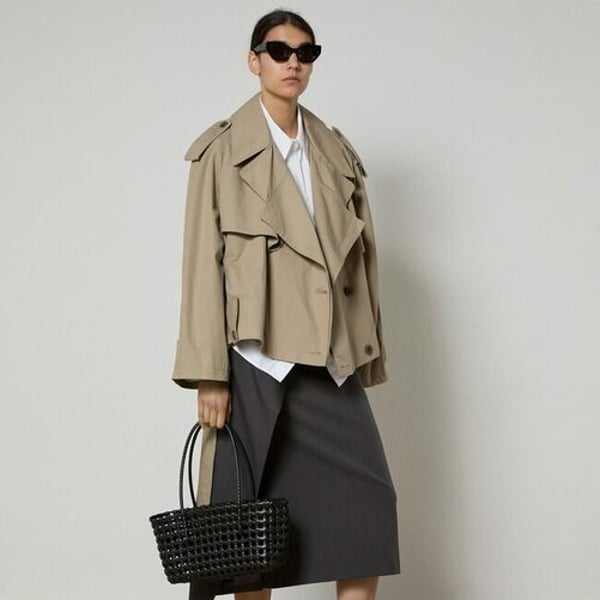
Launched in 2024, La piscine is a Milan-based womenswear label turning heads in the fashion industry. Founded by the duo behind Halfboy, the brand blends clean design, subtle edge, and sharp pricing—quickly catching the attention of major retailers like Harvey Nichols and Le Printemps. Still relatively unknown to the public, La piscine is gaining momentum for its smart, contemporary aesthetic—even amid a global market slowdown.
Spring/summer 2026 look featuring La piscine’s first accessories – La piscine
La piscine unveiled its first Autumn/Winter 2025–2026 capsule in February and instantly landed in over 30 top-tier multi-brand retailers. Buyers from Printemps in Paris, Harvey Nichols in Hong Kong, Beymen in Istanbul, and La Rinascente in Milan snapped up the collection. La Rinascente invited the brand to launch a pop-up store this September. The 60-square-meter space will run for one month on the fourth floor, next to names like Isabel Marant and Zimmermann.
Stylist Alice Moraschini and manager Giovanni Muracchini lead the brand, both as partners in life and business. The duo founded Halfboy in 2019 through their company Golden Eggs. That label, which reimagines masculine tailoring for women and explores experimental denim treatments, quickly took off. In just five years, Halfboy grew from €500,000 to €7 million in annual sales, with 80 international stockists and consistent triple-digit growth—until 2024, when sales increased by only 40%.
“We experienced explosive growth until last winter,” said Muracchini. “But we relied too heavily on department stores and e-commerce. Then the market shifted. Even high-end shoppers started focusing more on price, and that forced us to rethink our approach.”
They restructured their entire supply chain to reduce costs while preserving quality and design. Larger order volumes gave them new bargaining power. They moved production for loungewear, cotton pieces, and sweatshirts to Portugal, cutting prices in that category by 30%. For pieces still made in Italy, they brought prices down by 10 to 15%.
As demand grew in the U.S., the company opened a new American subsidiary. Today, the Milan-based label runs two showrooms—one in Milan, the other in Paris—and employs a team of 20.
Simple silhouettes, elevated by detail – La piscine
From day one, Moraschini and Muracchini built La piscine on the idea of strong design paired with smart pricing. “Halfboy sits at the entry-level of luxury—high-end products, but priced at half or even a third of what major French houses charge,” said Muracchini. “La piscine plays in a smarter contemporary space with a bold, clear identity. The early response proved that we’re hitting a sweet spot in the market. This is exactly what big buyers are looking for right now.”
“I wanted to create a style that feels classic and minimal—but never boring,” added Moraschini. “Each piece includes thoughtful details, a creative spark, and a practical touch. The color palette stays neutral, with subtle pops of color, so everything is easy to mix and match. The collection works for every generation—from daughters to mothers. It’s a flexible wardrobe designed for real life.”
Moraschini named the label after Jacques Deray’s 1969 film “La piscine,” starring Alain Delon, Romy Schneider, and Jane Birkin. Set on the French Riviera, the film captures the very essence the brand reflects—elegant, summery, chic, and effortlessly cool.
The collection mirrors that mood. It blends precise tailoring with relaxed silhouettes. Think oversized blazers with tuxedo-style satin lapels and cinched waists. Grey wool dresses feature lace details and open backs. Flared trench coats offer structure, while casual elements balance the lineup—like fitted fine-knit tops, a reversible button-down shirt, or a sky-blue striped maxi-shirt paired with a matching belt to transform it into a mini dress.
La piscine keeps the lines clean and intentional. One nylon bomber takes on an oval shape. A windbreaker doubles as a shirt. A navy poplin-and-nylon raincoat turns into a dress. The label focuses on detail: a jacket with a sharp back slit; a cropped shirt edged with metallic threads that ripple around the collar; or tailored shorts with a front pleated panel that mimic a miniskirt.
La piscine pairs tailored pieces with casual essentials – La piscine
The team priced each item to strike a balance between quality and accessibility. Jackets range from €350 to €500. Tops go for €120 to €250, shirts from €150 to €300, dresses from €250 to €400, pants from €150 to €300, and trench coats from €290 to €600.
“We built La piscine around price,” said Muracchini. “That ruled out producing in Europe—especially not in Italy, where costs are sky-high for young brands. Prototyping, dyeing, and manufacturing in Italy just aren’t sustainable for us.”
Instead, they looked to South Korea. They relocated all product development, manufacturing, and logistics to Seoul and its surrounding areas.
“South Korea has incredible creative energy. You’ve got a booming retail scene, exciting indie brands, a powerful beauty sector, and cutting-edge digital platforms. That creates a full-circle ecosystem,” said Muracchini. “There’s a network of small workshops and artisans who understand exactly what you want—and deliver it. And yes, their prices for labor and materials are far more competitive.”
“They set trends,” added Moraschini. “Today, South Koreans influence fashion the way the Japanese did a generation ago.”
South Korea’s trade agreements with many countries gave the brand another edge. “If we fully optimize local production, we’ll cut tariffs too,” said Muracchini. “That’s the goal—but let’s be honest, it’s not simple. We’re still a family-run brand… with all the complexity of a multinational.”
This article is an automatic translation. Click here to read the original article.
Iconix’s entire brand portfolio and related royalty revenue will once again be fully consolidated within its operating structure, creating a unified brand platform representing approximately $6 billion in global retail sales.
Iconix to reunite North American brand portfolio. – London Fog
The company announced on Monday that it has completed an upsizing of its existing credit facility with affiliates of Apollo to discharge the company’s securitization financing facility, which has been outstanding since 2012. Iconix expects to complete the transaction by January 2026.
The securitization financing facility was secured by a pledge of North American brand intellectual property and licensing royalties for several of Iconix’s brands, including Ed Hardy, Starter, Danskin, Ocean Pacific, London Fog, Mossimo, Zoo York, Rocawear, and Iconix’s portfolio of home brands.
The retirement of the securitization facility marks a significant milestone in Iconix’s turnaround and resurgence following its take-private transaction in 2021. The company will now be able to pursue strategic alternatives involving the North American rights of its brands, including targeted investments and partnerships that were previously restricted.
“We have always believed that it is extremely important to reunite the North American brand rights under a cohesive operating structure in the US, which is obviously an incredibly influential market for our brands globally,” said Bob Galvin, chief executive officer, Iconix International Inc.
“For the first time in nearly a decade, and since we took over the business with our partners at Lancer Capital, we will have the opportunity to fully exploit all of our brand rights in the most optimal way.”
Since management changes in late 2018, Iconix has executed a significant turnaround, including improving its cost structure, deleveraging its balance sheet, repositioning its global brand portfolio, including acquisitions such as Hoodrich in 2023 and Salt Life in 2024. These efforts have been carried out in partnership with Apollo over the past three years.
“This expanded commitment to Iconix reflects the strong performance of the business and its brands. We’ve worked closely with the management team for several years and are pleased to support this transaction, helping to position Iconix to fully leverage its unified global brand platform,” added Kurt Hoffman, managing director, Apollo.
Japanese footwear and sportswear brand Onitsuka Tiger is entering the fragrance world with its first collection of four scents, simply named ‘One,’ ‘Two,’ ‘Three,’ and ‘Four.’
Onitsuka Tiger “One”
Named ‘Wearing Quiet Radiance,’ the eau de parfum line symbolises the beauty of contrast and was conceived by world-renowned perfumer Mark Buxton. The fragrances draw inspiration from the fusion of tradition and modern innovation, combining craftsmanship with contemporary design- elements that have defined Onitsuka Tiger’s heritage, according to a statement.
The entire process of creating the fragrance line, from the selection and extraction of materials to blending and bottling, takes place exclusively in Grasse, in Provence, the world’s perfume capital.
The four fragrances, designed to evoke a sense of stillness that allows one to reconnect with one’s essence, are encased in elegant, bright-yellow bottles that reflect the brand’s distinctive colour, and are available in Onitsuka Tiger stores and on the Japanese brand’s official website.
Onitsuka Tiger One is built around green and mint notes, followed by lemon and mandarin. White florals and jasmine form the heart, while patchouli, leather, and guaiac wood add depth and resonance to the fragrance. Onitsuka Tiger Two opens with bergamot and lemon, joined by geranium and frankincense. Finally, velvety musk and sandalwood envelop the skin.
Onitsuka Tiger Three showcases the spicy, citrus nuances of angelica, followed by violet and marine notes. Smoky and spicy nuances then gently unfurl. In Onitsuka Tiger Four, peppermint and bergamot make an immediate impression, while absinthe and nutmeg add a bold accent. As the fragrance evolves, vanilla and vetiver add depth, and the scent ends with the crystalline clarity of citrus notes.
Founded in Kobe in 1949 by Kihachiro Onitsuka, the Japanese label originally produced only basketball shoes before becoming a lifestyle brand within the Asics group following a 1977 merger.
Europe is gaining momentum in Onitsuka Tiger’s business, as is the US, but the brand continues to rely mainly on its Asian operations, particularly in China and Japan. According to company president Ryoji Shoda, the brand generated revenue of 120 billion yen last year (705 million euros), almost double the figure from six years ago, with sales of its heritage range still accounting for the bulk of its revenue and generating substantial profitability.
This article is an automatic translation. Click here to read the original article.
Pandora has brought its leadership transition forward to January. The Danish jewellery brand announced on Monday that the Spanish executive Berta de Pablos-Barbier, until now the company’s chief marketing officer, will assume the role of CEO on January 1, taking over from Alexander Lacik. The company announced this change in leadership in September and it had initially been scheduled for completion in March, at its annual general meeting.
Berta de Pablos-Barbier will take over as CEO of Pandora on 1 January 2026. – Pandora
Pandora has opted to accelerate this transition thanks to “a smooth handover by the current CEO, Alexander Lacik, and the appointment of Jennie Farmer as the new chief marketing officer,” the jewellery brand said in a statement.
In this regard, the chairman of Pandora’s board of directors, Peter Ruzicka, commented: “The handover from Alexander to Berta has been exceptionally smooth. With the addition of Jennie Farmer as CMO, we are pleased to be able to carry out the leadership transition faster than anticipated.”
The Spanish executive Pablos-Barbier, for her part, said it would be “an honour” to lead Pandora in its next stage.
“In recent years we have consolidated a strong brand with a unique position in the accessible jewellery market. My immediate priority will be to navigate the current market turbulence as we prepare to take advantage of our untapped opportunities as a comprehensive jewellery brand and drive long-term growth. We are building a bigger Pandora,” she added.
The current CEO, Lacik, will retire after nearly seven years as chief executive and president of the brand, although he will remain with Pandora as a special adviser to the board of directors and the executive committee until the company’s annual general meeting, which will be held on March 11 next year.
On Lacik’s contribution, Ruzicka thanked him for “his exceptional leadership.”
“Since his arrival, Pandora’s revenue has grown by 45% and total shareholder return has exceeded 200%. He leaves the company with a solid foundation and significant growth potential,” he concluded.
Starting next year, Jennie Farmer will replace Pablos-Barbier as chief marketing officer. Currently senior vice-president of brand experience and channels, she joined Pandora in January 2025 and has more than 25 years of experience with luxury and FMCG brands, from Procter & Gamble to LVMH.
“Pandora is an iconic brand with a track record of redefining the jewellery industry. I look forward to building on the strong direction set by Berta and driving bold, creative marketing that connects with consumers across all our segments and channels,” she said.