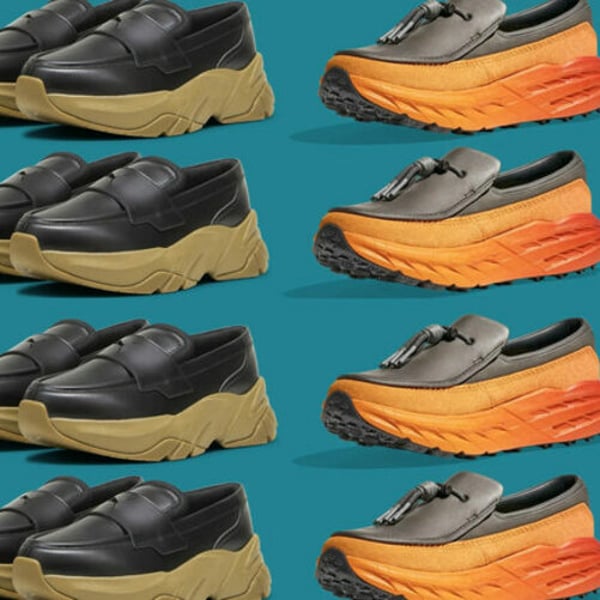
In the world of fashion hybrids, there are skorts (shorts that look like skirts), jeggings (leggings made of stretch denim), and shackets (shirt-jackets). The latest style mash-up: snoafers.
Puma Sophyr loafers and Hoka Speed Loafers continue to sell out quickly. – Illustration: 731 | Source: Puma and Hoka
One of the biggest trends in footwear combines the cushioned sole of a sneaker with the upper of a loafer, for a comfortable business-casual shoe that is meant to be worn anywhere. Although their divisive appearance initially generated backlash, snoafers have emerged as a viral breakout category for major sneaker brands including New Balance, Hoka, and Puma, selling out quickly and landing on online marketplaces at wildly inflated prices since last year.
Joining the trend late is Nike, which recently introduced its Air Max Phenomena, created through the company’s Serena Williams Design Crew apprenticeship program. Prior to its release last week, the $155 snoafer was listed on StockX for as much as $500, fueling buzz for the sportswear giant after a year-long sales slump.
In a $457 billion global footwear market loaded with sneakers, “customers are looking for something different,” said Drew Haines, senior marketplace director at resale marketplace StockX, which has seen an influx of shoppers vying for the latest snoafers.
Sneaker enthusiasts appear more receptive to unconventional silhouettes being developed by a wider array of brands, he said—an encouraging sign for footwear designers eager to experiment and differentiate themselves in an increasingly saturated market. When trends in fashion arise, they often have short lifespans—something amplified by a social media-driven culture—forcing companies to continuously innovate to stay relevant.
“I do think brands are going to start to take some of these risks… to produce and release products that are outside of the traditional scope,” Haines said. “Whenever they do that, it seems to really resonate.”
New Balance began selling its snoafer, the 1906L, in September and is credited with popularizing the silhouette.
“We’ve been blown away by how the 1906L has been embraced—not just by sneaker fans, but by a broader audience,” said Charlotte Lee, a New Balance design manager. “It’s opened up a new design space for us, and we’re definitely planning to explore that further.”
That includes new colors and materials expected to be released soon. New Balance did not provide sales figures, but the shoes quickly sold out online in the U.S., and Lee said demand has remained strong beyond the initial drop.
“We wanted to challenge the perception of loafers,” she said. By fusing the performance of a sneaker with the “dressier” look of formal footwear, the 1906L is “a product that fits how people actually live and move.”
Hoka, known for its running shoes, is currently sold out of its all-gender Speed Loafer, which retails for $185. Puma debuted its Sophyr loafer last year and is still sold out in multiple sizes.
Nike-owned Converse is also getting in the game, unveiling its All-Star Coinloafer in the U.S. in June. Different shoe variations have been offered in Japan as early as 2022, according to Women’s Wear Daily.
The hype hasn’t let up: Online searches for New Balance’s 1906L have increased 3,700% on StockX since last year’s first quarter—months before its release.
Kelly Baartman, 27, bought a pair of Rich Oak 1906Ls from a shoe store called Archive in June and said she loves the hybrid versatility of the shoes.
“I love wearing a sneaker and I love wearing a loafer,” said the content creator from South Africa. “To see that concept come together, just based on my personal style, I was like, ‘Oh, this is literally perfect.’”
Angel Edme, a content creator from Brooklyn, said she enjoys it when brands take creative risks.
“It was something different,” she said of her 1906Ls, which she wears to run errands and attend creator events. “It felt fresh and playful—something I could experiment with and style in new ways.”
Even big apparel companies are taking note.
“The loafer is 100% making a comeback in every single form,” said Mark Breitbard, president and chief executive officer of the Gap brand, in an interview with Bloomberg. He said Gap takes into account what shoe styles are trending when the company designs its jeans, to ensure its clothes complement what shoppers are wearing on their feet.
Dancing in the Clouds: the 2026 colour designated by the Pantone Color Institute is Pantone 11-4201 Cloud Dancer: “A neutral shade of white that fosters calm, clarity, and a creative breathing space in a world full of noise.”
Pantone 2026
Pantone’s website crashed as the countdown ended, while the announcement on social media showed a woman dressed in white, gazing dreamily at a cloud-filled sky.
Since 1999, beginning with Cerulean Blue, Pantone’s global experts have been naming the Color of the Year, the shade they believe will become prevalent across fashion, food, design, and entertainment; in 2026, that mantle falls to Cloud Dancer.
Cloud Dancer is a blank canvas on which to begin anew, explained Leatrice Eiseman, executive director of the Pantone Color Institute: “An invitation to open new paths and new ways of thinking.”
The mood is clearly one of serenity and an invitation to open new chapters; the election in New York of the young mayor Zohran Mamdani could be an example of this new philosophy. And yet, given the recent political climate in the US under Donald Trump, some, such as New York Times fashion editor Vanessa Friedman, have raised the possibility of MAGA and anti-DEI instrumentalisation, since the white of 2026 has ‘wiped out’ the 2025 colour, Mocha Mousse, a light brown between cappuccino and chocolate.
“Skin tones did not influence this at all,” Laurie Pressman, president of the Pantone Institute, was quick to point out, noting that Pantone has already received similar questions about other recent choices. “With Peach Fuzz in 2024 and then with Mocha Mousse 2025, we were asked whether the choice had anything to do with race or ethnicity. That’s not how it works. We try to understand what people are looking for and which colour can hopefully provide an answer.” And so Pressman invites us to look beyond metaphors: “It’s a softer white,” she said, describing the hue. “It isn’t a pure white, it isn’t a technical white, it isn’t that optically very bright white that, if we think back to the post-Covid period, people were seeking. This is deliberately an unbleached white, a very natural-looking white.”
Meanwhile, the launch of Cloud Dancer has attracted a host of brands eager to keep pace: Hasbro’s Play-Doh has created a tub of Play-Doh in this hue, while Post-it has released pads in the same shade as part of its Neutrality Collection; and the Mandarin Oriental luxury hotel chain will centre its afternoon tea and spa experiences on this minimalist colour. Spotify has also come on board, in its first collaboration with Pantone, creating a multisensory experience that translates “the emotion of colour” into sound through personalised playlists.
This article is an automatic translation. Click here to read the original article.
This is encouraging news for the European outdoor industry. On November 25, Australian biotechnology company Samsara Eco and the European Outdoor Group (EOG) launched the Nylon Materials Collective, a collaboration designed to make high-performance recycled nylon more accessible to outdoor brands. The initiative forms part of a broader drive to accelerate the sector’s transition to a circular textile economy.
Samsara Eco and EOG launch a collective to pool orders for recycled nylon – Samsara Eco
The Nylon Materials Collective is open to all EOG members and will be officially launched ahead of ISPO Munich 2025, where Samsara Eco will showcase its recycled nylon samples. But why did the EOG choose Samsara Eco? Founded in 2021, the Australian company specialises in recycling nylon 6,6 and polyester using enzymatic technologies- a strategy that has set it apart from direct competitors such as Matter, Recycling Technologies and ReCircle.
A collective of small and medium-sized enterprises
The high-performance recycled nylon produced by Samsara Eco is indistinguishable from virgin nylon, a material highly prized by outdoor brands. Despite their environmental ambitions, small and medium-sized players in the outdoor sector still find recycled nylon hard to access. That is why the EOG has joined forces with Samsara Eco: the Nylon Materials Collective is a collaborative demand-aggregation system that enables brands to participate collectively and access recycled materials.
The EOG represents more than 150 European brands – Gore-Tex
And to keep the collective running smoothly, participating companies must share “similar performance requirements, supply chain partners, and material specifications,” in the words of both parties.
Preparing for future regulations
“We want to do everything we can to help more brands access our materials so we can all reap the benefits of the circular economy,” said Sarah Cook, Samsara Eco’s commercial director. “The Nylon Materials Collective will make it easier for outdoor brands of all sizes to access and integrate recycled materials that are identical to the virgin material into future product ranges, whether they have more modest material needs or typically purchase at the fabric level,” she added.
Samsara Eco’s recycled nylon is identical to virgin nylon – Maloja
This partnership also helps brands strengthen their position ahead of forthcoming European regulations on the circular economy, concerning “extended producer responsibility and minimum recycled content obligations.”
Focus on circular materials
Katy Stevens, CSR and Sustainability Manager at the EOG, says: “The Nylon Materials Collective represents an opportunity for our members to work together with innovators like Samsara Eco to facilitate access to recycled nylon and accelerate the industry’s transition to circular materials.”
Samsara Eco uses enzymatic technologies to recycle nylon and polyester – Samsara Eco
For the European Outdoor Group, which represents around 150 brands, retailers, associations, and organisations along the value chain, this partnership is a concrete step to support the sector in its activities, so that it can “give more than it receives”.
This article is an automatic translation. Click here to read the original article.
Gant has a new CEO as of this month. The Swedish-but-with-American-roots brand has named Fredrik Malm as its chief executive, effective December 1.
Gant CEO Fredrik Malm
It’s an internal appointment with Malm having joined Gant in 2024 as EVP Commercial, Brand & Product. He succeeds Patrik Söderström, who’d led the company for six years.
Before joining the firm, Malm was CEO of SNS, and had been president Europe & International at Coach, as well as president of sales EMEA at Ralph Lauren, and retail director at ECCO.
Gant has been owned by privately-owned Swiss business MF Brands Group (which also owns Lacoste, Tecnifibre and Aigle) since 2008. And MF’s CEO Thierry Guibert said of Gant’s new leader: “Fredrik has brought valuable and extensive leadership experience from global premium fashion and lifestyle brands.
“I have full confidence in his ability to support Gant in its next phase of development, which will notably involve the continued elevation of the collections and an accelerated retailisation across both physical and digital channels.
“I would also like to deeply thank Patrik Söderström for his commitment alongside us over the past 10 years. He has played a pivotal role in transforming and elevating the brand while delivering strong financial performances over the years.”
Gant has been expanding this year, and in late May it reopened its Regent Street, London flagship. It said the refurbishment of the 6,300 sq m space “represents a key milestone in the brand’s global retail investments in the UK and worldwide”. Söderström said at the time that the reopening “kicks off a global initiative to elevate our retail experience”.
The company has also been focusing on its licenses and in June announced the early renewal of its exclusive licensing deal for the design, manufacture, and global distribution of its eyewear with Marcolin.