Connect with us

Business

French tourists didn’t believe the young guy on the subway was New York City’s new mayor, so he held up the newspaper to prove it

Published

on


Less than 24 hours after throngs of ecstatic supporters poured into Manhattan for his history-making inauguration, Zohran Mamdani began his first full day of work with a routine familiar to many New Yorkers: trudging to the subway from a cramped apartment.

Bundled against the frigid temperature and seemingly fighting off a cold, he set out Friday morning from the one-bedroom apartment in Queens that he shares with his wife. But unlike most commuters, Mamdani’s trip was documented by a photo and video crew, and periodically interrupted by neighbors wishing him luck.

The 34-year-old democratic socialist, whose victory was hailed as a watershed moment for the progressive movement, has now begun the task of running the nation’s largest city: signing orders, announcing appointments, facing questions from the press — and answering for some of the actions he took in his first hours.

But first, the symbolism-laden day one commute.

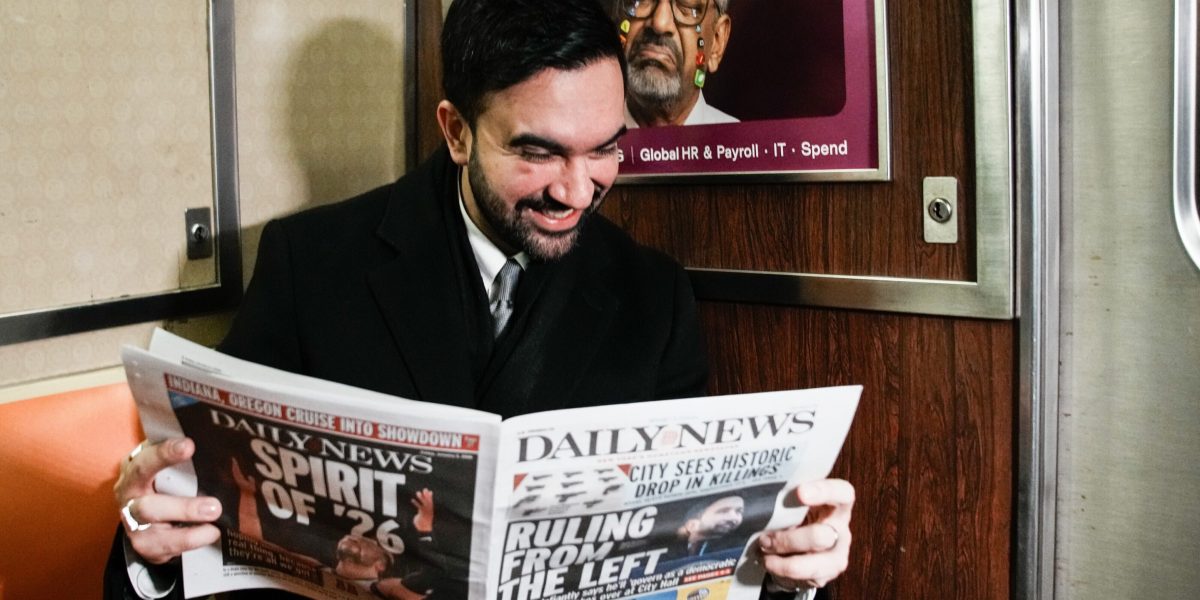
Flanked by security guards and a small clutch of aides on a Manhattan-bound train, he agreed to several selfies with wide-eyed riders, then moved to a corner seat of the train to review his briefing materials.

When a pair of French tourists, confused by the hubbub, approached Mamdani, he introduced himself as “the new mayor of New York.” They seemed doubtful. He held up the morning’s copy of the New York Daily News, featuring his smiling face, as proof.

Mamdani, a Democrat, is hardly alone among city mayors in using the transit system to communicate relatability. His predecessor, Eric Adams, also rode the subway on his first day, and both Bill de Blasio and Michael Bloomberg made a habit out of it, particularly when seeking to make a political point.

Within minutes of Mamdani entering City Hall, the images of him riding public transit had lit up social media.

If the ride served as a well-timed photo-op, it also seemed to reflect Mamdani’s pledge, made in his inaugural speech, to ensure his “government looks and lives like the people it represents.”

His other early actions have also seemed to underscore that priority.

After centering much of his campaign on making rent cheaper for New Yorkers, Mamdani raced from his inauguration ceremony Thursday to a Brooklyn apartment building lobby, drawing boisterous cheers from the tenants union as he pledged that the city would ramp up an ongoing legal fight against the allegedly negligent landlord.

Mamdani’s next action, meanwhile, showed the unusual scrutiny faced by his nascent administration, particularly around his criticism of Israel and outspoken support for the Palestinian cause.

In an effort to give his government a “clean slate,” he revoked a slate of executive orders issued by Adams late in his term, including two related to Israel: one that officially adopted a contentious definition of antisemitism that includes certain criticism of Israel, and another barring city agencies and employees from boycotting or divesting from the country.

The move drew swift backlash from some Jewish groups, including allegations from the Israeli government posted to social media that Mamdani had poured “antisemitic gasoline on an open fire.”

When a journalist on Friday asked about the revoked orders, Mamdani read from prepared remarks, promising his administration would be “relentless in its effort to combat hate and division.” He noted that he had left in place the Mayor’s Office to Combat Antisemitism.

Mamdani also announced the creation of a “mass engagement” office, which he said would continue the work his campaign’s field operation did to bring more New Yorkers into the political fold.

Ringed by supporters and passersby who stood several rows deep, phones in the air, to catch a glimpse of the new mayor, Mamdani then acknowledged the weight of the current moment.

“We have an opportunity where New Yorkers are allowing themselves to believe in the possibility of city government once again,” he said. “That is not a belief that will sustain itself in the absence of action.”

Also on Mamdani’s to-do list: Moving to the mayor’s official residence, a stately mansion in the Upper East Side neighborhood of Manhattan, before the lease on his Queens apartment ends later this month.

___

Associated Press writer Jennifer Peltz contributed to this report.


Source link

Continue Reading

Business

The ‘Holy Grail of comic books’ once owned by Nicolas Cage sells at auction for a record $15 million

Published

on


A rare copy of the comic book that introduced the world to Superman and also was once stolen from the home of actor Nicolas Cage has been sold for a record $15 million.

The private deal for “Action Comics No. 1” was announced Friday. It eclipses the previous record price for a comic book, set last November when a copy of “Superman No. 1″ was at sold at auction for $9.12 million.

The Action Comics sale was negotiated by Manhattan-based Metropolis Collectibles/Comic Connect, which said the comic book’s owner and the buyer wished to remain anonymous.

The comic — which sold for 10 cents when it came out in 1938 — was an anthology of tales about mostly now little-known characters. But over a few panels, it told the origin story of Superman’s birth on a dying planet, his journey to Earth and his decision as an adult to “turn his titanic strength into channels that would benefit mankind.”

Its publication marked the beginning of the superhero genre. About 100 copies of Action Comics No. 1 are known to exist, according to Metropolis Collectibles/Comic Connect President Vincent Zurzolo.

“This is among the Holy Grail of comic books. Without Superman and his popularity, there would be no Batman or other superhero comic book legends,” Zurzolo said. “It’s importance in the comic book community shows with his deal, as it obliterates the previous record,” Zurzolo said.

The comic book was stolen from Cage’s Los Angeles home in 2000 but was recovered in 2011 when it was found by a man who had purchased the contents of an old storage locker in southern California. It eventually was returned to Cage, who had bought it in 1996 for $150,000. Six months after it was returned to him, he sold it at auction for $2.2 million.

Stephen Fishler, CEO of Metropolis Collectibles/Comic Connect, said the theft eventually played a big role in boosting the comic’s value.

“During that 11-year period (it was missing), it skyrocketed in value.,” Fishler said “The thief made Nicolas Cage a lot of money by stealing it.”

Fishler compared it to the theft of Mona Lisa, which was stolen from the Louvre museum in Paris in 1911.

“It was kept under the thief’s bed for two years,” Fishler noted. “The recovery of the painting made the Mona Lisa go from being just a great Da Vinci painting to a world icon — and that’s what Action No. 1 is — an icon of American pop culture.”


Source link

Continue Reading

Business

Trump order says Venezuelan oil money is being held by US for ‘governmental and diplomatic purposes’

Published

on


President Donald Trump’s new executive order on Venezuelan oil revenue is meant to ensure that the money remains protected from being used in judicial proceedings.

The executive order, made public on Saturday, says that if the funds were to be seized for such use, it could “undermine critical U.S. efforts to ensure economic and political stability in Venezuela.”

The order comes amid caution from top oil company executives that the tumult and instability in Venezuela could make the country less attractive for private investment and rebuilding.

“If we look at the commercial constructs and frameworks in place today in Venezuela, today it’s uninvestable,” said Darren Woods, CEO of ExxonMobil, the largest U.S. oil company, during a meeting convened by Trump with oil executives on Friday.

During the session, Trump tried to assuage the concerns of the oil companies and said the executives would be dealing directly with the U.S., rather than the Venezuelan government.

Venezuela has a history of state asset seizures, ongoing U.S. sanctions and decades of political uncertainty.

Getting U.S. oil companies to invest in Venezuela and help rebuild the country’s infrastructure is a top priority of the Trump administration after the dramatic capture of now-deposed leader Nicolás Maduro.

The White House is framing the effort to “run” Venezuela in economic terms, and Trump has seized tankers carrying Venezuelan oil, has said the U.S. is taking over the sales of 30 million to 50 million barrels of previously sanctioned Venezuelan crude, and plans to control sales worldwide indefinitely.

“I love the Venezuelan people, and am already making Venezuela rich and safe again,” Trump, who is currently in southern Florida, wrote on his social media site on Saturday. “Congratulations and thank you to all of those people who are making this possible!!!”

The order says the oil revenue is property of Venezuela that is being held by the United States for “governmental and diplomatic purposes” and not subject to private claims.

Its legal underpinnings are the National Emergencies Act and the International Emergency Economic Powers Act. Trump, in the order, says the possibility that the oil revenues could be caught up in judicial proceedings constitutes an “unusual and extraordinary threat” to the U.S.


Source link

Continue Reading

Business

As U.S. debt soars past $38 trillion, corporate bond flood is a growing threat to Treasury supply

Published

on


As the Treasury Department looks to ensure investors continue absorbing the fresh supply of debt it must sell, growing competition from companies issuing their own bonds could send rates higher, according to Apollo Chief Economist Torsten Slok.

In a note on Saturday, he pointed out that Wall Street estimates for the volume of investment grade debt that’s on the way this year reach as high as $2.25 trillion.

That’s as the AI boom increasingly sends companies, including hyperscalers and adjacent firms, to the bond market to fund massive investments in data centers and other infrastructure.

“The significant increase in hyperscaler issuance raises questions about who will be the marginal buyer of IG paper,” Slok said. “Will it come from Treasury purchases and hence put upward pressure on the level of rates? Or might it come from mortgage purchases, putting upward pressure on mortgage spreads?”

With U.S. debt topping $38 trillion, the federal government has already borrowed $601 billion in the first three months of the 2026 fiscal year, which began in October 2025, according to the latest data from the Congressional Budget Office.

That’s $110 billion less than the deficit during the same period a year earlier as tariffs helped revenue outpace spending. But the Supreme Court could strike down President Donald Trump’s global tariffs soon, and this year’s tax season should see a surge of refunds to account for new tax cuts under the One Big Beautiful Bill Act.

Meanwhile, Trump has vowed to boost defense spending to $1.5 trillion a year from $1 trillion, threatening to further deepen federal budget deficits.

And despite the Federal Reserve’s series of rate cuts this past autumn, Treasury yields remain about where they were in early September, suggesting the government will not see much relief on debt-servicing costs that are also contributing to the overall tally of red ink.

“The bottom line is that the volume of fixed-income products coming to market this year is significant and is likely to put upward pressure on rates and credit spreads as we go through 2026,” Slok said.

Apollo

To make sure there’s sufficient demand among bond investors, Treasury yields must remain attractive relative to the competition. Failure to draw enough investors raises the risk of so-called fiscal dominance, or when a central bank must step into to finance widening deficits.

That’s what former Treasury Secretary Janet Yellen warned of last weekend, during a panel hosted by the American Economic Association.

“The preconditions for fiscal dominance are clearly strengthening,” she said, noting debt is on a steep upward trajectory toward 150% of GDP over the next three decades.

At the same time, he holders of U.S. debt have shifted drastically over the past decade, tilting more toward profit-driven private investors and away from foreign governments that are less sensitive to prices.

That threatens to turn the U.S. financial system more fragile in times of market stress, according to Geng Ngarmboonanant, a managing director at JPMorgan and former deputy chief of staff to Yellen during her tenure at Treasury.

Foreign governments accounted for more than 40% of Treasury bond holdings in the early 2010s, up from just over 10% in the mid-1990s, he wrote in a New York Times op-ed last month. This reliable bloc of investors allowed the U.S. to borrow vast sums at artificially low rates.

“Those easy times are over,” he warned. “Foreign governments now make up less than 15% of the overall Treasury market.”


Source link

Continue Reading

Trending

Copyright © Miami Select.