Connect with us

Business

French tourists didn’t believe the young guy on the subway was New York City’s new mayor, so he held up the newspaper to prove it

Published

on


Less than 24 hours after throngs of ecstatic supporters poured into Manhattan for his history-making inauguration, Zohran Mamdani began his first full day of work with a routine familiar to many New Yorkers: trudging to the subway from a cramped apartment.

Bundled against the frigid temperature and seemingly fighting off a cold, he set out Friday morning from the one-bedroom apartment in Queens that he shares with his wife. But unlike most commuters, Mamdani’s trip was documented by a photo and video crew, and periodically interrupted by neighbors wishing him luck.

The 34-year-old democratic socialist, whose victory was hailed as a watershed moment for the progressive movement, has now begun the task of running the nation’s largest city: signing orders, announcing appointments, facing questions from the press — and answering for some of the actions he took in his first hours.

But first, the symbolism-laden day one commute.

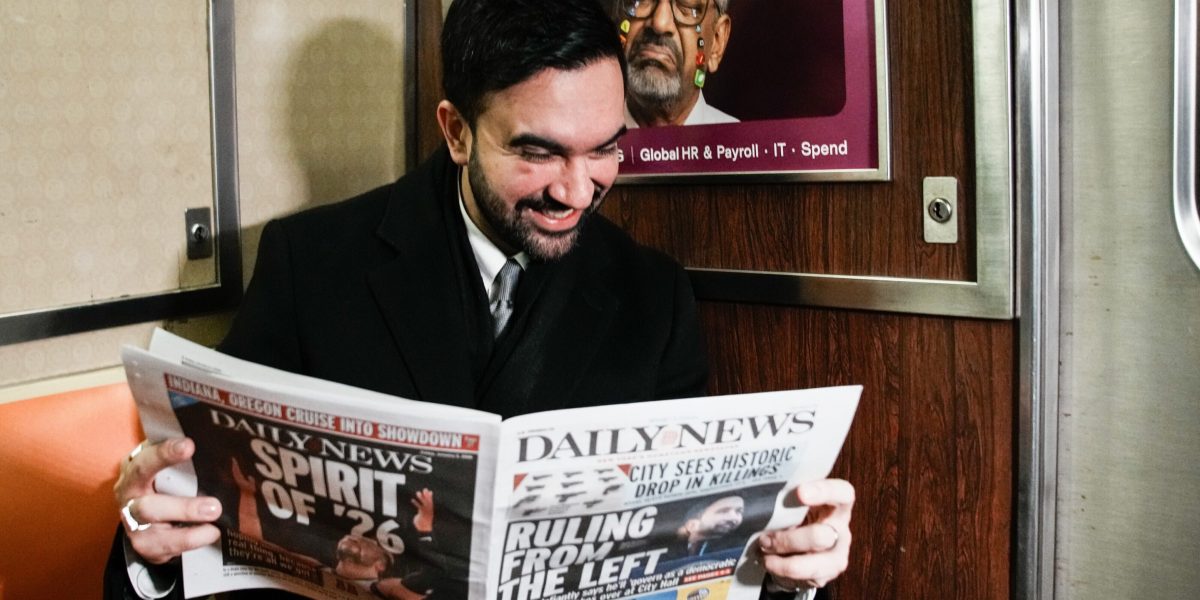
Flanked by security guards and a small clutch of aides on a Manhattan-bound train, he agreed to several selfies with wide-eyed riders, then moved to a corner seat of the train to review his briefing materials.

When a pair of French tourists, confused by the hubbub, approached Mamdani, he introduced himself as “the new mayor of New York.” They seemed doubtful. He held up the morning’s copy of the New York Daily News, featuring his smiling face, as proof.

Mamdani, a Democrat, is hardly alone among city mayors in using the transit system to communicate relatability. His predecessor, Eric Adams, also rode the subway on his first day, and both Bill de Blasio and Michael Bloomberg made a habit out of it, particularly when seeking to make a political point.

Within minutes of Mamdani entering City Hall, the images of him riding public transit had lit up social media.

If the ride served as a well-timed photo-op, it also seemed to reflect Mamdani’s pledge, made in his inaugural speech, to ensure his “government looks and lives like the people it represents.”

His other early actions have also seemed to underscore that priority.

After centering much of his campaign on making rent cheaper for New Yorkers, Mamdani raced from his inauguration ceremony Thursday to a Brooklyn apartment building lobby, drawing boisterous cheers from the tenants union as he pledged that the city would ramp up an ongoing legal fight against the allegedly negligent landlord.

Mamdani’s next action, meanwhile, showed the unusual scrutiny faced by his nascent administration, particularly around his criticism of Israel and outspoken support for the Palestinian cause.

In an effort to give his government a “clean slate,” he revoked a slate of executive orders issued by Adams late in his term, including two related to Israel: one that officially adopted a contentious definition of antisemitism that includes certain criticism of Israel, and another barring city agencies and employees from boycotting or divesting from the country.

The move drew swift backlash from some Jewish groups, including allegations from the Israeli government posted to social media that Mamdani had poured “antisemitic gasoline on an open fire.”

When a journalist on Friday asked about the revoked orders, Mamdani read from prepared remarks, promising his administration would be “relentless in its effort to combat hate and division.” He noted that he had left in place the Mayor’s Office to Combat Antisemitism.

Mamdani also announced the creation of a “mass engagement” office, which he said would continue the work his campaign’s field operation did to bring more New Yorkers into the political fold.

Ringed by supporters and passersby who stood several rows deep, phones in the air, to catch a glimpse of the new mayor, Mamdani then acknowledged the weight of the current moment.

“We have an opportunity where New Yorkers are allowing themselves to believe in the possibility of city government once again,” he said. “That is not a belief that will sustain itself in the absence of action.”

Also on Mamdani’s to-do list: Moving to the mayor’s official residence, a stately mansion in the Upper East Side neighborhood of Manhattan, before the lease on his Queens apartment ends later this month.

___

Associated Press writer Jennifer Peltz contributed to this report.


Source link

Continue Reading

Business

Argentina has repaid its $20 billion credit line from Trump administration, Scott Bessent says

Published

on


Argentina has repaid the funds it drew from a $20 billion credit line with the Trump administration, U.S. Treasury Secretary Scott Bessent announced Friday, in a crucial step for Argentine President Javier Milei to restore confidence in his chronically distressed economy.

In addition to making payments to bondholders, Milei’s radical libertarian administration had “quickly and fully repaid its limited draw,” Bessent said, without specifying the amount.

The Treasury’s latest report on the status of the credit line said that Argentina’s central bank had traded pesos for $2.5 billion through the swap as of the end of October.

The Argentine Central Bank confirmed Bessent’s announcement.

The contentious and largely unprecedented U.S. rescue provided dollar liquidity to the Trump administration’s cash-strapped ideological ally and halted a market rout in Argentina ahead of crucial midterm elections last October.

Milei’s libertarian party won a major victory in the vote, cementing support for his harsh austerity program and quelling investor concerns about the crisis-stricken country’s ability to repay debts. In another sign of the revived optimism around Milei’s reforms, his government issued a dollar bond for the first time in eight years last month, presaging a return to international bond markets.

Thanks to Argentina’s deposit, Bessent said, the U.S. Exchange Stabilization Fund tapped for the bailout holds no more Argentine pesos.

He praised the payment as a landmark that justified the Treasury’s bailout of Argentina, which raised doubts about the consistency of Trump’s “America First” foreign policy and drew backlash in the U.S. for putting taxpayer funds at risk. Experts have also criticized the opaque and apparently unconditional nature of the loan.

“Stabilizing a strong American ally – and making tens of millions in profit for Americans – is an America First homerun deal,” Bessent wrote. “Setting the course for Latin America, a strong and stable Argentina that helps anchor a prosperous Western Hemisphere is in our clear best interest.”

Luis Caputo, Argentina’s economy minister thanked the Trump administration “for the trust in our economic policy.”

“It is an excellent reality for our country to have been able to build this geopolitical alliance and to know that we have the explicit support of the most important country in the world,” he said.

But Argentina is not out of the woods.

Its foreign exchange reserves still run perilously low. The country is set to come under further strain in the coming months from repayments on previous International Monetary Fund loans and other private debt.


Source link

Continue Reading

Business

New study finds that late bloomers are more successful than child prodigies

Published

on


You may have a leg up on the child prodigies who made you feel inadequate as a school kid.

Despite outliers like Wolfgang Amadeus Mozart, a new analysis based on 19 studies involving 34,000 high achievers across multiple disciplines — including Nobel laureates, top chess players, Olympic champions, and elite musicians — found that individuals who achieved peak performance early in life were not always the same people to reach high success in adulthood. 

“Across the highest adult performance levels, peak performance is negatively correlated with early performance,” the report, which was published in the journal Science, said.

The researchers, led by Arne Güllich of RPTU Kaiserlautern-Landau in Germany, noted that prodigies often specialized in a single discipline, pigeonholing themselves in a particular field early in life. By contrast, late bloomers found success across multiple fields.

The study provides key insights into long-debated scientific inquiries into the origins of elite knowledge. While many parents may assume that helping their kids specialize early in life prepares them for successful careers, the latest research suggests otherwise. Early field-specific development can provide short-term success. However, longer-term success is more common among late bloomers.

“World top-10 youth chess players and later world top-10 adult chess players are nearly 90% different individuals across time,” the researchers wrote, suggesting that those who bloom early in life don’t tend to reach the height of their success at the same time late bloomers hit their stride. It also means that child prodigies and late bloomers develop differently and grow up to be fundamentally different people. 

To be sure, talented children usually find success in adulthood. In fact, a 2023 study found that child prodigies tend to earn more and have more career success than the average person.

Güllich and his team also note that their study is limited by its methodology. The research analyzed data from two types of studies: prospective studies, which scrutinize high-performing children over time, and retrospective studies, which looked back at the childhood development of high-achieving adults. Researchers pointed out that it is impossible to assign children to random careers, and that further research is required to understand how early development relates to success later in life.

Still, the study’s findings challenge the emphasis on early signs of high performance that elite schools, conservatories and youth sport academies often look for when recruiting talent.

In fact, earlier research indicates that such training could be detrimental, inspiring burnout. A 2018 NIH study found that “gifted” children had poor perceptions of their physical health, and that gifted kids were more at risk of poor mental health compared to non-gifted kids.

“All the findings obtained in this study suggest that gifted children are at risk in respect of mental health,” it warned.


Source link

Continue Reading

Business

Rumors are swirling about Venezuela holding $60 billion in Bitcoin—but crypto experts are skeptical

Published

on


Following the United States’ capture of Nicolás Maduro over the weekend, a report came out claiming that Venezuela had $60 billion stored in Bitcoin—leading to speculation that the U.S. could lay claim to cryptocurrency as well as oil. Despite numerous reports of the huge Venezuelan Bitcoin stash, however, a crypto forensic firm is skeptical of the claims. 

The news of Venezuela’s Bitcoin holding began to bubble up last Saturday, the same day that Maduro was ousted. The digital publication Project Brazen reported that his regime could control $60 billion in the original cryptocurrency—but offered little in the way of proof.

“The article does not mention any addresses as a starting point, making it difficult to verify any of these speculated claims,” said Aurelie Barthere, principal research analyst at Nansen, about Project Brazen’s report. 

Barthere is not the first person to express skepticism about the country’s purported crypto treasure trove. Mauricio di Bartolomeo, the Venezuelan co-founder of the financial services company Ledn, told Fortune on Wednesday that the level of the country’s corruption makes the figure hard to believe. He expanded his argument in an opinion piece he wrote for Coindesk

Estimates of Venezuela’s crypto holdings vary wildly. Bitcointreasuries.net estimates that the country has $22 million worth of Bitcoin. That figure would make Venezuela the government entity with the ninth-most money tied up in the original cryptocurrency, just behind North Korea. 

While the exact size of Venezuela’s Bitcoin wealth is unclear, the country has long been a player in crypto. Maduro introduced a token called the Petro in 2018, which was shuttered six years later. Its citizens have also turned to stablecoins as a way to fight their currency’s hyperinflation.

Trump has said that he will “run” Venezuela, and some have speculated that includes seizing the country’s Bitcoin holdings. Andrew Fierman, head of national security intelligence at Chainalysis, said he could not speak to the likelihood of such a seizure. He did, however, explain what gaining control of assets might look like. 

A freezing of assets could occur through centralized services, he says. These services would get a court order for an exchange or an issuer like Tether or Circle who could blacklist an address. The second method is through physical seizure. The U.S. could get control of wallets, devices, and keys through compelled cooperation. 

For now, there is unlikely to be a full and accurate account of Venezuela’s Bitcoin holdings until the political situation in the country becomes more stable.

Join us at the Fortune Workplace Innovation Summit May 19–20, 2026, in Atlanta. The next era of workplace innovation is here—and the old playbook is being rewritten. At this exclusive, high-energy event, the world’s most innovative leaders will convene to explore how AI, humanity, and strategy converge to redefine, again, the future of work. Register now.


Source link

Continue Reading

Trending

Copyright © Miami Select.