Brut Archives announces the opening of its second boutique worldwide, in New York, following its historic establishment in Paris. This launch marks a new milestone in the brand’s international development strategy.
Brut boutique in New York – DR
Founded in Paris by Paul Ben Chemhoun, Brut Archives launched in 2017 with the creation of a vintage showroom designed exclusively for fashion industry professionals. This first space brought together a tightly curated selection of textile archives, drawn mainly from workwear, Americana, and denim.
In March 2019, the brand took another step with the opening of its first Paris boutique at 3 rue Réaumur, in the 3rd arrondissement. For three years, the offer available to the public consisted exclusively of second-hand pieces and rare vintage archive pieces, while maintaining a B2B activity serving industry professionals. This address became a hybrid space at the crossroads of boutique, archive and the transmission of textile know-how.
In 2022, Brut Archives made a major strategic shift, bringing its vintage activity to a definitive close to focus fully on developing its own clothing line. All creative work, as well as the upcycling studio, was then centralised in Paris under the direction of managing director and creative director Paul Ben Chemhoun. The collections are founded on raw, durable materials, combining new fabrics with archive materials- an approach that has become the brand’s signature.
Originally conceived as a menswear brand, Brut Archives now appeals to an ever-growing female audience, thanks to timeless pieces and a cross-cutting vision of the wardrobe. The brand currently employs more than 40 people worldwide and remains 100% owned by its founder.
With the US now Brut Archives’ largest online market, and New York’s energy an integral part of its DNA, opening a shop in the city was an obvious move. The New York boutique, located at 37A Orchard Street, near Chinatown, offers a total floor area of around 144 square metres, with 74 square metres dedicated to retail space and 70 square metres to logistics. This is the brand’s second boutique worldwide. The brand deliberately distributes its collections exclusively via its official website and its two boutiques, with no wholesale network.
Brut Archives now operates two boutiques worldwide, in Paris and New York. The brand plans to reach turnover of €10 million by the end of 2025, a projection that accompanies the structuring and international expansion of the house.
This article is an automatic translation. Click here to read the original article.
TFG London and its brands Hobbs and Phase Eight reported their results a few days ago and now its Whistles chain has done likewise. And just like Phase Eight, it’s obviously faced some challenges in the year to late March 2025.
Whistles
The TFG-owned trio are moving in the right direction on many fronts but that doesn’t mean everything in the garden is rosy for contemporary womenswear label Whistles.
The company said that turnover during the year dropped to £57.7 million from £65.7 million and adjusted EBITDA dipped to £4.7 million from £5 million. Operating profit was down to £1.8 million from £2.5 million and profit after tax fell to £0.5 million from £0.9 million.
The company sells through its own stores, online and through department store concessions and operates both in the UK and internationally.
TFG noted a “steady performance for the year despite the ongoing challenging economic backdrop in the UK”. It added that Whistles grew its direct channel mix to 54.6% from 50% and while there was growth in its own channels, it underperformed in concessions where sales dropped 15% year on year. That reflects the performance at its stablemates Hobbs and Phase Eight with concessions also something of an issue for them during the year.
That was the main cause of Whistles’ 12% turnover drop, along with the fact that the company closed 19 stores while only opening five new ones. In fact, by the end of the financial year in the UK the company had 109 stores/concessions, down from 123 a year earlier.
But there was good news in that the gross margin was up at 69.9% from 67% due to that higher direct channel mix. The company’s distribution costs edged up but that was mainly due to a one-off warehouse move in March, the results filing said. Also good news is that administrative expenses were lower as a result of the drive to control costs.
We’ve reported other positive developments for Whistles towards the end of the year covered here, as well as post-year-end.
In early March this year it joined the ‘Brands at M&S‘ platform. That’s a hugely important move that puts it in front of millions more consumers. OK, it probably wasn’t positive overall in the early months of the deal due to the well-publicised cyberattack that took M&S offline for quite a few months. But it should have an overall beneficial effect longer term.
In April, it also appointed its very first creative director as it aimed to elevate and redefine its design direction and its overall creative vision.
Jacqui Markham joined after a career in which she’d been design director at Topshop and Topman, ASOS and Urban Outfitters Europe. She’d also been a designer at Oasis and Karen Millen and more recently was a freelance design consultant.
Her immediate boss at Whistles, product director Camille Sullivan, said she would be “instrumental in driving both the brand and our product offering forward in our next stage of growth”.
Mothercare’s latest half-year results on Tuesday came just three months after it had reported its full-year figures, but we have no objection to companies reporting more promptly. So what did they show?
Mothercare
The brand owner said the 26 weeks to late September showed worldwide retail sales by franchise partners of £90.7 million, down 25% from £121.2 million, or a fall of 22% at constant currency.
This “largely” resulted from ongoing store closures in its Middle Eastern markets and the planned exit from Boots in the UK. On a like-for-like basis retail sales were down ‘only’ 6% on last year.
It made adjusted EBITDA of £0.8 million, down from £1.7 million, and the group adjusted loss from operations was £0.5 million, worse than the £1.1 million profit a year earlier. The adjusted loss before taxation was £1.1 million, narrower than the loss of £1.4 million this time last year. And the net loss narrowed slightly to £1.7 million from £1.8 million. The company’s net debt fell to £5.8 million from £17.1 million.
The sales fall came as in Middle Eastern markets a net 50 stores were closed in the 12 months to 27 September. These closures were as a result of the “region-wide reduction in footfall and resultant sales, driven by the continuing regional unrest and evolving consumer behaviour. However we do not expect any further significant store closures, as now that the majority of the old inventory has been cleared the profitability of our franchise partner is improving, despite the challenges currently facing retailers in the region”.
Big international deals
Also internationally, Mothercare said it’s made “significant progress” with both the India joint venture with Reliance Brands Ltd and the license agreement for Türkiye, with Ebebek Mağazacılık AŞ.
In October 2024 it announced the Reliance deal with an entry valuation of around £30 million for the South Asian region.
It retains a residual 49% shareholding in the new joint venture company covering Mothercare’s franchise operations in India, Nepal, Sri Lanka, Bhutan and Bangladesh, which was granted perpetual rights for the use of the Mothercare brand and related intellectual property in those regions.
For FY25, its retail sales in India had amounted to £18.6 million and contributed around £0.4 million to adjusted EBITDA. But in FY24 under the previous franchise arrangements those figures were ar £24 million retail sales and £0.9 million adjusted EBITDA.
That may seem like it’s going backwards but despite receiving revenues at lower rates than previously, it noted that “Reliance have recently confirmed their aspirations for the reinvigorated business to significantly grow revenue levels, and we believe it is possible for them to grow their retail sales to around £300 million in five years, supported by a store opening programme targeting 50 new stores in the region in 2026. We also expect to benefit from both sourcing fees (supplying the joint venture with product) together with the value creation accruing to our residual 49% equity stake”.
As for the Türkiye deal, that was announced in June this year. Its partner Ebebek has some 280 stores and an online business producing revenues of around £400 million together with three stores recently opened in the UK. The license agreement gives Ebebek the exclusive right to use the Mothercare brand in Türkiye on products either designed and sourced by Ebebek or Mothercare for a period of 10 years.
It also allows Mothercare to purchase products Ebebek has sourced for itself, either under its own brands or Mothercare, for sale by its franchise partners outside of the territories where Ebebek trades and to rebrand these products with the Mothercare brand if relevant.
Ebebek is launching Mothercare products in-store imminently, with the full range available in the spring. And it has “expressed interest in extending the relationship to other territories”.
While the headline numbers in the half-year report didn’t look great for the brand, there were obvious signs of improvement in some areas, especially those international deals.
And Clive Whiley, chairman of Mothercare, seemed happy enough. He said: “Mothercare is making good progress against our strategic priorities. After the strategic and operational challenges of the last few years, our performance in the first half shows that Mothercare has been stabilised as a smaller and cash generative business with greatly reduced debt. Our new partnerships with Reliance in South Asia and Ebebek in Turkey are now bearing fruit, underlining the intrinsic value of and opportunity for our brand.”
From this position of “relative strength”, he noted that the key focus for 2026 is to “pursue options to rebuild our scale and operations both in the UK and globally, alongside pursuing the refinancing of our existing debt financing facilities. This is an exciting prospect for our partners, our colleagues and all our stakeholders as we look towards the new year and those opportunities ahead”.
Indian textile and apparel business Suditi Industries Limited plans to raise Rs 58.87 crore through a combination of equity shares and warrants to expand its children’s apparel and lifestyle brand Gini & Jony.
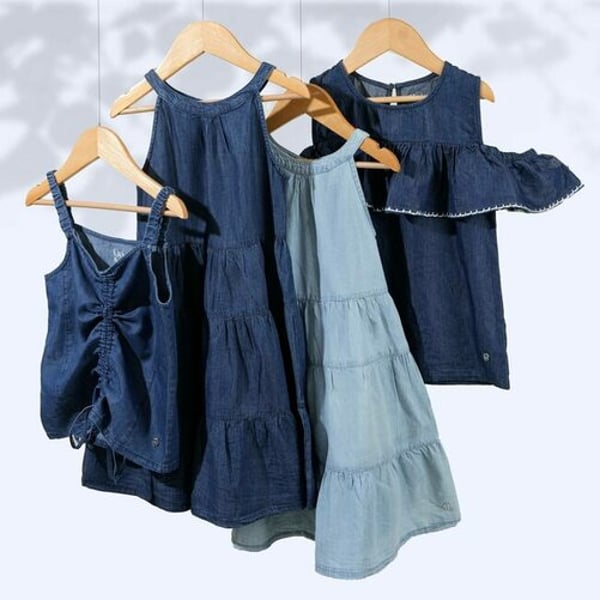
Denim by Gini & Jony – Gini & Jony- Facebook
“The Indian kid’s wear market presents a once-in-a-generation opportunity,” said Suditi Industries’ chairman and managing director Pawan Agarwal in a press release. “With Gini and Jony’s legacy, national footprint, and emotional connection with Indian parents, we are uniquely positioned to build a truly integrated ‘everything kids’ super brand. This fresh capital, combined with the experience and strategic depth of our incoming investors, enables us to accelerate growth while staying focused on our long-term vision- to be a trusted partner in every mother and child’s journey across the country.”
Keen to evolve into a vertically integrated kids’ retail business, the company will use the capital infusion to support its ambitious expansion plans for Gini & Jony. These include omni-channel retail expansion, deepening its product categories, and building a scalable backend infrastructure.
Participants in the funding round include Edelweiss co-founder Venkat Ramaswamy, former GlobalBees CEO Nitin Agarwal, Capwise Financial Services founder Naresh Biyani, and Rajesh Palviya among others. They join existing investors including Dream Sports’ chief marketing officer Vikrant Mudaliar and Third Wave Coffee co-founder Sushant Goel. The funding round was both led and advised by Capwise Financial Services Private Limited, which also took part as an investor.
“Building a modern consumer brand today demands excellence across technology, supply chain, data, marketing, and governance,” said Gini and Jony’s CEO Harsh Agarwal. “We are fortunate to have seasoned operators and founders as investors and advisors who have scaled businesses in exactly these areas. Their collective experience will help us compress learning cycles, sharpen execution at scale, and institutionalise governance frameworks befitting a market leader.”








 Politics8 years ago