Connect with us

Business

Fortune Tech: Opendoor’s big bet, Boring Company’s halt, Figure’s IPO pop

Published

on


Good morning. Allie here, filling in for the inimitable Andrew Nusca.

I’m back home in Los Angeles, still processing last week’s awesomeness that was Brainstorm Tech 2025. I interviewed Wyclef Jean and Jaeson Ma about the music business (huge for this Miami girl), talked with defense tech experts from companies like Anduril and Vannevar Labs, asked Oura CEO Tom Hale about data privacy, and grilled about ten different VCs on AI.

Of course, these days, what conversation isn’t an AI conversation? One question I’ve had recently: Will we see a trillion-dollar AI startup soon? The answer I got, both on the record and in casual conversations, was a resounding yes. Is that a good thing? I’m not sure. But one thing is clear: The AI boom is in full throttle, may get even faster, and for the foreseeable future, AI will still be conversation topic number one at tech conferences. (It will definitely be the case at our own Brainstorm AI in San Francisco, where I’ll be Dec. 8-9. Come hang out!)

And with that, today’s news.

Allie Garfinkle

Want to send thoughts or suggestions to Fortune Tech? Drop a line here.

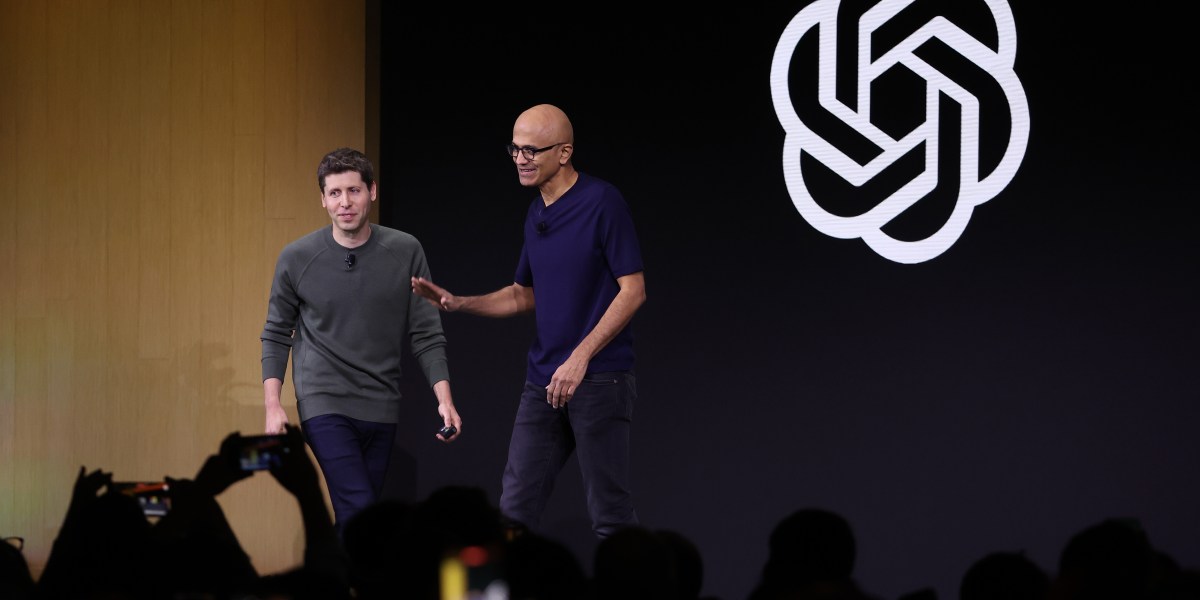
OpenAI’s deal with Microsoft could pave the way for an IPO

OpenAI’s path to a potential IPO may have just got a little clearer.

The AI company said last week that it has reached a preliminary agreement with major investor Microsoft that could allow the startup to restructure and, eventually, go public. Both companies signed a non-binding memorandum outlining “the next phase” of their relationship, with a definitive agreement expected in the coming months.

The announcement was light on details; financial small print was not disclosed, and the companies said they are still finalizing contractual terms. But the deal appears to address the structural and competitive friction that has complicated the relationship between OpenAI and its largest investor, paving the way for the $500 billion startup to convert its for-profit arm into a public benefit corporation (PBC).

OpenAI’s corporate structure is unusual. Originally founded as a nonprofit, it established a capped-profit arm in 2019, which allowed for large investments such as Microsoft’s. The company has been trying to restructure its profit-focused entity into a more conventional corporate model to allow it to raise additional capital, while leaving the nonprofit parent in control of the startup’s operations. A conversion to a more traditional structure, such as a Public Benefit Corporation, could allow the company to combine its public mission objectives with profit generation and possibly go public in the future.

Altman is well aware that speculators want to see OpenAI float on the stock exchange. He told CNBC last month he had “very conflicted” feelings on a potential IPO, explaining: “Whenever we do go public, if we ever go public, I think there will be tremendous upside left in front of the company, but I get why people would love for us to be public or sooner. And I’m sure people also get the reality of like we’re still in a crazy position and it would be very hard for us to be public given just all of the realities of that.” –Beatrice Nolan

Hyundai CEO says ICE raid on Georgia plant set back its opening by months

A raid by Immigration and Customs Enforcement (ICE) on a Georgia battery plant earlier this month pushed its opening date back by months, said Hyundai CEO Jose Muñoz.

Tinder tries to win back Gen Z with ‘modes’ for double dating and college students

Gen Z and dating experts have proclaimed traditional dating apps are doomed. But Tinder is courting the next generation by introducing new “modes” focused on double dating and connecting college students. 

Last week, Tinder introduced three new modes for users: a For You Mode, a Double Date Mode, and a College Mode. These each allow users to toggle between different match types based on what they’re looking for on any given day. The For You Mode lets users see all available matches based on a user’s preferences, while Double Date Mode allows users to pair up with a friend to find other match pairs. College Mode narrows down matches to other surrounding users who are also in college. 

Modes was built to accommodate changing needs and desires, based on feedback from Gen Z users, and changes in the dating industry at large, Cleo Long, Tinder’s senior director of global product marketing, told Fortune

Tinder had previously launched the double-dating feature and TinderU (dedicated to college students), but Modes allows users to have a more dedicated space to browse matches. 

A recent Forbes survey found more than 75% of Gen Z respondents felt burnt out using dating apps like Hinge, Tinder, and Bumble because they didn’t feel as if they could find a genuine connection with someone despite how much time they spent on the apps. 

Match Group and other dating-app companies had been struggling for a while following a boom in the early 2020s. –Sydney Lake

More Tech

Citymapper app owner Via falls 4.3% after $492.9 million IPO. The transit technology company’s stock opened at $44, below the $46 offer price.

Ray Dalio calls for wealth ‘redistribution policy’ when AI and humanoid robots start to benefit the 1% to 10% more than everyone else. Dalio described a future where humanoid robots and AI systems could render many current professions obsolete. 

A California bill that would regulate AI companion chatbots is close to becoming law. The bill has passed both the California State Assembly and Senate.

Apple Watch hypertension alerts cleared by FDA for new and old watches. The next Apple Watches will feature FDA-approved blood pressure monitoring.

Fortune Global Forum returns Oct. 26–27, 2025 in Riyadh. CEOs and global leaders will gather for a dynamic, invitation-only event shaping the future of business. Apply for an invitation.


Source link

Continue Reading

Business

Young people are ‘growing up fluent in AI’ and it’s helping them stand apart from older peers

Published

on


Gen Z, and younger generations, are getting a bad rap. The rise of ChatGPT and other AI tools have brought on complaints that students and young employees rely too much on AI to do everything from completing homework to writing emails. 

Yet Kiara Nirghin, a Stanford technologist and Gen Z entrepreneur, sees Gen-Z’s comfort with AI as an asset. “The younger generation isn’t adopting AI, we’re growing up fluent in AI,” she said at Fortune Brainstorm AI conference in San Francisco on Tuesday. 

Nirghin, who co-founded Chima, a U.S.-based applied AI research lab, explained that young entrepreneurs see coding as something to be done alongside AI agents, rather than done alone and from scratch. 

AI “fundamentally changes how you write, how you take tests, [and] how you apply to jobs or different applications—because it’s not from the ground up. It’s actually being able to do that with different models or agents, side by side,” Nirghin said. AI fluency sets Gen Z individuals apart from their older peers, allowing them to pioneer use cases and applications of AI that have yet to be unlocked, she explained. 

Some experts have argued that AI has eroded our critical thinking abilities. A 2025 study by researchers from MIT’s Media Lab found that users of ChatGPT “consistently underperformed at neural, linguistic, and behavioral levels.”

But Nirghin argued that this isn’t always true.“ The biggest misconception is that young people are using AI to not think things through, [but] I think that really intelligent Gen Z individuals are using it to think even deeper,” she said.

The entrepreneur pointed to how running complex research reports through AI could generate insights they may not have thought of otherwise—hence allowing users to get a fresh perspective.

Moving with the AI models

AI isn’t just for the young, however, and Nirghin stressed the technology’s ability to help workers at all levels of their careers. “We’re [only] at the beginning. It is only going to get faster, more advanced and more intelligent each and every model from here on out,” said Nirghin. 

She likened AI anxiety to climate anxiety—in that it stems from humanity’s fear of not moving fast enough to stay ahead of the game.

“In the past couple of weeks, [there’s] been two model releases that have engulfed the benchmarks in such an enormous way that pretty much everything you’ve ever used AI for can now just be 10x-ed,” Nirghin explained.

And to avoid being left behind, workers can familiarize themselves with “main model players” like ChatGPT and Gemini, and learn to use them as co-pilots and tools in everyday life. By continuously using the newest AI models, users will be more comfortable with the new technology, and thus lose their anxiety, she said. 

“The models right now are as dumb as they are ever going to be, [and] a couple months down the line, we are going to be in a very different landscape. Being able to be really comfortable with that, and having your core tools that you use and get comfortable with is really important.”


Source link

Continue Reading

Business

Mario Gabelli signals support for Paramount in Warner fight

Published

on


Money manager Mario Gabelli said it’s “highly likely” he will tender his clients’ Warner Bros. Discovery Inc. shares to Paramount Skydance Corp. in an effort to spark a bidding war for the film and TV company. 

In an interview, Gabelli said Paramount will ultimately have to increase its $30-a-share bid for Warner Bros. and that Netflix Inc. will also likely counter with a higher offer. Saying he supports the Paramount tender is a way of signaling he prefers more competition for the company.

“We’re in the early rounds,” Gabelli said. “Round five of a nine-round challenge.”

Warner Bros. shares were up 3.8% to $28.26 at the close in New York on Tuesday.

The longtime media investor attended Paramount’s presentation at a UBS conference on Tuesday and walked away impressed. Management “did a very good job” addressing potential regulatory challenges including at the state level, he said.

Gabelli’s firm and funds hold almost 5.7 million Warner Bros. shares, according to data compiled by Bloomberg, worth about $160 million based on Tuesday’s closing price. He also owns shares in Paramount and Netflix.

Warner Bros. agreed last week to sell its streaming and studios businesses, including HBO, to Netflix for $27.75 a share in cash and stock. Paramount on Monday went public with an all-cash tender offer for Warner Bros. and has been looking to convince investors its bid is better.

Gabelli plans to tender because the “terms of trade favor Paramount,” including an all-cash proposal that doesn’t rely on publicly traded stock or the spinoff of Warner Bros.’ cable networks, as Netflix’s offer does. 

Gabelli wouldn’t say which company was a better fit for Warner Bros.

“I don’t like to endorse things,” he said. “That’s why you play that card (a tender offer). It’s Texas hold ’em.”

On Tuesday, Gabelli’s company said in a regulatory filing it purchased more shares of the cinema and hotel company Marcus Corp.

Movie theater chains, which have been battered by tepid ticket sales and the threat of cutbacks in Hollywood releases, are a buy, Gabelli said. Paramount winning Warner Bros. would be “clearly better” for theaters because management believes in traditional film releases. 


Source link

Continue Reading

Business

Pluck eyebrows. Avoid surveillance cameras: Luigi Mangione’s to-do list as he tried to avoid arrest revealed in court

Published

on


Pluck eyebrows. Buy less conspicuous shoes. Take a bus or a train west toward Cincinnati and St. Louis. Move around late at night. Stay away from surveillance cameras.

A to-do list and travel plans found during Luigi Mangione’s arrest and revealed in court this week shed new light on the steps he may have taken — or planned to take — to avoid capture after UnitedHealthcare CEO Brian Thompson’s killing last year.

“Keep momentum, FBI slower overnight,” said one note. “Change hat, shoes, pluck eyebrows,” said another.

The notes, including a hand-drawn map and tactics for surviving on the lam, were shown on Monday at a pretrial hearing as Mangione’s bid to prevent prosecutors from using evidence seized during his Dec. 9, 2024, arrest at a McDonald’s in Altoona, Pennsylvania.

Excerpts of body-worn camera footage of the arrest, previously unseen by the press or the public, were released on Tuesday.

Police said they discovered the notes in Mangione’s backpack, along with a 9 mm handgun that prosecutors said matches the one used to kill Thompson five days earlier; a loaded gun magazine and silencer; and a notebook in similar handwriting which he purportedly described his intent to “wack” a health insurance executive.

Mangione’s lawyers haven’t disputed the authenticity of the notes or the provenance of the gun, pocket knife, fake ID, driver’s license, passport, credit cards, AirPods, protein bar, travel toothpaste, flash drives and other items seized from him and his backpack.

But they argue that anything found in the bag should be barred because police didn’t have a search warrant and lacked the grounds to justify a warrantless search. Prosecutors contend the search was legal — officers said they were checking for a bomb — and that police eventually obtained a warrant.

The notes, along with other evidence highlighted at the pretrial hearing, underscore that Mangione’s stop in Altoona, a city of about 44,000 people about 230 miles (370 kilometers) west of Manhattan, was only meant to be temporary.

One note said to check for “red eyes” from Pittsburgh to Columbus, Ohio or part way to Cincinnati (“get off early,” it reads). The map drawn below shows lines linking those cities, as well as other possible destinations, including Detroit, Indianapolis and St. Louis.

Thompson, 50, was killed as he walked to a Manhattan hotel for his company’s investor conference on Dec. 4, 2024. Surveillance video showed a masked gunman shooting him from behind and then fleeing the area. Over the next hours and days, police released photos of a suspect — first showing him in a mask and hooded coat and then his face and thick eyebrows.

Mangione, 27, has pleaded not guilty to state and federal murder charges. The pretrial hearing, which resumes for a sixth day on Thursday, applies only to the state case. His lawyers are making a similar push to exclude the evidence from his federal case, where prosecutors are seeking the death penalty.

Among the notes revealed this week was one with a heading “12/5” and a starred entry that said: “buy black shoes (white stripes too distinctive).”

Another, also written in to-do list style, suggested spending more than three hours away from surveillance cameras and using different modes of transportation to “Break CAM continuity” and avoid tracking. Below that, it said: “check reports for current situation,” a possible reference to news reports about the search for Thompson’s killer.

According to prosecutors, Mangione fled to Newark, New Jersey, immediately after the shooting and took a train to Philadelphia. Among the evidence shown at the pretrial hearing was a Philadelphia transit pass purchased at 1:06 p.m. — a little more than six hours after the shooting — and a ticket for a Greyhound bus, booked under the name Sam Dawson, leaving Philadelphia at 6:30 p.m. and arriving in Pittsburgh at 11:55 p.m.

A note with the heading “12/8” lists a number of tasks, including an apparent trip to Best Buy to purchase a digital camera and accessories, “hot meal + water bottles,” and “trash bag(s).” Under “12/9,” the day of Mangione’s arrest, the note lists tasks including “Sheetz,” an Altoona-based convenience store chain, “masks” and “AAA bats.” Under “Future TO DO,” it listed “intel checkin” and “survival kit.”

Mangione had a Sheetz hoagie in his backpack when he was arrested, along with a loaf of Italian bread from a local deli, according to police officers testifying Monday and Tuesday. It had been raining, and the bag and items inside it were wet, the officers said. They were heard on body-worn camera footage played in court theorizing that Mangione had gotten soaked walking from the city’s bus station.

Police responded to the McDonald’s after a manager called 911 to relay concerns from customers who thought that Mangione, eating breakfast in a back corner, resembled the man wanted for killing Thompson. On the call, played in court, the manager could be heard saying that because Mangione was wearing a medical mask, she could only see his eyebrows and that she searched online for a photo of the suspect for comparison.

Altoona Police Officer Stephen Fox testified on Tuesday that Mangione, the Ivy League-educated scion of a wealthy Maryland family, expressed concern for the 911 caller’s wellbeing. Fox said Mangione asked if police had planned on releasing her name, which they didn’t. The officer recalled him saying: “It would be bad for her” and “there would be a lot of people that would be upset.”

At another point, Fox said, a shackled Mangione stumbled while trying to keep up with the brisk-moving officer. Fox said he apologized and said, “I forgot you were shackled.”

He said Mangione responded: “It’s OK, I’m going to have to get used to it.”


Source link

Continue Reading

Trending

Copyright © Miami Select.