Connect with us

Business

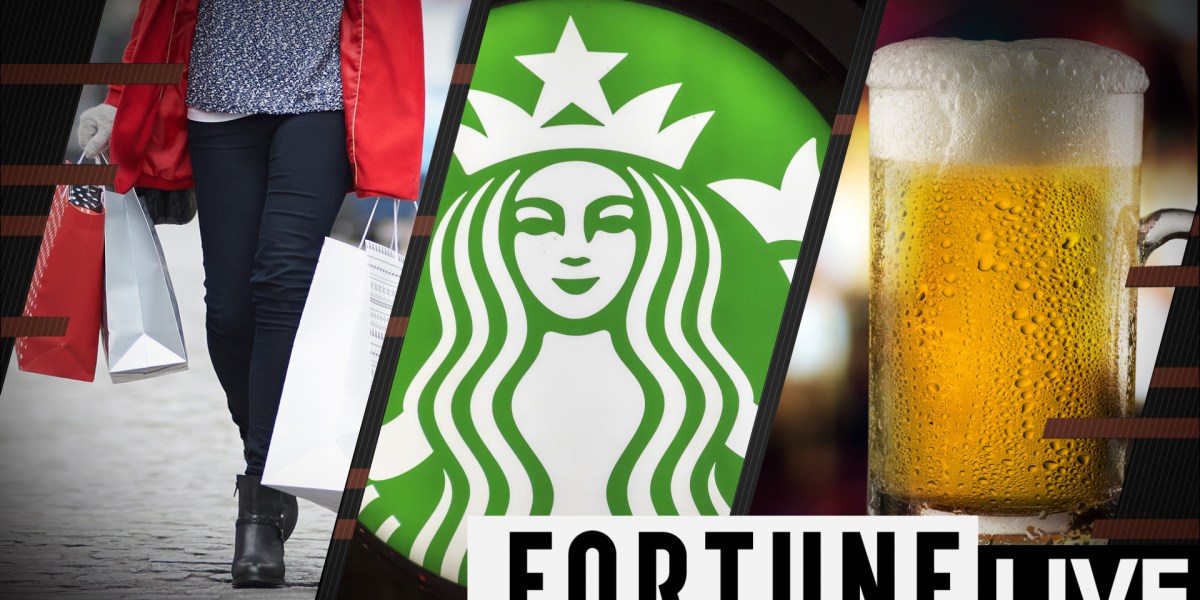
Fortune Live: Starbucks’ Future, Holiday Shopping & Craft Beer

Published

on


We have a great lineup today for Fortune Live, our weekly business show hosted by Leigh Gallagher.

First up, we tackle some of this week’s top news. Fortune’s Brian O’Keefe and Beth Kowitt join the show to talk about Donald Trump’s evolving relationship with the business community. Plus, we discuss his continued impact on the stock market. Then, we turn to Starbucks‘ plans for the future. Tune in to find out our thoughts.

Up next, we met the company that has “do-it-yourself fashion” trending on social media. Find out how the McCall Pattern Company has stayed relevant since 1863.

Then, Leigh sits down with Wealthfront founder Andy Rachleff to talk about his decision to return to the leadership position of CEO after leaving the company years ago.

And then, meet some of the women who are changing the the craft beer industry one brewer at a time. We take you on a tour inside Lineup Brewing and Local Brewing Co.

Next, forecasters have been predicting a strong holiday season for retailers. So far, shoppers seem to be spending as expected. But what does the rest of the season look like? For answers, we ask a panel of experts to join us in a game of “Fact or Fiction.” Tamara Gaffney, principal analyst and director of Adobe Digital Insights, Jeff Glueck, CEO of Foursquare, and Lila Snyder, president of global e-commerce for Pitney Bowes, give us their thoughts.

To close our show, we head to one of Amazon‘s fulfillment centers in New Jersey to talk shopping trends and learn more about the product that Amazon (AMZN) says has been its biggest seller this season.

You can go to fortune.com/fortunelive to watch the full show and individual segments on demand after the show concludes.

Join us at the Fortune Workplace Innovation Summit May 19–20, 2026, in Atlanta. The next era of workplace innovation is here—and the old playbook is being rewritten. At this exclusive, high-energy event, the world’s most innovative leaders will convene to explore how AI, humanity, and strategy converge to redefine, again, the future of work. Register now.


Source link

Continue Reading

Business

Down Arrow Button Icon

Published

on


S&P 500 futures were up a solid 0.35% this morning before the opening bell in New York, after the index added 0.88% in its Friday session. The Christmas week is—obviously—often a quiet one with thin trading and low volatility. Traders are focused more on positioning for 2026 than they are on the week ahead and so far they appear to like what they are seeing in the year ahead.

We may even see a new all-time high—the S&P is just less than 1% from its previous record peak.

Two big reasons for that are the Fed and President Trump.

Most recently, the U.S. Federal Reserve delivered a cut in interest rates of 25 basis points, bringing the base rate down to 3.5%. Cheaper borrowing costs usually result in more money flowing into equities. Traders are not expecting another interest rate cut in January but 46% of them are now pricing in one for March, according to CME FedWatch tool, which tracks bets on fed funds futures. That number has been ticking up gradually all month.

The Fed has also begun another program that adds liquidity to the market: Its monthly Reserve Management Purchases (RMPs), each worth $40 billion. The purpose of the program is to provide more daily liquidity for banks borrowing in the “repo” market. Banks often borrow money overnight to fund their operations but interest rates had recently become more volatile than they are intended be, so the Fed is lubricating that market with monthly purchases of short-dated T-bills. 

It is not intended to be a new round of “quantitative easing,” but as far as some on Wall Street are concerned it might as well be—and that’s likely to be good for stocks.

“Over the past 2 weeks, the Fed’s balance sheet has grown by $21.1b using Reserve Management Purchases (RMPs), with the stated intent of keeping repo and related markets operating smoothly,” Piper Sandler’s Chief Global Economist Nancy Lazar told clients over the weekend. “The Fed emphatically says this is not Quantitative Easing. Nonetheless, from an eco-perspective, the added banking reserves will help keep short rates lower, helping support M2 and bank loan growth.”

Putting all this together, an expanding Fed balance sheet will further boost [the money supply] and bank loans, in turn supporting nominal GDP growth, which is already healthy at ~5%.”

At Wells Fargo, Ohsung Kwon and his colleagues see it much the same way. New money means buy the dips when they occur, they recommended to clients last week. “We expect a sharp rebound in our Liquidity Indicator as the Fed expands its balance sheet by $40B/mo. Historically, dips were buying opportunities in a liquidity upcycle, a simple strategy of buying SPX at the close on 1%+ drop days and selling at the close the next day, largely followed the liquidity regime. With liquidity entering a mini upcycle, we believe equity dips will become buying opportunities,” they said.

And then there is what Axios has labelled President Trump’s “cash bazooka”: a $1,776 “warrior dividend” for members of the military, billions in a bailout to farmers hurt by his tariff scheme, “Trump Accounts” for children, and (less certainly) a $2,000-per person tariff rebate for taxpayers.

All of that presages new demand in the economy, and a likelihood that will end up as either increased earnings per share for companies or extra demand for stocks from savers.

Here’s a snapshot of the markets ahead of the opening bell in New York this morning:

  • S&P 500 futures are up 0.33% this morning. The last session closed up 0.88%. 
  • STOXX Europe 600 was down 0.17% in early trading. 
  • The U.K.’s FTSE 100 was down 0.39% in early trading. 
  • Japan’s Nikkei 225 was up 1.81%. 
  • China’s CSI 300 was up 0.95%. 
  • The South Korea KOSPI was up 2.12%. 
  • India’s NIFTY 50 was up 0.79%. 
  • Bitcoin was at $89K.


Source link

Continue Reading

Business

The corner office still favors insiders

Published

on


Internal promotions remain the dominant path to the top of America’s largest companies. As of June 30, 2025, nearly 60% of S&P 500 C-suite leaders were appointed from inside their own organizations, reinforcing the enduring value of leadership development and disciplined succession planning.

That internal bias is even stronger at the very top, according to a Spencer Stuart report. Seventy-six percent of CEOs and 80% of chief operating officers (often a stepping stone to the corner office) were promoted from within their companies, making these roles the most likely to be filled by insiders.

Company scale plays a meaningful role in these outcomes. Larger organizations, particularly those with multiple business units, tend to generate deeper internal talent benches. More functional leadership roles allow high-potential executives to be developed, tested, and rotated across the enterprise, increasing the odds that boards can look inward when critical roles open.

External hiring still remains a vital lever, especially when companies need to strengthen capabilities in highly specialized areas such as technology, but it is typically used selectively rather than as the default.

Industry dynamics also shape internal promotion rates. In the industrial and consumer sectors, 61% and 62% of C-suite leaders, respectively, were internal appointments. Healthcare and technology trail with 56 percent—the lowest share of insiders among major sectors. Even when companies recruit externally, expectations differ by role. For CEOs and COOs, industry experience remains a strong prerequisite, with fewer than 20% of external hires coming from outside the company’s sector.

Taken together, the data suggest that building a long runway inside an organization, gaining breadth across functions and business units, and developing a track record of industry expertise continue to outweigh external visibility alone when boards make their most consequential decision for the top job.

Check out the 2026 most powerful rising executives in the Fortune 500

Next to Lead will be off for the holidays and back in your inbox on Jan. 5.

Ruth Umoh
ruth.umoh@fortune.com

Smarter in seconds

Flexible futures. LinkedIn CEO says it’s ‘outdated’ to have a five-year career plan: It’s a ‘little bit foolish’ considering the pace AI is changing the workplace

Succession lessons. What David Ellison can learn from a hostile bid battle of his father

Inner work. Red Lobster’s CEO says the key to being a better leader is being a better person: ‘Leadership is self-improvement’

Ego management. How to deal with bosses who think they are the smartest person in the room

Leadership lesson

Mattel’s CEO on correctly pricing toys this holiday season: “The strategy is to have a pricing architecture that is broad enough and flexible enough to cater to different consumers. It’s more akin to the fashion industry than packaged goods… There are certain things that are hot or not, and you need to figure it out.”

News to know

Teenagers are already launching AI startups, using vibe-coding tools and social media to build businesses years before many can even drive. WSJ

Despite fears that AI is replacing finance jobs, experts say recent Wall Street layoffs reflect cyclical cuts and efficiency drives more than an imminent AI takeover. Fortune

CBS News pulled a “60 Minutes” segment on deported Venezuelan men, fueling claims the decision was politically motivated. NYT

Leaked files show Binance let suspicious accounts operate after its 2023 U.S. plea deal, despite terror links and failed ID checks. FT

The 46-year-old CEO of Compass is waging an aggressive campaign against Zillow to reclaim control of home listings and reshape how power and data flow in real estate. BI

A former Elon Musk rival and robotics expert is the latest Silicon Valley transplant to join GM’s leadership ranks. WSJ

Shield AI’s CEO says the $5.6 billion defense-tech startup has reached an inflection point as it looks to scale its AI software beyond its own drones and overcome fallout from a high-profile accident. Fortune

Waymo resumed its robotaxi service in the San Francisco Bay Area after pausing operations during widespread blackouts that disrupted vehicle behavior. CNBC

Join us at the Fortune Workplace Innovation Summit May 19–20, 2026, in Atlanta. The next era of workplace innovation is here—and the old playbook is being rewritten. At this exclusive, high-energy event, the world’s most innovative leaders will convene to explore how AI, humanity, and strategy converge to redefine, again, the future of work. Register now.


Source link

Continue Reading

Business

Down Arrow Button Icon

Published

on


The sudden shift in the industry’s landscape got me thinking about a classic tool for understanding any industry. Harvard Business School professor Michael Porter created the “Five Forces” framework in 1979, and it still stands as a brilliant way to grasp a given industry’s big picture. Note that it’s a way to characterize an industry, not an individual company

So, for example, the first force, “threat of new entrants,” means, “Is this an industry in which new entrant companies could easily compete, or not?” If the answer is, “This force is weak,” it would mean there is little threat of new entrants coming into that industry, which would be good news for incumbents. We asked expert analysts Charlie Dai of Forrester and Arun Chandrasekaran of Gartner and our own Fortune AI experts for context about how each force might affect Google Gemini and OpenAI.

Force One: Threat of new entrants. Chandrasekaran sees the industry becoming “a three-horse race” with OpenAI, Google, and Anthropic; he can’t see how a new company could “be on a par with these three.” Dai sees formidable barriers to new entrants in “compute cost, talent scarcity, and regulatory complexity.” Conclusion: This force is weak which bodes well for the incumbents. Google may be better positioned than OpenAI given how much more of the AI value chain it controls.

Force Two: Bargaining power of suppliers. Dai says suppliers of chips hold strong power because only a few companies, especially Nvidia, AMD, and Huawei, design the best chips and can’t supply them fast enough. The picture here is similar to the vast amounts of AI cloud capacity that AI providers must buy or build. Chandrasekaran notes that the major LLM companies train their models by crawling the internet and scooping up data—but some data providers are now demanding money. This force is strong. Google may be better protected by its control of its own chips, its own cloud, and nearly all its needed infrastructure.

Force Three: Bargaining power of buyers. It’s tempting to think that buyers aren’t super-strong in bargaining because over time they’ll get effectively locked into a provider’s system. “If [OpenAI’s] ChatGPT is integrated into your workflow and processes, extricating out of an application like ChatGPT is not really easy,” Chandrasekaran says. But buyers are increasingly using multiple models and finding they can be compatible. This force is moderate to strong. Google has stronger structural lock-in, but OpenAI has more brand affinity from consumers.

Force Four: Threat of substitutes. “Open-source alternatives like DeepSeek and Qwen will play a key role” in the industry, Dai says. In addition, Chandrasekaran says, “we are starting to see smaller language models challenging the larger models in very specific domains.”  This force is medium and getting stronger. Google and OpenAI are about equally able to confront it.

Force Five: Rivalry among existing firms. Our experts agree: This force is strong and getting much, much stronger. OpenAI and Google are in a virtual tie, though OpenAI has fewer defensive moats and must innovate quickly to retain its lead.

Bottom line: In what may be the most profoundly important industry yet seen, OpenAI has a fragile lead but faces an imposing foe that may benefit more as the Five Forces act on the sector. In five years, will one be the clear winner? Or will a Chinese competitor show that we grievously underestimated the “threat of new entrants”? Going through your industry’s Five Forces framework can be a demanding exercise, but it’s worthwhile for leaders in any industry. When done right, it will spark debates, insights—and possibly even a code red.—Geoff Colvin

Contact CEO Daily via Diane Brady at diane.brady@fortune.com

Top news

No refunds if Supreme Court strikes down tariffs, Hassett says

In an interview on CBS News’ Face the Nation on Sunday, National Economic Council Director Kevin Hassett predicted that the justices will rule in the White House’s favor because refunding the companies that paid them would be “very complicated,” Hassett says. Lower courts have ruled that the so-called reciprocal tariffs invoked under the International Emergency Economic Powers Act are illegal, though the Supreme Court will have a final say. “And I also think that if they didn’t find with us, that it’s going to be pretty unlikely that they’re going to call for widespread refunds, because it would be an administrative problem to get those refunds out to there,” Hassett said.

Possible successor to GM’s Barra is old foe of Musk

Sterling Anderson, 42, joined GM in June as its global product chief. He previously worked at Tesla but fell out with Elon Musk and was sued by Musk after he left, the WSJ reports. The robotics expert is a possible successor to CEO Mary Barra, 64, the paper says.

Justice Department published, deleted, and then published again some of the Epstein files

The Justice Department released a portion of the Epstein files on Friday and into Saturday, and some came with heavy redactions. At least 16 files then vanished from the DOJ’s Epstein document webpage a day after they were posted on Friday. Among them was file 468, an image showing a drawer filled with photographs, including one with President Trump alongside Jeffrey Epstein, Melania Trump, and Epstein associate Ghislaine Maxwell. Another photograph in the drawer showed Trump surrounded by women. Deputy Attorney General Todd Blanche told NBC’s Meet the Press on Sunday there were concerns that the photos inadvertently revealed the faces of victims, to the photos were retracted before being republished again. “It has nothing to do with President Donald Trump,” he said.

Contempt charges drafted for Bondi

On Sunday, Rep. Thomas Massie (R-Ky.) and Rep. Ro Khanna (D-Calif.) told Face the Nation on Sunday that they are drafting “inherent contempt” charges against Attorney General Pam Bondi for every day that the entirety of the files aren’t released. 

Apollo preparing for ‘when something bad happens’

Apollo Global—$908 billion in assets under management—is moving into cash, cutting its leverage, and derisking from certain parts of the debt market in preparation for “when something bad happens,” according to CEO Marc Rowan. He wants the company to be prepared to invest when the market goes through any upcoming turmoil, he said in private meetings at a Goldman Sachs conference, according to the FT.

Economists say any Fed Chair will clash with Trump

National Economic Council Director Kevin Hassett is the favorite on prediction market Kalshi to replace Jerome Powell as Fed Chair, but economists last week argued that any Fed chair will have trouble lowering rates as much as President Trump would like. Meanwhile, Hassett said over the weekend that he believes the Supreme Court will find Trump’s tariffs legal, but tariff refund checks probably won’t come even if they don’t.

AI not destroying finance jobs—yet

Experts told Fortune that AI isn’t destroying finance jobs—at least, for now. Although AI in theory can perform hours of junior-level analyst tasks in just seconds, experts agree that AI-related layoffs have been insignificant so far. “If there’s a large company that might say, ‘Well, we’re not planning to hire as much because of AI,’ or maybe ‘We’re letting people go because of AI,’ I think there’s a little bit of smoke and mirrors there,” Robert Seamans, director of New York University Stern’s Center for the Future of Management, tells Fortune

SpaceX explosion endangered three jets

The January 16 explosion of a SpaceX rocket over the Caribbean rained debris over a vast area of airspace for 50 minutes, the WSJ reports, endangering three passenger jets carrying 450 people.

The markets

S&P 500 futures are up 0.33% this morning. The last session closed up 0.88%. STOXX Europe 600 was down 0.17% in early trading. The U.K.’s FTSE 100 was down 0.39% in early trading. Japan’s Nikkei 225 was up 1.81%. China’s CSI 300 was up 0.95%. The South Korea KOSPI was up 2.12%. India’s NIFTY 50 was up 0.79%. Bitcoin was at $89K.

Around the watercooler

Shield AI took its drones from the ‘Batcave’ to the battlefield. Now the $5.6 billion defense-tech startup’s new CEO says it’s at an inflection point by Jessica Mathews

Sam Altman says he’s ‘0%’ excited to be CEO of a public company as OpenAI drops hints about an IPO: ‘In some ways I think it’d be really annoying’ by Sasha Rogelberg

‘They’ll lose their humanity’: Dartmouth professor says he’s surprised just how scared his Gen Z students are of AI by Nick Lichtenberg

Bill Gates identifies the biggest burden being passed on to his children after seeing his daughter harassed online by Eleanor Pringle

CEO Daily is compiled and edited by Joey Abrams, Claire Zillman and Lee Clifford.


Source link

Continue Reading

Trending

Copyright © Miami Select.