Connect with us

Business

Forget the K-Shape: We have a barbell economy—and the middle class is buckling under the weight

Published

on


If you look at the aggregate numbers, the U.S. economy in early 2026 appears resilient. GDP is humming and the soft landing engineered by the Federal Reserve seems to have held. But aggregates are often optical illusions. As a gender economist who analyzes disaggregated data, I do not see a resilient system. I see a dangerously brittle one.

We have transitioned from a K-shaped recovery into a Barbell Economy, a system heavily weighted at the extremes of wealth and precarity, connected by a middle class that is rapidly snapping.

By concentrating wealth, assets, and leverage in a specific, homogenous demographic while hollowing out the economic stabilizers traditionally provided by women and people of color, we have engineered a single point of failure. We have built an economy with a massive engine and insufficient braking mechanisms.

Here is the anatomy of that fracture, and why the next recession won’t be caused by a labor collapse, but by a demographic margin call.

The Risk of the Fragile Top

The prevailing wisdom in corporate boardrooms for the last three years has been simple: Pivot to the premium consumer. As inflation eroded the purchasing power of the middle class, companies shifted strategies to chase the resilient top 20%.

This was a strategic error based on a misunderstanding of risk.

The prosperity of this top cohort is not driven by wage growth. While their wages have risen, they have stagnated relative to the explosive returns on capital. Instead, their consumption is driven by the “Wealth Effect.” New analysis shows that 70% of recent economic growth is now driven by just 20% of earners. These consumers aren’t spending wages; they are spending paper gains tethered to a market bubble.

This makes U.S. GDP effectively a leveraged bet on the sentiment of a single cohort. With the CAPE ratio (Cyclical Adjusted Price-to-Earnings) at its highest level since the Dot-Com bubble, the market they rely on is dangerously extended. Furthermore, the engine is tiny: the top 10 companies now comprise 40% of the S&P 500’s value, a historic concentration risk.

When the market corrects, this group doesn’t just taper spending; they freeze it.

We are already seeing the cracks. The aspirational consumer, the wage-earning professional in the 80th to 95th percentile, has retreated. They are the bridge between the middle class and the wealthy. Yet, in 2025, they reduced luxury spending by roughly 35%.

This retreat exposes the structural flaw. It leaves the economy dependent on the 95th to 99th percentile, the asset-rich households. While wealthy, this cohort is not immune; their consumption is psychologically tethered to their portfolio balance. When the S&P 500 drops, they feel significantly poorer and freeze discretionary spending. In a healthy economy, the middle and working classes provide a floor of stable demand that cushions this volatility.

In 2026, there is no one there to catch it.

The Missing Floor: A Failure of Redundancy

In portfolio theory, redundancy is safety. You hedge volatile assets with stable ones. In an economy, women and people of color have historically acted as that hedge, providing the inelastic demand for care, food, and community services that keeps an economy moving when financial markets seize up.

But we have stripped that floor away. While the top 20% spends paper gains, the bottom 80% is currently financing groceries with shadow debt, having fully depleted their pandemic-era savings buffers.

My analysis of 2020–2025 data shows that the handle of the barbell, the shock absorbers of the economy, has been decimated.

This is not a social justice issue; it is a liquidity crisis.

The subprime auto loan market is currently flashing red, with delinquency rates surpassing 2008 levels. But the risk isn’t contained to car lots; it is moving upstream into asset-backed securities (ABS) held by pension funds and insurers. We are learning the hard way that you cannot build a AAA-rated financial system on the back of a subprime workforce.

The Corporate “Premium Trap”

For the Fortune 500, this demographic concentration has created a premium trap.

By chasing the top of the barbell, companies like Starbucks and Target have exposed their earnings to the specific volatility of the affluent consumer. We are seeing a gentrification by basket, where Walmart reports that its primary growth is coming from households earning over $100,000.

This is not a sign of health; it is a sign of distress. Analysis shows that 80% of luxury sector growth since 2019 was driven by price hikes rather than sales volume. Companies are priced for perfection in an economy that is running on fumes.

Diversity is a Hedge

It is time to stop viewing equity as a moral preference or a CSR initiative. In 2026, equity is structural risk management.

An economy that relies on the asset-derived spending of a homogenous top 10% is inherently unstable. It is subject to groupthink, correlated panic, and rapid contraction. This dependency on the wealth effect accounts for 0.3% of annualized consumption growth, growth we cannot afford to lose in a low-margin world.

To stabilize the U.S. economy, we must diversify our shareholder base. We need to capitalize the real economy,  Black and Latina women who are currently the most under-utilized assets in the nation. By clearing the capital bottlenecks for Latina entrepreneurs and closing the wage arbitrage that drains Black and Native households, we unlock $3.1 trillion in economic growth. Closing the wealth gap is not charity; it is the only way to build a floor under the stock market.

We do not diversify our economy to be nice. We diversify so that when the top weight of the barbell slips, the whole system doesn’t collapse.

The opinions expressed in Fortune.com commentary pieces are solely the views of their authors and do not necessarily reflect the opinions and beliefs of Fortune.

This story was originally featured on Fortune.com


Source link

Continue Reading

Business

Rural America is getting a bailout, but not from Trump—billionaires are riding to the rescue

Published

on


Rural America is getting a bailout.

Billionaires are increasingly stepping in to plug gaps in services, education, and opportunity that many small towns say have been ignored for years. While Washington remains gridlocked over how to revive areas left behind by industrial and demographic change, a growing class of wealthy donors is quietly reshaping the economic future of the countryside with nine-figure checks and thousands of acres of land.

Minnesota billionaire Glen Taylor, who built Taylor Corp. into a printing empire and became his state’s wealthiest resident, is now redirecting a significant slice of his fortune back to the rural communities that raised him. The 84-year-old former dairy farm kid from outside Comfrey, Minnesota (pop. 376 as of 2024), is transferring farmland and securities worth roughly $100 million into the Taylor Family Farms Foundation, with a specific mandate to support rural areas in Minnesota and Iowa.

Rather than offering a one-time cash infusion, Taylor’s gift is structured to generate income for years, building on a 2023 transfer of about $173 million in farmland that already funds grants through regional nonprofit partners. Taylor said the move is rooted in his own upbringing in southern Minnesota, where he worked on farms and raised chickens, and in a desire to “make a positive impact on the lives of others in a region that I love so much,” Taylor said in a statement to the Observer.​

Billionaire rural wave

Taylor is part of a broader pattern in which ultrawealthy donors are focusing explicitly on small-town and rural America rather than the big-city universities and museums that long dominated philanthropy. Investment banker Byron Trott, who grew up in Union, Missouri, has pledged $150 million to a network of universities to boost enrollment from rural students, a push that has already helped drive a 20% increase in applications.

Philanthropist MacKenzie Scott has similarly turned her attention to rural education, donating $36 million to North Carolina institutions such as Robeson Community College and Bladen Community College to bolster opportunities in some of the country’s poorest counties. Together, these gifts signal a recognition among billionaires that the country’s economic and political fault lines increasingly run between thriving metros and struggling rural regions—and that private money can move faster than federal policy.

Politics, power and dependence

The surge of billionaire attention comes as rural voters remain a core political base for Trump, whose “forgotten men and women” rhetoric helped power his return to the White House but has not translated into a sweeping federal revival plan for small-town America. In that vacuum, philanthropists like Taylor, Trott, and Scott are effectively writing their own rural policy agendas through foundations and grantmaking, deciding which towns get ambulances, which fire departments get radios, and which students get a shot at college.

Trump’s administration has announced a $12 billion bailout for farmers in the wake of a wipeout amid his tariff regime, particularly for soybeans. At one point in 2025, as Trump and Treasury Secretary Scott Bessent announced support for like-minded ally Javier Milei in Argentina, China cut its U.S. soybean purchases to zero and began buying them from Argentina instead. After a Trump-Xi summit, China resumed soybean purchases, and more recently Argentina has repaid its full $20 billion credit line. Kentucky soybean farmer Caleb Ragland told the Associated Press in early January that Trump’s aid for farmers was “a Band-Aid on a deep wound. We need competition and opportunities in the market to make our future brighter.”

For this story, Fortune journalists used generative AI as a research tool. An editor verified the accuracy of the information before publishing.


Source link

Continue Reading

Business

Highway 1 along Big Sur reopens after 3 years of closures amid tourism-destroyin landslide

Published

on


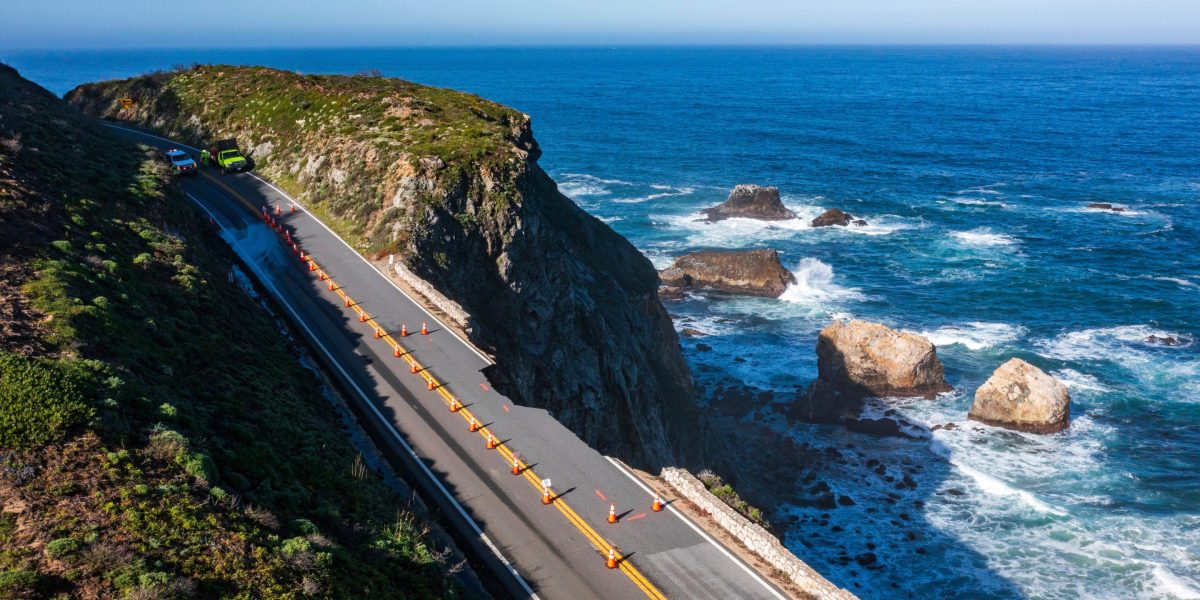
A 90-mile (145-kilometer) section of California’s Highway 1 along the famous Big Sur coast finally reopened Wednesday after three years of closures and repairs following a series of landslides and a roadway collapse that hampered tourism on the scenic route.

The reopening around midday came three months ahead of schedule, and business owners say that should give travelers plenty of time to plan their spring and summer road trips.

“Today is a monumental milestone for us,” said a relieved Colin Twohig, general manager of the Big Sur River Inn. “We’re hitting the light at the end of the tunnel after three long years.”

The first shutdown came in January 2023 when a series of powerful atmospheric rivers triggered a major landslide. The highway was buried again the following year during another wet winter, when a lane also collapsed down a cliff near the Rocky Creek Bridge.

The traffic stoppage between Carmel and Cambria cut off access to Big Sur, an isolated stretch of the state’s central coast where misty, forested mountains rise up from the ocean. What used to be a short drive between the southern and northern sections — with tiny Big Sur Village roughly in the middle — became an eight-hour trek inland and then back toward the seashore.

The isolated area, home to fewer than 2,000 residents, is known for its panoramic hiking trails along high cliffs and craggy beaches where seals and sea lions sometimes sprawl out. The late “Tropic of Cancer” author Henry Miller lived there for nearly two decades starting in the 1940s, and there’s now a library devoted to his work.

Highway 1 is famously a must for California visitors traveling between Los Angeles and San Francisco, and Twohig said he looks forward to seeing tourists in cars and motorhomes back on the road.

Twohig estimated that his inn, with 22 guest rooms, a large restaurant and a general store, saw a 20% drop in business. He said the road closure directly following COVID-19 restrictions was a one-two punch. The inn spent the down time making improvements and marketing heavily to entice California residents to visit during the off-seasons.

“When you have a hospitality business, you really rely on the busy season, and when there is no busy season, it can be a hard pill to swallow,” he said. “Having that lifeline back is huge.”

There were multiple closures at various locations throughout the past three years, and the last stretch that remained shut was a 7-mile (11-kilometer) span near Lucia, according to the California Department of Transportation, or Caltrans.

Gov. Gavin Newsom announced the opening on social media, thanking Caltrans for the speedy work in “reviving a vital economic lifeline for local business owners and residents affected by the closure.”

Caltrans, which has called Highway 1 the jewel of the state highway system, placed steel and concrete to shore up the collapsed cliffside.


Source link

Continue Reading

Business

If your phone is on SOS (and you can see this), yes, Verizon is having a major outage across the U.S.

Published

on


Many Verizon customers encountered a widespread outage on Wednesday, disrupting calling and other cellular services across the U.S.

The carrier acknowledged that there was an “issue impacting wireless voice and data services.” Verizon didn’t specify what was causing the disruptions, but said in an update shared on social media that it had deployed its engineering teams.

“We understand the impact this has on your day and remain committed to resolving this as quickly as possible,” the New York-based company wrote.

Outage tracker Downdetector showed that Verizon customers began to report issues with their service around noon E.T. Reports appeared to peak at more than 175,000 by 12:30 p.m. ET — but still remained elevated later into the afternoon, sitting at nearly 57,000 as of 3:30 p.m. ET.

Impacted users said their phones were in “SOS” mode or had other no signal messages. In cities like New York, alerts were sent out warning that the outage may disrupt 911 calls — urging residents to try landlines and devices from other carriers, if available, or visit a local police or fire station in-person in case of an emergency.

Per Downdetector, other major hubs impacted by Verizon’s outage included Washington D.C., Chicago, Houston, Los Angeles and Portland, Oregon. But consumers across the country said they were experiencing disruptions.

A handful of outage reports for other carriers also bubbled up on Wednesday — but companies like T-Mobile and AT&T quickly confirmed online that their services were operating normally. Both suggested that their customers may be encountering issues contacting people with Verizon’s service, however.

When cellular outages happen, some phone companies also urge consumers to try to connect to Wi-Fi and use internet calling. If Wi-Fi is still unavailable, there can be a limited number of other options — including sending messages via satellite on newer iPhones.

This story was originally featured on Fortune.com


Source link

Continue Reading

Trending

Copyright © Miami Select.