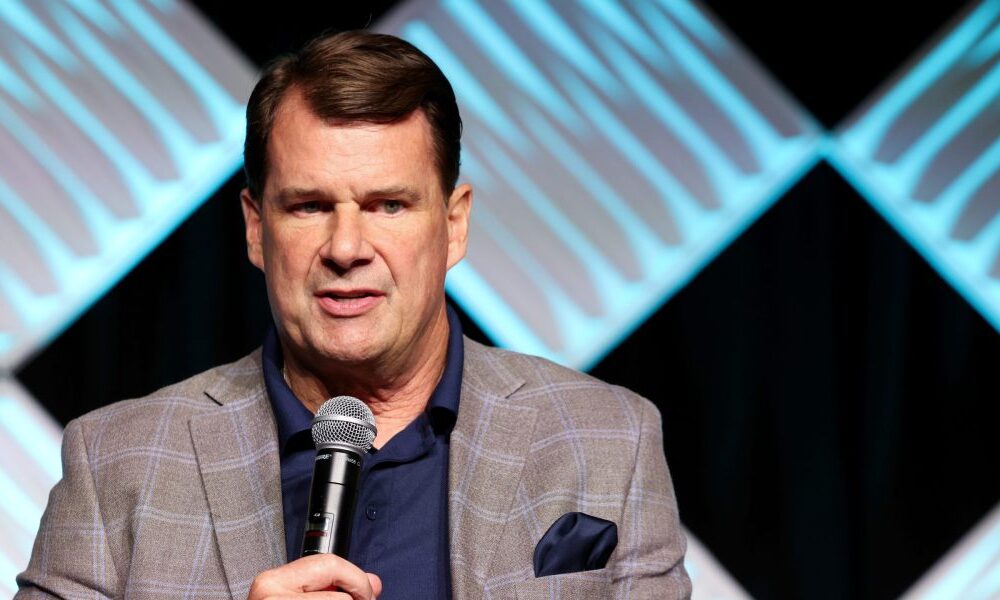
The United States can’t actualize its moonshot AI goals if it’s lacking key workers to bolster the infrastructure to build the technology, according to Ford CEO Jim Farley.
With AI predicted to balloon to a $4.8 trillion market by 2033, Farley warned the U.S. has overlooked the labor needed to build and sustain data centers and manufacturing facilities. While President Donald Trump imposed sweeping tariffs to revive factory jobs, there continues to be recruitment and retention problems in U.S. manufacturing.
“I think the intent is there, but there’s nothing to backfill the ambition,” Farley told Axios in September 2025. “How can we reshore all this stuff if we don’t have people to work there?”
Farley’s concern about staffing AI data centers and factories is part of what he identifies as a crisis affecting the “essential economy” of blue-collar workers making up $12 trillion in U.S. GDP, per the Aspen Institute. The Ford CEO has said that AI could wipe out half of white-collar jobs, while creating mass demand for skilled trades.
But the labor force to fill this growing clamor for workers isn’t there, Farley said. The country is short 600,000 factory workers and 500,000 construction workers right now, and will need 400,000 auto technicians over the next three years, he wrote in a LinkedIn post in June 2025.
Analysts have attributed this shortage to an aging domestic workforce, as well as restrictive immigration policies limiting population growth. Farley blames a lack of awareness surrounding the shortage.
For its part, Ford announced last month it would scrap the rollout of some of its larger EV models and repurpose a Kentucky battery factory to manufacture batteries for data centers and large-scale industrial customers.
“We all sense that America can do better than we are doing,” Farley said at the Aspen Ideas Festival last June. “We need a new mindset, one that recognizes the success, the importance of this essential economy and the importance to our vibrancy and sustainability as a country.”
AI infrastructure labor shortage
This labor shortage is already being felt in the AI sector. Dame Dawn Childs, CEO of Pure Data Centres Group, a U.K.-based data center operator, said while data center demand is booming, a shortage of construction workers is hampering expansion plans.
“There’s just not enough skilled construction workers to go around,” she told the BBC last year.
In addition, data centers are also struggling to carry out specialized functions because of shortages in skilled labor. Uptime Institute, IT service management firm, found in a 2020 survey of data center operators that half were experiencing challenges finding candidates for open positions, compared to 38% in 2018. An April 2025 Deloitte report found this problem has persisted, with 51% of 120 surveyed U.S.-based power company and data center executives saying a shortage of data center related skilled labor was a “core challenge.” More than 60% of respondents said it was their top challenge.
The scarcity is beginning to hit even the largest tech companies. Oracle has delayed the completion dates of some of the data centers its developing for OpenAI from 2027 to 2028 due to labor shortages, as well as a lack of materials, Bloomberg reported in December, citing anonymous sources. Meanwhile, demand for computational data centers continues to skyrocket, projected to require $6.7 trillion in global capital expenditure between now and 2030, according to McKinsey. Large cloud service providers called hyperscalers are expected to spend $300 billion in 2025 alone.
“On the surface, this looks like a people problem, and most are,” Farley told Axios. “But it’s actually not that simple. It’s an awareness problem. It’s a societal problem.”
Farley said solving the labor shortage will also require policy changes. He has advocated for increased investment in vocational training and apprenticeship opportunities, as well as pro-trade policies and capacity-building regulatory reform.
“If we are successful—when we are successful—we’ll take on bigger, higher-class problems,” he said. “Right now, the problems we’re trying to solve are pretty practical. I need 6,000 technicians in my dealerships on Monday morning.”
A version of this story originally published on Fortune.com on September 29, 2025.
More on Ford CEO Jim Farley: