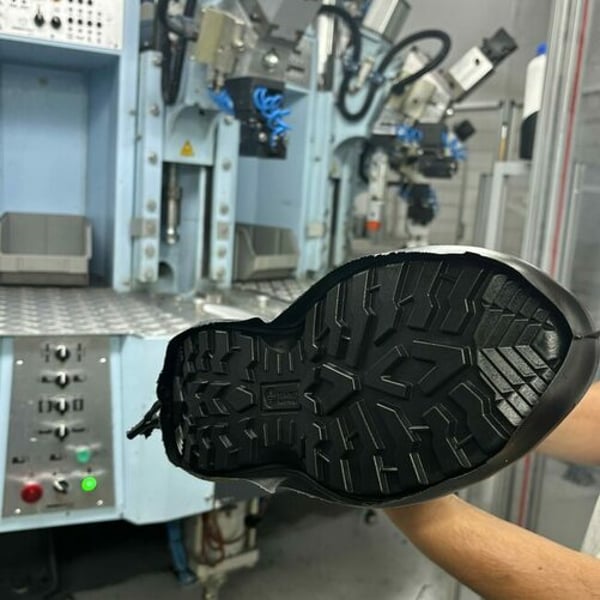
Home to one of Europe’s leading footwear production clusters, Portugal is sought after above all for its leather shoes, which in 2023 accounted for 71% of its exports. The sector not only aims to go further by diversifying the destination of its production but also intends to multiply its growth options. To this end, it has invested in technological development to strengthen its presence in segments such as technical and professional footwear.
Companies such as Carité are investing heavily in new production solutions, particularly with the support of the FAIST project.
Industry looks to technical and professional footwear for growth
With its sights set on these segments, the industry aims to double exports of technical footwear to reach 100 million euros by 2030.
Reinaldo Teixeira, president of the Footwear Technology Center, stressed in a statement issued by APICCAPS that “Portugal already has all the conditions to establish itself as a benchmark in the development of technical footwear,” adding: “We have the knowledge, the installed capacity, and we are prepared to expand our offer, even in the military segment.”
The military segment is, in fact, one of the sector’s big bets in the field of professional footwear. Luís Onofre, president of the Portuguese Association of Footwear, Components, Leather Goods and Their Substitutes (APICCAPS), believes that the expected increase in investment in defense, considering the current world scenario, represents “an opportunity” for the sector.
“Portugal has a long tradition of supplying the main European security and military forces,” he recalled, adding that the “reinforcement of NATO countries’ defense budgets could be an opportunity” for the Portuguese industry.
Sector invests 50 million euros with FAIST project
As this is a more demanding segment in technical terms and in terms of certifications, in order to consolidate and expand its horizons in this type of footwear, the Portuguese cluster has invested in initiatives that cover the industry as a whole.
The sector looks to technological development for growth
The FAIST (Acronym for Agile, Intelligent, Technologically Sustainable Factory) mobilizing project was born precisely with the aim of developing cutting-edge technology capable of providing companies with the best technical solutions to respond to the market. As part of the PRR (Recovery and Resilience Program), it brings together 44 partners and brings with it an investment of 50 million euros to enrich the sector “with innovative technologies, processes, and sustainable materials, increasing its ability to respond to market demands and continuing to make the Portuguese footwear and leather goods industry the most modern in the world.”
Led by the company Carité and technically coordinated by the CTCP (Footwear Technology Center of Portugal), the consortium involved in the FAIST project brings together 14 footwear and leather goods companies, nine component companies, 15 technology-based companies, and six associative entities from the scientific and technological interface, which have come together to invest in the “development of robotic and automated production processes, production management and control software, in parallel with the development and production of new types of ecological and sustainable products.” In more precise terms, the consortium has committed to developing 34 pieces of equipment, 20 software solutions, five integrated production lines, more than 15 innovative footwear products and components, and three pilot experimentation and demonstration units.
With companies such as Carité and AMF committed to developing technical and professional footwear, particularly using new automated production solutions, or Fernando Ferro developing and producing automation lines to equip the major players in the sector, Portuguese footwear has taken consistent steps to assert itself beyond the boundaries of classic models made from leather.
The CTCP is the only place in Portugal where companies can certify their footwear, an essential step in technical models
Florbela Silva, FAIST’s coordinator, believes that the project “is repositioning the Portuguese footwear industry internationally”: “Re-industrialization and the use of high productivity processes are allowing companies to manufacture faster and at competitive prices, managing to enter the large distribution chains, particularly in the more technical segments.”
An industry with an international outlook
In 2024, the Portuguese footwear cluster (which includes footwear, components, and leather goods companies) generated 2.2 billion euros, with footwear accounting for 77% of exports, leather goods (bags and accessories such as belts) for 19% and components for 4%.
Exporting 90% of its production to over 170 countries, almost 80% of the sector’s output is destined for the European Union, with Germany leading the way (23%), followed by France (19%) and the Netherlands (12%).
The efforts to diversify Portuguese footwear have also involved diversifying the countries of destination. Currently, the United States is the largest market for Portuguese footwear outside Europe, accounting for 5.2% of the cluster’s exports, which have also invested in Asian and Latin American markets to reduce dependence on Europe and multiply growth opportunities.
This article is an automatic translation. Click here to read the original article.
“It is with great pleasure that we announce Micaela Oliveira, the celebrated Portuguese designer, as one of the featured couturières at the Saudi Arabia Creative Women Forum 2025 Gala Dinner and Awards Ceremony,” the organisation declared on its social media channels, in a post also shared on the designer’s Instagram account, announcing the tribute at the event held on November 6 at the National Museum in Riyadh. The evening opened with an address by Princess Noura bint Saud bin Naif bin Abdulaziz Al Saud, patron of the Forum and founder of Saudi Fashion Week, followed by a runway show by the Portuguese designer, celebrating the rich traditions of this enchanted kingdom.
Lux
The publication further notes that the Trofa-born couturière “grew up surrounded by fabrics, prints, and creativity- a world that has shaped her lifelong devotion to fashion,” and that over the past 20 years she has “built an extraordinary career defined by elegance, daring, and refinement, consolidating her name among the leading designers of wedding dresses and haute couture,” the statement continues.
“Her creations- a harmonious blend of sophistication, sensuality, and femininity- embody her belief that each dress should tell a story, evoke emotion, and reflect the unique essence of the woman who wears it,” reads the message shared simultaneously on the Forum and the eponymous designer’s Instagram accounts.
“Guided by the values of exuberance, creativity, and impeccable craftsmanship, Micaela’s creations blend classic beauty with contemporary art, achieving a timeless charm,” the post adds, highlighting “a vision that transcends borders” that “continues to enchant the global fashion world, transforming dreams into haute couture masterpieces that celebrate individuality and the eternal elegance of femininity.”
Lux
For her part, Micaela Oliveira expressed her gratitude for the honour at the Saudi Arabia Creative Women Forum 2025 Gala Dinner and Awards Ceremony, which took place in Riyadh, the capital and principal financial centre of Saudi Arabia: “It was a privilege, as a designer, to travel to the Kingdom of Saudi Arabia, where I was honoured before members of international royalty and government representatives at a truly magnificent awards ceremony,” she said in a statement quoted by Lux.
“This prestigious award was presented to me by Her Royal Highness Princess Noura bint Saud bin Nayef bin Abdulaziz Al Saud, a pioneering woman and a leading figure in the Kingdom’s artistic community. I had the great honour of presenting a fashion show celebrating the rich traditions of this remarkable country during the Creative Women Forum 2025 Gala Dinner and Awards Ceremony.”
Instagram
“We are delighted to announce the return of the Creative Women Forum in Riyadh, which will take place from November 4–6, 2025, under the esteemed patronage of Her Royal Highness Princess Noura bint Saud bin Nayef Al Saud,” announced Creative Women Platform on Instagram. “This year’s forum will be held at the iconic Princess Nourah bint Abdulrahman University- the largest women’s university in the world.”
“A powerful stage for a global gathering of visionary women,” it continues. “Join us for three transformative days filled with innovative leadership, inspiration, and ground-breaking ideas, as we explore creativity, entrepreneurship, sustainability, and the future of women in leadership.”
This time, the experience culminated in a fabulous gala dinner and awards ceremony, “celebrating the brilliance of the women who shape our world,” concludes Creative Women Platform, on its social media.
This article is an automatic translation. Click here to read the original article.
British footwear brand Clarks is celebrating its 200th anniversary this year. In Italy, the brand is marking the bicentennial by opening a pop-up space within the Candiani Denim Store, in piazza Mentana 3 in Milan, where customers are able to personalise their Clarks shoes throughout December.
Clarks shoes can be personalised at the Candiani Denim Store in Milan – Clarks
From December 2 to 9, the Milanese store by Candiani, a premium Italian denim producer with its own jeans line, is hosting a Clarks pop-up shop. Visitors will have the opportunity to explore the British footwear brand’s history, its signature models, and learn about some of the leading figures who have worn Clarks and helped define its identity, influencing generations. A documentary about Clarks’s 200 years in business, entitled From Somerset to the World, will be screened inside the pop-up shop. The shop will showcase a selection of Clarks Originals models, including the Wallabee, Desert Boot and Desert Trek, as well as several items from the Fall/Winter 2025-26 collection, reinterpreting materials, shapes and colours with a contemporary feel.
In parallel with the pop-up shop (where a special event was staged on Thursday December 4), throughout December the Candiani Denim Store is giving Clarks customers the chance to create a personalised version of their shoes, choosing from two Clarks Originals models, the Wallabee and the Desert Boot. The limited-edition shoes will feature a personalised denim fob, and customers will be able to choose from an extensive library of patterns and designs. The motif chosen will be lasered directly on to the shoes at Candiani Custom, the denim brand’s urban micro-factory for bespoke jeans located next to the store.
FashionNetwork.com has had the opportunity to talk about Clarks’s distribution plans in Italy with Fabio Antonini, CEO of 3A, the company that has been distributing the British brand’s men’s and women’s lines since the Fall/Winter 2025-26 season.
FashionNetwork.com: Clarks has been busy overhauling its retail presence in Italy. What are the implementation steps, and what have the initial results been?
Fabio Antonini: Unlike the previous distributor, whose strategy was chiefly aimed at monobrand stores, we have rejigged Clarks’s distribution model by focusing on the wholesale channel and on a strong presence in multibrand stores. This is enabling us to rapidly extend our territorial footprint, making the brand more accessible and better integrated within the Italian market.
Fabio Antonini, CEO of 3A
FN: How many more Clarks corners are you planning to open in 2026 in Italy? And what about Clarks’s monobrand presence? Are you considering other initiatives like the one with Candiani?
FA: We currently don’t have any plans for new corners or monobrand stores. Our strategy is focused on the wholesale channel and multibrand retailers. The initiative with Candiani was developed as a special project to celebrate Clarks’s 200th anniversary. Over the next few years, we will assess new collaborations and special projects, in line with the brand’s future requirements. FN: In how many multibrand stores is Clarks currently distributed, and how many more are you planning to reach?
FA: In 2025, we have made Clarks available at 433 clients for a total of 619 doors [in Italy]. Next year, we’re expecting to grow the number of clients served by approximately 10%. FN: Clarks recently announced and deployed a strategy designed to boost its position in global e-marketplaces, is it also being implemented in Italy?
FA: Clarks’s new global strategy is set to make the brand even more accessible and reachable by online consumers. Its expanded presence on new global marketplaces is making Clarks easier to access in Italy too, strengthening its online presence and making it easier for consumers to buy. FN: What revenue result did 3A reach in fiscal 2024, how much did it grow by, and what is your forecast for 2025?
FA: In 2024, 3A generated a revenue of approximately €110.3 million, up 4.84% over the €105.2 million recorded in 2023. We’re expecting to grow at a similar rate in 2025.
Clarks
FN: Have there been new entries or other changes within 3A’s brand portfolio?
FA: Yes, there have been changes. Our portfolio includes underwear by Nike, Jordan, Calvin Klein and Tommy Hilfiger, as well as footwear and other products by Clarks, Converse Shoes, Nike Swim, Nike, Jordan, Converse Apparel Kids, Lacoste Kids, Huggies Apparel and Crep Protect.
We’re pursuing a strategy aimed at introducing new lines with a distribution exclusive, to further enrich our portfolio also in terms of brand quality. Some new lines will feature as early as spring 2026.
Brand background
Clarks was founded in Street, Somerset, in 1825, when Cyrus Clark opened a tannery with his brother James. It began shoemaking by using leather offcuts to create slippers. In 1950, Clarks created the revolutionary Desert Boot shoes. Since then, Clarks has built an archive of over 22,000 models that have been worn across generations all over the world.
In fiscal 2024, Clarks’s parent company C&J Clark Ltd reported a revenue drop of 9.4%, to £901.3 million (approximately €1.07 billion), and a pre-tax loss of £39.3 million. This led the company to overhaul the Clarks brand, cutting overheads, modifying the marketing approach, and repositioning the range. The brand’s retail strategy too has been reappraised, streamlining the store fleet and developing initiatives like the Milanese pop-up store.
Clarks, in typically innovative fashion, is also expanding its online presence with several new launches on global e-tailers like Shein, Walmart, Target, Secret Sales and TikTok Shop. In the UK, Clarks has recently been introduced on Shein and Secret Sales, while in Europe it will be available at Secret Sales Netherlands and Dress for Less later this year. In the Americas, it has been featured on eBay for the last five years, and has recently reached Shop Simon, Shein and Walmart, while it will be available on Target this month.
Clarks has recently returned to Tottenham Court Road in London, with a new retail concept – Clarks
Clarks is also aiming to consolidate its presence on TikTok Shop. It launched on the Chinese social shopping channel in Singapore and Malaysia last year, and this year it has reached the UK and the Americas, with Europe set to follow in 2026. This expansion drive follows the September announcement of the first Clarks-owned digital marketplace, which is set to be launched in the UK in early 2026.
Candiani is an Italian family company founded in 1938 and based in Robecchetto con Induno, near Milan, in the Ticino Park Nature Reserve. Besides owning the store in piazza Mentana in Milan, with the Candiani Custom micro-factory for bespoke jeans, Candiani owns among others the patent for Coreva, the first and only biodegradable and compostable stretch denim available on the market.
Another creative director departure at a major brand is shaking up the fashion industry. It is now the turn of Austrian designer Norbert Stumpfl to leave Brioni. The label has just confirmed the end of its collaboration with the designer in a statement. Stumpfl had designed Brioni’s collections for the past seven years.
The fashion house founded in 1945, which in 1952 became the first menswear brand to stage a fashion show (in Florence’s legendary Sala Bianca), has expressed its “deep gratitude for the contribution he has made over the years. During his tenure at Brioni, Norbert interpreted with precision the concepts of lightness and discretion, contributing to the evolution of the men’s wardrobe with a modern approach that pays homage to tradition,” Brioni said.
Federico Arrigoni, CEO of Brioni, said, “Our journey continues, and the Maison will continue to consolidate its tradition- perfection of craftsmanship, exceptional materials, and innovation in tailoring techniques- to create true masterpieces, from formalwear to leisurewear and accessories. Brioni pursues its mission of defining the contemporary codes of Italian elegance, while elevating its mastery of high tailoring and bespoke craftsmanship for those who lead and accept nothing but the exceptional.”
Since 2011, Brioni has been part of the Paris-based French luxury group Kering. From 2018 until his departure, the brand’s collections were designed by Norbert Stumpfl, the acclaimed Austrian menswear couturier, celebrated for his blend of impeccable tailoring and cutting-edge fabrics- among his creations were dinner jackets woven with 24-carat gold threads and enzyme-treated silk-linen blends with a soft, distinctive handle. During his tenure, Brioni also expanded masterfully into womenswear, expressing discreet luxury with rare aplomb.
A pinnacle of Roman sartorial luxury, the Italian label marked its 80th anniversary in late November with an exhibition of its superb tailoring and a gala dinner at the Chiostro del Bramante in Rome.
This article is an automatic translation. Click here to read the original article.