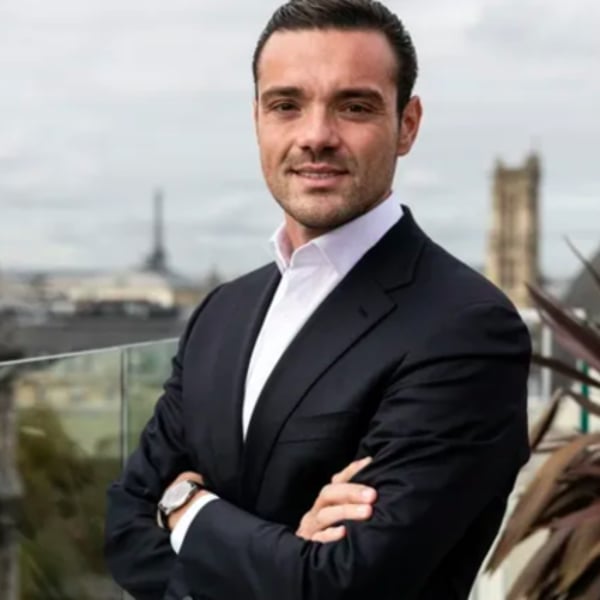
Under fire since his alliance with Shein, Frédéric Merlin, the young head of BHV whose rise has been meteoric, admits he “underestimated” the challenge posed by the Paris department store, but stands by his strategy, intended to “keep retail alive.”
Frédéric Merlin, president of Société des Grands Magasins (SGM) and owner of BHV, during a photo shoot in Paris, 22 October 2025. – (AFP – Thibaud MORITZ)
“I always try to be humble, because at 34, you don’t know everything,” the executive recently told AFP during an interview on the sixth floor of the Bazar de l’Hôtel de Ville.
It is here that Shein, the Asian e-commerce giant accused of unfair competition and environmental pollution, is due to open its first permanent shop on Wednesday, under an agreement with Société des Grands Magasins (SGM), the commercial property company founded in 2021 by Frédéric Merlin and his sister, Maryline.
Originally from the Lyon region and raised by a father who ran a small industrial piping business and a stay-at-home mother, the siblings’ fortune is estimated at €600 million, ranking them 233rd in France, according to Challenges.
A “friend” of former president Nicolas Sarkozy, Merlin benefited from the financial backing of businessman Jean-Paul Dufour, a shareholder alongside SGM with “a 42.5% stake in the majority of the group’s subsidiaries,” according to its latest social report published in August 2024, as noted by L’Express.
“Ocean liner”
The owner of the BHV business since 2023, SGM also operates a dozen shopping centres, as well as seven Galeries Lafayette stores in the provinces, five of which are set to host Shein.
In protest, several brands have announced they are leaving the Paris department store, already shunned by suppliers unhappy about a build-up of unpaid invoices, which Merlin says are linked to “tools” issues that are being resolved, and not to cash-flow problems.
Dropped by Banque des Territoires (an entity of Caisse des Dépôts et Consignations) for the acquisition of the BHV building, SGM has also been excluded from the Union du grand commerce de centre-ville (UCV), while the Galeries Lafayette group refuses to allow Shein to set up in stores bearing its name.
“Who would want to work with a pathological liar?” said Yann Rivoallan, president of the Fédération Française du Prêt-à-Porter Féminin, on RMC.
Merlin “is not collaborative”, Nicolas Bonnet-Oulaldj, the deputy mayor of Paris in charge of commerce, told AFP.
“He told everyone that he had the support of Anne Hidalgo regarding Shein, which is totally false.” More generally, Merlin didn’t realise he was taking on “an ocean liner”, according to the department store’s inter-union body.
“What I underestimated was all the political and media attention that comes with taking on this Paris monument right opposite City Hall,” admits Merlin, denouncing the “surrounding hypocrisy” in the face of Shein and its many consumers.
“Head of the family”
“We could have done better,” admits the man who says he has made BHV “profitable” and works “14 hours a day.”
Born in the Lyon suburb of Vénissieux, Merlin grew up in a family that gave him “self-confidence” and “entrepreneurial drive.” After a spell at law school, the young man obtained a BTS in property, having been drawn to the profession during a placement.
Armed with a “€15,000 student loan,” he and his sister founded, at the age of 20, a commercial property consultancy (IMEA) before launching another (ADI) in 2014, specialising in the redevelopment of commercial buildings.
The Merlins hired their father, who brought his “industrial rigour,” until his death in 2018, the year SGM was launched, turning around shopping centres that nobody wanted any more in towns such as Roubaix or Mulhouse.
“You had to have a lot of nerve,” recalls Fabrice Fubert, co-director of a commercial property consultancy, who notably suggested in 2021 that Merlin acquire seven Galeries Lafayette stores.
Not “from the establishment,” Merlin is “an audacious man who takes risks and shakes things up,” as when he brought in Pokémon or YouTuber Squeezie for pop-up shops at BHV, says Fabrice Fubert.
The father of a young boy, Merlin asserts his role as “head of the family,” putting himself on the front line to “protect” his sister and his mother, Dominique, SGM’s deputy managing director.
This article is an automatic translation. Click here to read the original article.
It looks like Frasers Group may be planning to relaunch Matchesfashion in 2026 although it’s not a dead cert and there’s been no confirmation from the company.
Matchesfashion
A report said the Matchesfashion.com website was back online with the words “relaunching 2026” under the name. But the situation is unclear as all that’s there as we published this story was an almost-empty page in the brand’s familiar green tone with no mention of a relaunch date.
A relaunch wouldn’t exactly come as a shock, although the speed with which Frasers had earlier closed the business did surprise some.
Frasers acquired the business out of administration for a reported £52 million just before Christmas 2023 but put it into administration in March 2024, citing the enormity of the task to turn it around.
Matches — which began as a physical retailer — had been one of the pioneers of luxury online retail and once had a valuation of around £800 million. But a succession of CEOs failed to turn it into a digital-first business that was able to make a profit.
Its struggles came at the same time as other pioneers such as Farfetch and Net-A-Porter encountered their own profitability problems.
But despite the problem with online luxury real, the big names in the sector remain valuable properties with a high profile. Coupang’s acquisition of Farfetch and LuxExperience’s purchase of Yoox Net-A-Porter highlighted how in-demand they are.
As for Matchesfashion, there had been rumours of a comeback for it and in May, The Times reported that Frasers was working on a “members-only Matches Fashion relaunch” and that it had seen an “internal pitch deck” suggesting the luxury fashion webstore could be turned into what it described as the “Soho House of retail”.
LVMH Moët Hennessy Louis Vuitton presented its first Life 360 Awards to recognise environmental progress in the group, in the same week as it celebrated earning the coveted CDP triple ‘A’ score.
A snapshot of LVMH’s Life 360 Awards – Lucas Barioulet
Held inside LVMH’s global HQ on Paris’ Avenue Montaigne on Wednesday evening, the group presented awards to 13 winning initiatives. These were selected from 187 submitted projects by 41 Maisons in a carefully staged presentation designed to highlight the environmental transformation undertaken by LVMH.
Teams from LVMH brands from several continents joined via video link- from Tiffany in New York and Chandon in Sao Paulo to Loro Piana in Milan and champagne marques gathered in Epernay.
“The Life 360 Awards illustrate how our Maisons are advancing the group’s environmental roadmap. This collective momentum confirms that these issues are at the very heart of our strategy… The winning initiatives point us in a clear direction: a responsible form of luxury, underpinned by concrete and ambitious action,” said Antoine Arnault, image and environment, LVMH, and the driving force behind the project.
Arnault, eldest son of LVMH’s chairman and controlling shareholder Bernard Arnault, in particular celebrated that LVMH had again been recognised with a CDP triple ‘A’ rating for its action on climate, forests, and water.
The giant French luxury behemoth underlined that its Life 360 environmental program (LVMH Initiatives For the Environment), is structured around five pillars: Climate, Biodiversity, Creative Circularity, Traceability & Transparency, and Stakeholders. With the group keen to publicly highlight successful initiatives and results.
All told, it claimed to have achieved a 55% reduction in its direct greenhouse gas emissions, reaching its 2026 target two years ahead of schedule. The preservation and regeneration of more than 3.8 million hectares of natural habitats. An increase to 33% in the share of recycled materials used in products and packaging. And the reduction of around one-third in its indirect emissions.
“The award-winning initiatives reflect the quality of the work carried out collectively around Life 360. They demonstrate tangible progress and create genuine momentum across the group by encouraging the sharing of the most effective solutions between our Maisons and with our supplier partners,” said Hélène Valade, environmental development director, LVMH.
The winning projects were selected by a jury composed of Group executives and experts.
Among the winners, Tiffany & Co. installed significant solar capacity at the Maison’s diamond cutting and polishing facility in Botswana, reducing greenhouse gas emissions, as well as training and hiring local craftspeople for the project.
Moët Hennessy reduced its transport-related carbon footprint, by notably increasing the share of maritime and rail transport. That led, in 2025, to a reduction of nearly 50% in transport-related carbon emissions compared with 2019.
Other awards went to Celine, Louis Vuitton, Rimowa, Chaumet, Christian Dior Couture, and Christian Dior Parfums, the latter for an ambitious strategy aimed at gradually phasing out virgin fossil-based plastics from customer.
While Guerlain played on its historic links to bees in an awareness-raising initiative on the role of these insects, delivered by employees and aimed at primary-school pupils around the world. And, via Women For Bees, a program in partnership with UNESCO enabling women to become beekeepers.
In terms of transparency, Bulgari dreamed up its own Digital Passport, via micro-engraving on each creation, readable via a smartphone scan using Al- revealing gemmological certificates, origin, and craftsmanship.
In addition to these awards, the jury presented a special ‘coup de cœur’ Prize to Moët Hennessy in recognition of its Living Soils, Living Together program, where the Champagne and Wines & Spirits labels work to reduce their environmental footprint.
Among which, Château Galoupet, a Cru Classé Côtes de Provence acquired by LVMH in 2019, has already been certified organic since 2023- deploying a regenerative viticulture approach. Covering crops on 100% of the vineyard, more than 2.6 km of agroforestry hedgerows, regenerative hydrology structures, increased soil organic matter, and the installation of numerous shelters for biodiversity.
If at times, the mood seemed a tad self-congratulatory among LVMH executives, one was also struck by the sense that the Group’s senior management had put real pressure on many brands to come up with genuine environmentally friendly solutions. Which made the whole event a plausible reason for applause and optimism.
In a move that celebrates the house’s Italian roots, Pucci is setting course for Sicily to unveil its new collection, ‘L’Alba.’ The fashion show will be held on April 17 at an as-yet-unspecified location on the island, where artistic director Camille Miceli intends to fuse Mediterranean light with the Maison’s vibrant aesthetic.
Emilio Pucci – Courtesy of Emilio Pucci Archive
“Sicily possesses a magnetic energy that aligns perfectly with the Pucci spirit,” said the designer. “The collection is an even deeper exploration of movement, colour, and rhythmic silhouettes, elements that will be heightened by this evocative experience.”
‘L’Alba’ promises to be a celebration of awakening and the first light of day, a moment when “a psychedelic night dissolves into the glow of the morning.” The collection will reinterpret Pucci’s stylistic codes through vibrant graphic motifs, reimagined archival prints, and refined textures.
In keeping with trending see-now-buy-now strategies, the collection will be available to purchase immediately after the conclusion of the fashion show.
The initiative aims to keep the excitement of the event alive, while also offering an immediate ‘souvenir’ of the Sicilian experience and reaffirming the indissoluble bond between the Maison and Italy.
This article is an automatic translation. Click here to read the original article.