In 2025, South Korean fashion takes another step up on the global stage. In a sector where technological innovations are redefining production processes, South Korea stands out for its ability to turn these developments into drivers of growth and global appeal, according to a Spherical Insights study published in November.
South Korean menswear makes its mark internationally, seen here at Pitti Uomo – Pitti Uomo
According to the South Korean Ministry of Trade, Industry and Energy (MOTIE), almost $27 million is set to be invested in 2025 to strengthen the national textile value chain.
This policy forms part of a broader strategy that provides more than $19 billion in support for firms operating in industrial textiles, the creation of an Industrial Textile Alliance, and a certification centre for technical products. The aim is to lift digital transformation across the sector from 35% to 60% and increase South Korea’s share of the global markets for industrial and sustainable textiles from 2-3% to 10% by 2030.
A dynamic domestic market
These ambitions are underpinned by an already robust industry. In 2024, South Korea imported $12.37 billion worth of clothing, including $5.08 billion in menswear. Exports totalled almost $2 billion, of which $1.7 billion comprised synthetic textiles and crocheted fabrics. This momentum reinforces a domestic market characterised by diverse demand, rapid trend adoption and strong cultural influence.
South Korea invests in its textile industry – Shutterstock
At the heart of this evolution lies the global rise of Korean menswear. Korean brands stand out for their attention to detail, mastery of cut and tailoring, and a strong appetite for exploring experimental materials, bold silhouettes and assertive colours. This stylistic approach, oscillating between minimalism and exuberance, meets a growing demand for pieces capable of expressing individual identity, according to the study.
Exports to be developed
The trends for 2025 confirm this direction: oversized cuts, unique patterns, bright colours, sustainable materials, a fusion of traditional and contemporary styles, as well as layering, athleisure and gender-fluid fashion, are at the forefront. From oversized kimono-polos to two-tone pink shirts, the Korean aesthetic offers a balance of comfort, experimentation and sophistication.
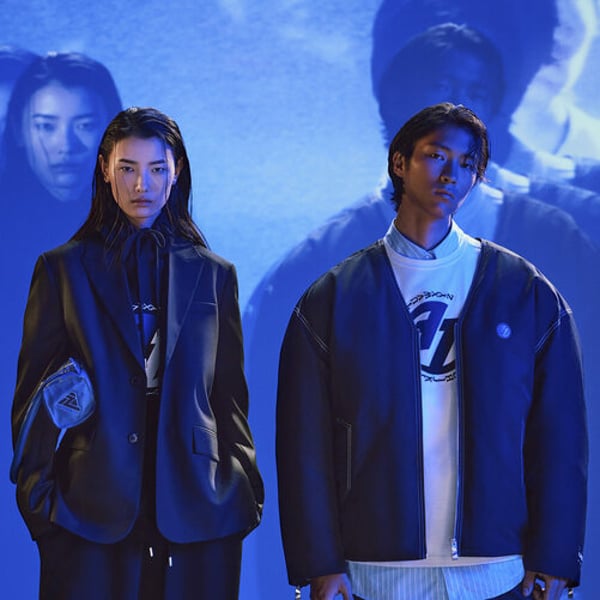
Ader Error is one of the young South Korean brands flourishing internationally (here, its collaboration with Zara) – Zara
This creative ecosystem is supported by a myriad of ‘flagship’ brands. Names already recognised worldwide such as Gentle Monster, Andersson Bell, Kusikohc, Hyein Seo and We11done fuel the country’s international aura through their distinct worlds, blending art, streetwear, craftsmanship and conceptual design. In 2025, other labels are taking centre stage: Ader Error and its deconstructivist streetwear, Wooyoungmi and its modern tailoring, ThisIsNeverThat and its distinctly Korean take on streetwear, as well as 87MM, Recto, Amomento, PushButton and Minjukim, whose gender-fluid offerings are gaining visibility.
By combining massive public investment, a capacity for innovation, cultural richness and creative power, South Korea is putting its fashion industry on an upward trajectory in 2025. It can be seen not only as an exporter of aesthetics, but also as a key player in technical and sustainable textiles, with the ambition of playing a central role in contemporary global fashion.
Bulgari has named Laura Burdese, a 10-year veteran of LVMH, to be the famed jewellery brand’s CEO, though her appointment is only effective from July 1, 2026. Burdese succeeds Jean-Christophe Babin and will report to Stéphane Bianchi.
Laura Burdese is Bulgari’s new CEO – Bulgari
“I am very proud of this smooth transition from one great leader to another. For the past three years, Laura and Jean- Christophe have worked side by side to sustain and orchestrate the brand elevation of the iconic Roman jewellery Maison. The nomination of Laura, while opening a new chapter for Bulgari, is a tribute to her strong contribution and accomplishments,” said Stéphane Bianchi, LVMH group managing director and CEO of LVMH watches and jewellery, in a release.
Burdese began her career in the LVMH Group as CEO for Acqua di Parma, before joining Bulgari in 2022 as chief marketing officer. After leading the brand transformation and elevation over recent years, she was promoted to deputy CEO in July 2024.
“Jean-Christophe has shaped the success of TAG Heuer and Bulgari while creating unique paths within their respective industries. I am confident that in his new missions, he will bring the same energy and keep on supporting LVMH and its maisons thanks to his extraordinary vision,” Bianchi added in a release.
Babin will step down as CEO of Bulgari after more than 25 years in the giant luxury group, first at TAG Heuer and then at Bulgari. Under his leadership, the maison underwent a profound transformation, reclaiming its unique position as the quintessential Roman high jeweller. He also spearheaded Bulgari’s advancements in watchmaking and expanded Bulgari into the luxury hospitality industry with new hotels in major global cities.
Babin also demonstrated a strong commitment to Italian craftsmanship, evidenced by the inauguration of a new factory extension in Valenza and the launch of the Scuola Bulgari. Babin will continue to serve as chairman of the Bulgari Board, CEO of the Bulgari Hotel Business Unit, and president of the Bulgari Foundation. He will also report to Bianchi.
Burdese started her career in the beauty industry, holding brand management positions at Beiersdorf and L’Oréal. In 1999, she joined the Swatch Group as marketing director Italy, before doing management stints at Klein Watch and Jewelry and Swatch Group’s Italian subsidiary. In addition to this role in 2012, she was named president and CEO of Calvin Klein Watch & Jewelry Co. Ltd.
In October 2016, she joined LVMH as president and CEO of Acqua di Parma. In 2022, Burdese was appointed vice president of marketing and communications at Bulgari, before being appointed deputy CEO in 2024. She holds a degree in International Economics from the University of Trieste and a Master’s degree in Marketing and Communication.
In 2025, Vivaia is betting on the world’s fashion capitals. After establishing itself in New York and then London, the footwear brand has opened its second French store, on the outskirts of Paris at the Westfield Les 4 Temps shopping centre in La Défense. Inaugurated on December 9, this new location follows the first Parisian boutique, opened in 2024 at the Carrousel du Louvre, and underscores the brand’s strategy to expand its physical retail footprint. The Les 4 Temps boutique spans 135 square metres and offers the full range of Vivaia collections.
Vivaia boutique at Les 4 Temps – DR
The brand was founded in 2020 by Marina Chen, who had previously worked in fashion at Camuto Asia, and Jeff Chan, a Chinese entrepreneur who describes himself as the co-founder of the Nordace travel backpack brand. The duo envisioned a direct-to-consumer (DTC) brand with a focus on using recycled materials. The brand says it works with certified suppliers, including Repreve, to transform recycled PET plastic bottles into yarn used in the manufacture of its shoes. Production also relies on 3D knitting technologies, helping to reduce waste and incorporate recycled materials into the collections.
Marina Chen, co-founder of Vivaia – Vivaia
Since its launch, Vivaia has developed more than 200 models, from ballet flats to trainers, Mary Janes, and boots, with a particular emphasis on sole comfort and the fit of elastic uppers.
The brand has been accelerating its global roll-out, appointing Howard Herman as managing director in 2022. A former executive at Li & Fung Limited, the global supply-chain giant, he brings expertise in retail development and international strategy.
Vivaia is operated in Europe by London-based Stroud International. However, the brand rights are held by Shenzhen Starlink Network Technology Co (Starlink), a Chinese company specialising in international e-commerce. Established in Shenzhen around 2016–2017, the company, led by co-founder John Lau, was conceived as a platform for creating consumer brands to be sold directly and via marketplaces outside China, particularly in the US and Europe. Starlink, not to be confused with the company behind SpaceX, is therefore the parent of the Vivaia women’s footwear brand, as well as an athleisure label called Fanka. In 2021, the group received strategic investments from ByteDance, owner of TikTok, and Sequoia Capital, giving it the means to accelerate its global expansion.
Today, Vivaia does not disclose its turnover, but according to several media outlets it generated around €180 million in 2024. The brand is now present in 61 countries, with two directly operated stores in France and 75 internationally, including Milan and Rome, as well as in key Asian cities such as Tokyo, Manila, Singapore, Taipei, Hong Kong, Macau, and Kuala Lumpur.
In the US, the brand is stocked by major department store chains Dillard’s and Von Maur. Still absent from China, like Shein, the brand has also recently entered new markets such as Brazil and Australia, a sign of its ambition for international expansion.
This article is an automatic translation. Click here to read the original article.
Zara has become the latest fast-fashion retailer to use AI to help create new images of real models in different outfits, speeding up the production process as part of an industry shift that could have a major impact on fashion photography.
Inside a Zara store
Zara’s AI experimentation follows Swedish rival H&M, which earlier this year said it had created AI clones of models to use in marketing. European online fashion retailer Zalando is also using AI to create imagery faster.
“We are using artificial intelligence only to complement our existing processes,” a spokesperson for Zara owner Inditex said in a statement. “We work collaboratively with our valued models- agreeing any aspect on a mutual basis- and compensate in line with industry best practice.”
Zara’s move was first reported by London business-focused newspaper CityAM, which cited an unnamed model saying Zara asked for approval to edit images of them with AI to show different items, and that they were paid the same amount as if they had travelled for another photo shoot.
H&M and Zalando, like Inditex, have said AI would complement their creative teams’ processes and help them be more efficient rather than replacing them, downplaying the risk to photographers and production teams who work on fashion shoots. Inditex chair Marta Ortega, daughter of the founder Amancio Ortega, has spoken in interviews about her passion for fashion photography.
Since 2021 her MOP (Marta Ortega Perez) Foundation gallery in A Coruna, the town in northern Spain where Zara was founded, has hosted exhibitions showcasing the work of major photographers. It is currently showing Annie Leibovitz’s fashion photography, and previous exhibitions have spotlighted photography greats Steven Meisel– with whom Zara has worked extensively- and Helmut Newton.
Ortega has tried to move Zara upmarket, cutting store numbers to focus on fewer, bigger flagships with a more spacious, sophisticated feel. Isabelle Doran, CEO of the Association of Photographers in London, said the use of AI would reduce the number of times photographers, models, and production teams are commissioned, impacting a whole ecosystem of established professionals as well as early-career fashion photographers trying to get a foothold in the industry.