
Politics
Florida’s voucher program at a crossroads


What if a state program were bleeding billions of taxpayer dollars, providing funds to nearly anyone who applied, with minimal oversight?
Fiscal conservatives would demand immediate intervention. They would call for rooting out waste, fraud, and abuse, insist on accountability from those in power, and demand swift action to protect public money.
While much public attention has focused on charter school expansion, including Schools of Hope, this discussion concerns a different program altogether: Florida’s rapidly expanding, taxpayer-funded voucher program.
That program, particularly the unchecked growth of the Family Empowerment Scholarship (FES), now allows public dollars to fund private school and homeschool education on an unprecedented scale.
State officials tout a budget surplus, but independent analysts project that an additional $4–5 billion in annual voucher spending will lead to an imminent budget deficit.

The findings of a recent independent audit of FES are alarming. It examined what happens to these public funds and whether they truly “follow the child,” as Floridians were repeatedly promised.
They did not.
The auditor general was blunt: “Whatever can go wrong with this system has gone wrong.”
The audit raises more questions than answers:
— Why would state legislators steer a previously healthy state budget toward a projected deficit?

— Why is the state unable to account for roughly 30,000 students — representing approximately $270 million in taxpayer dollars — on any given day?
— And why is voucher spending deliberately obscured from public scrutiny by burying it in the public-school funding formula?
According to auditors, Florida’s voucher program has grown faster than the state’s ability to manage it. They identified gaps in real-time tracking, limited verification of eligibility and enrollment, and financial controls that have failed to keep pace with explosive growth.
These are not minor administrative errors; they are flashing warning lights.
Waste, fraud, and abuse are not partisan concerns; they are fiscal ones. Any government program that cannot clearly show where public dollars are or whether they are used appropriately represents a failure of the Legislature’s duty to safeguard taxpayer funds.
It is also important to be honest about what voucher growth truly represents. Despite frequent claims of a mass exodus from public schools, data show that roughly 70%of voucher recipients in recent years were not previously enrolled in public schools.
This is not a story of families fleeing public education. It is a story of public dollars being quietly redirected away from it.
That distinction matters because Florida’s public School Districts remain subject to strict accountability standards that do not apply to private or homeschool programs that receive voucher funds. Public schools must administer state assessments, publish performance data, comply with open-records laws, and undergo regular financial audits.
Public education across Florida is not stagnant. School Districts are actively innovating while serving as responsible stewards of public dollars by expanding career pathways, strengthening partnerships with local employers and higher education, and adapting to an increasingly complex choice landscape. When Districts are supported by stable policy and predictable funding, they lead.
But choice only works when transparency and quality accompany it. If state dollars support a student’s education, those dollars should be accompanied by state-level accountability, including meaningful oversight and participation in statewide assessments.
State dollars should meet state standards.
The audit also makes clear that technical fixes alone are insufficient. As long as voucher funding remains intertwined with public school funding formulas, billions of dollars in voucher spending will remain obscured from public scrutiny. The program must stand on its own.
Florida’s fiscally conservative Senators recognized this reality when they introduced SB318, a bipartisan bill to implement the auditor general’s recommendations and bring transparency and fiscal responsibility to school choice. The House must now follow suit.
Families like mine value school choice. But without meaningful reform, the current system is not financially sustainable.
Fiscal responsibility and educational opportunity are not competing values. Floridians must insist on both.
___
Liz Barker is a Sarasota County School Board member.
Politics
Tucker Carlson takes Ron DeSantis to task for ‘foreign policy stuff’ and antisemitism legislation
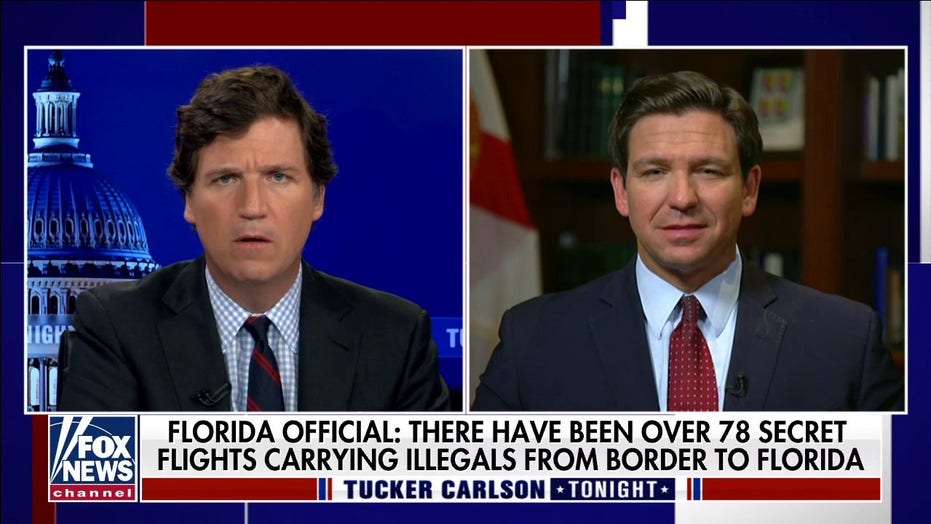
Just a few short years ago, Gov. Ron DeSantis often went on Tucker Carlson’s show on Fox News to make news.
But more recently, the politician and the commentator couldn’t be farther apart, as evidenced by Carlson’s recent interview with gubernatorial candidate James Fishback.
Carlson said he was “out” on the man who previously was a featured guest in the A-Block of his prime time show for his shifting positions on the Ukraine War and his signing of a bill that protected people, including Jews, from being harassed for wearing traditional clothes, from having images projected on their buildings, from having trash dumped on their property, and from being harassed at schools or while sitting Shiva.
“I always admired DeSantis certainly during COVID. I thought he was just a remarkable leader, interviewed him many times. I know him and his wife. And it was the foreign policy stuff that made me wonder, like, what is this and how controlled is he by Ken Griffin and the rest of his donors? And then he had this moment where he signed a hate speech law out of the country. He flew to a foreign country, Israel to sign a hate speech law for Florida. And I thought, well, this is obviously unconstitutional. It’s immoral, but it’s also part of an elaborate humiliation ritual where you have to go not just like enslave your own people with a hate speech law, which that is slavery.”
Carlson had previously said Griffin “told (DeSantis) to change his view on Ukraine from ‘It’s a regional conflict we shouldn’t get involved in’ to ‘It’s a super important thing. We should send more money.’”
DeSantis originally deemed the war a “territorial dispute” and not one of America’s “vital national interests” in a statement provided to Tucker Carlson, in a seeming effort to curry favor with the now-former Fox News host.
He soon enough walked that position back, telling Piers Morgan “it wasn’t that I thought Russia had a right to that, and so if I should have made that more clear, I could have done it.”
He would go on from there to call for a “settlement” in the war, before a spirited exchange in July with Carlson in Iowa at the Family Leadership Summit.
DeSantis took issue with Carlson saying he changed his position from telling Carlson that the Russian invasion was a simple “territorial dispute,” rejecting Carlson’s restatement of DeSantis’ position as changing his view “to describe Putin as a war criminal and say that it was central to America’s foreign policy.”
DeSantis has responded to Carlson’s “bizarre” attacks on him as a “pure puppet … totally a marionette of his donors,” calling him irrelevant and saying that when Carlson “lost the Fox show, (DeSantis) kind of lost track of what he was doing.”

As U.S. seizures of Venezuela-linked oil tankers surge, concerns grow in Cuba about whether the island’s government and economy will survive.
Experts warn that a sudden halt in Venezuelan oil shipments to Cuba could lead to widespread social unrest and mass migration following the stunning U.S. military raid that resulted in the capture of former President Nicolás Maduro.
“I’d be lying if I told you that I don’t want to leave the country,” said 16-year-old Cuban student Amanda Gómez. “We’re all thinking about leaving, from the youngest to the oldest.”
Long before the Jan. 3 attack, severe blackouts were sidelining life in Cuba, where people endured long lines at gas stations and supermarkets amid the island’s worst economic crisis in decades.
The lack of Venezuelan oil could push Cuba over the brink, experts say.
“This will take an already dire situation to new extremes,” said Michael Galant, senior research and outreach associate at the Center for Economic and Policy Research in Washington, D.C. “This is what a collapsing economy looks like.”
Galant said he believes that’s the goal of the Trump administration: “to cause such an indiscriminate suffering in the civilian population as to instigate some sort of uprising, regime change.”
“This sort of besiegement of Cuba is very intentional. Will it work from their perspective? I think that the Cuban people have experienced suffering for a very long time, and the Cuban government is very well versed in how to handle these situations,” Galant said. “I think it’s very difficult to predict what will and will not spark actual regime instability. From the perspective of (U.S. Secretary of State Marco ) Rubio, it’s a sort of wait them out. … There’s always a breaking point.”
From 2020 to 2024, Cuba saw its population drop by 1.4 million, which experts largely attribute to migration spurred by the worsening crisis.
Juan Carlos Albizu-Campos, a Cuban economist and demographics expert, noted that while Cubans with means have already left, migration will continue.
“Fuel is a factor that affects everything,” he said. “People are going to feel that they are in worse conditions, and people who hadn’t considered leaving will feel the need to do so.”
At the Spanish embassy in Havana on Friday, Ernesto Macías, a 53-year-old doctor, stood in line behind dozens of people to request a family member visa for his daughter, having already obtained his Spanish citizenship.
“I wouldn’t want Cuba to be invaded or anything like that. I hope it doesn’t happen, but I’m sure people will continue to emigrate because there is no other way,” he said.
Cuba’s gross domestic product has fallen 15% in the last six years, and President Miguel Díaz-Canel noted in December that there was a 4% decrease in 2025 alone.
Although the Cuban economy never fully recovered after the fall of the Soviet Union in the 1990s, it experienced relative prosperity between 2000 and 2019, fueled by a boom in tourism and exports of services, nickel, rum and tobacco.
Then the COVID-19 pandemic hit, and coupled with a radical increase in U.S. sanctions under Trump’s second administration to pressure for political change – stifling every imaginable sector – Cuba’s crisis erupted with force.
Through it all, Cuba remained dependent on Venezuela for oil, receiving an estimated 35,000 barrels a day from the South American country before the U.S. attacked, along with some 5,500 barrels daily from Mexico and roughly 7,500 from Russia, according to Jorge Piñón, of the Energy Institute at the University of Texas at Austin, who tracks shipments using oil tracking services and satellite technology.
Even with all those shipments, blackouts persisted, experts noted.
“An indefinite shutdown of the electrical system, which is no longer so impossible to imagine, can be envisioned under a total suspension of oil shipments from Venezuela, which seems to be the current strategy of the American government,” said Jorge Duany, with the Cuban Research Institute at Florida International University.
“It would lead us to imagine the possibility of mass protests,” he said.
Andy S. Gómez, retired dean of the School of International Studies and senior fellow in Cuban Studies at University of Miami, said that even if protests do occur, he doesn’t envision the downfall of Cuba while Raúl Castro is still alive and running the military.
“Are they concerned? You bet,” Gómez said. “They’re not well armed; their equipment is outdated.”
But Gómez noted that civilians aren’t armed, and that it’s unlikely one of the three factions of Cuba’s army would break with the ruling elite.
“At the end of the day, someone is going to have to take the big pill, and it’s either going to be Díaz-Canel or (Prime Minister) Manuel Marrero Cruz for not being able to solve the problems,” Gómez said.
____
Republished with permission of the Associated Press.
Politics
Nick DiCeglie, Danny Alvarez file bill to require unified 911 call centers in every Florida county

Sen. Nick DiCeglie and Rep. Danny Alvarez have filed legislation that would require Florida counties to consolidate emergency call handling into a single, unified 911 center per county.
If approved, SB 1586 and HB 1427 would require each county or region to transition to a single 911 center. More than 25 Florida counties – including Pinellas, Pasco, Leon and St. Lucie counties – already successfully operate some form of unified 911 and dispatch centers.
Counties would have until Jan. 1, 2027, to submit a plan outlining how their unified 911 center would operate under the legislation. Counties would be required to certify that all emergency calls are being dispatched through a single, fully unified system by 2029. If a county fails to meet the planning deadline, authority over 911 services would default to the local Sheriff’s office.
“When someone dials 911, they are most likely having the worst moment of their life,” Brevard County Sheriff Wayne Ivey said in a statement. “Representative Alvarez’s and Senator DiCeglie’s bill strengthens our emergency services, eliminates unnecessary delays, and ensures law enforcement and first responders have a seamless delivery of services that will no doubt enhance response times and ultimately save lives. This is exactly the kind of leadership and common sense Florida needs to keep our communities safe!”
Alvarez said Florida’s current system is fragmented and inefficient, arguing that consolidation can reduce costs and improve response times.
“Proven models in Pinellas, Pasco, Leon and St. Lucie counties show consolidation reduces response times, cuts costs, and provides peace of mind to people who need emergency services to answer the call,” Alvarez said. “This plan modernizes the way we respond to current threats like active shooters, terrorist attacks and other bad actors, in a way that maximizes first responder safety and response to citizens’ needs.”
DiCeglie said the bill is meant to ensure first responders have the tools they need to respond quickly when seconds matter.
“Updating Florida’s 911 system is long overdue, and it is incredibly important work,” DiCeglie said. “When someone calls 911, every second counts, and making that system faster and more reliable can truly mean the difference between life and death. This legislation helps ensure our first responders have what they need and that Floridians get help as quickly as possible when it matters most.”
Alvarez said the proposal should garner non-partisan support, as simplifying the 911 system should improve chances of saving lives because of less delay.
“Public safety is nonpartisan,” he said. “When Floridians call 911, they deserve a world-class system without delays or response-delaying transfers. Besides being important for intake of information and response within a county when a large-scale emergency takes place, unification is one of the recommendations of the Marjorie Stonemen Douglass committee. It is time to act. ”



No, Trump can’t use example of fraud in Minnesota to block childcare subisidies to 5 blue states, judge says

Guess Who This Proud Grandpa Is!

‘The Thing’ Actor T.K. Carter Dead at 69
-

 Politics8 years ago
Congress rolls out ‘Better Deal,’ new economic agenda
-
Entertainment8 years ago
New Season 8 Walking Dead trailer flashes forward in time
-
Politics8 years ago
Poll: Virginia governor’s race in dead heat
-
Entertainment8 years ago
The final 6 ‘Game of Thrones’ episodes might feel like a full season
-
Politics8 years ago
Illinois’ financial crisis could bring the state to a halt
-
Entertainment8 years ago
Meet Superman’s grandfather in new trailer for Krypton
-
Business8 years ago
6 Stunning new co-working spaces around the globe
-
Tech8 years ago
Hulu hires Google marketing veteran Kelly Campbell as CMO