Connect with us

Business

Florida’s ‘Treasure Coast’ yields long-lost Spanish hoard worth $1 million

Published

on


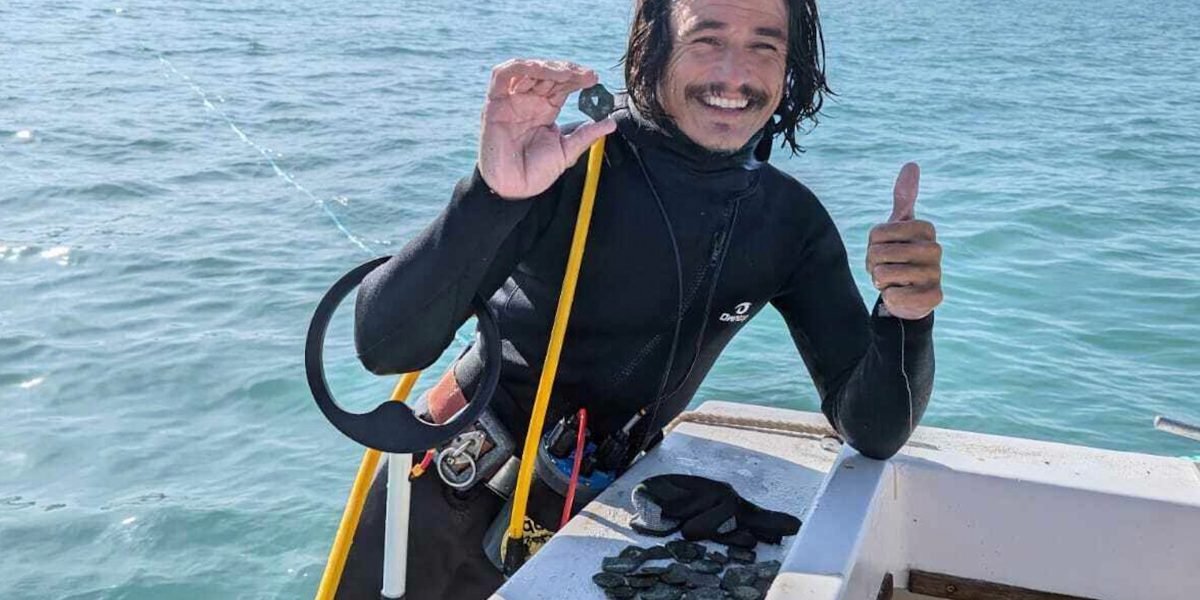
Hidden beneath the turquoise waters off a stretch of Florida known as the “Treasure Coast,” a team of divers from a shipwreck salvage company have uncovered exactly that — a load of long-lost Spanish treasure they estimate is worth $1 million.

More than 1,000 silver and gold coins thought to be minted in the Spanish colonies of Bolivia, Mexico and Peru were uncovered this summer off Florida’s Atlantic coast, 1715 Fleet – Queens Jewels LLC announced this week.

It’s not the first time the site has yielded a trove of, well, treasure.

Centuries ago, a fleet of Spanish ships laden with gold, silver and jewels taken from the New World was sailing back to Spain when a hurricane wrecked the flotilla on July 31, 1715, spilling the treasures into the sea, according to the 1715 Fleet Society.

Over the years, millions of dollars in gold coins from the 1715 Fleet have been found by salvagers and treasure hunters in a coastal area stretching from Melbourne to Fort Pierce.

Dates and mint marks are still visible on some of the recently recovered coins, the salvage company said, a benefit for historians and collectors hoping to glean more from the lost treasure.

“This discovery is not only about the treasure itself, but the stories it tells,” Sal Guttuso, director of operations for the salvage company said in a statement. “Each coin is a piece of history, a tangible link to the people who lived, worked, and sailed during the Golden Age of the Spanish Empire. Finding 1,000 of them in a single recovery is both rare and extraordinary.”

Guttuso’s team employs dive crews and a fleet of boats and uses underwater metal detection-devices, plus hand-fanning of sand or sand suction to comb the sea floor, according to a public notice for a federal permit application the company filed.

Last year, Florida officials announced they had recovered dozens of gold coins stolen by salvagers from the wreck. The suspect was identified as a family member of the team contracted by 1715 Fleet – Queens Jewels LLC to work the site.

Under Florida law, any “treasure trove” or other historic artifacts “abandoned” on state-owned lands or in state waters belong to the state, though excavators can be permitted to carry out “recovery services.” The law requires that roughly 20% of the recovered archaeological materials be retained by the state for research collections or public display.

Guttuso told The Associated Press his team develops a detailed inventory of all the artifacts collected each season to be reviewed by the state. Florida officials select up to 20% of the items to keep for the public, in a negotiation process that is ultimately approved by a federal court. Remaining artifacts are split equally among the salvage company’s owners and its subcontractors, Guttuso said.

“We want to do it right,” Guttuso said.

“And it benefits the people of Florida. They end up in the museums,” he said of the treasures.

___

Kate Payne is a corps member for The Associated Press/Report for America Statehouse News Initiative. Report for America is a nonprofit national service program that places journalists in local newsrooms to report on undercovered issues.

Fortune Global Forum returns Oct. 26–27, 2025 in Riyadh. CEOs and global leaders will gather for a dynamic, invitation-only event shaping the future of business. Apply for an invitation.


Source link

Continue Reading

Business

Davos 2026: reading the signals, not the headlines

Published

on


Davos 2026: reading the signals, not the headlines | Fortune

Louisa Loran advises boards and leadership teams on transformation and long-term value creation and currently serves on the boards of Copenhagen Business School and CataCap Private Equity. At Google, Louisa launched a billion-dollar supply chain solutions business, doubled growth in a global industry vertical, and led strategic business transformation for the company’s largest customers in EMEA—working at the forefront of AI, data, and platform innovation. At Maersk, she co-authored the strategy that redefined the brand globally and doubled its share price, helping pivot the company from traditional shipping to integrated logistics. Her career began in the luxury and FMCG space with Moët Hennessy and Diageo, where she built iconic brands and led innovation at the intersection of heritage and digital transformation.


Source link

Continue Reading

Business

Hotels allege predatory pricing, forced exclusivity in Trip.com antitrust probe

Published

on


China’s hotels are welcoming record numbers of travelers, yet room rates are sinking—a paradox many operators blame on Trip.com Group Ltd.

For Gary Huang, running a five-room homestay in the scenic Huzhou hills near Shanghai was supposed to secure his family’s financial future. Instead, he and other hoteliers in China’s southeastern Zhejiang province say nightly rates have fallen to levels last seen more than a decade ago, as Trip.com’s frequent discount campaigns force them to cut prices simply to remain visible on China’s dominant booking platform.

“The promotion campaigns now are almost a daily routine,” said Huang, who asked to use his self-given English name out of concern of speaking out against Trip.com. “We have to constantly cut prices at least 15% to attract travelers. We have no choice but to go along with the price cuts.”

Trip.com has been central to China’s post-pandemic travel rebound, connecting millions of travelers with small operators like Huang. But for many hotels, visibility—and sometimes survival—comes at the expense of profits.

That dynamic is now at the heart of Beijing’s antitrust probe. Regulators allege Trip.com is abusing its market position, with analysts citing deflation across the sector as the government’s main concern. Interviews with lodging operators, industry groups and travel consultants describe a system where constant price-cutting and opaque policies are eroding profitability, even as demand rebounds.

Trip.com has said it’s cooperating with the government’s investigation. The company’s stock dove more 16% since the probe was announced a week ago. 

Revenue per room—a key hotel metric—was flat across China in 2025, even as other Asian markets saw gains, according to Bloomberg Intelligence. Marriott International Inc.’s revenue per room in China fell 1% most of last year, while Hilton’s China room revenue trailed its regional peers.

The company controls about 56% of China’s online travel market, according to China Trading Desk, and has grown into the world’s largest booking site. Its dominance has helped fuel domestic tourism’s recovery—nearly 5 billion trips were logged in the first three quarters of 2025—but operators say the benefits are being offset by falling room yields.

“The market has developed unevenly and innovation is lacking due to monopolistic practices,” said He Shuangquan, head of the Yunnan Provincial Tourism Homestay Industry Association that represents some 7,000 operators. “The entire online travel agency sector is stagnating in a pool of dead water.”

‘Pick-one-of-two’

The broader challenge is oversupply and cautious consumer spending. In regions like Yunnan, hotel capacity has tripled since the pandemic, just as travelers tightened budgets. Consultants note that while people are traveling more, they’re spending less—leaving hotels slashing rates to fill empty beds and posting billions in losses.

For operators like Huang, the paradox is stark: the platform that delivers customers is also accelerating the race to the bottom. The complaints center around Trip.com’s “er xuan yi,” Mandarin for pick-one-of-two exclusivity arrangements—a practice that Chinese regulators have repeatedly vowed to stamp out.

Trip.com categorizes merchants into tiers with “Special Merchants” enjoying the most visibility and traffic, Yunnan Provincial Tourism’s He said. However, these top-tier merchants are typically prohibited from listing on rival platforms like Alibaba’s Fliggy, ByteDance’s Douyin or Meituan. Merchants who aren’t bound by these exclusive arrangements report being effectively compelled to offer the lowest prices on Trip.com’s online booking platform Ctrip, or risk facing a raft of measures like lowered search rankings.


Source link

Continue Reading

Business

CEOs at Davos are buying into the agentic AI hype

Published

on


Good morning. The atmosphere here at the World Economic Forum in Davos is all about nervous excitement as the Trump administration descends on the normally quaint but currently chaotic ski town in the Alps.

President Donald Trump will be making remarks just a couple hours from now, and Fortune will be reporting live from USA House on the main promenade, with insights from government officials and chief executives during and immediately following the president’s conversation. Keep an eye on our livestream, here https://fortune.com/2026/01/21/ceos-davos-buy-into-the-agentic-ai-hype/.

Elsewhere around town, CEOs are setting their agendas for the year. Here’s what’s top of mind for a few of them:

This will actually be the year of agentic AI. The first time I heard the term “agentic AI” was at Davos last year. For all the hype around it, does the average CEO really know what it is or how to deploy it? And is AI good enough yet for agents to replace or even significantly assist human employees? The answer appears to be yes. Google Gemini head Demis Hassabis told me that Gemini 3 achieved some milestones that allow agentic AI to truly proliferate in terms of its capabilities. ServiceNow CEO Bill McDermott is also an emphatic “yes,” and says he is already using it to do things like automate his IT department (without doing layoffs, he stresses; he says he has repurposed employees instead). He thinks other CEOs are ready to do the same.

Get ready for Google glasses—for real, this time. A decade ago, Google launched its Google Glass eyewear to widespread mockery. Hassabis thinks the timing was just off; at the time there was no super app to go on the platform. AI has changed that, and Hassabis is bullish on Gemini glasses being the future form for consumer AI. Meta is betting the same thing, and OpenAI is also reportedly considering a super-device, but it doesn’t seem like either can match Gemini’s capabilities any time soon.

There’s artificial intelligence, and now there’s also “energy intelligence.” Schneider Electric CEO Olivier Blum says that nailing energy intelligence is his mission this year. By that he means he wants to capture data from various energy sources into a single “data cube,” filter it, and use agentic AI so customers can manage it all in one place to find opportunities to save power and money. “Our job is to make sure we go to the next level of energy technology to make energy more intelligent,” he told me yesterday. If he can achieve it, he sees a 7%-10% annual growth opportunity ahead.

Greenland: national panic or national security risk? I’ve heard various reactions to President Trump’s desire for a full U.S. takeover of the huge islandfrom outrage to vigorous support. If he does get his wish (which some here think is likely), could Europe retaliate by making life harder and more restrictive for big U.S. tech companies? That was one CEO’s consideration. Said another: “Clear-eyed people can agree that that is a national security concern. And having a national security concern is not just a U.S. concern, it’s also a NATO concern.” They were optimistic that the in-person meetings this week would help move the matter in a positive direction. You can follow all our Davos coverage—including Fortune live interviews today with Ray Dalio, Dara Khosrowshahi and more—right here.—Alyson Shontell

Contact CEO Daily via Diane Brady at diane.brady@fortune.com

Top news

The crisis CEOs can’t ignore

The annual Edelman Trust Barometer, revealed at Davos every year, shows an “insular” mindset permeating the business world, with 70% of respondents not wanting to talk to, work for, or even be in the same space with anyone with a different world view. Richard Edelman says CEOs must adopt a sense of urgency in addressing the crisis; they need to sense that “time is running out.”

The Fortune 2026 World’s Most Admired Companies list

Fortune published the 2026 World’s Most Admired Companies this week, an annual ranking in collaboration with Korn Ferry that surveys executives, directors, and analysts across a range of industries. Apple made the top of the list among leaders in all industries for the 19th year in a row—read who else made the cut.

Netflix co-CEOs boost the case for the Warner Bros. deal

Netflix co-CEOs Ted Sarandos and Greg Peters praised the streaming company’s planned acquisition of Warner Bros. Discovery during its earnings call on Tuesday, selling the deal as a boost to its streaming business and a production boost for America. Investors, however, remain worried that the deal will push Netflix away from its core business, and the stock dropped almost 5% after hours.

The markets

S&P 500 futures are up 0.19% this morning. The last session closed down 2.06%. STOXX Europe 600 was down 0.41% in early trading. The U.K.’s FTSE 100 was down 0.02% in early trading. Japan’s Nikkei 225 was down 0.41%. China’s CSI 300 was up o.09%. The South Korea KOSPI was up 0.49%. India’s NIFTY 50 was down 0.3%%. Bitcoin was at $89K.

Around the watercooler

What Walmart’s CEO succession reveals about the smartest time to exit by Ruth Umoh

Americans are paying nearly all of the tariff burden as international exports die down, study finds by Jacqueline Munis

The 9 most disruptive deals of Trump’s first year back in the White House by Geoff Colvin

Gen Z’s nostalgia for ‘2016 vibes’ reveals something deeper: a protest against the world and economy they inherited by Nick Lichtenberg and Eva Roytburg

CEO Daily is compiled and edited by Joey Abrams, Claire Zillman and Lee Clifford.


Source link

Continue Reading

Trending

Copyright © Miami Select.