Tourism isn’t just an industry in Florida — it’s the lifeblood of the state.
From the beaches of Miami to the theme parks of Orlando, Florida’s identity and economy are inseparable from its ability to attract visitors from around the world. And nothing symbolizes that legacy more powerfully than Miami Beach’s iconic Fontainebleau Resort.
That’s exactly why legislation (HB 399) sponsored by Rep. David Borrero — and a recently approved amendment to it — deserves support, not skepticism.
The amendment would require local governments to administratively approve certain variances for large-scale destination resorts, provided the improvements align with existing codes. For the Fontainebleau, currently seeking approval for a stunning renovation to its outdoor pool deck and the addition of a world-class, family-friendly entertainment experience, this bill couldn’t be more timely.
And here’s a question worth asking: Why is this even a controversy in the first place?
Seventy years of improvement, and suddenly it’s a problem?
Since its grand opening in 1954, the Fontainebleau has been one of the most celebrated and visited resorts on the planet. Frank Sinatra performed there. Presidents have stayed there. And in those seven decades, the resort has renovated and reimagined its iconic pool area and backyard amenities not once, not twice, but six times.
Six renovations. Six modernizations. Six moments where the Fontainebleau invested in its product, elevated the guest experience, and delivered economic dividends to Miami Beach and the state of Florida.
Nobody stopped the clock then. Nobody cried preemption. Nobody organized opposition.
So why now? What is fundamentally different about a seventh round of improvements — improvements that don’t expand the footprint, don’t touch the historic Morris Lapidus architecture, don’t add density, and don’t generate a single additional car on surrounding streets?
The answer, unfortunately, appears to be a vocal minority with influence over an unelected historic preservation board that seems more interested in governing by sentiment than by statute.
The Legislature’s intent is clear — and correct
The amendment to Borrero’s bill is explicit about its purpose.
“It is the intent of the Legislature to promote and sustain national and international tourism to this state by encouraging the ongoing maintenance, renewal, renovation, and improvement of large destination resorts,” the legislation now reads.
That’s not bureaucratic boilerplate. That’s a declaration of values — a recognition that Florida’s tourism economy, which supports millions of jobs and generates tens of billions of dollars in revenue annually, requires a regulatory environment that encourages investment rather than strangling it in red tape and neighborhood politics.
Tourism is the heart and soul of Florida. It is the engine that powers Miami Beach. And the Fontainebleau, celebrating its eighth decade as one of the most recognized resort brands on earth, is the crown jewel of that engine. When an iconic institution like this one seeks to modernize in ways that fully comply with existing codes, the default answer from government should be yes — swiftly and without drama.
Instead, the Fontainebleau finds itself navigating a process where an unelected historic preservation board has already delayed a vote once, while objections pile up from opponents who apparently want one of the world’s great resorts frozen in amber.
Let’s be clear about what this project is — and isn’t
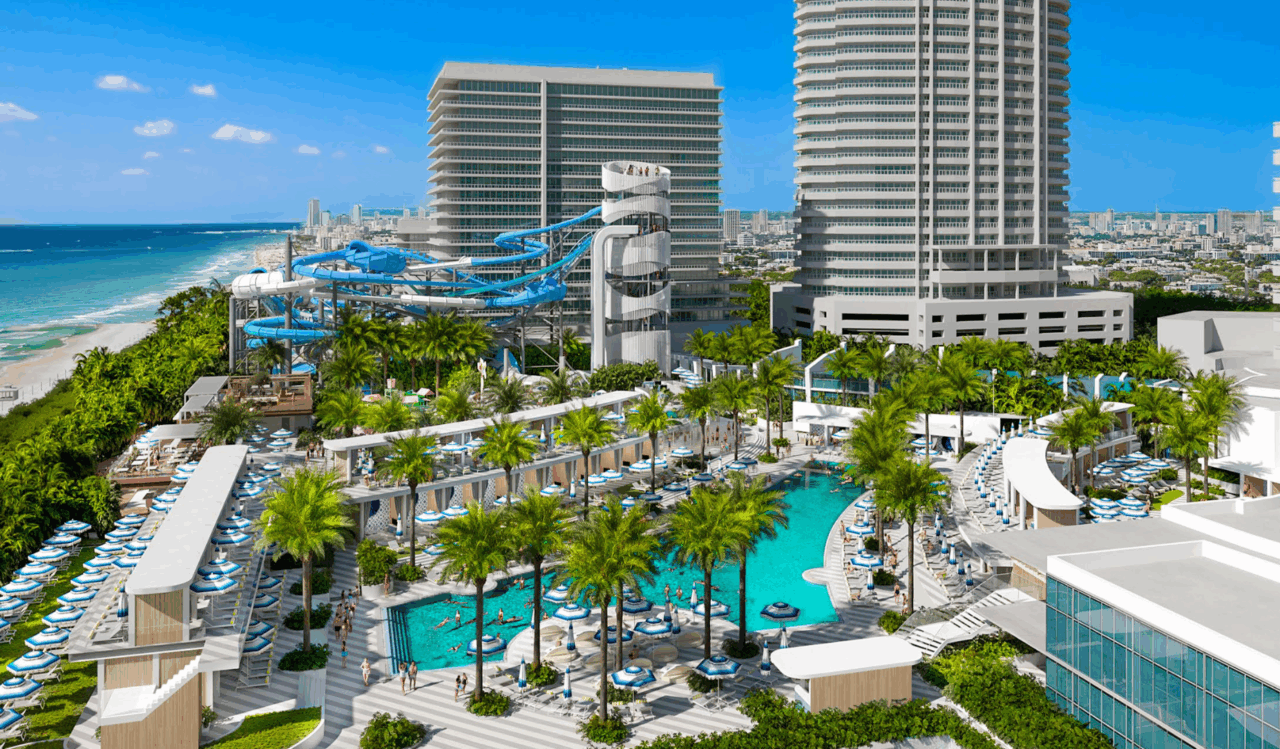
The proposed improvements are straightforward and compelling: all-new pools and water features, exhilarating slides and family attractions, elevated food and beverage offerings, and upgraded poolside entertainment — all designed to complement the resort’s existing luxury character and iconic aesthetic.
What this project is not is equally important. It does not alter the historic Fontainebleau building, a registered landmark that remains fully protected and explicitly excluded from administrative approval under Borrero’s bill. It does not expand the resort’s physical footprint. It does not rezone anything. It does not increase traffic — every amenity is a private, guest-exclusive experience, meaning guests who are already on property stay on property.
The only variances needed are minor: one to use turf rather than grass, and one for sidewalks in a setback to access the slide area. These are not controversial asks. They are routine accommodations in support of improvements that any reasonable person reviewing the project would approve.
The economic case is overwhelming
The Fontainebleau project isn’t just good for the resort — it’s good for Miami Beach and good for Florida. Hundreds of new jobs across construction, hospitality and operations will be created. The project will spur increased spending at nearby restaurants, retailers and businesses. And it will create a strengthened position for Miami Beach as a premier family-friendly destination in a competitive global tourism marketplace.
As the first large-scale family entertainment attraction of its kind on Miami Beach, this project has the potential to draw an entirely new category of visitor to the area — families who previously might have chosen other states or international destinations over South Florida.
That’s new money. New jobs. New tax revenue. All flowing from a resort that has been a cornerstone of Miami Beach’s economy for 70 years.
Preemption isn’t always a dirty word
Critics have seized on the word “preemption” as if it ends the debate. It doesn’t.
Florida preempts local authority all the time — when doing so advances a compelling statewide interest. Protecting and promoting Florida’s tourism economy, which is the backbone of the state’s financial health, is about as compelling as it gets.
And let’s contextualize the concern: The amendment would not strip Miami Beach’s elected government of authority. It would streamline a process currently bottlenecked by an unelected board of appointees applying subjective standards to a project that already meets every applicable code.
If Miami Beach’s leaders won’t protect the interests of the institutions that power their economy, it’s entirely appropriate — and necessary — for state lawmakers to step in.
Florida built its legacy on tourism — it’s time to protect it
The Fontainebleau has been reinventing itself since Dwight D. Eisenhower was in the White House. It has survived recessions, hurricanes and shifting travel trends by doing exactly what great institutions do: investing, improving and adapting. Borrero’s legislation ensures Florida’s regulatory environment is a partner in that mission, not an obstacle to it.
Approve the bill. Support the project. And let the Fontainebleau do what it has done for 70 years: show the world why Florida is the greatest tourism destination on earth.