Florida’s wildlife watchdog agency is being accused of muzzling its critics online, with activists and residents accusing it of quietly scrubbing negative comments and blocking users from its social media accounts in a possible First Amendment violation.
Instagram and Facebook users say their comments have disappeared from Florida Fish and Wildlife Conservation Commission (FWC) posts.
They also complain that many of the comments were removed even though they complied with FWC’s official code of commenter conduct, which frequently accompanies the agency’s posts.
An Aug. 29 post by Instagram user @Florida_Legacy_has served as a repository for recent complaints about issue. In one reply to the post, Sanford resident Connor McGuire said FWC has repeatedly blocked him.
“I guess old Rodney had a temper tantrum again,” McGuire wrote, adding that he believes he was blocked because Barreto dislikes being called out for “his conflict of interest.” Barreto, among other things, invests in real estate development, an industry that can sometimes conflict with environmental conservation.
Army combat veteran Solomon Wisewrote that FWC has been blocking people and deleting comments “for quite a while.” He said the agency was “especially” active in doing so in 2023 amid backlash over its officers killing dozens of captive snakes at a South Florida reptile facility.
Brent Fannin, a drone pilot and filmmaker, forwarded to Florida Politics a June 4 email he sent Barreto asking that he and “all other blocked accounts” have their access restored, citing First Amendment concerns.
He never got a reply.

“Our comments have always complied with the page’s code of conduct,” Fannin said in the email. “I can only assume our account was blocked due to the viewpoint expressed in those comments.”
FWC’s Social Media Comment Policy, last updated in 2023, states the agency “reserves the right” to remove or hide posts containing vulgar language, libel, explicit content, threats and harassment.
Other comments warranting removal, the policy says, include anything that is “clearly off topic” or “repetitive.”
FWC appears to have been liberal in applying its rules. In response to one Aug. 28 Facebook post by the agency, a counter showed 102 comments had been made by Friday afternoon. Seventy-four were visible.
Of the 82 visible comments across both posts, just two included negative statements about FWC and its policies.
FWC Communications Director Shannon Knowles said her agency hasn’t blocked any accounts. She did not respond to questions about whether deleted comments are retained and, if so, where they are stored and for how long.
Barreto did not respond to a request for comment.
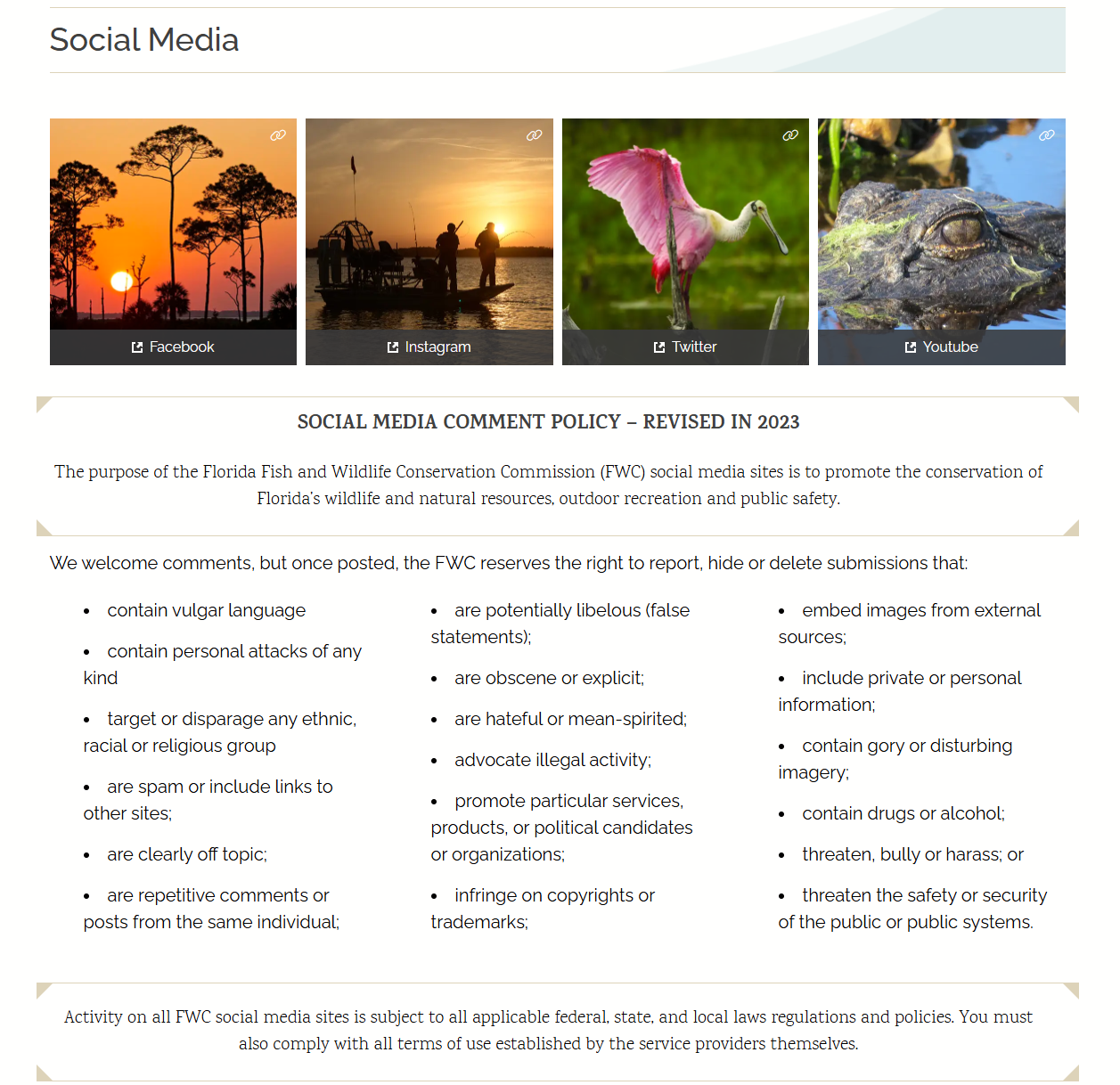
A screenshot of the Florida Fish and Wildlife Conservation Commission’s Social Media Policy page.
Government agencies that host public comments on official social media pages face First Amendment limits. Courts generally treat these forums as digital town squares, meaning that any restrictions must be applied evenly, reasonably and in a viewpoint-neutral fashion.
Several recent court cases provide guidance. In the 2024 case Linkde v. Freed, the U.S. Supreme Court held that speech by a public official on social media counts as state action if the official has authority to speak for the government and purports to exercise that authority in their posts.
Two 2019 cases, Davidson v. Randall and Robinson v. Hunt, found that the comments section of a government or public official’s social media page counts as a public forum. Blocking users (Davidson) or removing critical comments (Robinson), the courts found, is a form of unconstitutional “viewpoint discrimination.”
That isn’t to say certain speech is beyond reproach. Two landmark Supreme Court cases, Chaplinsky v. New Hampshire (1942) and Brandenburg v. Ohio (1969), provided that governments may regulate unprotected speech, like actual threats, incitement and obscenity.
But most critical online speech doesn’t meet those narrow exceptions. Posts that are “off topic” or “repetitive” clearly don’t.
Florida law and its official recordkeeping guidelines add further protection.
This year’s edition of the Attorney General’s Government-in-the-Sunshine Manualsays government social media pages and materials posted there, including the government’s posts and public comments, are public records subject to Florida’s retention schedules.
Florida’s GS1-SL schedule requires such content to be preserved for at least three years.
Some officials have gotten into hot water for failing to do so, like Doug Underhill, a former Escambia Commissioner who cost his county more than $190,000 after he failed to turn over records from his Facebook page.
But there’s a relatively high bar for enforcement. In 2016, mortgage broker, activist and blogger Grant Stern sued Miami Beach and its then- Mayor, Philip Levine, for a list of blocked Facebook accounts and other records from Levine’s social media and SiriusXM show.
Stern argued the content counted as official city business and was subject to public records requests. The city refused to comply, claiming the information was personal and not subject to disclosure.
Bobby Block, executive director of the First Amendment Foundation, said FWC’s alleged practices mirror a statewide and national issue, and a big part of the problem is that many of the pertinent laws were written before the digital age.
“There’s this disconnect,” he said. “People still violate those laws, and unfortunately, the only way you correct these things is to sue. Then usually, once you see there’s a credible lawsuit or the threat of one, you suddenly see these things change and everyone snaps into order.”
That’s a harder result to reach these days. Block, a longtime journalist, lamented a “new normal” today where shrinking newsroom budgets have made it easier for governments and officials to flout public records laws.
The burden of accountability is increasingly shifting from media outlets to ordinary citizens, he said. And they, too, are frequently at a significant financial disadvantage.
“The complaints we receive today at the First Amendment Foundation are not from reporters but from normal people, local activists and members of small county committees and boards who are trying to get information and find that they are blocked,” he said.
“Many of those individuals don’t have the resources to sue. And without that stick, or without increasing the penalties and updating our public records laws for the modern era, it’s become a game of Whack-a-Mole. And you’ve got to have the coins to put in the machine to play. That’s how they get away with it. Because a lot of people give up.”
Last Call – A prime-time read of what’s going down in Florida politics.
First Shot
Black Democratic members of the Florida Legislature are set to push back against Attorney General James Uthmeier’s recent opinion declaring Florida’s affirmative action laws unconstitutional.
Lawmakers are scheduled to hold a noon news conference on the Fourth Floor Rotunda, where they are expected to challenge both the substance and the real-world implications of the Attorney General’s position.
According to a media advisory, Florida Legislative Black Caucus Chair Sen. Darryl Rouson, alongsidetwo dozen Black Democratic members of the House and Senate, will discuss how the opinion could impact civil rights and equal protection, health care equity, education and workforce pipelines, small business development, public boards and governance, as well as how the opinion may be applied in practice across state government.
The news conference comes after Uthmeier issued a nonbinding but sweeping opinion asserting that Florida statutes requiring race-based considerations in hiring, contracting and other government functions violate the U.S. and Florida Constitutions. The opinion drew immediate attention, particularly given its release on Martin Luther King Jr. Day.
In the 14-page opinion, the Attorney General specifically cited an “egregious” Florida statute that mandates statewide participation in “programs of affirmative and positive action” and stipulates that every executive agency “develop and implement an affirmative action plan” that includes goals for race-based hires.
“Every time I think about this, I think about Jurassic Park. There was a message there. … There was a warning about technologies exactly like this. Just because you can do something doesn’t necessarily mean you should.”
— AFL-CIO Director of Politics and Public Policy Rich Templin, on the “AI bill of rights.”
Put it on the Tab
Look to your left, then look to your right. If you see one of these people at your happy hour haunt, flag down the bartender and put one of these on your tab. Recipes included, just in case the Cocktail Codex fell into the well.
Order a Final Approach for Rep. Adam Botana, whose proposal to turn the Naples Airport Authority into a Board elected by voters soared through the Government Operations Committee.
Breakthrough Insights
Tune In
UCF women play at No. 14 Baylor
The UCF Knights women’s basketball team travels to Waco, Texas, for a matchup with No. 14 Baylor tonight (8 p.m. ET, ESPN+).
The Knights (10-8, 2-5 in Big 12) are coming off a 74-68 victory over Colorado in the annual Space Game. The Knights rebrand as the Citronauts for the game and wear Space U uniforms. The game honors UCF’s founding mission from 1963 to provide personnel for the U.S. Space program.
Against Colorado, UCF saw sophomore guard Summer Yancy score a career-high 25 points, including making five three pointers in the victory. Yancy is one of 12 players in the conference to score 25 points with at least six rebounds and four assists in a game.
Baylor (17-3) is tied with Texas Tech and TCU atop the Big 12 standings. The Bears’ success has been based on a strong defense. Baylor ranks No. 1 in the nation in 3-point defense, holding opponents to 22% from beyond the arc. They have been even stingier in conference play, limiting Big 12 opponents to under 20% from long range.
The Bears come into the game on a six-game winning streak. Baylor is led by Taliah Scott, who averages 20.5 points per game. The Orange Park, Fla. native began her career at Arkansas before transferring to Auburn and now to Baylor. She has averaged at least 20 points in all three of her college seasons.
Tonight’s matchup is the first of two between the programs this season. The Bears return to Central Florida on Feb. 15.
After tonight’s game, the Knights continue the homestand against another ranked team from Texas when they host No. 9 TCU on Saturday.
___
Last Call is published by Peter Schorsch, assembled and edited by Phil Ammann and Drew Wilson, with contributions from the staff of Florida Politics.
The Attorney General published his opinion after Davie was considering a shopping cart retaining ordinance.
Attorney General James Uthmeier has issued an opinion that municipal governments can’t force businesses to submit a shopping cart collection plan to the local government for approval.
Uthmeier published his three-page opinion following a request from Allan Weinthal, the Town Attorney for Davie in South Florida. Weinthal asked for an opinion from the Attorney General’s Office in March as the Davie Town Council was considering enacting a shopping cart retention ordinance.
Weinthal asked in a letter to the Attorney General’s Office if state law preempts municipalities from enacting such a law. He also wanted to know if local governments can impose monetary penalties on businesses that don’t submit a plan.
In his opinion, Uthmeier said local governments don’t have any authority to establish such ordinances and they don’t have the legal ability to generally impose fines.
Uthmeier cited Florida law that “expressly preempts municipal ordinances that allow a municipality to require a business owner to submit a shopping cart retention plan to the municipality (or) deny a shopping cart retention plan (and) impose a monetary penalty for failing to submit and adhere to a shopping cart retention plan.”
Uthmeier said he understands the questions from Davie’s Town Attorney since Florida precedent does provide some leeway to municipalities, as they are “given broad authority to enact ordinances under its municipal home rule powers.” But state law preempts any “fee, fine, or costs” from being assessed, according to Uthmeier’s opinion.
Uthmeier acknowledged that local governments can impose fines on retailers if their carts are found on public property if the carts were removed from the retail establishment by retailers themselves. In that case, the Florida Department of Agriculture and Consumer Services has upheld some fines.
Democrats representing Florida in Congress say Florida’s Health Department doesn’t need to nix support for 10,000 AIDS patients. Worse, they say doing so could both cost lives and lead to further spread of the disease.
U.S. Reps. Lois Frankel and Debbie Wasserman Schultz slammed a recent decision by the Department of Health (DOH) to change eligibility requirements for the Ryan White AIDS Drug Assistance Program. That program, named for deceased child AIDS activist Ryan White, provides prescription drugs for more than 50,000 people living with HIV or AIDS in Florida. But financial eligibility changes strip coverage for more than 10,000 people.
“Researchers estimate the average lifetime health care costs associated with HIV infection can get up into the hundreds of thousands,” said Frankel, a West Palm Beach Democrat.
She made the comments on a press call featuring Florida Democrats and medical experts.
Frankel said the decision to kill funding for the program likely means a death sentence for many who will lose access to care, and now she wants the U.S. Department of Health and Human Services to investigate Florida’s administration of the program.
Wasserman Schultz, a Weston Democrat, said ending coverage for many would be a choice, and a wrong one, by Gov. Ron DeSantis’ administration.
“This is a lifeline that provides critical financial assistance to low-income Floridians living with HIV and AIDS. It helps ensure that they can afford their prescriptions and their health insurance, and despite its resounding success now the program is in jeopardy,” she said.
She said the change means most Floridians applying for the program would be denied if they made $120,000 or more, but HIV medication can cost thousands each month.
The subject has already spurred discussions in the Florida Legislature about whether other funding should be diverted.
He notably blamed a budget shortfall on a federal government shutdown in the Fall, one that ultimately failed to lead to any extension in funding for pandemic-era Affordable Care Act tax credits. Ultimately, he said, that left funding for the program $120 million short.
But cutting the AIDS program is the wrong answer, experts on the call said. Michael Rajner, a public health advocate who personally has lived with HIV since 1995, said cutting the eligibility for the program will create an impossible financial burden on many patients.
“We need the Surgeon General and the Governor to give a halt to this and reverse these cuts and find the money, whether it’s through a budget spending authority request to the Legislature and the Governor,” he said.
Moreover, he said he believed money had been misappropriated. DOH has been criticized for spending money on marketing campaigns about marijuana and abortion ballot measures ultimately defeated at the ballot box last year, though Rajner declined to say explicitly which funding he was referring to. But he said some spending mistakes are easily documented.
“This is a problem that they created themselves because of how they administer the program and the fact that they’ve also forced out several staff over the last year,” Rajner said.
Carl Baloney Jr., President and CEO of AIDS United, said the consequences of cutting participation in the program could be far-reaching.
“This is not only morally wrong, it’s financially reckless,” Baloney said. “Consistent HIV treatment saves money, and disrupting care leads to emergency room visits, hospitalizations and higher uncompensated care. Florida is acting without transparency, without following the required regulatory process.”
Wasserman Schultz noted that Biktarvy was the most prescribed once-daily pill used by HIV patients, and forcing people to switch off that drug could cost individuals thousands each year and put their health at risk.
Dr. Elizabeth Sherman of Nova Southeastern University, an HIV clinical pharmacy specialist, said Florida ranks third in the nation right now for new HIV diagnoses. But with the help of public funding, the state has also seen fast incorporation of treatments like Pre-Exposure Prophylaxis, or PrEP, which uses drugs that not only treat HIV, but prevent its transmission.
That suggests that ending programs won’t just shorten lives, but will potentially lead to more infections.
“We have been the envy of many other states for successfully implementing test-and-treat programs where people with HIV are started on treatment on day one of their diagnosis,” she said. “We can continue to make incredible progress, or we can let our guard down now and watch it get worse.”
Frankel dismissed accusations that the problem came from the federal government. The U.S. House Appropriations Committee member said Florida has not requested additional help.
“Florida, I think, last year got about $130 million. And as far as I know, there has not been any request by the federal government to the states to put in their own funds,” she said, “nor do I know of any outreach by Gov. DeSantis to any of us on appropriations for more money.”
She said the impact on eligibility warranted a federal investigation to figure out the true cause of the funding shortfall.