Florida’s wildlife watchdog agency is being accused of muzzling its critics online, with activists and residents accusing it of quietly scrubbing negative comments and blocking users from its social media accounts in a possible First Amendment violation.
Instagram and Facebook users say their comments have disappeared from Florida Fish and Wildlife Conservation Commission (FWC) posts.
They also complain that many of the comments were removed even though they complied with FWC’s official code of commenter conduct, which frequently accompanies the agency’s posts.
An Aug. 29 post by Instagram user @Florida_Legacy_has served as a repository for recent complaints about issue. In one reply to the post, Sanford resident Connor McGuire said FWC has repeatedly blocked him.
“I guess old Rodney had a temper tantrum again,” McGuire wrote, adding that he believes he was blocked because Barreto dislikes being called out for “his conflict of interest.” Barreto, among other things, invests in real estate development, an industry that can sometimes conflict with environmental conservation.
Army combat veteran Solomon Wisewrote that FWC has been blocking people and deleting comments “for quite a while.” He said the agency was “especially” active in doing so in 2023 amid backlash over its officers killing dozens of captive snakes at a South Florida reptile facility.
Brent Fannin, a drone pilot and filmmaker, forwarded to Florida Politics a June 4 email he sent Barreto asking that he and “all other blocked accounts” have their access restored, citing First Amendment concerns.
He never got a reply.

“Our comments have always complied with the page’s code of conduct,” Fannin said in the email. “I can only assume our account was blocked due to the viewpoint expressed in those comments.”
FWC’s Social Media Comment Policy, last updated in 2023, states the agency “reserves the right” to remove or hide posts containing vulgar language, libel, explicit content, threats and harassment.
Other comments warranting removal, the policy says, include anything that is “clearly off topic” or “repetitive.”
FWC appears to have been liberal in applying its rules. In response to one Aug. 28 Facebook post by the agency, a counter showed 102 comments had been made by Friday afternoon. Seventy-four were visible.
Of the 82 visible comments across both posts, just two included negative statements about FWC and its policies.
FWC Communications Director Shannon Knowles said her agency hasn’t blocked any accounts. She did not respond to questions about whether deleted comments are retained and, if so, where they are stored and for how long.
Barreto did not respond to a request for comment.
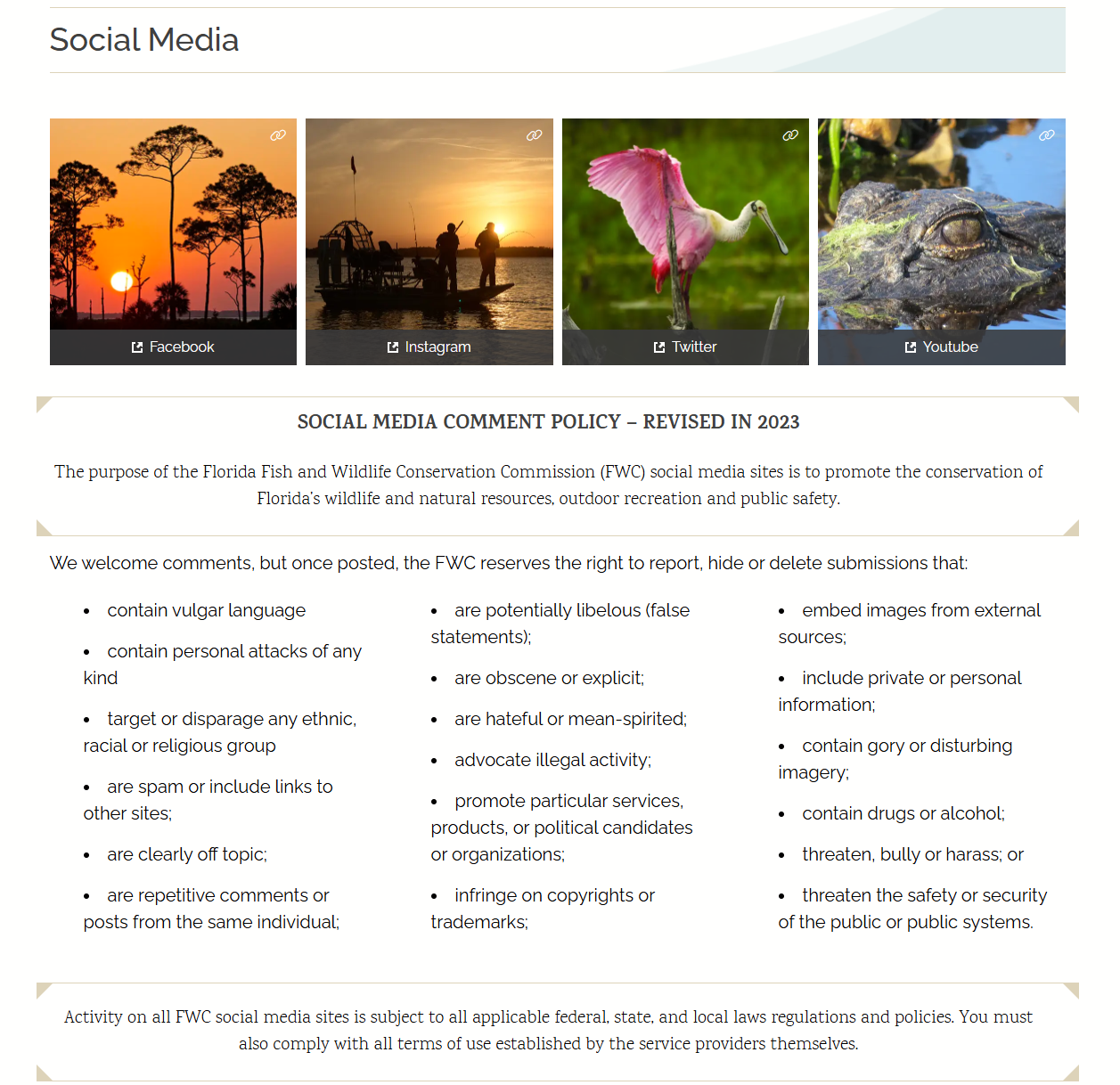
A screenshot of the Florida Fish and Wildlife Conservation Commission’s Social Media Policy page.
Government agencies that host public comments on official social media pages face First Amendment limits. Courts generally treat these forums as digital town squares, meaning that any restrictions must be applied evenly, reasonably and in a viewpoint-neutral fashion.
Several recent court cases provide guidance. In the 2024 case Linkde v. Freed, the U.S. Supreme Court held that speech by a public official on social media counts as state action if the official has authority to speak for the government and purports to exercise that authority in their posts.
Two 2019 cases, Davidson v. Randall and Robinson v. Hunt, found that the comments section of a government or public official’s social media page counts as a public forum. Blocking users (Davidson) or removing critical comments (Robinson), the courts found, is a form of unconstitutional “viewpoint discrimination.”
That isn’t to say certain speech is beyond reproach. Two landmark Supreme Court cases, Chaplinsky v. New Hampshire (1942) and Brandenburg v. Ohio (1969), provided that governments may regulate unprotected speech, like actual threats, incitement and obscenity.
But most critical online speech doesn’t meet those narrow exceptions. Posts that are “off topic” or “repetitive” clearly don’t.
Florida law and its official recordkeeping guidelines add further protection.
This year’s edition of the Attorney General’s Government-in-the-Sunshine Manualsays government social media pages and materials posted there, including the government’s posts and public comments, are public records subject to Florida’s retention schedules.
Florida’s GS1-SL schedule requires such content to be preserved for at least three years.
Some officials have gotten into hot water for failing to do so, like Doug Underhill, a former Escambia Commissioner who cost his county more than $190,000 after he failed to turn over records from his Facebook page.
But there’s a relatively high bar for enforcement. In 2016, mortgage broker, activist and blogger Grant Stern sued Miami Beach and its then- Mayor, Philip Levine, for a list of blocked Facebook accounts and other records from Levine’s social media and SiriusXM show.
Stern argued the content counted as official city business and was subject to public records requests. The city refused to comply, claiming the information was personal and not subject to disclosure.
Bobby Block, executive director of the First Amendment Foundation, said FWC’s alleged practices mirror a statewide and national issue, and a big part of the problem is that many of the pertinent laws were written before the digital age.
“There’s this disconnect,” he said. “People still violate those laws, and unfortunately, the only way you correct these things is to sue. Then usually, once you see there’s a credible lawsuit or the threat of one, you suddenly see these things change and everyone snaps into order.”
That’s a harder result to reach these days. Block, a longtime journalist, lamented a “new normal” today where shrinking newsroom budgets have made it easier for governments and officials to flout public records laws.
The burden of accountability is increasingly shifting from media outlets to ordinary citizens, he said. And they, too, are frequently at a significant financial disadvantage.
“The complaints we receive today at the First Amendment Foundation are not from reporters but from normal people, local activists and members of small county committees and boards who are trying to get information and find that they are blocked,” he said.
“Many of those individuals don’t have the resources to sue. And without that stick, or without increasing the penalties and updating our public records laws for the modern era, it’s become a game of Whack-a-Mole. And you’ve got to have the coins to put in the machine to play. That’s how they get away with it. Because a lot of people give up.”
U.S. Rep. Kat Cammack already knows who she wants to win a newly open race neighboring her own North Florida district.
The Gainesville Republican is endorsing Republican Party of Florida Chair Evan Power to succeed retiring U.S. Rep. Neal Dunn.
“I don’t back candidates who seek permission slips. I back fighters. That’s why I’m proud to endorse Evan Power for Congress,” Cammack said.
“Washington is broken because too many politicians cling to the status quo. Evan isn’t one of them. He’s a proven conservative leader who fights bureaucracy, stands up to the radical left, and wins. I’ve seen him push back against government overreach, defend Florida values, and hold firm under pressure.”
Power, a Tallahassee Republican, filed last week to run in Florida’s 2nd Congressional District a day after Dunn announced he will not seek another term. Cammack first won election in 2020 to Congress to represent Florida’s 3rd Congressional District.
On social media, Power said he was “honored to have the endorsement and support of Kat Cammack.”
It’s an early endorsement for the party leader as other candidates rush to file.
Already, former U.S. Senate candidate Keith Gross filed in the Republican Primary. Other Republicans, including Austin Rogers, the General Counsel for U.S. Sen. Rick Scott, andChuck Perdue, the Bay County Talk Collector, are exploring runs.
Cammack said Power’s history working on political issues and campaigns led her to publicly support his candidacy.
“Evan doesn’t just talk about freedom, the Constitution, and fiscal responsibility, he delivers. He knows our job is to serve the people, not grow government, appease special interests, or play nice with the swamp,” she said.
“If you want a rubber stamp, look elsewhere. If you want a conservative who will join me to secure the border, protect parents, defend life, back law enforcement, and put America First then Evan Power is the fighter we need in Congress. I’m all in for Evan Power. I hope you are too.”
Aileen Rodriguez, who is challenging Republican Hillsborough County Commissioner Joshua Wostal this election cycle, is officially kicking off her campaign next week.
The event will feature U.S. Rep. Kathy Castor as a special guest, as well as a host committee that includes myriad community stakeholders, ranging from elected officials, business leaders and political activists to current and former candidates for office.
The kickoff is Wednesday, Jan. 28, at J.C. Newman Cigar Company, located at 2701 N. 16th St. in Tampa, from 5:30-7:30 p.m.
Castor endorsed Rodriguez earlier this month, writing in a letter to the candidate that she appreciates “your willingness to step forward and serve your Hillsborough County neighbors.”
“I value your commitment to listening to residents across our community and ensuring that every neighbor, in every neighborhood, has a voice in our county government,” Castor wrote.
“I look forward to working with you on the issues our residents care most about, including greater access to affordable housing, child care, and public transportation. These priorities are critical to responsible growth, environmental preservation and modernizing infrastructure. Together, we can help build a County government that is more accessible, accountable, and truly reflects the people it serves.”
Rodriguez’s honorary host committee includes, among others, Tampa City Council members AlanClendenin, LynnHurtak, GuidoManiscalco and Luis Viera; Hillsborough County School Board members Nadia Combs, Lynn Gray, Karen Perez and Jessica Vaughn; former Hillsborough County Commissioner and former University of South Florida President Betty Castor; former state Sen. Janet Cruz; former Hillsborough County Commissioner Kimberly Overman; and former Tampa City Council member and current Florida House candidate Mike Suarez.
The host committee includes local business leaders and political insiders such as ErinAebel, KarenClay, BryanFarris, RickFernandez, RickFifer, AndyJohnson, NeilManimala, StephaniePoyner, HoytPrindle, TaylorRalph, MichaelReeves, C.L Townsend and others.
Rodriguez, a former regional director for former Republican U.S. Sen. MelMartinez, filed paperwork last week to run. Rodriguez, a Democrat, is so far the only candidate challenging Wostal.
Rodriguez is a career public relations expert, having run her own PR firm, AR Public Affairs and Strategic Solutions, since 2009. She also worked from 2014 to 2017 as a senior manager of executive affairs for the Hillsborough County Aviation Authority.
Prior to that, she served as marketing communications director for the Helios Education Foundation and Communications Director for the 2012 Tampa Bay Host Committee for the Republican National Convention.
Rodriguez was previously registered as a Republican but changed her political affiliation in 2019, saying the GOP left her and no longer reflected her values as a Christian.
Rodriguez was born in Puerto Rico, a U.S. territory, and raised in the Tampa Bay area. Her campaign will focus largely on the affordability crisis that is plaguing not just Hillsborough County residents, but those throughout the state and nation.
Rodriguez also said she would prioritize infrastructure spending and expanded transportation options to break gridlock in Hillsborough County, calling such moves “common sense.”
District 7 is elected countywide, where Republicans hold a voter registration advantage with nearly 292,000 voters compared to nearly 273,000 Democrats. With another more than 217,000 independent voters, Rodriguez’s experience as both a Republican and Democrat could help bridge the voter registration gap by enticing moderate voters.
That could be especially true in a Midterm Election year expected to favor Democrats amid frustration with federal policies under the Donald Trump administration and GOP trifecta in Washington.
Historically, the party in power in the White House suffers losses in Midterm years, and this year is not expected to be any different. But it’s worth noting that in the last Midterm cycle, in 2022, Republicans overperformed in Florida even as they underperformed elsewhere in the nation.
That was also the same year the Hillsborough County Commission flipped red, with the defeat of two incumbent Democrats, shifting the board from a 5-2 Democratic advantage to a 4-3 Republican majority. Wostal was first elected that year, defeating incumbent Democrat Kimberly Overman with more than 52% of the vote despite being significantly underfunded.
As of the end of 2025, Wostal had already raised more than $108,000 for his race, with only about $1,000 of that spent. Because she only just filed to run, Rodriguez has not yet reported any fundraising.
Two Democrats had previously filed to challenge Wostal: former state Rep. Adam Hattersley and Mark Nash, who has sought office unsuccessfully before. Both have since withdrawn from the race.
One day after Hurricane Helene skirted past the Tampa Bay area on Sept. 26, 2024, leaving devastating flooding, St. Pete Beach residents were still blocked from returning to their homes to survey damage, as crews worked to ensure it was safe to return.
Yet even as residents grew anxious to see what remained of their homes and communities, St. Pete Beach Mayor AdrianPetrila was already on the island and, it appears, already taking steps to repair his flooded home.
On Sept. 27, 2024, the city of St. Pete Beach posted a warning on Facebook informing residents that access points to the local barrier islands “remain closed today” as “crews from the county and impacted municipalities continue to work on clearing impassable roadways, removing dangerous debris, restoring power, and addressing other infrastructure issues including returning power to our sanitary sewer system.”
The post went on to caution residents that they “should plan to spend multiple days away from their houses.”
That same day, a local resident who had remained on the island to weather the storm captured video at Petrila’s home of what appears to be crews bringing in fans to dry flood areas.
DonnaMiller had stayed on the island with a neighbor — a decision she said many residents made after weathering numerous storms without much damage and with no risks to safety. This time was different, as flooding impacted much of the island, leaving homes badly damaged.
She told Florida Politics that she and others who had stayed behind were unable to obtain water, food or other supplies as the barrier islands remained closed because they were told they could leave the island, but would not be able to return until access was restored. Not wanting to miss out on time to address flood damage, many continued to stay.
Instead, Miller and a friend hopped in her car to check on other neighbors. In doing so, they came across Petrila’s home, where video Miller took shows a crew carrying several large fans into the home. The video is just 10 seconds long, but Petrila’s address is visible in the footage and metadata on the video confirms it was taken the day after the hurricane. Petrila is also visible in the garage.
Miller said she stopped filming to confront the homeowner. Said she didn’t realize it was the Mayor until after the confrontation.
Miller told Florida Politics that during the interaction, she asked Petrila, “How is it that you have workers cleaning out your house when people need food and supplies?”
He responded, according to Miller, that the men had already been on the island, a claim Miller said she doubts.
“It seemed like he played the Mayor card to get them in,” she said.
Florida Politics reached out to Petrila on Monday via his city email asking about the video. The email included questions about how workers were able to bring supplies to his house. As of Wednesday, he had still not responded.
Miller, meanwhile, has sent letters to the Pinellas County Sheriff’s Office and to U.S. Rep. Anna Paulina Luna complaining about what she perceived as Petrila misusing his authority as Mayor for personal benefit.
“A Mayor who puts himself before the people needs to find another career,” Miller told Florida Politics. “What he did was horrible. Instead of getting trucks on the island with emergency supplies, he got blowers and workers on the island.”
Petrila, a Republican, is up for re-election this year. He faces fellow Republican Scott Tate in what is expected to be a tight race. Petrila is the top fundraiser in the race, but only barely. Tate has nearly matched Petrila’s fundraising, with new fourth-quarter totals showing he has brought in just over $14,000, only $1,300 less than Petrila.
The tighter-than-usual fundraising in a beach town election cycle that is more often than not a quiet affair comes as Petrila faces criticism for proposing to impose tolls at the north, central and southern access points to the island to fund ongoing infrastructure repairs and improvements following back-to-back hurricanes in 2024 that devastated the island.
Despite his plan exempting residents, employees and business owners, it has been controversial, with some worrying such tolls would reduce tourism and other revenue-generating traffic on St. Pete Beach.
And Petrila, like neighboring St. Petersburg Mayor Ken Welch, who is also facing intraparty opposition for his re-election, is also earning resident frustration over a permitting backlog following the hurricanes that is ongoing as residents continue to rebuild. While Tate has not directly weighed in on the tolling issue, he has lamented that the permitting red tape is a failure of leadership.
Petrila is facing his first re-election contest after first being elected in 2023, when he unseated then-incumbent Alan Johnson.
The St. Pete Beach municipal election is March 10.