Connect with us

Politics

Florida stands alone in taking fines from those who help defendants post bond

Published

on


Is Florida running a bail grift?

That’s how one Judge described the state’s decades-old policy of keeping bail money from third parties and using it to pay off defendants’ outstanding fines and fees.

At least one member of an 11th Circuit Court of Appeals panel that considered the issue this month appears to agree with that assessment.

So do several current and former lawmakers who have tried to end the practice.

Florida is the only U.S. state that forces local governments to take money from organizations and individuals who post bail for another person to cover the defendant’s debt.

State law mandates that county Clerks must seize bail money that’s usually returned to pay for defendants’ fines and fees, regardless of who paid.

Those fees and fines frequently add up to hundreds or thousands of dollars. And they often come as a surprise, said Josh Mitman, Senior Policy Counsel at the nonprofit Bail Project.

“In Florida, people trying to support a loved one during a devastating moment are caught in a financial trap,” he said. “After their bail money has already been accepted, they discover — without sufficient notice and often through buried fine print — that they are suddenly on the hook for court fees from decades ago, turning an act of support into an unexpected financial loss.”

Legal fight pits bail fund against state mandate

There’s an ongoing federal case over the issue. The American Civil Liberties Union of Florida (ACLU) filed a complaint against Leon County Clerk Gwen Marshall on behalf of the local Tallahassee Bail Fund nonprofit in August 2022, alleging that Florida’s bail system unlawfully punishes third parties, including charitable bail funds.

Notably, the ACLU made clear that while Marshall was the named defendant, she isn’t to blame for the state law with which she must comply.

“Because she’s the person enforcing it, she’s who has to get sued,” ACLU lawyer Jerry Edward told the Tallahassee Democrat at the time. “There’s no way to challenge the statute by itself. You have to challenge the enforcement.”

Bail bond agents are exempt from a Florida law requiring county Clerks to withhold bail cash from third parties to pay for defendants’ outstanding fines and fees. Image via Daniel Schwen/Wiki Commons. License here.

The ACLU argued that Florida’s bail practice is unconstitutional because it violates the Eighth Amendment’s prohibition on excessive bail and punishment, since it drains funds from innocent third parties rather than defendants.

Between its founding in 2020 and the time the ACLU filed its suit, the volunteer-run Tallahassee Bail Fund had raised $12,700 to bail out cash-strapped defendants.

Of that, $5,200 — about 41% — was withheld by the Leon Clerk’s Office to pay fines and fees, hampering the organization’s ability to recycle funds and forcing it to turn away more people than it helped.

Fast forward to February 2024, Chief U.S. District Judge Mark Walker ruled in the Tallahassee Bail Fund’s favor and issued an injunction preventing enforcement of the state statute in question.

But the injunction was extremely narrow, applying solely to the local bail fund and not any other person or group offering similar bail-related aid.

The state appealed, and a three-Judge panel at the 11th Judicial Circuit Court of Appeals heard oral arguments over the issue three weeks ago. One of the panelists, U.S. Circuit Judge Adalberto Jordan, a Barack Obama appointee, didn’t mince words in how he viewed Florida’s bail-withholding practice.

This is all a scam,” he said, adding that the policy isn’t even consistent because while it applies to spouses, family members, friends and organizations, it doesn’t apply to bail bond agents. He also pushed back against a state argument that only individual defendants, not the bail fund itself, had standing to sue, since it was the bail fund’s money that was being held.

The panel — Jordan, an Obama appointee; Senior U.S. District Judge Timothy Corrigan, a George W. Bush appointee; and U.S. Circuit Judge Kevin Newsom, a Donald Trump appointee — gave no timeline for a ruling.

Legislative fixes keep hitting political snags

By this time next year, there’s a slight chance the case’s central contention could become a non-issue, depending on whether state lawmakers pass a repeatedly proffered proposal that would repeal the unique law.

During the 2025 Legislative Session, the proposal came in the form of companion measures (SB 1396HB 243) introduced by Fort Pierce Sen. Erin Grall and Pensacola Rep. Alex Andrade, both Republican lawyers.

If passed, the measure would have shifted the fine and fee burden solely to the defendant or their spouse, effectively ending Florida’s policy of withholding money from third-party bond payments. It would also have required Clerks to more prominently display the revised withholding policy on relevant paperwork and enroll defendants in payment plans if the withheld funds weren’t enough to cover all fine and fee costs.

The legislation died after the Senate refused to take up the Senate bill.
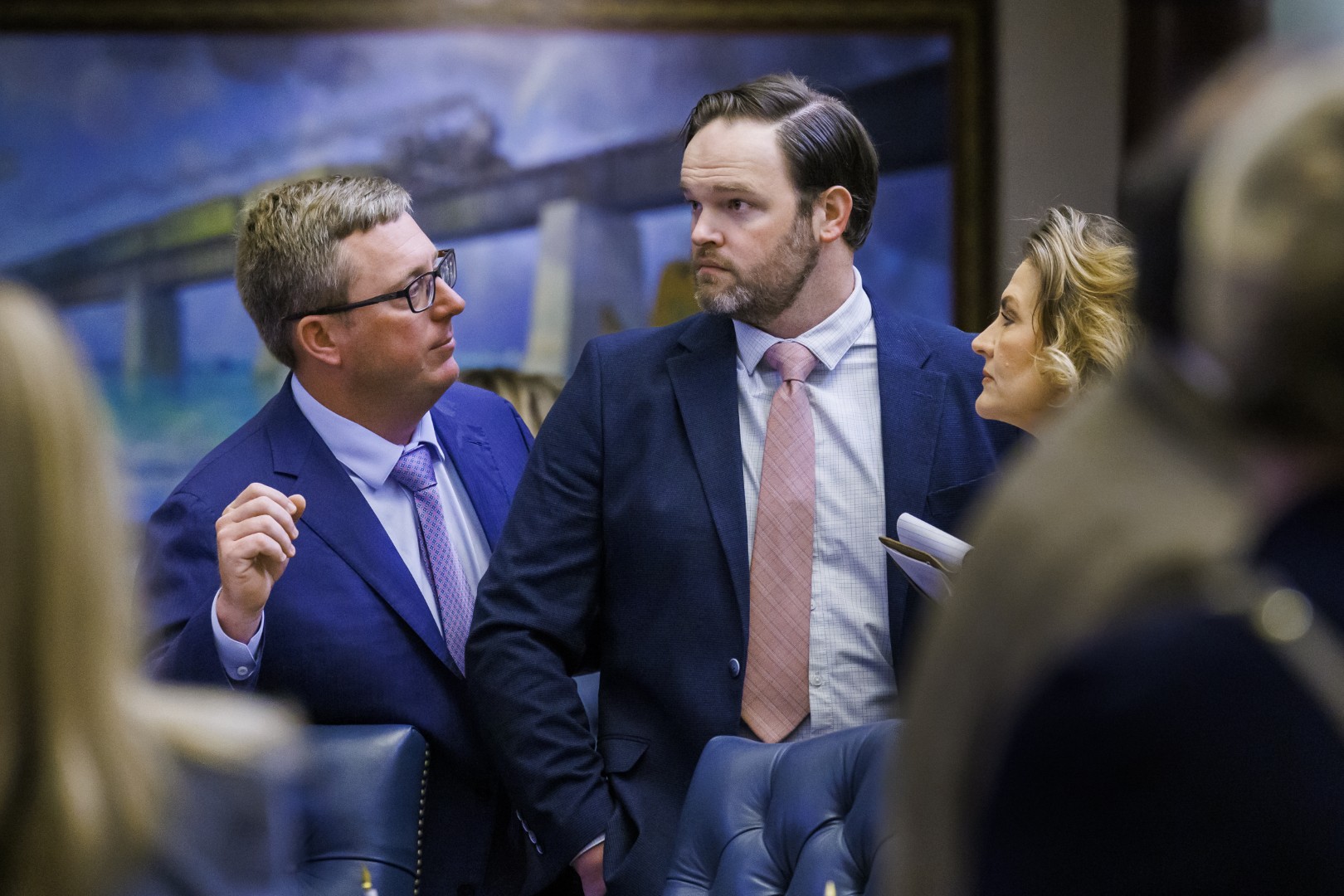
Pensacola Rep. Alex Andrade, center, flanked by fellow Republican Reps. Lawrence McClure of Dover, left, and Jennifer Canady of Lakeland at the start of a Senate floor Session on May 2, 2025. Image via Colin Hackley/Florida Politics.

Andrade, who first filed the legislation in 2021 with upper-chamber support from former Orange County Democratic Sen. Linda Stewart, said the change comports with conservative principles.

“It’s a conservative issue to say the government shouldn’t take property that they’re not entitled to,” he told Florida Politics.

“If the defendant or their spouse posts that cash bond and the defendant owes money, well then yeah, you have that money to pay off that defendant’s debt. But churches, civic groups, friends, roommates — they’re not obligated to pay the debt of the criminal defendant, or at least they should be. And the fact that we in the state of Florida say, ‘Even if you uphold your end of the bargain and the person shows up to court, we still take your money,’ it just feels like an unconstitutional taking to me.”

Andrade said he plans to bring the bill back for the coming Session, but opposition to the bill consistently runs into each year has been attritive. Much of it centers on the same argument: that troublemaking groups will view the bail law’s repeal as a loophole to get members back onto the streets more quickly, allowing them to continue committing crimes.

“It obviously won’t, because (the posted bond money will only be returned if) someone has shown up to all of their court dates and the case is over. But there’s so many preconceived notions and so much ignorant bias about the entire topic,” he said. “If I uphold my end of the bargain and make sure the defendant shows up to all their court dates, the government shouldn’t get to take my money.”

Cash bail is a major driver of jail populations in the U.S. On any given day, about two-thirds of U.S. inmates are legally presumed innocent, yet can’t return home while awaiting trial because they can’t afford bail, according to the Prison Policy Initiative.

Studies have shown that pretrial detention due to unaffordable bail disproportionately impacts low-income defendants and people of color, with even short jail stays contributing to job loss, housing instability and recidivism.

Other contributing factors include drug and property crime enforcement in some jurisdictions, mental health and substance abuse issues, and certain sentencing policies like mandatory minimums, three-strike laws, and lengthy probation and parole terms.


Post Views: 0


Source link

Continue Reading

Politics

Last Call for 1.19.26 – A prime-time read of what’s going down in Florida

Published

on


Last Call – A prime-time read of what’s going down in Florida politics.

First Shot

Did Christina Pushaw break the law by asking gubernatorial candidate James Fishback to delete text messages the two exchanged in recent months?

Maybe.

Pushaw, who earns a $179,000 tax-funded salary as a senior management analyst for Gov. Ron DeSantis, all but confirmed the authenticity of texts between her and Fishback in which she appears to have written, “I need you to confirm that you deleted everything with my name on it.”

The exchange has raised questions about whether she solicited the destruction of public records, which would be illegal if the messages involved her government duties, but likely not if they were strictly campaign-related, as she says.

Fishback posted a screenshot of the exchange following a public blowup between the two after they, according to Pushaw, spoke “frequently” since October about Fishback’s campaign.

On X, Pushaw accused Fishback of deception, writing: “Thanks for proving my point that you have no qualms about lying and revealing private messages. I truly believed that we were friends, and I feel sickened and violated by this betrayal.”

Pushaw, who has worked for DeSantis as both a campaign and government staffer, says she was never paid for advising Fishback and never told the Governor about her communications with Fishback.

In a brief phone interview on Monday, she said none of her messages with Fishback touched her state job.

“I never talked to him about government business,” she said. She declined to explicitly confirm the authenticity of Fishback’s screenshots, including one that referenced her government position.

Read more on Florida Politics.

Evening Reads

—“Donald Trump ties Greenland takeover bid to Nobel Prize in text to Norway leader” via Ellen Francis and Steve Hendrix of The Washington Post

—”Trump’s letter to Norway should be the last straw” via Anne Applebaum of The Atlantic

—”Trump’s Greenland move is one of the dumbest political decisions I have ever seen” via Chris Cillizza of So What

—”The race to build the DeepSeek of Europe is on” via Joel Khalili of WIRED

—”Three maps tell a tale of the 2026 Midterms.” via Ashley Cai and Shane Goldmacher of The New York Times

—”Orlando Sentinel 150: Remembering MLK’s only visit to Orlando in 1964” via the Orlando Sentinel

—“Jeff Brandes: Six ideas Legislature can’t afford to ignore in 2026” via Jeff Brandes for Florida Politics

—”The Indiana-Miami CFP game is the Hollywood tangle we didn’t know we needed” via Steven Zeitchik of The Hollywood Reporter

—”‘It shaped my DNA’: The very Miami story of Mario Cristobal” via Andrea Adelson of ESPN

—”Two other Hoosiers from Miami are coming home, too — and could play a big role” via David J. Neal and Jordan McPherson of the Miami Herald

Quote of the Day

“I didn’t vote for this weather.”

Marc Caputo on a frigid morning in Miami.

Put it on the Tab

Look to your left, then look to your right. If you see one of these people at your happy hour haunt, flag down the bartender and put one of these on your tab. Recipes included, just in case the Cocktail Codex fell into the well.

Even though it’s booze-free, the Duval delegation could use a Cortisol Cocktail to calm their nerves after a bomb threat landed in their inboxes.

Disney and Universal are getting an Investigators Rite, courtesy of Central Florida Democrats, who are requesting they look into a company that operates independent restaurants on their properties.

Someone should’ve sent an Out of Office for Attorney General James Uthmeier, because he picked an odd day to drop his latest opinion.

Breakthrough Insights

Tune In

Miami plays for national title at home

The Miami Hurricanes try for the program’s first national championship since 2001 when they face top-seeded Indiana at Hard Rock Stadium tonight (7:30 p.m. ET, ESPN).

Miami entered the College Football Playoff as the 10th seed and knocked off Texas A&M, Ohio State, and Ole Miss to reach the finals. The Hurricanes (13-2) have benefitted from a defense that has limited opponents to 14 points per game this season. Defensive end Rueben Bain Jr. was named the ACC defensive player of the year and is a likely Top 10 pick in the NFL Draft.

Indiana (15-0) has enjoyed the greatest season in program history. In the second season under Curt Cignetti, the Hoosiers have not only won more games than they ever have in a season, but also more than the program ever did in two consecutive seasons combined before Cignetti’s arrival.

The Hoosiers are led by Heisman Trophy-winning quarterback Fernando Mendoza.

The two programs have met twice in history, with Indiana winning the first meeting in 1964 and the Hurricanes taking the return match in 1966. The two programs have not met since.

The last time a college football team won the national championship by winning a game on its home field was the Hurricanes, who won the Orange Bowl following the 1987 season to win the program’s second of five national championships.

___

Last Call is published by Peter Schorsch, assembled and edited by Phil Ammann and Drew Wilson, with contributions from the staff of Florida Politics.


Source link

Continue Reading

Politics

James Fishback ordered to turn over Azoria stock, luxury items to pay $229K court judgment

Published

on


Gubernatorial candidate James Fishback’s legal woes are deepening.

A federal magistrate Judge has ordered Fishback, the founder and CEO of Azoria Capital, to turn over company stock certificates and a slate of luxury purchases to the U.S. Marshals Service by the end of the month as payment on a $229,000 judgment to his former employer, Greenlight Capital.

U.S. Magistrate Judge Martin Fitzpatrick of the Northern District of Florida granted two unopposed motions by Greenlight after Fishback failed to respond by a court-ordered deadline.

It’s the latest escalation in a dispute between Greenlight and Fishback, a former analyst for the hedge fund who has made more headlines recently for his race-baiting rhetoric in the Governor’s race, allegations of grooming, multistate voter registration and public blowup with Gov. Ron DeSantis adviser Christina Pushaw.

Greenlight told the court that Fishback still owes it money under a June 2025 court order. The firm asked the court in late November to compel Fishback to surrender his stock or share certificates in Azoria Capital, Inc., a Delaware corporation Greenlight described as founded by Fishback and controlled by him at “75% or more.”

Because Fishback did not oppose the request, the court granted it and directed him to “locate, obtain, and turn over” all Azoria stock and/or share certificates to the U.S. Marshals Service by Jan. 30.

The Marshals Service, in turn, is ordered to sell the stock for the benefit of Greenlight as the judgment creditor. Fitzpatrick warned Fishback that federal courts have inherent authority to enforce orders and cautioned that ignoring the directive could place him “in danger of being held in contempt of court.”

Fitzpatrick also granted a second motion by Greenlight seeking the turnover of personal property belonging to Fishback. The firm alleged that Fishback claimed he lacked means to pay the $229,000 judgment while making more than $37,000 in debit card purchases over 16 months through a previously undisclosed JPMorgan Chase account.

The court summarized transactions at retailers including eBay, Nordstrom, Burberry, Bucherer and others, but noted it did not know what exactly Fishback purchased. Still, Fitzpatrick described the spending as “extravagant” and found that Fishback, by not responding by the deadline, waived his chance to argue the items were exempt or not personal property.

Under the order, Fishback must turn over 43 items listed in the motion paper, along with a list, to the Marshals Service by Jan. 30. The Marshals must hold the items for 30 days, allowing Greenlight’s lawyers to retrieve and sell them as partial satisfaction of the judgment.

Fishback worked at Greenlight from 2021 to 2023, after which he and the company became embroiled in a very public dispute over how he described his role there. He said he was “head of macro” for Greenlight, while the New York hedge fund insisted no such title ever existed and that the loftiest role Fishback held was as a research analyst.

Greenlight alleged that Fishback misrepresented his position to boost credibility and attract investors for Azoria. Fishback, meanwhile, argued Greenlight’s denial harmed him with potential backers and pointed to internal communications he says support his version of events.

He did, however, admit to sharing confidential Greenlight portfolio information and agreed to pay costs to resolve a separate lawsuit.

Trustees of a white-label exchange-traded fund (ETF) under Tidal Financial Group also voted in October to liquidate two Azoria ETFs — SPXM and TSLV, which together held about $40 million in assets — after Fishback admitted to sharing the information.

Between when he launched his campaign on Nov. 24 and Dec. 31, when fourth-quarter bookkeeping closed, Fishback reported raising less than $19,000 through his campaign account and nothing through an affiliated political committee.

Fishback is seeking the Republican nomination for Governor. The race’s poll-tested front-runner, U.S. Rep. Byron Donalds, amassed $45 million last quarter.


Source link

Continue Reading

Politics

Anna Eskamani hits $1M fundraising milestone for Orlando Mayor race

Published

on


Rep. Anna Eskamani says she has raised more than $1 million so far as she tries to become the next Orlando Mayor.

The Orlando Democrat says she hit the milestone last week as lawmakers returned to Tallahassee for the start of the 2026 Legislative Session.

Term-limited in the House, Eskamani is running in 2027 to replace Orlando Mayor Buddy Dyer, who is not running for re-election.

“This campaign is powered by everyday Orlandoans who believe our city can be more affordable, more connected, and safer for everyone,” Eskamani said in a statement.

“Raising over one million dollars from thousands of grassroots donors sends a clear message: people are ready for leadership that listens, leads with integrity, solves problems, and puts community first. Together, we’re building a movement that reflects the heart of Orlando and delivers real results for working families.”

Her campaign has given out 900 yard signs and knocked on more than 33,000 doors in the city, according to a press release.

So far, no other established candidates have filed to run against Eskamani, although she has drawn her first competitor on the ballot: Abdelnasser Lutfi.

Lutfi, who filed to run for Mayor in late December, was not immediately available when reached for comment Monday afternoon.

Eskamani and Lutfi are running to replace Dyer, the longest-serving Mayor in Orlando’s history. Dyer was first elected in 2003.

Eskamani also said she is launching a podcast called “Twinning with Anna and Ida” with her twin sister. 

Every episode will unpack economic public policy issues that are critically important to everyone, but aren’t always well understood by the vast majority of people — often because they have been made intentionally opaque by politicians and the corporations who fund them to benefit from the complex system,” a press release said.

“But they will also have some fun along the way, from exposing a ‘grift of the month’ in Florida politics to exploring the punk rock scene in Orlando.”


Source link

Continue Reading

Trending

Copyright © Miami Select.