Connect with us

Politics

Florida bear hunt to take place next month after judge rejects injunction
Published

on


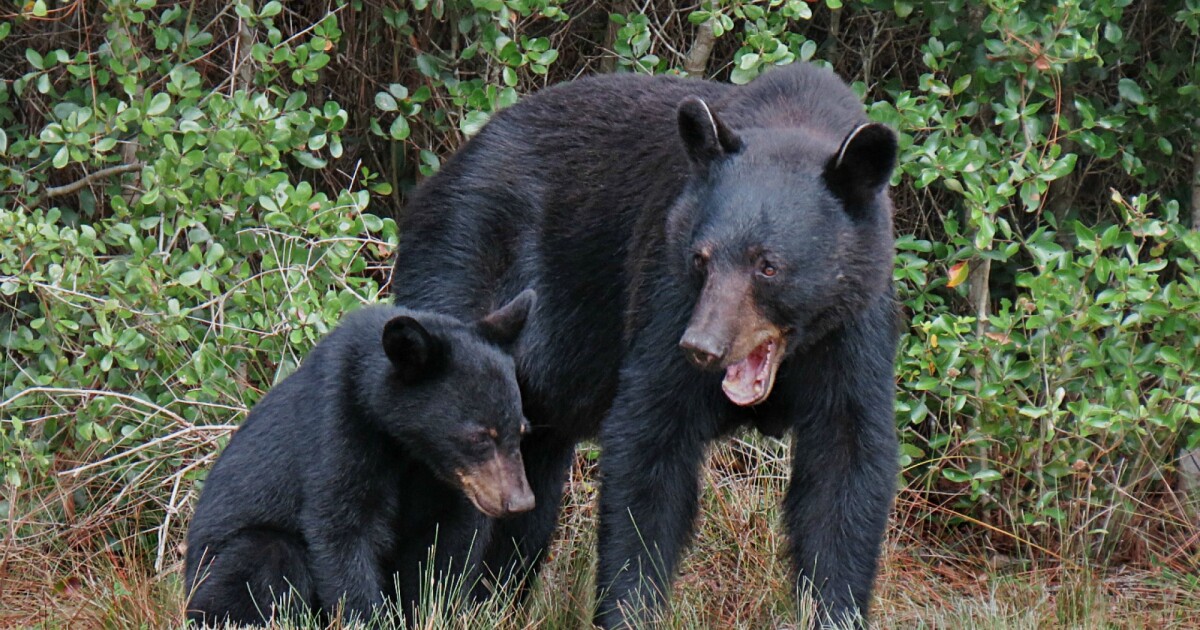
Florida’s first bear hunt in a decade will take place as scheduled next month after a state judge on Monday denied a motion by a conservation group to stop it from taking place.

Leon County Circuit Judge Angela Dempsey denied the temporary preliminary injunction sought by Bear Warriors United, which argued the hunt authorization was based on outdated data and will harm the bear population in Florida — right now estimated at around 4,050.

The group filed a lawsuit in September seeking to stop the 23-day hunt, after it was approved by the Florida Fish and Wildlife Conservation Commission (FWC) in August and is scheduled to take place from Dec. 6 to Dec. 28.

“I’m going to find here that the plaintiff has not met their burden on substantial likelihood of success on the merits,” Judge Dempsey said at the end of a two-and-half-hour hearing that took place via Zoom on Monday.

“The 2015 hunt was found constitutional under the rational basis test and this hunt is significantly more conservative than that hunt in 2015, both in number of bears that could be harvested as well as the timing, when it’s a little less likely for more female bears to be killed.”

Supporters of the hunt point to increased interactions between bears and humans and consequent fears of attacks.

Questions about the data
Bear Warriors United contended the FWC was relying on “stale and outdated” data to reach the conclusion that the best way to manage the black bear population in Florida was a regulated hunt.

The most dramatic part of the hearing was an exchange between Thomas Crapps, attorney for Bear Warriors United, and FWC bear management coordinator Mike Orlando. Crapps asked Orlando at one point whether it “wouldn’t be more prudent to wait to get that information to decide whether or not a hunt was appropriate, based on more current data?”

“Actually, the science that we have now is actually very good data and, as those population estimates come in over time, we have the ability to actually adjust harvest rates and other things. But no, the population estimates that we’re working with right now are fantastic,” Orlando responded. “It’s good science.”

Orlando said that it takes up to two years for FWC to conduct a population study. That prompted Crapps to ask him why not wait to get more current data before making such an important decision?

“Because we will never have new data. It will always be old,” Orlando said. “So, what we’re doing again is taking a very conservative estimate approach to the hunting season, using the best available science that we have and, any new science that comes in, we will make adjustments. We have to be adaptive. That’s management 101.”

This will be the first bear hunt in Florida since 2015, when the hunt was shut down at the end of its second day after nearly 300 bears had been killed.

The bears are spread out across the state in seven areas known as Bear Management Units by the FWC. In justifying the hunt, the agency has said that, since 2015, the four largest subpopulations of bears have grown annually, and no subpopulations have shown evidence of decline.

Plan calls for removal of 172 bears in four ‘hunting zones’
The plan now allows for the removal of 172 bears from four “bear hunting zones” — 68 in the East Panhandle; 31 in the North; 18 in Central Florida; and 55 in the South hunting area.

To participate, individuals must have been at least 18 years old by Oct. 1 and hold a hunting license and a bear harvest permit. Bear harvest permits cost $100 for Florida residents and $300 for non-residents and are not transferable. It cost $5 to submit an application, and there was no limit on how many applications individuals could submit.

However, not all of those who have received a permit will use it to kill a bear.

News 6 WKMG in Orlando reports that 44 people selected for the bear hunt are against killing bears.

“By the time it’s all over with, we’ve got at least 52 of the 172, which will reduce the number of bears killed down to about 120 or less,” said Chuck O’Neal, president of Speak Up for Wildlife.

In his closing statement representing Bear Warriors United, Crapps noted that agency staff presented the first report on the Florida Black Bear Management Plan in December 2024 with a recommendation that no immediate action was needed.

“And it’s the FWC commissioners then direct them to have a hunt,” he said. “At that point, the science is being driven by the politics. And that is wrong.”

Not true, argued attorney Rhonda Parnell, representing the FWC.

“The science is sound,” she said. “Bears have always been a game animal. This hunt is no different than any other hunt, whether it is deer, turkey, quail, etc. We are the ones who get to make that determination. It is not for the court to say, ‘Well, you can determine deer hunting, but you can’t determine bear hunting.’ That would be an impermissible ruling by this court.”

Litigation will continue, as Judge Dempsey declined FWC’s request to dismiss the lawsuit. A hearing on that motion will take place on Dec. 15 — halfway through the bear hunt.

In a survey conducted by the FWC of more than 13,000 self-selected participants, 75% opposed the proposal, with just 23% in support. Other polls, such as a Remington Research survey commissioned by the Humane World for Animals, showed that 81% of Florida residents oppose the reopening of bear-hunting season.

___

Mitch Perry reports via Florida Phoenix, a part of States Newsroom, a nonprofit news network supported by grants and a coalition of donors as a 501c(3) public charity. Florida Phoenix maintains editorial independence. Contact Editor Michael Moline for questions: [email protected].


Source link

Continue Reading

Politics

New statewide insurance trust enters 2026 with sustained growth and millions more in taxpayer savings

Published

on


The Florida Educator Health Trust (FLEHT) enters 2026 less than a year old, but already with significant progress under its belt.

Established to help Florida School Districts save on employee health plans without having to pass along benefit reductions, the program opened last June with just three counties on board, representing 1,671 public school employees in DeSoto, Hardee and Hendry counties.

By the end of December, the nonprofit health insurance program had eight counties enrolled, with the addition of Brevard, Charlotte, Okeechobee, Highlands and Polk counties, bringing its total public school employee representation to nearly 22,000 people.

As of mid-January, more School Boards have voted to join the program at various points throughout 2026, which will bring the total counties enrolled to 15.

“In an era of rising health insurance costs for employees, we set out to provide much-needed services to School Districts without compromising benefits to educators, and it is working,” said Ted Roush, a former Superintendent of Schools and FLEHT Executive Director.

“In only 6 months, we have shown demonstrable savings to the districts, and consequently to taxpayers, realizing savings in the millions of dollars. Our growth — going from three to 15 counties in our first year of full operation — will allow us to continue achieving significant economies of scale, saving taxpayers even more money while maintaining a high level of health insurance for district employees.”

“By harnessing the power of the group district membership, FLEHT is able to perform for the whole what is not possible individually in the insurance marketplace,” Roush added.

The FLEHT realizes savings for School Districts by bringing Districts together to deliver efficient health programs for employees.

Formerly known as the FSHIP program, it was established in 2009 by the Florida School Board Insurance Trust. The program transitioned to FLEHT under the Florida Association of District School Superintendents last year. The change was meant to align the needs of Florida educators.

The FLEHT under its new structure is overseen by an executive committee composed of Superintendents, with all member Districts represented with voting trustees.

Hernando County is expected to be the next School Board to enter into a participation agreement with FLEHT. Program officials estimate they will have as many as 20 School Districts on board by Spring Break season. The group also estimates it has saved taxpayers more than $12 million.

The program is responding to rising health care premiums across the U.S. While cost of living is already creating a challenge, at an estimated 17% increase, health care premiums have increased by 45%, according to the National Council on Teacher Quality.

In order to participate in FLEHT, School Boards must first adopt a participation agreement. The District must already be or become self-insured. From there, the District establishes a transition plan into FLEHT and then formally enters the program. Once a District is a member, its Superintendent becomes a member/trustee of the program.

The program estimates savings of 7%-12% when fully transitioning from a fully-insured health insurance plan to a self-insured FLEHT participant. Within one to three years, the program claims members will enjoy savings of up to 13%.


Source link

Continue Reading

Politics

Austin Rogers considering a run to succeed Neal Dunn in CD 2

Published

on


The Panama City currently serves as Rick Scott’s General Counsel.

Austin Rogers may shift from advising U.S. Sen. Rick Scott to running for Congress himself. Sources close to Rogers, the General Counsel for Sen. Rick Scott, confirmed he is exploring a run to succeed retiring U.S. Rep. Neal Dunn in Florida’s 2nd Congressional District. The Lynn Haven Republican and Panama City native has worked for Scott.

The Federalist Society member holds both a law degree and a master’s in Theology from Duke University, where he also served on the Duke Law Journal and Harvard Journal of Law & Public Policy.

Before graduate school, he earned a bachelor’s in International Business in 2012 from Lakeland-based Southeastern University, then pursued a second degree in Theology from Wheaton College.

After clerking in the Middle District of Florida for Chief Judge Steven D. Merryday, Rogers worked for international law firm White & Chase, then took a job working on Capitol Hill.

He started work in 2023 as Senior Counsel of Oversight and Investigations for the Senate Judiciary Committee when it was chaired by U.S. Sen. Lindsey Graham, a South Carolina Republican, and rose to Chief Counsel within four months. He continued working for the Committee under its new Chair, U.S. Sen. Chuck Grassley, an Iowa Republican, and stayed there until taking a job with Scott last July.

He has been an active bar member in Washington, where he is also a member of the Republican National Lawyers Association and active in his local church.

Dunn announced last week that he would not seek re-election at the end of his fifth term.

Rogers, if he runs, will enter a rapidly crowding Republican Party field that already posts a couple of heavy hitters.

Republican Party of Florida Chair Evan Power, a Tallahassee Republican, filed for the seat last week. So did Keith Gross, another attorney who previously challenged Scott in a Republican Primary for his Senate seat in 2024.


Source link

Continue Reading

Politics

Last Call for 1.19.26 – A prime-time read of what’s going down in Florida

Published

on


Last Call – A prime-time read of what’s going down in Florida politics.

First Shot

Did Christina Pushaw break the law by asking gubernatorial candidate James Fishback to delete text messages the two exchanged in recent months?

Maybe.

Pushaw, who earns a $179,000 tax-funded salary as a senior management analyst for Gov. Ron DeSantis, all but confirmed the authenticity of texts between her and Fishback in which she appears to have written, “I need you to confirm that you deleted everything with my name on it.”

The exchange has raised questions about whether she solicited the destruction of public records, which would be illegal if the messages involved her government duties, but likely not if they were strictly campaign-related, as she says.

Fishback posted a screenshot of the exchange following a public blowup between the two after they, according to Pushaw, spoke “frequently” since October about Fishback’s campaign.

On X, Pushaw accused Fishback of deception, writing: “Thanks for proving my point that you have no qualms about lying and revealing private messages. I truly believed that we were friends, and I feel sickened and violated by this betrayal.”

Pushaw, who has worked for DeSantis as both a campaign and government staffer, says she was never paid for advising Fishback and never told the Governor about her communications with Fishback.

In a brief phone interview on Monday, she said none of her messages with Fishback touched her state job.

“I never talked to him about government business,” she said. She declined to explicitly confirm the authenticity of Fishback’s screenshots, including one that referenced her government position.

Read more on Florida Politics.

Evening Reads

—“Donald Trump ties Greenland takeover bid to Nobel Prize in text to Norway leader” via Ellen Francis and Steve Hendrix of The Washington Post

—”Trump’s letter to Norway should be the last straw” via Anne Applebaum of The Atlantic

—”Trump’s Greenland move is one of the dumbest political decisions I have ever seen” via Chris Cillizza of So What

—”The race to build the DeepSeek of Europe is on” via Joel Khalili of WIRED

—”Three maps tell a tale of the 2026 Midterms.” via Ashley Cai and Shane Goldmacher of The New York Times

—”Orlando Sentinel 150: Remembering MLK’s only visit to Orlando in 1964” via the Orlando Sentinel

—“Jeff Brandes: Six ideas Legislature can’t afford to ignore in 2026” via Jeff Brandes for Florida Politics

—”The Indiana-Miami CFP game is the Hollywood tangle we didn’t know we needed” via Steven Zeitchik of The Hollywood Reporter

—”‘It shaped my DNA’: The very Miami story of Mario Cristobal” via Andrea Adelson of ESPN

—”Two other Hoosiers from Miami are coming home, too — and could play a big role” via David J. Neal and Jordan McPherson of the Miami Herald

Quote of the Day

“I didn’t vote for this weather.”

Marc Caputo on a frigid morning in Miami.

Put it on the Tab

Look to your left, then look to your right. If you see one of these people at your happy hour haunt, flag down the bartender and put one of these on your tab. Recipes included, just in case the Cocktail Codex fell into the well.

Even though it’s booze-free, the Duval delegation could use a Cortisol Cocktail to calm their nerves after a bomb threat landed in their inboxes.

Disney and Universal are getting an Investigators Rite, courtesy of Central Florida Democrats, who are requesting they look into a company that operates independent restaurants on their properties.

Someone should’ve sent an Out of Office for Attorney General James Uthmeier, because he picked an odd day to drop his latest opinion.

Breakthrough Insights

Tune In

Miami plays for national title at home

The Miami Hurricanes try for the program’s first national championship since 2001 when they face top-seeded Indiana at Hard Rock Stadium tonight (7:30 p.m. ET, ESPN).

Miami entered the College Football Playoff as the 10th seed and knocked off Texas A&M, Ohio State, and Ole Miss to reach the finals. The Hurricanes (13-2) have benefitted from a defense that has limited opponents to 14 points per game this season. Defensive end Rueben Bain Jr. was named the ACC defensive player of the year and is a likely Top 10 pick in the NFL Draft.

Indiana (15-0) has enjoyed the greatest season in program history. In the second season under Curt Cignetti, the Hoosiers have not only won more games than they ever have in a season, but also more than the program ever did in two consecutive seasons combined before Cignetti’s arrival.

The Hoosiers are led by Heisman Trophy-winning quarterback Fernando Mendoza.

The two programs have met twice in history, with Indiana winning the first meeting in 1964 and the Hurricanes taking the return match in 1966. The two programs have not met since.

The last time a college football team won the national championship by winning a game on its home field was the Hurricanes, who won the Orange Bowl following the 1987 season to win the program’s second of five national championships.

___

Last Call is published by Peter Schorsch, assembled and edited by Phil Ammann and Drew Wilson, with contributions from the staff of Florida Politics.


Source link

Continue Reading

Trending

Copyright © Miami Select.