As the creative leads of many of the world’s great fashion houses begin to forge new identities on their runways, it’s a great time to question what consumers really want. Is quiet luxury over? Are loud labels back? Is bespoke the last real exclusivity? Is maximalism the mode of the day?
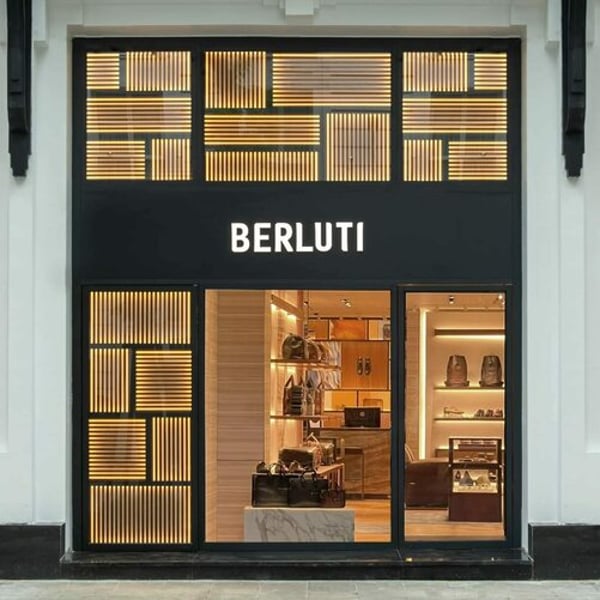
A Berluti store – S&S Group
The one thing I keep hearing from designers and industry chief executives is that a sense of “private luxury,” or luxury that’s just for one’s self or one’s small community of peers, is what the highest spenders are looking for. Private luxury can be a lot of things. For example, a watch from a brand so obscure that your boss doesn’t know it’s nicer than the one he wears. Or the old niche car you won in an auction on Bring a Trailer while a small but vocal group of nerdy fellow enthusiasts cheered you on. Or a pair of shoes made just for your feet from a custom cobbler who keeps a pair of lasts in his shop with your name on them.
It’s not exactly “quiet” luxury — apparel characterised by sumptuous textiles, simple lines, subtle textures, and muted tones — although it, too, refuses to shout about itself. Private luxury is understanding why something that you own is special, and preferring that most other people don’t know about it. The smaller the circle of people who recognise and appreciate your choices, the better. Then you belong in an elite group of those in the know — the people who’ve heard about that obscure winery, too, and have made the effort to know the winemaker and get on the exclusive mailing list.
I recently spoke about private luxury and other aspects of contemporary shopping mores with Berluti CEO Jean-Marc Mansvelt, who took the reins of the LVMH-owned house from Antoine Arnault at the start of 2024. Berluti isn’t one of the group’s fashion behemoths such as Louis Vuitton or Christian Dior — rather it focuses on its heritage as a shoemaker, with additional pillars of ready-to-wear clothing and leather goods like bags and jackets. Berluti doesn’t expand beyond that because, as Mansvelt says, he wants to stick with what he knows the company is good at.
“We don’t want to expand, we don’t want to multiply our stores, we don’t want either to enlarge our craft lines,” he says. “We just try to do the three things as well as we can.”
Berluti’s clothing and accessories tend to be simple but finely made, and everything is priced in the luxury tier: A pair of sneakers starts at $1,200, and a briefcase will run you around $4,600. A leather jacket with Berluti’s famous ombre “patina” polish treatment is $9,000 or more. Because of the brand’s craftsmanship and legacy, Mansvelt says, Berluti’s No. 1 market is Japan, and the Middle East is growing in importance. (America is fifth.)
When I asked Mansvelt about what his consumers wanted in luxury today, he gave me five insights:
1) Customers “want to be part of the family.” They want to feel like they’re members of a unique club and that the club appreciates them back. “If you discuss with any of our clients, they all say the same thing: It’s really a love affair,” Mansvelt says. The affinity between brand and customer is a two-way street. They want to feel the brand’s employees know them and appreciate them. “They don’t come to shop one day and not return. They come and come back again,” he adds. “They are extremely comfortable in our stores; they feel like they are part of a family.”
Ultra-high-end brands have known this for a long time — invites to fashion shows, fabulous Very Important Client (VIC) events and trips, personal shoppers who greet you at the store or send stuff to your home without being asked — they’re all tactics that rely on this human instinct to be part of a club.
And members know other members when they see them. “You have a few subtle signs which are recognised by the club of people who know Berluti,” Mansvelt adds. “It’s quite discreet.”
2) They want something “confidential.” According to Mansvelt, what’s trending is not clothing or shoes that you see everywhere; rather, it’s distinctive and rare items. “People are looking for things that are not owned by everyone, like from gigantic stores around each corner of each street,” says Mansvelt. “There is a search, at least from a certain clientele, of a more low-key thing.”
Say you wear a watch from a brand like A. Lange & Soehne or F.P.Journe — most people won’t recognise their singular design or even realise how expensive they are. But a certain cohort will be able to tell, because they’re fans or they have one of their own. And then the item offers an easy way to strike up a conversation with those peers.
3) Customers are attuned to price combined with the quality. “The value formula is more important than ever,” Mansvelt says. “The right price with the right creativity, the right materials and the right craftsmanship, that is key.” Luxury will always feel expensive, that’s part of the appeal. But as luxury prices have skyrocketed over the past five years due to inflation, the price of gold, tariffs, and plain old cash grabs, quality has not increased — or even remained consistent.
“The sector’s rapid expansion over the past five years has led to overexposure and has weakened the industry’s promise of exclusivity, creativity, and craftsmanship,” says a McKinsey report on the state of luxury from January. “Brands increased prices, though some failed to sufficiently adapt their creative strategies and supply chains to meet new scale requirements, thereby weakening their core value proposition and ultimately failing to keep their promise to clients.”
However, McKinsey’s updated luxury report from this month notes that “among ultra-high-net-worth individuals, higher product quality and craftsmanship and better in-store service are among the top factors that would encourage them to buy more from luxury brands in the year ahead.”
4) “They want to feel the authenticity.” “If you make a product, does it have meaning with regards to the history of the maison?” Mansvelt says. “Does it come from somewhere?”
Many of Berluti’s leather goods, which are all made in Italy, share the brand’s signature patina — including an adorable Jour de Pouch bag I saw during our interview, which is sized and shaped precisely to fit one book. Berluti’s Forestière jacket, which was originally designed for the architect Le Corbusier and made by the French maison Arnys (which Berluti acquired in 2012), is offered in a number of new varieties for next season. Under Mansvelt, the brand is focusing on these core motifs rather than a wide array of new designs.
This relates to what he told me about not wanting to extend into new categories. It also happens to be what Van Cleef & Arpels CEO Catherine Rénier said last month when I asked her about expanding beyond jewellery: No thanks.
5) “They are looking for something that will last.” Clients will invest a little more for “something that has a purpose” that will become a staple in their wardrobe for years to come — whether it’s the best pair of shoes they can wear for formal events or the perfect jacket for fall weather. “Of course we need to bring new silhouettes every season, in order to express what is new,” Mansvelt says.
“It’s part of the creativity, and it says that the brand is alive,” he says. “But we really pay a lot of attention to mixing those fresh things with former pieces.” And it goes without saying, all the products have to be superbly well-constructed, so they can go the distance with the buyer.