Connect with us

Business

Fed officials and data keep signaling Wall Street won’t get continued cuts

Published

on


U.S. economic data keeps coming back stronger than expected, and frankly it’s raining on the parade for markets.

For the majority of 2025, investors have been hankering after multiple base interest rate cuts from Jerome Powell and the Federal Open Market Committee (FOMC), knowing it would kickstart cheaper borrowing and foster economic activity. The general consensus was that once the Fed was confident enough to start cutting, it would spell a change in the weather: A move toward the greatly-anticipated “normalization” of the funds rate.

So when the FOMC cut in September this apparent fact was not only baked in by markets, but so too were the cuts expected to come for the rest of the year.

Unfortunately, the economy is faring far better than many estimated—meaning the Fed may not be forced into further action as quickly as anticipated.

Markets continued to struggle yesterday—the third day in a row—with Deutsche Bank’s Jim Reid noting: “The main catalyst was a strong batch of U.S. data, which meant investors dialled back their expectations for rapid Fed rate cuts, and pushed front-end Treasury yields higher. So that meant rate-sensitive sectors like tech took a hit, with the Magnificent 7 dragging down the broader equity market.”

That sums up the counterintuitive position traders are in at the moment: When healthy economic data actually works against the sentiment of analysts and investors. The data this week should have reassured them: Weekly jobless claims fell to 218,000 for the week ended September 20, GDP increased at an annual rate of 3.8% for Q2 2025, according to a third estimate from the Bureau of Economic Analysis.

With the labor market softening (the economy added less than 30,000 jobs according to most recent data), analysts had hoped this would push the Fed to continue cutting. But with inflation—the pesky other side of the Fed’s mandate—remaining elevated at near 3% (ahead of its target at 2%) that gives the Fed just enough reason to remain cautious.

Kevin Khang, Vanguard’s senior international economist, wrote in a note seen by Fortune this week: “It’s no surprise that every hint of a dovish Fed pivot is met with enthusiasm. But two realities about the yield curve—and the broader rate environment—are worth keeping in mind.”

“First, the short end of the curve will continue to be shaped by the Fed’s dual mandate of ensuring both price stability and maximum sustainable employment. Although inflation has come down meaningfully from its peak, it remains sticky. This is partly due to supply-side forces, including tariffs and an immigration slowdown.”

“At the same time, the labor market, though showing signs of softening, remains in balance by historical standards. These dynamics suggest that the Fed’s path to sustained rate cuts is narrow. With inflation poised to remain above its 2% target for a fifth consecutive year, the Fed is unlikely to ease the policy rate substantially—unless inflation somehow makes a more decisive move toward target sooner.”

The longer view

Undeterred by data suggesting the contrary, investors have continued to bank on a further cut coming in October. According to CME’s FedWatch barometer, investors are still banking on a 87.7% chance of a further 25bps cut in the October meeting.

Indeed, members of the FOMC have been signaling that while further cuts could be to come, anything beyond a meeting-to-meeting approach would be an error. As Mary Daly, president of the San Francisco Fed said in a speech Wednesday: “Moving forward, it is likely that further policy adjustments will be needed as we work to restore price stability while providing needed support to the labor market … But these are projections, not promises, and making good decisions will require us to anchor on our objectives, assess the tradeoffs, and decide, again and again.”

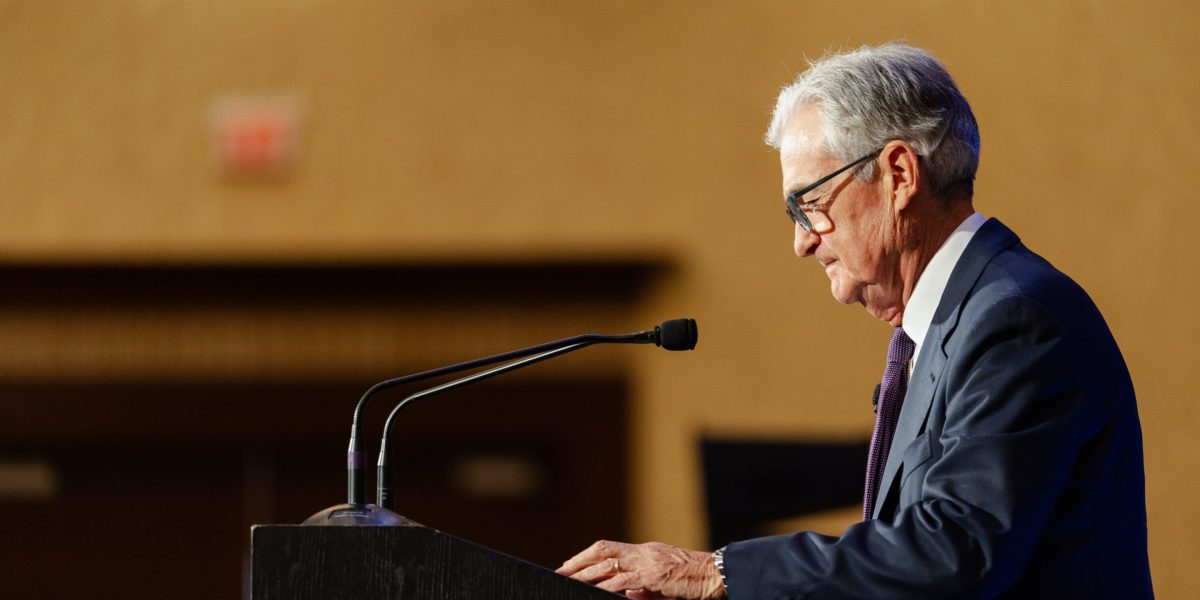
This steady approached was echoed by Chairman Jay Powell, who was given the nickname “Too Late” by the Oval Office, courtesy of his cautious approach to easing. But speaking in Rhode Island this week, Powell stuck by his measured approach: “Our policy is not on a preset course. We will continue to determine the appropriate stance based on the incoming data, the evolving outlook, and the balance of risks. We remain committed to supporting maximum employment and bringing inflation sustainably to our 2 percent goal.”

“Our success in delivering on these goals matters to all Americans. We understand that our actions affect communities, families, and businesses across the country.”

Here’s snapshot of the markets ahead of the opening bell in New York this morning:

  • S&P 500 futures were flat this morning. The index closed down 0.5% in its last session.
  • STOXX Europe 600 was up 0.31% in early trading. 
  • The U.K.’s FTSE 100 up 0.37% in early trading.
  • Japan’s Nikkei 225 was down 0.87%.
  • China’s CSI 300 was up 0.6%.
  • The South Korea KOSPI was down 2.45%.
  • India’s Nifty 50 was down 0.91% before the end of the session.
  • Bitcoin declined to $109.7K.
Fortune Global Forum returns Oct. 26–27, 2025 in Riyadh. CEOs and global leaders will gather for a dynamic, invitation-only event shaping the future of business. Apply for an invitation.


Source link

Continue Reading

Business

Nvidia CEO says U.S. data centers take 3 years, but China ‘can build a hospital in a weekend’

Published

on


Nvidia CEO Jensen Huang said China has an AI infrastructure advantage over the U.S., namely in construction and energy.

While the U.S. retains an edge on AI chips, he warned China can build large projects at staggering speeds.

“If you want to build a data center here in the United States from breaking ground to standing up a AI supercomputer is probably about three years,” Huang told Center for Strategic and International Studies President John Hamre in late November. “They can build a hospital in a weekend.”

The speed at which China can build infrastructure is just one of his concerns. He also worries about the countries’ comparative energy capacity to support the AI boom.

China has “twice as much energy as we have as a nation, and our economy is larger than theirs. Makes no sense to me,” Huang said.

He added that China’s energy capacity continues to grow “straight up”, while the U.S.’s remains relatively flat.

Still, Huang maintained that Nvidia is “generations ahead” of China on AI chip technology to support the demand for the tech and semiconductor manufacturing process.

But he warned against complacency on this front, adding that “anybody who thinks China can’t manufacture is missing a big idea.”

Yet Huang is hopeful about Nvidia’s future, noting President Donald Trump’s push to reshore manufacturing jobs and spur AI investments.

‘Insatiable AI demand’

Early last month, Huang made headlines by predicting China would win the AI race—a message he amended soon thereafter, saying the country was “nanoseconds behind America” in the race in a statement shared to his company’s X account.

Nvidia is just one of the big tech companies pouring billions of dollars into a data center buildout in the U.S., which experts tell Fortune could amount to over $100 billion in the next year alone.

Raul Martynek, the CEO of DataBank, a company that contracts with tech giants to construct data centers, said the average cost of a data center is $10 million to $15 million per megawatt (MW), and a typical data centers on the smaller side requires 40 MW.

“In the U.S., we think there will be 5 to 7 gigawatts brought online in the coming year to support this seemingly insatiable AI demand,” Martynek said.

This shakes out to $50 billion on the low end, and $105 billion on the high end.


Source link

Continue Reading

Business

Trump finally meets Claudia Sheinbaum face to face at the FIFA World Cup draw

Published

on


Their long-delayed first face-to-face discussion focused on next year’s World Cup — and included side discussions about trade and tariffs — but immigration was not the top issue. That’s despite Trump’s push to crack down on the U.S.-Mexico border being a centerpiece of his administration, and the driving force in the relations between both countries.

Trump has been in office for more than 10 months, and his having taken so long to see Sheinbaum in-person is striking given that meeting with the leader of the country’s southern neighbor is often a top priority for U.S. presidents.

Trump and Sheinbaum had been set to meet in June on the sidelines of the Group of Seven summit in Canada, but that was scrapped after Trump rushed back to Washington early amid rising tensions between Israel and Iran.

Soccer took center stage — but tariffs still loom large

Trump and Sheinbaum sat talking in the president’s box and also appeared onstage with Canadian Prime Minister Mark Carney at the Kennedy Center for Friday’s 2026 World Cup draw. The U.S., Mexico and Canada are co-hosting the tournament, which begins in June.

A senior White House official, who spoke on the condition of anonymity to discuss private meetings, said Trump, Sheinbaum and Carney met privately after participating in the draw.

Sheinbaum had said before leaving Mexico that she’d talk to Trump about tariffs that his administration has imposed on automobiles, steel and aluminum from Mexico, among other things. She said after appearing at the Kennedy Center that the three leaders “talked about the great opportunity that the 2026 FIFA World Cup represents for the three countries and about the good relationship we have.”

“We agreed to continue working together on trade issues with our teams,” Sheinbaum posted on X.

Mexico is the United States’ largest trading partner. The the U.S.-Mexico-Canada Agreement which Trump forged in his first term as a replacement for 1994’s North American Free Trade Agreement also remains in place. But U.S. Trade Representative Jamieson Greer has begun scrutinizing it ahead of a joint review process set for July.

In the meantime, the U.S. and Mexico’s priorities have been reshaped by the steep drop in the number of people crossing into the U.S. illegally along its southern border, as well as the White House’s — so far largely unrealized — threats to impose large trade tariffs on its neighbor.

Before speaking in-person, Trump and Sheinbaum had repeatedly talked by phone, discussing tariffs and Mexican efforts to help combat the trafficking of fentanyl into the U.S. But despite other world leaders, including Russian President Vladimir Putin and Chinese President Xi Jinping, having already met with Trump this term, the meeting with Sheinbaum hadn’t happened until Friday.

The Trump whisperer?

Waiting so long to meet in person hasn’t seemed to hurt Mexico’s president’s standing with Trump.

The two spoke by phone in November 2024, with the then-U.S. president-elect declaring afterward that they’d agreed “to stop Migration through Mexico” — even as Sheinbaum suggested her country had already been doing enough.

Trump soon after taking office threatened to impose a 25% tariff on goods imported from Mexico in an effort to force that country to better combat fentanyl smuggling, only to later agree to a pause.

The White House subsequently backed off tariff threats against most Mexican goods. Then, in October, Sheinbaum announced that the U.S. had given her country another extension to avoid sweeping 25% tariffs on goods it imports to the U.S. — even as many items covered by the USMCA trade deal remain exempt.

Mexico, though, hasn’t avoided all U.S. tariffs. Sheinbaum’s country continues to try to negotiate its way out of import levies Trump has imposed worth 25% on the automotive sector and 50% on steel and aluminum.

Sheinbaum’s success at mitigating many tariffs, and other successes in the bilateral relationship, has led some to wonder if she has a special gift for getting what she wants from him.

She’s largely pulled it off by affording Trump the respect the U.S. president demands from leaders around the world — but especially a neighboring country — and by deploying occasional humor and pushing back, always respectfully, when necessary.

Sheinbaum also defused another potential point of contention, Trump’s renaming of the Gulf of Mexico to the “Gulf of America,” by proposing dryly that North America should be renamed “América Mexicana,” or “Mexican America.” That’s because a founding document dating from 1814 that preceded Mexico’s constitution referred to it that way.

Still, Mexican officials continue to work furiously to lessen the trade blow from tariffs going into 2026 — levies that could wreck its already low-growth economy, particularly in its all-important automotive sector. Sheinbaum’s government has also sought to defend its citizens living in the U.S. as the Trump administration expands its mass deportation operations.

Sheinbaum’s government also lobbied unsuccessfully against a 1% U.S. tax on remittances, or money transfers that millions of Mexicans send home every year from the United States. It was approved as part of Trump’s tax cut and spending package and takes effect Jan. 1.

Trump’s push for mass deportations

Trump has directed federal officials to prioritize major deportation pushes in Democratic-run cities — an extraordinary move that lays bare the politics of the issues. He’s also deployed the National Guard in an effort to curb crime, which has led to a spike in immigration-related arrests, in places like Los Angeles, Chicago and Washington, as well as Memphis, Tennessee, and Portland, Oregon.

The Trump administration says its priority is targeting “the worst of the worst” criminals, but most of the people detained in operations around the country have not had violent criminal histories.

Such operations often meant targeting Mexican citizens who have lived and worked in the United States for years and may face deportation to a homeland they no longer know well. It also has meant serious threats of declining remittance income, which has fallen for seven consecutive months.

The lower number of illegal U.S.-Mexico border crossings has knocked immigration off its perch as the top agenda item for the U.S.-Mexico bilateral relations for the first time in recent memory.

Mexican officials now say conversations around immigration have shifted toward cajoling countries into taking back their citizens and reintegrating them to keep them from leaving again — a major Trump administration priority around the world.

Cooperation on security

Sheinbaum has blunted some of the Trump administration’s tough talk on fentanyl and drug smuggling cartels by giving her security chief Omar García Harfuch more authority.

Mexico has also extradited dozens of drug cartel figures to the U.S., including Rafael Caro Quintero, long sought in the 1985 killing of a DEA agent. That show of goodwill, and a much more visible effort against the cartels’ fentanyl production, has gotten the Trump administration’s attention.

That’s a significant improvement. Only a few years ago, the DEA struggled to get visas for its people in Mexico, and then-President Andrés Manuel López Obrador accused the U.S. government of fabricating evidence against a former Mexican defense secretary, though he never presented evidence to back up the allegation.

Not everything has gone so smoothly, though. Trump criticized Sheinbaum for rejecting his proposal to send U.S. troops to Mexico to help thwart the illegal drug trade.

Last month, Sheinbaum said there was no way the U.S. military would be able to make strikes in Mexico, after Trump said he was open to the idea. And she has denounced U.S. strikes on boats allegedly carrying drugs in the Caribbean and eastern Pacific.

“The president of Mexico is a lovely woman, but she is so afraid of the cartels that she can’t even think straight,” Trump said earlier this year.

Sheinbaum declined to take the bait — and avoided turning up the political pressure — by sidestepping Trump’s criticism.

___

Associated Press writer Chris Sherman contributed from Mexico City.


Source link

Continue Reading

Business

Former Amazon exec warns Netflix-WBD deal will make Hollywood ‘a system that circles a single sun’

Published

on


A Netflix-Warner Bros. merger would risk a monopsony where a single buyer wields enormous control over the marketplace, the former head of Amazon Studios warned.

Roy Price, who is now chief executive of the studio International Art Machine, wrote in a New York Times op-ed on Saturday that predictions of doom are nothing new in the film industry, pointing to the advent of TV, home video, streaming, and AI.

“But if Netflix acquires Warner Bros., this long-prophesied death may finally arrive, not in the sense that filmmaking will cease but in the sense that Hollywood will become a system that circles a single sun, materially changing its cultural output,” he added. “All orbits—every deal, every creative decision, every creative career—will increasingly revolve around the gravitational mass and imprimatur of one entity.”

To be sure, Netflix has said Warner Bros. operations will continue, and the studio’s films will still be released in theaters. Meanwhile, Warner’s TV channels will be spun off via a separate company, though HBO will be included in Netflix.

But Price said the danger “is not annihilation but centralization,” with the combined company accounting for an even bigger slice of overall content spending.

A reduction in bidders also means less content will be produced, while a separate development culture, set of tastes, and risk tolerances will be sidelined, he predicted.

“A Netflix merger with Warner Bros. would create a monopsony problem: too few buyers with too much bargaining power,” Price explained. “Writers, directors, actors, showrunners, puppeteers, visual effects artists—all are suppliers. The fewer buyers competing to hire them, the lower their compensation and the narrower their opportunities.”

Such reasoning sank Penguin Random House’s attempt to merge with Simon & Schuster that would’ve created a book publisher with too much leverage over authors, he pointed out.

Of course, the remaining players in Hollywood and content creation are giants in their own right as well. A KPMG survey of spending in 2024 put NBC Universal parent Comcast at the top with $37 billion, followed by Alphabet’s YouTube ($32 billion), Disney ($28 billion), Amazon ($20 billion), Netflix ($17 billion) and Paramount ($15 billion). Comcast and Paramount also made bids for Warner Bros.

Theater owners, producers and other creative workers have also voiced opposition to the deal. In addition to the business impact of a Warner Bros. takeover, other opponents raised even weightier concerns.

Oscar winner Jane Fonda sounded the alarm on a “constitutional crisis” and demanded that the Justice Department not use its regulatory power to “extract political concessions that influence content decisions or chill free speech.”

For its part, the Trump administration views the deal with “heavy skepticism,” sources told CNBC. The merger is expected to face exceptional antitrust scrutiny, and Netflix’s $5.8 billion breakup fee is among the biggest ever.

On Wall Street, analysts see a tech angle in the merger, namely the importance of content to train and power the next generation of AI models that will shape the entertainment industry’s future.

The acquisition of Warner Bros. would help Netflix stand out in an AI future, Divyaunsh Divatia, research analyst at Janus Henderson Investors, said in a note on Friday.

“They’re also levering up on premium entertainment at a time when competition on engagement from short form video is expected to intensify especially if AI models democratize video creation at an increasing rate,” he wrote.


Source link

Continue Reading

Trending

Copyright © Miami Select.