Connect with us

Politics

Fed gives reporters rare look at its $2.5B renovation project as tensions flare before Donald Trump visit
Published

on


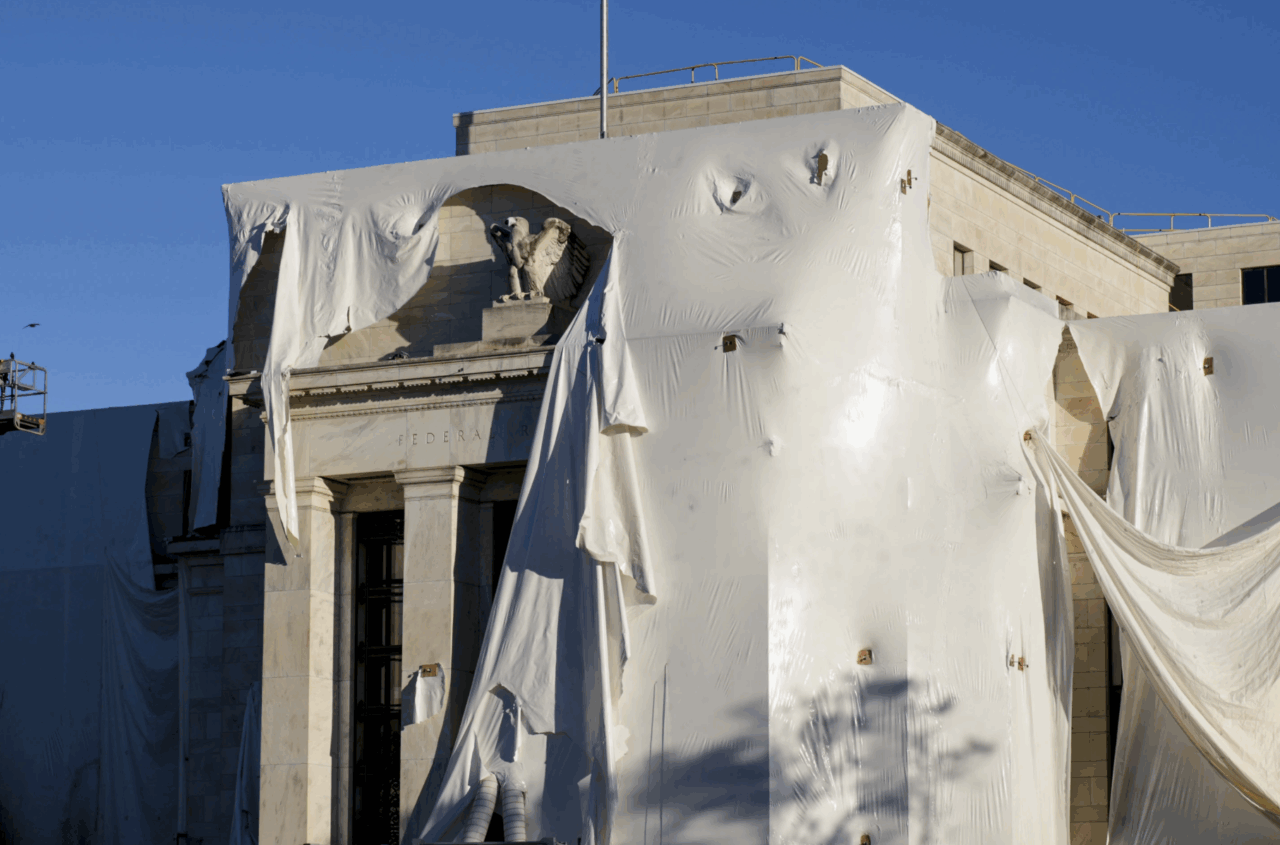
The Federal Reserve, known for its tight lips, structured formality and extraordinary power to shape the global economy, opened up a costly building renovation Thursday to reporters and President Donald Trump.

Trump and his allies say a $2.5 billion renovation of the Fed headquarters and a neighboring building reflects an institution run amok — a belief they hope to verify in an afternoon tour of the construction site. The Fed allowed reporters to tour the building before the visit by Trump, who, in his real estate career, has bragged about his lavish spending on architectural accoutrements that gave a Versailles-like golden flair to his buildings.

The visit is an attempt to further ratchet up pressure on Fed Chair Jerome Powell, whom the Republican President has relentlessly attacked for not cutting borrowing costs. Trump’s criticisms have put the Fed, a historically independent institution, under a harsh spotlight. Undermining its independence could reduce the Fed’s ability to calm financial markets and stabilize the U.S. economy.

“This stubborn guy at the Fed just doesn’t get it — Never did, and never will,” Trump said Wednesday on Truth Social. “The Board should act, but they don’t have the Courage to do so!”

Journalists get rare tour of Fed renovation

On Thursday, reporters wound through cement mixers, front loaders, and plastic pipes as they got a close-up view of the active construction site that encompasses the Fed’s historic headquarters, known as the Marriner S. Eccles building, and a second building across 20th Street in Washington.

Fed staff, who declined to be identified, said that greater security requirements, rising materials costs and tariffs, and the need to comply with historic preservation measures drove up the cost of the project, which was budgeted in 2022 at $1.9 billion.

The staff pointed out new blast-resistant windows and seismic walls that were needed to comply with modern building codes and security standards set out by the Department of Homeland Security. The Fed has to build with the highest level of security in mind, Fed staff said, including something called “progressive collapse,” in which only parts of the building would fall if hit with explosives.

Sensitivity to the President’s pending visit among Fed staff was high during the tour. Reporters were ushered into a small room outside the Fed’s boardroom, where 19 officials meet eight times a year to decide whether to change short-term interest rates. The room, which will have a security booth, is oval-shaped, and someone had written “oval office” on plywood walls.

The Fed staff downplayed the inscription as a joke. When reporters returned to the room later, it had been painted over.

During the tour, Fed staff also showed the elevator shaft that congressional critics have said is for “VIPs” only. Powell has since said it will be open to all Fed staff. The renovation includes an 18-inch (45-cm) extension so the elevator reaches a slightly elevated area that is now accessible only by steps or a ramp. A planning document that said the elevator will only be for the Fed’s seven governors was erroneous and later amended, staff said.

Renovations have been in the works for a while

Plans for the renovation were first approved by the Fed’s governing board in 2017. The project then wended its way through several local commissions for approval, at least one of which, the Commission for Fine Arts, included several Trump appointees. The commission pushed for more marble in the second of the two buildings the Fed is renovating, known as 1951 Constitution Avenue, specifically in a mostly glass extension that some of Trump’s appointees derided as a “glass box.”

Fed staff also said tariffs and inflationary increases in building material prices drove up costs. Trump in 2018 imposed a 25% duty on steel and 10% on aluminum. He increased them this year to 50%. Steel prices are up about 60% since the plans were approved, while construction materials costs overall are up about 50%, according to government data.

Fed staff also pointed to the complication of historic renovations — both buildings have significant preservation needs. Constructing a new building on an empty site would have been cheaper, they said.

As one example, the staff pointed reporters to where they had excavated beneath the Eccles building to add a floor of mechanical rooms, storage space, and some offices. The Fed staff acknowledged such structural additions underground are expensive, but said it was done to avoid adding HVAC equipment and other mechanics on the roof, which is historic.

The Fed has previously attributed much of the project’s cost to underground construction. It is also adding three underground levels of parking for its second building. Initially the central bank proposed building more above ground, but ran into Washington, D.C.’s height restrictions, forcing more underground construction.

Renovation project could be impetus to push out Powell

Trump wants Powell to dramatically slash the Fed’s benchmark interest rate under the belief that inflation is not a problem, but Powell wants to see how Trump’s tariffs impact the economy before making any rate cuts that could potentially cause inflation to accelerate.

The renovation project has emerged as a possible justification by Trump to take the extraordinary step of firing Powell for cause, an act that some administration officials have played down given that the Fed chair’s term ends in May 2026. White House budget director Russell Vought suggested in a July 10 letter to Powell that changes to the renovations in order to save money might have violated the National Capital Planning Act.

Fed staff said there were just two changes to the plans they had submitted to the National Capital Planning Commission, and neither were significant enough to warrant a re-submission of the plans. They removed a seating area on the roof of the Eccles building, because it was an amenity, and two water features in front of the second building, which they said saved money.

More recently, Trump has said he has no plans to oust Powell, which could be illegal based on a note in a May Supreme Court ruling. The Supreme Court found that Trump had the power to remove board members of other independent agencies, but indicated that a Fed chair could only be removed for cause.

Pushing Powell out also would almost certainly jilt global markets, potentially having the opposite effect that Trump wants as he pushes for lower borrowing costs.

Not everyone in Trump’s administration agrees with the President’s contention that Powell needs to resign.

“There’s nothing that tells me that he should step down right now,” said Treasury Secretary Scott Bessent, whom Trump has floated as a potential replacement for Powell, in a recent interview with Fox Business. “He’s been a good public servant.”

When asked last week if the costly rebuilding could be grounds to fire Powell, Trump said, “I think it sort of is.”

“When you spend $2.5 billion on, really, a renovation,” Trump said, “I think it’s really disgraceful.”

___

Republished with permission of The Associated Press.


Post Views: 0


Source link

Continue Reading

Politics

House panel OKs bill to restore the Ocklawaha River

Published

on


A House subcommittee unanimously approved a bill to restore the Ocklawaha River that drew strong praise from environmentalists and fierce opposition from local officials in Putnam County.

The mixed public feedback on HB 981 makes it clear that the legislation to remove the river’s dam remains controversial after Gov. Ron DeSantis vetoed $6.25 million in funding for Ocklawaha River restoration during the 2025 Session.

“It’s a local decision. It’s a local issue. It needs to stay local,” said Putnam County Commissioner Larry Harvey, who voiced concerns about West Putnam lakes drying up. 

“Putnam County wasn’t considered locally. We’ve never been asked about this. We don’t want this.”

Rep. Wyman Duggan, a Jacksonville Republican, defended his bill and argued the restoration project carries a greater importance since the Ocklawaha is the primary tributary running into the St. Johns River.

“This is, at a minimum, a regional issue. The Ocklawaha River touches 12 counties, but I submit it’s a state level issue. The St. Johns River is the longest river in the state and it’s the most significant,” Duggan said.

Lawmakers on the House Natural Resources and Disasters Subcommittee were not swayed by the bill’s opponents.

Behind the Everglades and the Kissimmee River Basin restoration projects, the Ocklawaha River will become “the third-greatest restoration in the state of Florida’s history,” said Rep. Jim Mooney Jr., an Islamorada Republican.

Rep. Lindsay Cross called the bill “a big lift.”

“I will be a strong supporter of it, and hope we can get this across the finish line this year,” said Cross, a St. Petersburg Democrat.

Duggan added that the Department of Environmental Protection (DEP) will oversee the river restoration and will take into account local residents’ concerns with water level impacts.

Duggan’s bill would require the DEP to develop a plan to restore the Ocklawaha River by Jan. 1, 2027, then finish the work by Dec. 31, 2032.

What made the bill necessary, Duggan said, was the U.S. Army Corps of Engineers designating the dam as a high hazard.

Living beyond its 50-year life span, the 58-year-old Rodman Dam doesn’t perform any flood control or generate electricity, Duggan said. 

“There is no alarm system in place to warn the downstream communities in the event of a dam failure,” Duggan said. “It’s not even clear that if we try to reconstruct the dam, bring it up to code, that the Army Corps of Engineers would permit that effort.”

The dam is also known as the Kirkpatrick Dam.

Restoring the Ocklawaha would put 21 billion gallons of water into the St. Johns River, which environmentalists said will improve the water and help the fisheries and the manatees, Duggan explained.

Environmentalists also said removing the dam would bring back 20 lost springs.

Another major component of Duggan’s bill is to beef up economic development in Clay, Marion, Putnam and St. Johns counties to promote water and nature activities from swimming to fishing and wildlife viewing. The bill would create the Northeast Florida River and Springs Recreation and Economic Development Council and create a grant program to fund the council’s outdoor recreation plan.

“The bill shows people what they gain and not what they lose,” said Chip Laibl, Vice President of the Great Florida Riverway Trust. “It’s time to quit kicking this issue down the road for a vocal minority and consider the safety, economic needs, and recreation facilities for all of Putnam County and beyond.”

Laibl argued that HB 981 will make “Putnam County the outdoor recreation hub of the state.”


Source link

Continue Reading

Politics

Consumer protections for Hispanics, veterans, seniors, and retirees are smart policy

Published

on


Hispanic Floridians have played a pivotal role in building our state, and today their impact is stronger than ever. Increasing numbers of Hispanic families, business owners, seniors, retirees, and veterans call Florida home.

As our community grows, public policy must keep pace in protecting those most at risk.

Florida has a longstanding record of defending seniors, veterans, and retirees — from expanded homestead exemptions to laws guarding against elder abuse and financial exploitation. HB 427 and SB 266 build on that tradition by addressing a pressing problem: predatory public adjuster contracts targeting vulnerable residents after home damage.

When fires, plumbing disasters, or storms strike, seniors, retirees, and veterans often face pressure to sign complicated contracts quickly — sometimes while recovering from hospitalization or other emergencies.

Many Hispanic seniors face an additional hurdle: English is not their primary language, yet contracts are not required to be available in Spanish or other easy-to-understand formats.

Too often, elderly Hispanic residents are navigating these high-stakes decisions alone. Adult children may live far away and cannot assist immediately. Contracts must be reviewed and signed quickly, leaving residents exposed to confusing terms or high-pressure tactics.

HB 427 and SB 266 provide common sense relief. They allow seniors, retirees, and veterans to cancel public adjuster agreements — without penalty — if they are unable to fully understand the contract. This safeguard is especially important for Spanish-speaking residents and others facing language or comprehension challenges.

Ethical public adjusters have nothing to worry about. The bills target exploitative practices, not responsible business operations. They strike a balance: protecting Floridians while leaving legitimate professionals free to do their work.

At its core, this legislation is about fairness, clarity, and respect. It ensures that those who have contributed to Florida — Hispanics, seniors, retirees, and veterans alike — are not taken advantage of in moments of vulnerability.

Florida can once again demonstrate leadership in consumer protection. HB 427 and SB 266 offer practical, balanced reforms that reflect our values and protect those who need it most.

On behalf of Hispanic seniors, and all of Florida’s retirees and veterans, I urge lawmakers to act in support of these commonsense protections.

___

Julio A. Fuentes is president and CEO of the Florida State Hispanic Chamber of Commerce (FSHCC).


Source link

Continue Reading

Politics

John Harshman announces Sarasota City Commission bid

Published

on


Business leader John Harshman has entered the race for the Sarasota City Commission, running for an at-large seat in the city’s next municipal election.

Harshman, a longtime Sarasota commercial real estate executive, said decades of local business experience and civic involvement have prepared him for his bid for office. He faces incumbent Jen Ahearn-Koch, Flo Entler and Rob Rominiecki for two at-large seats.

“I fell in love with Sarasota and have built my career and life here,” Harshman said in a statement. “It would be my privilege to serve all members of our community on the city commission.”

Harshman, who moved to Sarasota more than five decades ago, founded Harshman & Co., Inc. in 1989. The firm has since grown into one of Southwest Florida’s top commercial real estate companies.

In his announcement, Harshman emphasized land-use policy and fiscal responsibility as core issues driving his candidacy. Harshman said he decided to run after completing a 45-day “listening tour,” during which he met with neighborhood leaders, business owners, arts organizations, environmental advocates and local government officials.

“The encouragement that I received from this very diverse group convinced me that my decades of living, working, and volunteering in the Sarasota community have prepared me for serving the citizens of the town I dearly love,” Harshman said.

Beyond his business career, Harshman has held leadership or volunteer roles with civic and nonprofit organizations, including the Sarasota Chamber of Commerce; Association of Downtown Commercial Property Owners, Inc.; Downtown Sarasota Alliance, Girls, Inc.; The Pines of Sarasota, Inc.; Sarasota County Public Facilities Finance Advisory Board; Sarasota Community Redevelopment Advisory Board; Sarasota County Environmental Lands Oversight Committee; City of Sarasota Tree Advisory Committee; National Estuary Program Volunteer; Sarasota Ballet Board; and John and Mable Ringling Museum of Art.

Harshman is a graduate of the University of South Florida and a Leadership Sarasota alumnus. He is also an honorary alumnus of New College of Florida.

Outside of his professional and civic work, Harshman also taught Taekwondo to hundreds of local families and earned a fifth-degree black belt — winning several national championships as a competitor.


Source link

Continue Reading

Trending

Copyright © Miami Select.