Connect with us

Politics

Fed gives reporters rare look at its $2.5B renovation project as tensions flare before Donald Trump visit
Published

on


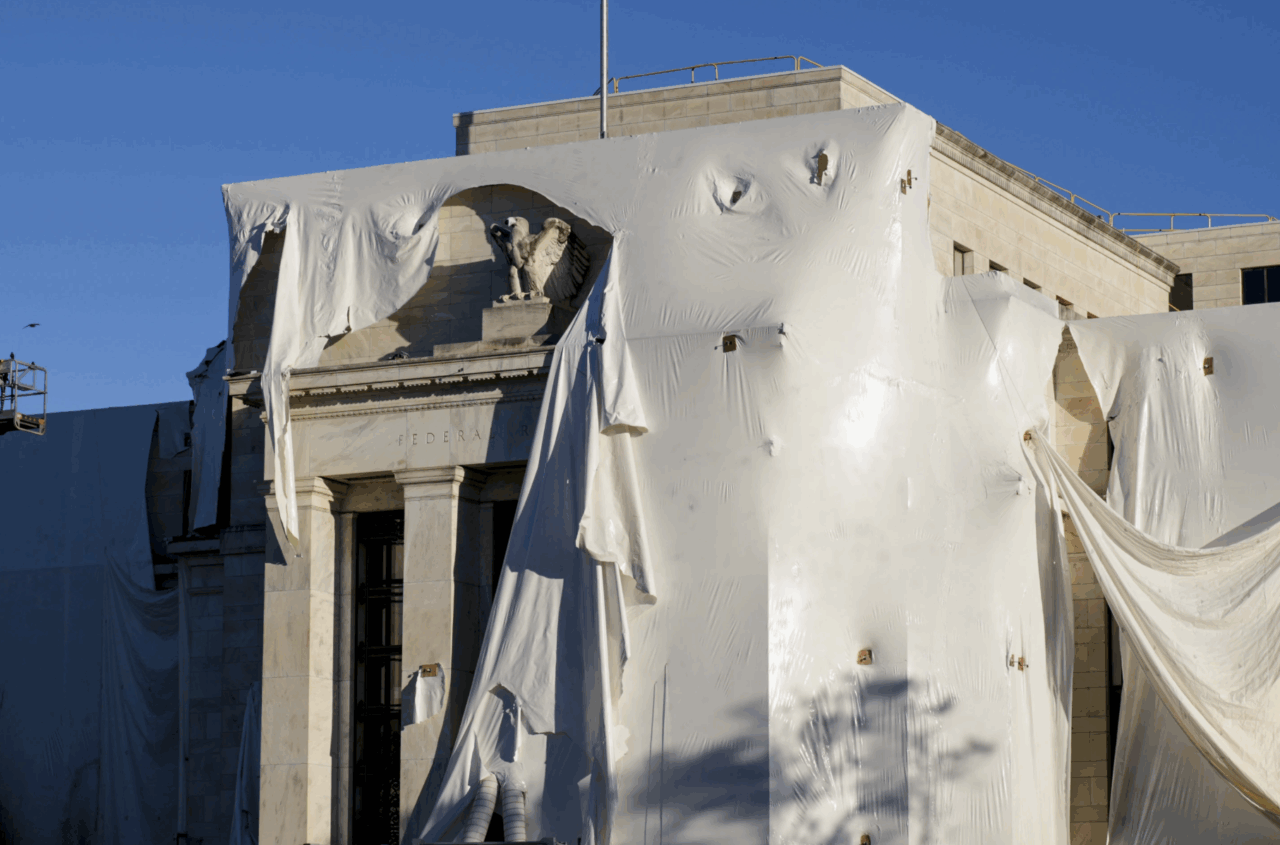
The Federal Reserve, known for its tight lips, structured formality and extraordinary power to shape the global economy, opened up a costly building renovation Thursday to reporters and President Donald Trump.

Trump and his allies say a $2.5 billion renovation of the Fed headquarters and a neighboring building reflects an institution run amok — a belief they hope to verify in an afternoon tour of the construction site. The Fed allowed reporters to tour the building before the visit by Trump, who, in his real estate career, has bragged about his lavish spending on architectural accoutrements that gave a Versailles-like golden flair to his buildings.

The visit is an attempt to further ratchet up pressure on Fed Chair Jerome Powell, whom the Republican President has relentlessly attacked for not cutting borrowing costs. Trump’s criticisms have put the Fed, a historically independent institution, under a harsh spotlight. Undermining its independence could reduce the Fed’s ability to calm financial markets and stabilize the U.S. economy.

“This stubborn guy at the Fed just doesn’t get it — Never did, and never will,” Trump said Wednesday on Truth Social. “The Board should act, but they don’t have the Courage to do so!”

Journalists get rare tour of Fed renovation

On Thursday, reporters wound through cement mixers, front loaders, and plastic pipes as they got a close-up view of the active construction site that encompasses the Fed’s historic headquarters, known as the Marriner S. Eccles building, and a second building across 20th Street in Washington.

Fed staff, who declined to be identified, said that greater security requirements, rising materials costs and tariffs, and the need to comply with historic preservation measures drove up the cost of the project, which was budgeted in 2022 at $1.9 billion.

The staff pointed out new blast-resistant windows and seismic walls that were needed to comply with modern building codes and security standards set out by the Department of Homeland Security. The Fed has to build with the highest level of security in mind, Fed staff said, including something called “progressive collapse,” in which only parts of the building would fall if hit with explosives.

Sensitivity to the President’s pending visit among Fed staff was high during the tour. Reporters were ushered into a small room outside the Fed’s boardroom, where 19 officials meet eight times a year to decide whether to change short-term interest rates. The room, which will have a security booth, is oval-shaped, and someone had written “oval office” on plywood walls.

The Fed staff downplayed the inscription as a joke. When reporters returned to the room later, it had been painted over.

During the tour, Fed staff also showed the elevator shaft that congressional critics have said is for “VIPs” only. Powell has since said it will be open to all Fed staff. The renovation includes an 18-inch (45-cm) extension so the elevator reaches a slightly elevated area that is now accessible only by steps or a ramp. A planning document that said the elevator will only be for the Fed’s seven governors was erroneous and later amended, staff said.

Renovations have been in the works for a while

Plans for the renovation were first approved by the Fed’s governing board in 2017. The project then wended its way through several local commissions for approval, at least one of which, the Commission for Fine Arts, included several Trump appointees. The commission pushed for more marble in the second of the two buildings the Fed is renovating, known as 1951 Constitution Avenue, specifically in a mostly glass extension that some of Trump’s appointees derided as a “glass box.”

Fed staff also said tariffs and inflationary increases in building material prices drove up costs. Trump in 2018 imposed a 25% duty on steel and 10% on aluminum. He increased them this year to 50%. Steel prices are up about 60% since the plans were approved, while construction materials costs overall are up about 50%, according to government data.

Fed staff also pointed to the complication of historic renovations — both buildings have significant preservation needs. Constructing a new building on an empty site would have been cheaper, they said.

As one example, the staff pointed reporters to where they had excavated beneath the Eccles building to add a floor of mechanical rooms, storage space, and some offices. The Fed staff acknowledged such structural additions underground are expensive, but said it was done to avoid adding HVAC equipment and other mechanics on the roof, which is historic.

The Fed has previously attributed much of the project’s cost to underground construction. It is also adding three underground levels of parking for its second building. Initially the central bank proposed building more above ground, but ran into Washington, D.C.’s height restrictions, forcing more underground construction.

Renovation project could be impetus to push out Powell

Trump wants Powell to dramatically slash the Fed’s benchmark interest rate under the belief that inflation is not a problem, but Powell wants to see how Trump’s tariffs impact the economy before making any rate cuts that could potentially cause inflation to accelerate.

The renovation project has emerged as a possible justification by Trump to take the extraordinary step of firing Powell for cause, an act that some administration officials have played down given that the Fed chair’s term ends in May 2026. White House budget director Russell Vought suggested in a July 10 letter to Powell that changes to the renovations in order to save money might have violated the National Capital Planning Act.

Fed staff said there were just two changes to the plans they had submitted to the National Capital Planning Commission, and neither were significant enough to warrant a re-submission of the plans. They removed a seating area on the roof of the Eccles building, because it was an amenity, and two water features in front of the second building, which they said saved money.

More recently, Trump has said he has no plans to oust Powell, which could be illegal based on a note in a May Supreme Court ruling. The Supreme Court found that Trump had the power to remove board members of other independent agencies, but indicated that a Fed chair could only be removed for cause.

Pushing Powell out also would almost certainly jilt global markets, potentially having the opposite effect that Trump wants as he pushes for lower borrowing costs.

Not everyone in Trump’s administration agrees with the President’s contention that Powell needs to resign.

“There’s nothing that tells me that he should step down right now,” said Treasury Secretary Scott Bessent, whom Trump has floated as a potential replacement for Powell, in a recent interview with Fox Business. “He’s been a good public servant.”

When asked last week if the costly rebuilding could be grounds to fire Powell, Trump said, “I think it sort of is.”

“When you spend $2.5 billion on, really, a renovation,” Trump said, “I think it’s really disgraceful.”

___

Republished with permission of The Associated Press.


Post Views: 0


Source link

Continue Reading

Politics

Senate panel advances bill establishing task force to propose e-bike regulations

Published

on


A Senate bill proposing more regulations on e-bikes and scooters is gaining traction, though with some modifications.

The Senate Transportation Committee unanimously approved a measure (SB 382) sponsored by Sen. Keith Truenow, a Tavares Republican, that calls for increased regulation and data collection on e-bikes and scooters. Those devices have grown in popularity in recent years, with more accidents involving the devices occurring as well.

In the committee meeting, Truenow said he provided a strike-all amendment to revise his original draft of the bill.

“As we know it’s been a fad for a lot of reasons,” Truenow said of the growing popularity of e-bikes. “They’re causing more and more problems.”

He said his original draft called for an increase in enforcement of e-bikes and scooters. But he acknowledged that, as the original bill was scrutinized, stakeholders worried provisions in the original proposal “would be difficult to accomplish.”

A major amendment calls to establish an “electric bicycle task force.” Truenow said the issue of e-bikes in particular needs thorough study before enforcement stipulations are settled.

“The purpose of the task force is to examine and recommend improvements to state law and regulatory framework governing electric bicycles in order to encourage the safe operation of electric bicycles and to prevent traffic incidents, injuries, and fatalities involving such bicycles,” the bill states.

The Electric Bicycle Safety Task Force would collect data on e-bike and scooter accidents, provide recommendations on enforcement, and submit a report to the Florida Department of Highway Safety and Motor Vehicles. The e-bike task force would be composed of representatives of law enforcement, the e-bike industry and other “stakeholders,” and will be charged with completing its report in the Fall.

The amended bill still calls for e-bike operators to be restricted “above a certain speed limit.” Truenow said, at least initially, he would like to see speeds capped at 10 mph on sidewalks, trails and pathways.

But Sen. Shevrin Jones, a Miami Gardens Democrat, wondered how that speed limit would be enforced.

Truenow acknowledged that would have to rely on “best judgment,” and it’s doubtful that radar detector devices would be readily available in pedestrian areas.

Other members of the committee wondered if increased enforcement of e-bikes and scooters would reduce access to easy and affordable transportation for some Florida residents who rely on them.

“We’re not seeing the problems coming from those folks,” Truenow said, noting that more rowdy operators and “YouTubers” are the main target of increased enforcement, which would ultimately result in a noncriminal infraction.

Republican Rep. Yvette Benarroch is sponsoring a similar bill in the House (HB 243). That bill has three committee stops ahead.

E-bikes have been increasing in presence on roads, especially in the Sunshine State, where tourist-rich areas are seeing a striking rise, with accidents increasing as well.

Some local governments have already enacted some e-bike regulations. The Palm Coast City Council passed an ordinance in October that makes it illegal for owners of the vehicles to modify the battery-powered engines to exceed 30 mph, along with other stipulations.

The St. Johns County Commission passed a resolution in August to join forces with the Sheriff’s Office and the St. Johns County School District to promote more awareness and safety for the operators of e-bikes, e-scooters and other electronic motorized devices.


Source link

Continue Reading

Politics

Ola Hawatmeh’s CD 19 campaign notches endorsement from ‘MAGA Meg’ Weinberger

Published

on


Small-business owner Ola Hawatmeh’s bid to succeed fellow Republican Byron Donalds in Florida’s 19th Congressional District is getting a boost from one of South Florida’s most prominent Donald Trump-aligned state lawmakers.

Palm Beach Gardens state Rep. Meg Weinberger, dubbed “MAGA Meg” for the support she has given, and received from, Trump and his supporters, just threw her political influence behind Hawatmeh’s CD 19 campaign.

She believes Hawatmeh, a health and wellness entrepreneur, is most likely to win in November and keep the U.S. House in GOP hands post-Midterms.

“With Republicans needing to keep their slim majority in the U.S. House of Representatives,” Weinberger said in a statement, “we need more loyal America First Republicans like Ola to help President Donald Trump continue defending our God-given American freedoms and liberties.”

Hawatmeh, whose X page heavily features posts supporting Trump and Weinberger, also carries an endorsement from economist and Trump policy adviser Stephen Moore.

Hawatmeh said in a statement that she is “honored” to have Weinberger’s endorsement.

“Meg understands how important it is to help President Donald J. Trump retain the narrow Republican majority in the House of Representatives with true America First candidates,” she said.

Hawatmeh is running in a crowded Republican Primary to replace Donalds, the GOP front-runner in Florida’s gubernatorial race. Others competing for the party nomination include former U.S. Rep. Madison Cawthorn of North Carolina, Stephen Elliott, Johnny Fratto, Dylan Modarelli, former Illinois state Sen. Jim Oberweiss, Mike Petersen and Jim Schwartzel.

Democrat Howard Sapp, a longtime community leader in Fort Myers, has been running unopposed for his party’s nomination since February 2025.

CD 19 covers a swath of Southwest Florida spanning large parts of Charlotte, Collier, Glades, Hendry, Lee and Sarasota counties. Cities in the district include Bonita Springs, Cape Coral, Fort Myers, Fort Myers Beach, Marco Island, Naples and Sanibel.

The district leans heavily Republican, with a Cook Partisan Voting Index of R+14.


Source link

Continue Reading

Politics

Joe Gruters bill restricting public pot smoking clears first Senate stop

Published

on


A proposal that would ban smoking and vaping marijuana in public places has cleared its first Senate committee stop.

The Senate Regulated Industries Committee voted to advance a bill (SB 986) sponsored by Sarasota Republican Sen. Joe Gruters to amend the Florida Clean Indoor Air Act to prohibit smoking or vaping marijuana products in public places. The measure was presented to the committee by Doral Republican Sen. Ana Maria Rodriguez, the bill’s co-sponsor, on Gruters’ behalf.

“There is currently no prohibition on smoking marijuana in public places if adult use is approved by the voters,” Rodriguez told the committee. “By banning public smoking of marijuana, we are protecting community health and quality of life, as well as protecting certain outdoor spaces from marijuana smoke such as beaches and parks.”

Rodriguez told the committee that every state allowing recreational marijuana either bans public smoking outright or imposes tight restrictions on where it can occur. SB 986 would prohibit smoking or vaping marijuana in public places, while also folding marijuana into Florida’s existing Clean Indoor Air Act framework.

The bill defines public places as streets, sidewalks, parks, beaches and common areas of apartment buildings, restaurants, retail shops, transportation facilities and government buildings. It does not change Florida’s ban on smoking tobacco in enclosed indoor workplaces.

The Florida Restaurant & Lodging Association spoke in support of the bill’s intent but raised concerns about how the definition of “public places” could affect private property.

“We support adding vaping and marijuana to the provisions of the Florida Indoor Clean Air Act,” association Vice President of Government Relations Samantha Padgett said.

However, she said restaurants and hotels worry the bill could interfere with designated smoking areas created in compliance with existing law. Padgett said many businesses made significant investments to comply with current statutes and urged lawmakers to preserve that flexibility as the bill moves forward.

“This gives all employers the freedom to ensure a smoke-free environment in their places of employment,” she said. “We have received feedback of concern from our members regarding the definition of smoking in designated spaces on private property such as patios and designated hotel rooms or floors.”

Meanwhile, medical marijuana advocates argued the bill could have unintended consequences for patients. Jody James, speaking on behalf of the Florida Cannabis Action Network, said the proposal is overly broad and could limit lawful access for medical marijuana patients, particularly those living in apartment complexes or staying in lodging where indoor smoking is prohibited but outdoor smoking is permitted.

James also raised concerns that the bill’s definition of public places could blur the line between public and private property, potentially affecting patients smoking just outside their homes.

“We understand the problems of having people smoking everywhere, but we also hope that you’ll consider patients and property rights in this discussion,” James said. 

Committee members questioned whether the bill could inadvertently sweep in activities such as non-tobacco hookah use or vaping on private property. Rodriguez said the bill does not target marijuana use so tightly that it should affect a person smoking outdoors near their homes, or other extreme interpretations of the law.

“There is a difference between someone’s front door and a public place where the general public can gather, whether it’s a restaurant, whether it’s in a park or a beach,” Rodriguez said. Your house is your dwelling, and the front door of your house is not the same as being in a public place.”

The committee voted to report SB 986 favorably. The bill will now head to its second of three committee stops with the Senate Appropriations Committee on Agriculture, Environment, and General Government.


Source link

Continue Reading

Trending

Copyright © Miami Select.