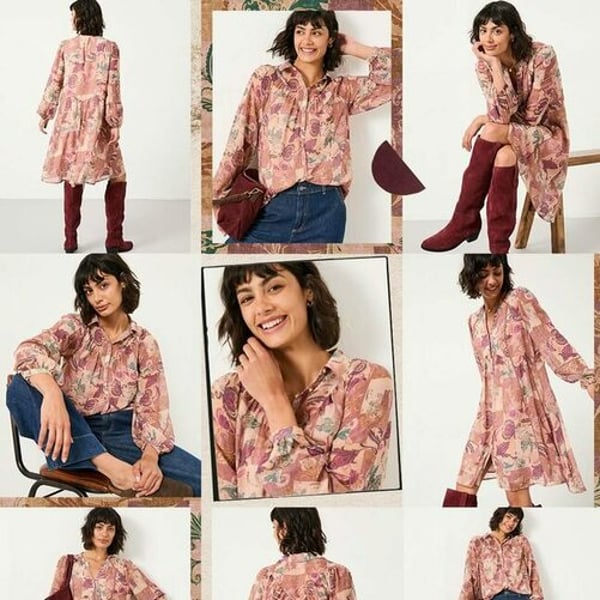
FatFace, which is now owned by Next, has expanded into the German market via a deal with local online giant Zalando, which has started carrying the brand’s collections.
FatFace
And the company is planning further launches across Europe via Zalando, which is no surprise given the ever-closer links that parent company Next has been forging with the German e-tailer.
Next has partnered with Zalando’s ZEOS fulfilment operation for its online European orders, expanding its previous relationship that was simply about selling its products on Zalando’s webstore. Now it also takes in European sales generated via Next’s own webstore and other marketplaces.
So the FatFace move seems a logical one as that brand drives its strategy to expand its international multichannel offering.
Customers in Germany can now shop the womenswear and menswear ranges on Zalando. The brand’s premium womenswear collection, Copper & Black, will also be available.
FatFace said “initial trading has been positive, with the business anticipating strong sales heading into Autumn, driven by the demand for transitional dressing”.
The brand is also planning to expand its product offer on Zalando over the coming months to include accessories and footwear.
Alexandra Dalwood, Head of Partners at FatFace said: “Joining the Next family has given us the platform to drive growth and expand into new international markets. Our launch on Zalando marks an important step in building our global brand awareness, and we’re really pleased to be able to bring FatFace to a new audience on this platform in Germany.Early interest has been very encouraging.”
The move follows a period of strong trading for FatFace with full-price sales up 6.6% in the first half and sales through the Next Label operation up 86%. Digital now accounts for 36% of total revenue, with over 40 million visits to FatFace’s website annually.
FatFace continues to invest in physical stores as well as digital growth and is still opening and refurbishing UK and Ireland stores. It’s also trialling new formats and in July, it opened its first ever concession in a Next store at Lakeside Shopping Centre.
Two indie fashion brands, Auralee from Japan and Études Studio from France, staged highly contrasting collections on Tuesday, the opening day of Paris Fashion Week Men, testifying to the dynamism of the season in the French capital.
Auralee: Purist fashion with polish
A moment of grace on Tuesday evening at Auralee, where Ryota Iwai’s deceptively understated designs never fail to impress.
Auralee’s answer to its question: “What makes winter joyful?” – Luca Tombolini
Staged in the Musée de l’Homme facing an illuminated Eiffel Tower, the show was the latest pure statement by a designer whose clothes blend subtlety with refinement.
Whatever fabric Iwai plays with always seems just right: whether speckled Donegal tweeds seen in brown knit pants for guys, or a frayed hem skirt for girls in this co-ed show. Leather or lambskin jerkins and baseball jackets, all were ideal.
Semi-transparent nylon splash vests or wispy trenches had real cool. While Iwai’s detailing was also very natty- like the flight jacket trimmed with fur.
A women’s look by Auralee – Luca Tombolini
He is also a great colourist- from the washed-out sea green of a canvas ranger’s jacket to the moody Mediterranean blue of a caban. Though his finale featured a quintet of looks in black. Most charmingly a languid, deconstructed double-breasted cashmere coat worn on a shirtless model- the picture of perfection.
There were perhaps not that many sartorial fireworks in the show, but there didn’t need to be. This was a purist fashion statement of polish and precision that this audience could only admire.
Backed up by a great soundtrack – Sounding Line 6 by Moritz. Von Oswald or the cutely named Autumn Sweater by Yo La Tengo- the whole display won Ryota a loud and long ovation. Fully deserved too.
Études Studio: Resonating in IRCAM
Études Studio certainly know how to stage a show. The design duo invited guests into the bowels of the Institute for Research and Coordination in Acoustics/Music, or IRCAM a unique French concept dedicated to experimental sounds.
A look by Études Studio – Collective Parade – Gaspar J. Ruiz Lidberg
Which we enjoyed a lot of thanks to Darren J. Cunningham, a British electronic musician known professionally as Actress. It made for a dramatic mood, as keys and chords swelled and raged throughout this show.
As a result, the design duo of Aurélien Arbet and Jérémie Egry titled this Autumn/Winter 2027 collection ‘Résonances.’ Terming it in their program: “A medley bringing into dialogue the minimalist experiments rooted in John Cage’s philosophy with the emergence of intelligent Dance Music in the early 1990s.”
The result was a rather moody series of clothes, made in a sombre palette of muddy brown, dark purple, black, black, and even more black.
Muted tones at Études Studio – Collective Parade – Gaspar J. Ruiz Lidberg
What stood out were the bulbous, off-the-shoulder puffers, worn over corduroy shirts or roll-necks- topped by some great rancher hats courtesy of Lambert. One could also admire sleek raingear; cool cocoon shaped jerkins and fuzzy mohair sweaters. And appreciate a sleek A-Line coat and zippered knit safari jacket in a rare women’s look in this show.
Photoshopped faces in black and white scarves all looked very appealing, as did the brand’s debut bag, a satchel in tough canvas. And one had to applaud one great dull gold, wildly deconstructed puffer.
That said, the collection lacked proper kick and rarely resonated as the show title suggested it would. A decent statement about the mode, but far from a fashion moment.
Not a label, not a lobby, not even a legal entity. That is how Arielle Lévy, president of the Une Autre Mode Est Possible (UAMEP) collective, characterises this nascent union. Animer, an acronym for “Acteurs Nationaux Indépendants Mode Engagée Régénérative,” aims to shine a light on all the initiatives undertaken by fashion stakeholders, from producers to brands, who are advancing responsible, regenerative fashion in France.
The union was founded by eight collectives involved in regenerative fashion – UAMEP
The union was officially launched on Monday January 19, following the petition initiated by Arielle Lévy against Shein in response to the watering down of the anti–fast fashion law. Titled “Paris deserves better than Shein,” the petition drew nearly 140,000 signatures. “I wanted us to unite because I realised how strong the civic voice was,” explains Arielle Lévy. “These collectives are doing superb work and, at a certain point, there is a desire to close ranks, to make society together,” she says.
“Breaking the isolation of initiatives across the regions”
In addition to UAMEP, a number of other collectives are behind Animer, including Fashion Revolution France, L’Âme du Fil (Angers), Collectif Baga (Marseille), Café Flax (Clermont-Ferrand), Le Comptoir de la mode responsable (Poitiers), Le Conservatoire de la Mode Vintage (Isère), and La Grande Collecte/Textile Lab (La Rochelle). “It’s a union of independent collectives, committed to their local areas and sharing the same societal project,” Arielle Lévy emphasises.
The union hopes to represent all French territories – Collectif Baga
The union plans to focus its efforts on the ground, working across supply chains, regions, practices and even our shared imagination. With “hundreds” of stakeholders already on board via the various founding collectives, Animer is built on ten key ideas: dignity, value-sharing, traceability as a common language, less and better, circular design, smart re-localisation, carbon sobriety, inclusion and plurality, cooperation rather than “sterile competition”, and proof through action.
Animer’s founders plan to bring together all the initiatives active in regenerative fashion across the country. The union hopes to become a preferred interlocutor in defending a societal project focused on respect for the earth, and for men and women. With the help of Fashion Revolution, it aims to act in the national interest by engaging the general public and the country’s institutions.
This article is an automatic translation. Click here to read the original article.
French cosmetics giant L’Oreal said on Wednesday it will set up a beauty tech hub in the south Indian city of Hyderabad with an initial investment of over 35 billion rupees ($383.4 million).
L’Oréal
The hub aims to be a global base for AI-driven beauty innovation, create 2,000 tech jobs through 2030, and speed up the rollout of advanced AI beauty solutions, the company said in a statement.
Nicolas Hieronimus, L’Oreal’s CEO, and the state government of Telangana formalized the partnership at the World Economic Forum, Davos.
Telangana has rapidly emerged as a key investment and technology hub in southern India.
Bilateral trade between India and France stood at $15 billion in 2024, and Indian Prime Minister Narendra Modi and French President Emmanuel Macron have been forging warmer ties.
The two sides have also been working to recast their tax treaty since 2024 to modernize it by adapting global standards on tax transparency, Reuters reported in December.