Fashion
Fast fashion, delivery apps tap India’s next billion consumers
By
Bloomberg
Published
December 30, 2025
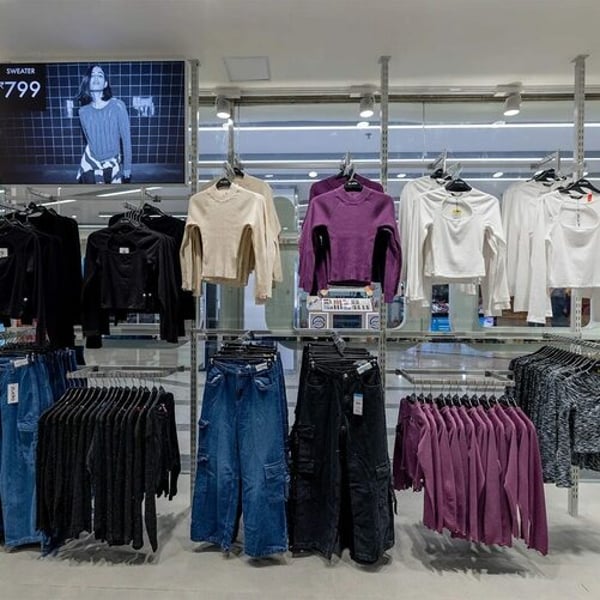
Inside the Zudio outlet on Ballapur Road in Dehradun, a stream of young shoppers drifted into the store on a recent Thursday morning, the glass storefront looming above the chai stalls and biryani counters just opening for business. Racks and hangers across three floors offered ribbed sweaters and light-wash jeans for $10, sneakers for $11- all made in Bangladesh. Alongside its apparel, the chain sells beauty and personal-care items, much like Zara, but starting at about $1 for a hand cream.
“The same products as H&M and Zara you’ll find in Zudio,” Aditya Singh, who grew up in the small city tucked into the Himalayan foothills, said as he lingered over a puffer jacket. Zudio’s formula- fast fashion priced for India’s small cities- has helped the chain expand to more than 800 stores in under a decade. Zara’s footprint by contrast has remained confined to major metropolitan areas, with just 22 stores.
For all its promise of a billion-people market, the discretionary spending boom in the world’s most populous nation has been powered by “India 1,” only about 150 million affluent, English-speaking Indians in a handful of major cities. Now, with India’s economy headed toward becoming the world’s fourth largest, a new race is on to court the next billion: a vast, price-conscious yet aspirational consumer in smaller towns, eager for the conveniences and brands once reserved for the urban elite. Companies are now retooling everything from products and pricing, to logistics and content, to reach them.
As hundreds of millions of these consumers inch upward, even small discretionary purchases- a new shirt, a delivery snack, a streaming subscription- become the battleground for the country’s next phase of growth.
This consumer group was long viewed as all but unmonetisable- too frugal, too distant, too hard to convert into steady consumers. But rising incomes, cheap smartphones and data, and improved roads have begun knitting smaller cities and industrial hubs into the national economy. Companies are finding that the problem is not aspiration, but a need to market and design for this audience on its own terms.
Sameer Narula, whose bicycle shop spills out into one of the main thoroughfares of Dehradun, has watched a trickle of cars swell into a honking, traffic-jammed roar. Porsches, BMWs, and Toyota Motor Corp.’s Fortuner SUVs now jostle with Maruti Suzuki’s compact hatchbacks and Hero MotoCorp’s budget-friendly motorbikes. A steady flow of professionals from Delhi and Mumbai has snapped up second homes here- fleeing pollution and crowds- pushing up property prices and turning this once-sleepy hill station into a small metropolis.
The boom has brought other changes. Ten-minute delivery apps like Blinkit, Zepto, and Swiggy Ltd. zip across the city, ferrying food and cosmetics from international brands as they push into smaller towns, chasing their next wave of growth. Big-name brands are muscling in alongside longstanding mom-and-pop outlets. Chain hotels and pubs have sprouted across town.
Companies are extending services in smaller cities, experimenting with cheaper aspirational products, regional languages, and locally tailored offerings to tap into this broader, more complex market. Faux-premiumisation is taking hold as brands chase aspirational demand by offering the look and feel of global labels at local prices. Aimed at “India 2” consumers, chains such as Burger Singh- which has locations across Dehradun- riff on Burger King’s look and menu. In other parts of India, fast-food outlets like American Fried Chicken, often branded simply as AFC, mirror Kentucky Fried Chicken, or KFC, along with its red-and-white branding and store interiors to project a premium feel.
It’s a bet that the future of India’s consumption story will be written not in Mumbai’s high-rises but in the mountain lanes of Dehradun and other emerging cities outside India’s urban cores.
“Companies clearly understand that the penetration levels in the top cities is largely over,” said Aditya Sharma, investment analyst at Shikhara Investment Management, which forecasts India’s economy will double to $8.5 trillion by 2032 on the strength of new consumers outside the metro cities. That shift, he said, is forcing brands to rethink their playbooks. “Companies have to onboard new customers,” he said. “And they have to convert the light customers to heavy customers and have to go down deeper” to smaller markets.
Around Dehradun, the city’s roots remain visible: elephant-crossing signs along forested stretches; hills rising behind famed boarding schools, military academies and engineering colleges; migrant workers arriving from nearby Uttar Pradesh. With roughly 1 million residents, a far cry from the 20-million plus who sprawl across Delhi some 150 miles to its south, it’s no megacity- but it’s urban enough to spark fresh habits. A Starbucks opened here in 2022.
E-commerce retailer Meesho Ltd. surged nearly 60% in a blockbuster listing this month, pushing its valuation to $8.5 billion and making it India’s best-performing major IPO of 2025. The SoftBank-backed company sells everything from footwear to kitchen staples, and nearly 90% of its buyers live outside India’s top cities. Its ascent points to a deeper change: small-city India is coming online at scale.
The last few years have pulled Dehradun squarely into India’s quick-commerce revolution. Blinkit, InstaMart, Zomato, and Swiggy now cover much of the city. Lower costs also make smaller cities more appealing for the dark stores that power instant deliveries.
“Platforms like Blinkit and Zepto are setting up dark stores in Tier 2 and Tier 3 cities, driven not just by consumer demand, but also because of lower real estate prices,” said Pintu Babu, leader in the practice development group at Nishith Desai Associates. A dark store in a Tier 2 city needs only about 800 orders a day to break even, according to financial services firm Emkay Global, compared with 1,300 in a Tier 1.
The boom has drawn workers too. For Ankit Kumar, a 30-year-old InstaMart delivery driver earning about 25,000 rupees a month, the job is a step up from the years he spent selling vegetables in his smaller hometown of Saharanpur. He could have gone to Delhi, but Dehradun offered better prospects- and a quick trip home thanks to new roads. “The boys in my village do this because it’s convenient,” he said. “I can reach home in one hour.”
Despite concerns about a quick-commerce bubble, Ravi Kapoor of PwC India said the sector still has significant runway, noting that it currently serves only a small fraction of India’s roughly 19,000 ZIP codes. While companies are cutting prices and localising assortments to expand into those markets, lower costs and lighter competition help cushion the hit. “The pressure to deliver in 10 minutes is not so dire,” he said. “Anything short of 30 minutes is below the noticeable level for Tier 2 or Tier 3 markets.”
But speed alone won’t determine how far the model can spread. India is one of the world’s most unequal societies: In fiscal 2023, the top 1% captured 22.6% of national income and held 40.1% of its wealth, according to the World Inequality Lab. Less than 10% of India- about 30 million households- account for the vast majority of discretionary spending, Blume Venture Advisors estimates.
That inequality is reflected across consumer patterns: Less than 10% of Indians- around 140 million people, or 30 million households- account for the vast majority of discretionary spending- twice as much as the rest of the country put together, according to Blume Venture Advisors in Mumbai.
Yet this picture is shifting. That’s why companies are now pushing hardest into Tier 2 cities like Dehradun- places big enough to hum with aspiration, small enough to remain price-sensitive, and increasingly reachable thanks to expanding highways, new airports, and the logistics networks that trail them.
“The next billion aren’t unwilling to pay,” said Karthik Srinivasan, a Bengaluru-based marketing consultant. “Their willingness sits behind barriers: trust, access, habit, and perceived value.”
India is also defined by its geographic and linguistic divides. Its 22 national languages pose steep challenges for brands trying to expand beyond Hindi- and English-speaking metros. And despite the attention lavished on mega-cities like Mumbai, Delhi, and Bengaluru, India remains fundamentally rural: roughly 60% of its population still lives in villages.
The shift toward the local is playing out offline as well. As domestic travel expands and smaller cities draw more visitors, demand is rising for affordable, reliable stays. Long known for five-star luxury with the Taj group of hotels, Indian Hotels Co. is now pushing into the mid-scale market with Ginger Hotels, reflecting how even legacy premium brands are reworking their playbooks to reach a broader, more price-sensitive consumer base.
Yet for all the momentum, India’s consumer economy is littered with companies whose tried-and-true global playbooks collapsed on the subcontinent. Many stumbled over high import duties, misaligned partnerships, or a failure to adapt to local tastes, said Adrian Mutton, founder of London-based consultancy Sannam S4 Group, who has spent nearly two decades helping companies break into South Asia. When Ford Motor Co. launched premium vehicles in India two decades ago, some vehicles featured power windows only in the front- standard in the US, but a misread in India, where affluent buyers are driven by chauffeurs, and often sit in the back.
It’s a trap that foreign entrants to the country often fall into when they simply try and port existing products into the Indian market, said Nivruti Rai, CEO of Invest India, the country’s national investment promotion agency. “A chip is identical country-to-country,” she said. “But cars have features, and if you continue to keep one Ford design for the entire world, that does not work.”
India can be difficult for outsiders to read. The country rarely yields to imported playbooks. One global brand still searching for its footing is Harley-Davidson Inc., the Milwaukee-based motorcycle maker whose on-again-off-again history in India has long been a talking point for President Donald Trump.
After a decade of rapid growth, India’s consumer market is no longer shaped from the top down but from the habits of people far from the megacities. In Dehradun, aspiration shows up not in big purchases but in small shifts, moving a little closer to the lifestyle once reserved for India. And that transformation is hardly unique to Dehradun. From Uttarakhand to Jharkhand, the same pattern is playing out.