Luxury fashion labels are increasingly extending their influence beyond the red carpet and exclusive parties of the cinema world, becoming partners with filmmakers and production companies. At this year’s Cannes film festival, which begins Tuesday, labels aim to showcase their couture creations and their credibility as investors in the entertainment industry.
From red carpets to credits: Fashion’s expanding role at Cannes – Alain JOCARD / AFP/Archives
Celebrating its 78th edition from May 13 to 24, 2025, the Cannes Film Festival remains the most prestigious and widely covered event in the cinematic calendar. Drawing more than 30,000 industry professionals and 5,000 journalists each year, the festival continues to serve as a global crossroads for cinema and culture — second only to the Olympic Games in terms of media visibility.
Alongside corporate heavyweights such as Chanel and Dior, the trendy Paris-based label Ami and its founder, Alexandre Mattiussi, are linking up with the festival for the first time.
Ami will introduce a new award for emerging talent — the Grand Prix Ami Paris — during the Critics’ Week section, a parallel program spotlighting fresh voices in cinema.
“We’re going there humbly, in support of cinema and its actors, to accompany artists,” said Mattiussi, who serves as creative director of his brand, in a statement to AFP.
Beyond its fashion accolades, Ami has also co-produced several films, including The Beast (2023) by Bertrand Bonello, starring French actress Léa Seydoux, and Enzo by Robin Campillo, which will premiere at Cannes this year.
“Fashion and cinema are, in a way, the same job. I also tell stories through clothing. A runway show has a context, music, and this idea of spectacle — it’s a narrative process too,” said the 44-year-old designer.
Still, Mattiussi emphasized that he doesn’t see himself as a film producer. “That would be pretentious,” he added. “I don’t get involved in the scripts or creative decisions.”
His label contributed costumes for The Beast, much like Jonathan Anderson — the newly appointed creative director of Dior Homme and formerly at Loewe — did for Luca Guadagnino’s 2024 film Queer.
For years, Anderson’s runway shows have also doubled as gathering points for cinema figures, including Timothée Chalamet and Tilda Swinton.
Expanding roles
Other fashion houses continue to broaden their footprint in film. Saint Laurent now operates a dedicated cinema division, namely Saint Laurent Productions.
Led by artistic director Anthony Vaccarello, the division aims to co-produce two to three films annually. It has already supported productions by Paolo Sorrentino (Parthenope), David Cronenberg (The Shrouds), and Jacques Audiard’s 2024 breakout musical Emilia Perez.
Kering — parent company of Gucci, Saint Laurent, and Balenciaga — sponsors a prominent Cannes prize, Women in Motion, which honors individuals advancing the role of women in cinema and society. This year’s recipient is Australian actor Nicole Kidman.
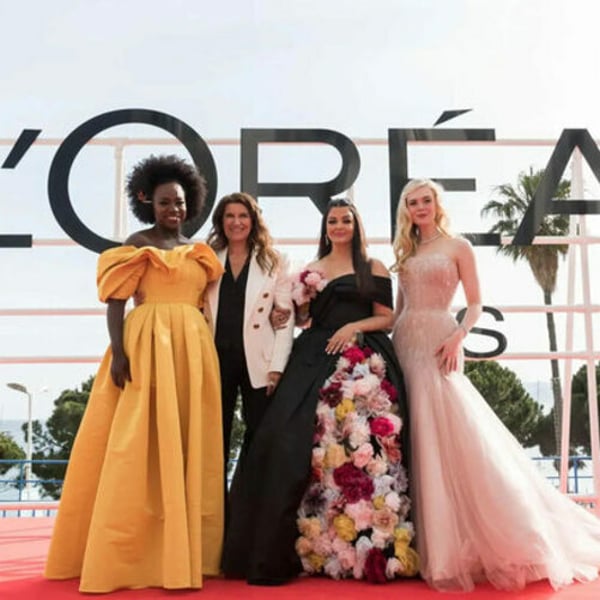
L’Oréal, the festival’s official makeup partner for 28 years, also presents an award celebrating “women in cinema.” In return, its logo gains high visibility on red carpets alongside stars such as Eva Longoria, Helen Mirren, Andie MacDowell, Viola Davis, and Aishwarya Rai.
Viola Davis, Delphine Viguier-Hovasse, Aishwarya Rai, and Elle Fanning — ambassadors of L’Oréal Paris — pose at the Cannes film festival in May 2022. – Photo: Getty Images
A new entrant this year is French carmaker Alpine, which has partnered with the Directors’ Fortnight — another key section of the festival. Alpine plans to showcase its sports cars along Cannes’ iconic boulevard, La Croisette.
BasicNet’s Kappa turns back the sporting clock for its new AW25 collection, which celebrates “local heroes in football” with a community-focused campaign “honouring the places and people that inspire a lifelong love of the game”.
Image: Kappa
The campaign shines a light on local talent Tyrone Marsh in his hometown of Bedford, revisiting the streets, pitches and community spots “that shaped his football journey”.
Local photographer Simon Gill, who had pictured Marsh during many home and away games, not only “captures the Bedford Town player in the spaces that helped define his skill”, but also highlights the brand’s “rich football heritage with contemporary streetwear energy, creating visuals that pay tribute to community, culture and grassroots football”.
The journey includes Hartwell Drive, the early days of his after-school kickabouts, Hillgrounds Road, synonymous with Bedford football culture, and then onto Faraday Square, locally identified by the concrete pitches and community spirit.
To reflect that journey, the AW25 collection “offers a sense of nostalgia” with Kappa’s long-standing history in fashion and sports “seen through the Omini logo placements and 222 Banda strip”.
The campaign sees Marsh wearing Kappa styles including the Lyman and Uriah Track Tops paired with the Ulrich Track Pants in classic colourways including navy and light blue.
The wider collection includes track tops, track pants, shorts, polos, sweatshirts and T-shirts, available at select retailers across the UK including 80s Casual Classics, Terraces Menswear and RD1 Clothing.
UK footfall down in November? Blame the Budget and bad weather. Those two important factors damaged shoppers’ desire to venture out, resulting in an albeit slender 0.8% year-on-year dip in footfall last month, with all types of destinations suffering. It was also the seventh consecutive footfall decline, noted the latest British Retail Consortium (BRC)/Sensormatic report
Image: Nigel Taylor
That meant visits to high streets were down 1.2% in November and down from a 0.6% rise in October; shopping centre footfall dipped 1.3% last month, down from a 0.9% dip in October; and retail park visits were down 0.4% in November, but were better than a 0.5% dip in October.
The BRC also noted that November’s Storm Claudia prompted many consumers to search online for Black Friday deals throughout November, leading some to not visit physical stores on Black Friday.
But there was good news, with some northern UK cities – including Manchester and Sheffield – continuing to buck the trend, “recording positive footfall for the eighth consecutive month”.
So with many shoppers holding off on store visits until this month, Helen Dickinson, chief executive of the British Retail Consortium, said: “With the Golden Quarter in full swing, retailers are continuing to invest what they can to entice customers into stores over Christmas.
“However, as we approach the New Year, given the downward trend in footfall across recent years, we need a comprehensive strategy to revitalise our high streets and shopping centres, from better transport, affordable parking, to a reformed planning system to enable faster, better development.”
Andy Sumpter, Retail Consultant EMEA for Sensormatic, added: “November may have been dominated by caution, but there are glimmers of hope. The Golden Quarter isn’t over yet, and with four of our predicted Top Five shopping days still to come, the festive season could deliver the lift retailers need. A last-minute rush may top off the year, turning caution into celebration. With the right balance of value, convenience, and experience, there’s still time to make December count.”
The world’s largest fashion retailer staged a stock-market comeback this week as Inditex SA’s push to differentiate itself from fierce ultra-low-price competition shows signs of bearing fruit.
Inside a Zara store – Zara
The owner of Zara, Bershka, and Massimo Dutti has seen its shares jump 14%, putting them on track for their best week in five years. Strong third-quarter results, coupled with accelerating November sales, were seen as evidence of the company’s resilience against weaker consumer sentiment.
This week’s surge put the stock on course for an annual gain, after what had previously looked like a lacklustre 2025. Inditex- whose second-largest market is the US- had been punished for its exposure to tariffs and a weaker greenback, amid concerns about softening consumer demand and intensifying competition from Chinese fast-fashion firms.
While its 10% rise this year trails the 50% jump for UK retailer Next Plc and the 19% gain at Sweden’s Hennes & Mauritz AB, Inditex is now outperforming the broader European retail sector. Analysts have welcomed the firm’s push to steer its Zara and Massimo Dutti brands further into the premium segment as it seeks to outmuscle competitors such as Shein and Temu. “The strategy is not to chase ultra-low prices, but to deliver premium-looking products at a good-value price point,” Alphavalue analyst Jie Zhang wrote in a note.
After this week’s rally, Inditex is trading at a substantially higher valuation than peers at 26 times forward earnings- on par with luxury behemoth LVMH. The firm’s strong third-quarter earnings reinforce “the quality of the business and will make investors question whether the right peer group for this company is luxury rather than retail in our view,” said Deutsche Bank AG analyst Adam Cochrane.
Inditex’s latest trading update spurred upward earnings revisions and price target upgrades, with more bullishness among brokers likely to follow, as the current consensus 12-month forward price target doesn’t leave any room for further upside. “These growth levels should provide reassurance of the continued opportunity for outperformance, including into 2026,” said JPMorgan & Chase Co. analyst Georgina Johanan.