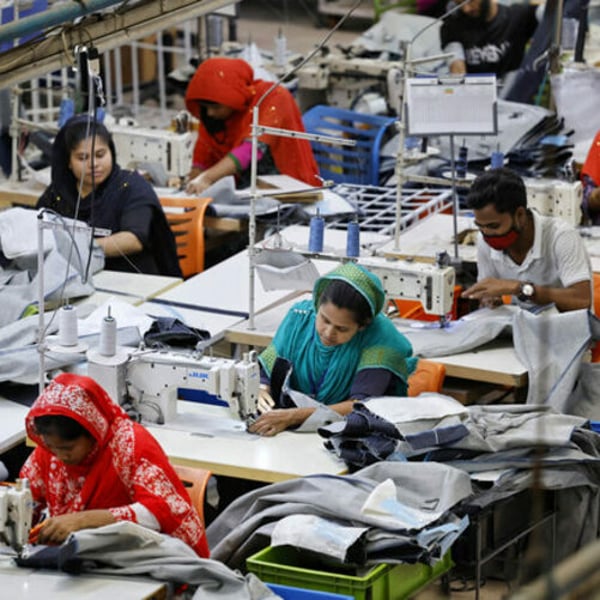
With open land scarce in Bangladesh, the textile industry is playing a part in the nation’s clean energy transition by using roof space for solar power.
Reuters
Under pressure from global brands to go green, textile suppliers, which account for 85% of Bangladesh’s exports, are hoping new initiatives can help find the funds they need to expand rooftop solar power systems.
Small and medium-sized factories that form the bulk of Bangladesh’s garment and textile manufacturers often lack financing to build their own solar plants, and few energy companies have came forward to make the investments – wary of failing to get returns in case smaller factories default on their obligations.
To break this deadlock, fashion brands are teaming up with energy companies to co-invest in building rooftop solar capacity for smaller Bangladeshi suppliers, creating a synergy of brand investment and commitment with energy company expertise.
One example is the Greener Garments Initiative (GGI), in which the Danish clothing brand Bestseller joined with the solar energy company SOLShare to jointly invest in construction of rooftop solar plants at garment factories in Bangladesh.
“Scaling up brand support to suppliers’ solar growth could speed up the industry’s energy transition,” said Aziza Sultana Mukti, Deputy CEO at SOLShare.
Involvement of fashion brands encourages suppliers to switch to solar power faster while making the investment financially safer for the solar energy company that builds the photovoltaic system, she added.
The joint initiative catering to small and medium-sized factories has already installed a combined capacity of more than seven megawatt-peak (MWp) in the last two years, said Mukti.
While such a capacity is not terribly large, GGI’s solar installations have grown by more than 200% in the last 18 months and it plans to build out capacity in the coming years, he added.
Other initiatives being tested include the Apparel Impact Institute, which is pooling contributions from brands and philanthropic organizations to support Bangladeshi factories in developing rooftop solar capacity.
Bangladesh’s textile-dominated industrial sector could build roughly 5,000 MW of solar power, about fifth of the country’s total generation capacity, while rooftop solar installations now make up less than 1%, according to an analysis by the Institute for Energy Economics and Financial Analysis (IEEFA), a global think tank.
“Industrial rooftop solar has not been reaching its true potential as many manufacturers struggle to access the required finance,” said Shafiqul Alam, IEEFA’s lead energy analyst for Bangladesh.
Most of the progress in building rooftop solar capacity so far has come from large manufacturers.
The DBL Group, one of the country’s biggest manufacturers with 50,000 workers, invested to build 5.42 MW capacity on its factory rooftops – a significant amount for a single business group – and plans to multiply its solar generation in the next few years.
“Arranging finance for renewable energy projects is not a big challenge for us – and we have made our own investments in our rooftop solar plants,” said Mashook Mujib Chowdhury, senior manager of sustainability at the DBL Group.
Large suppliers are more likely to build rooftop solar plants with their own investments using capital expenditure, said Chowdhury.
Smaller joint initiatives like the GGI by SOLShare and Bestseller, on the other hand, are implementing operational expenditure projects in the textile sector, he said.
This means an energy company builds, owns and runs the rooftop solar plant and charges the factory for the power generated – while selling any surplus power to the grid.
Such a model “works better for smaller suppliers to meet their gaps in finance, knowledge and technical know-how,” said Mohiuddin Rubel, former director of Bangladesh Garment Manufacturers and Exporters Association and also managing director of Denim Expert Ltd.
For fashion brands like Bestseller, reducing suppliers’ emissions is key to their decarbonization goals as these account for 96% of the sector’s emissions, said a study published last year by the Apparel Impact Institute.
“As a big buyer from Bangladesh – one of our key sourcing regions – we are committed to support suppliers who are navigating more and more climate targets,” said Felicity Tapsell, head of responsible sourcing at Bestseller.
Bestseller is also considering supporting suppliers with big ticket clean technology investments like biomass boilers or heat pumps, said Tapsell.
“Financing solar plants on factory rooftops may not be enough – as they need a few more things for energy transition,” said Rubel.
For decarbonization to be sustainable, suppliers need long-term partnership from brands, low-cost financing and tax cuts from the government, he added.
Barcelona-based label Desigual is expanding its line-up of international collaborations. The label has unveiled a new collection co-created with Masha Popova, a Ukrainian designer based in London, resulting in an offering that blends Mediterranean spirit with a distinctly London edge and will be available from February 17 across all the company’s physical retail outlets and online.
The new capsule created with Masha Popova will be available from 17 February in stores and online – Desigual
The collection has been conceived as a dialogue between Desigual’s archive and the bold, sensual, and rebellious aesthetic that defines Popova’s creative universe. The pieces reinterpret the brand’s bohemian essence through a contemporary lens, combining craftsmanship, a raw attitude and a confident, modern visual language; garments include hand-finished denim, fitted silhouettes, and avant-garde pieces.
This launch comes at a strategic moment for Desigual in the UK market. In 2025, the company posted double-digit digital growth in the UK, with a 16% increase in turnover, cementing it as one of the brand’s most promising European markets. At present, the brand operates in the country exclusively via its e-commerce platform, with no brick-and-mortar network.
Furthermore, through this new alliance, Desigual reaffirms its commitment to collaborating with international brands and designers as a driver of creative renewal and global reach. In this vein, the label has recently developed capsules with the French label Egonlab and Botter, founded by designers Lisi Herrebrugh and Rushemy Botter in Amsterdam.
Founded in 1984 by Thomas Meyer, Desigual is a Barcelona-based fashion company with more than 280 company-owned stores and a presence in 107 markets across ten sales channels. On the economic front, the company closed the 2024 financial year with turnover of €332 million, supported especially by its international expansion and the growth of its digital business.
This article is an automatic translation. Click here to read the original article.
Alix Morabito, director of assortment and buying at Galeries Lafayette, is rounding out her team within a newly restructured buying division. To lead buying for the pivotal womenswear and leather goods segment, the Parisian department store has turned to a rival currently in the midst of a revamp: La Samaritaine.
Victoria Dartigues has been appointed Director of Womenswear and Leather Goods Buying at Galeries Lafayette – David Atlan/ Galeries Lafayette
Victoria Dartigues has taken up her new post after four years heading buying and merchandising at LVMH’s Right Bank department store in Paris. Since 2019, she has been with DFS, the luxury group’s duty-free subsidiary that spearheaded the Paris project, and played a key role in the relaunch of La Samaritaine.
For Victoria Dartigues, a graduate of HEC Montréal and IFM, this appointment at Galeries Lafayette is something of a homecoming: her first experience in Parisian department stores was as a buying assistant at Galeries Lafayette. She went on to join rival Printemps as a womenswear buyer in 2012.
After more than six years at the Printemps group, where she rose to head of merchandising overseeing the designer offer, she spent a stint at Kenzo before moving to DFS in 2019.
“A specialist in the multi-brand and department store sector, she has built strong relationships with brands over the years, curating assortments and leading negotiations,” Galeries Lafayette said in a press release. The group added that her appointment completes a buying leadership team comprising Alice Feillard for menswear and footwear, Pascale Leboutet-Reberat for beauty, and Violaine Moreau, who has been promoted to head up childrenswear, home and luggage.
“This new structure addresses the strategic challenge of asserting Galeries Lafayette’s commercial and creative vision through an increasingly exclusive offering,” the group said in its press release.
This article is an automatic translation. Click here to read the original article.
Great Portland Estates (GPE) has appointed a new chief financial officer, with Jayne Cottam joining the London-centric commercial property firm’s board from 16 March.
Great Portland Estates
She succeeds Nick Sanderson who is stepping down as GPE’s chief financial & operating officer to take up the position of chief financial officer at British real estate services company Savills from 30 January.
Cottam “brings significant financial leadership and operational experience” stock market-listed GPE said on announcing her appointment to the London Stock Exchange Monday (19 January).
Most recently, she served as CFO of healthcare property company Assura from September 2017 to December 2025.
GPE chair William Eccleshare said: “Jayne brings a wealth of skills, knowledge and experience which will be invaluable to the board and management team as we progress our growth agenda.” And CEO Toby Courtauld added: “Jayne brings an excellent blend of financial, operational and leadership qualities with the right values for GPE’s culture.”
She joins at a time when analysts are noting that GPE continues to outperform the broader UK property sector, boosted not only by slowly increasing demand for London offices but also via its catchment area of prime prime West End retail sites that continue to be in high demand as the company continues to capture the ‘flight to quality trend’.
The company’s most recent investor commentary reiterated “stable-to-improving” leasing momentum across its core West End and City portfolio.








 Politics8 years ago