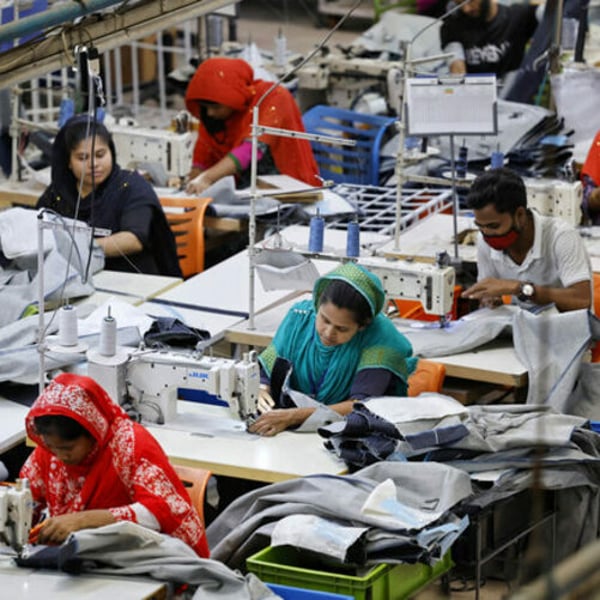
With open land scarce in Bangladesh, the textile industry is playing a part in the nation’s clean energy transition by using roof space for solar power.
Reuters
Under pressure from global brands to go green, textile suppliers, which account for 85% of Bangladesh’s exports, are hoping new initiatives can help find the funds they need to expand rooftop solar power systems.
Small and medium-sized factories that form the bulk of Bangladesh’s garment and textile manufacturers often lack financing to build their own solar plants, and few energy companies have came forward to make the investments – wary of failing to get returns in case smaller factories default on their obligations.
To break this deadlock, fashion brands are teaming up with energy companies to co-invest in building rooftop solar capacity for smaller Bangladeshi suppliers, creating a synergy of brand investment and commitment with energy company expertise.
One example is the Greener Garments Initiative (GGI), in which the Danish clothing brand Bestseller joined with the solar energy company SOLShare to jointly invest in construction of rooftop solar plants at garment factories in Bangladesh.
“Scaling up brand support to suppliers’ solar growth could speed up the industry’s energy transition,” said Aziza Sultana Mukti, Deputy CEO at SOLShare.
Involvement of fashion brands encourages suppliers to switch to solar power faster while making the investment financially safer for the solar energy company that builds the photovoltaic system, she added.
The joint initiative catering to small and medium-sized factories has already installed a combined capacity of more than seven megawatt-peak (MWp) in the last two years, said Mukti.
While such a capacity is not terribly large, GGI’s solar installations have grown by more than 200% in the last 18 months and it plans to build out capacity in the coming years, he added.
Other initiatives being tested include the Apparel Impact Institute, which is pooling contributions from brands and philanthropic organizations to support Bangladeshi factories in developing rooftop solar capacity.
Bangladesh’s textile-dominated industrial sector could build roughly 5,000 MW of solar power, about fifth of the country’s total generation capacity, while rooftop solar installations now make up less than 1%, according to an analysis by the Institute for Energy Economics and Financial Analysis (IEEFA), a global think tank.
“Industrial rooftop solar has not been reaching its true potential as many manufacturers struggle to access the required finance,” said Shafiqul Alam, IEEFA’s lead energy analyst for Bangladesh.
Most of the progress in building rooftop solar capacity so far has come from large manufacturers.
The DBL Group, one of the country’s biggest manufacturers with 50,000 workers, invested to build 5.42 MW capacity on its factory rooftops – a significant amount for a single business group – and plans to multiply its solar generation in the next few years.
“Arranging finance for renewable energy projects is not a big challenge for us – and we have made our own investments in our rooftop solar plants,” said Mashook Mujib Chowdhury, senior manager of sustainability at the DBL Group.
Large suppliers are more likely to build rooftop solar plants with their own investments using capital expenditure, said Chowdhury.
Smaller joint initiatives like the GGI by SOLShare and Bestseller, on the other hand, are implementing operational expenditure projects in the textile sector, he said.
This means an energy company builds, owns and runs the rooftop solar plant and charges the factory for the power generated – while selling any surplus power to the grid.
Such a model “works better for smaller suppliers to meet their gaps in finance, knowledge and technical know-how,” said Mohiuddin Rubel, former director of Bangladesh Garment Manufacturers and Exporters Association and also managing director of Denim Expert Ltd.
For fashion brands like Bestseller, reducing suppliers’ emissions is key to their decarbonization goals as these account for 96% of the sector’s emissions, said a study published last year by the Apparel Impact Institute.
“As a big buyer from Bangladesh – one of our key sourcing regions – we are committed to support suppliers who are navigating more and more climate targets,” said Felicity Tapsell, head of responsible sourcing at Bestseller.
Bestseller is also considering supporting suppliers with big ticket clean technology investments like biomass boilers or heat pumps, said Tapsell.
“Financing solar plants on factory rooftops may not be enough – as they need a few more things for energy transition,” said Rubel.
For decarbonization to be sustainable, suppliers need long-term partnership from brands, low-cost financing and tax cuts from the government, he added.
China’s HongShan Capital Group (HSG) has sent a 2.5 billion euro ($2.91 billion) offer to private equity Permira to buy Italian luxury sneaker maker Golden Goose, with the aim of signing the deal by Christmas, daily la Repubblica reported on Friday.
Golden Goose is known for its luxury sneakers – goldengoose.com
Details still need to be defined but the offer gives the luxury group an enterprise value of 10 times the core profit expected by the end of the year, debt included, the newspaper said. Golden Goose’s revenues totalled 655 million euros in 2024, with an adjusted core profit of 227 million euros.
HSG has asked veteran fashion industry executive Marco Bizzarri to become Golden Goose’s future chairman, la Repubblica said, adding that the Chinese private equity aims to expand Golden Goose’s directly-managed stores, particularly in Asia, and plans to list the group in the medium-term.
Last year the Venice-based company, which sells sneakers for more than 500 euros a pair, shelved plans for an initial public offering on the Milan Bourse, citing market volatility caused by political uncertainty in Europe.
IKEA plans to source more products from factories in the United States, the Swedish furniture group’s top supply chain executive told Reuters, as President Donald Trump‘s tariffs drive up the cost of importing bookcases, mattresses and sofas.
IKEA logo is seen in this illustration taken, February 11, 2025 – REUTERS/Dado Ruvic/Illustration/File Photo
This marks a big shift for IKEA after the share of the company’s US-made products declined over the past decade. Inter IKEA, the brand franchiser, used to have a factory in Danville, Virginia, but shut it in 2019 and moved production back to Europe.
IKEA’s push to source products closer to where it sells them aims to support the retailer’s expansion in the US, its second-biggest market, and the wider region, where it has stores in Canada, Mexico, Chile, and Colombia, with plans to open in Costa Rica and Panama.
“We are designing our supply chain network to be much more resilient, robust, and responsive,” Susanne Waidzunas, Global Supply Manager at Inter IKEA said in an interview with Reuters, adding that the company’s stores in North and South America are very dependent on furniture being shipped in, with long lead times.
“The closer we can build, the faster we can react from a supply perspective, both when it goes up in demand but also when it goes down,” said Waidzunas. The plan to produce closer to US consumers predates this year’s tariff hikes and is part of a global initiative.
But the timing is now beneficial: IKEA prides itself on low prices but was forced to increase them on some products in the US to offset the tariff impact. The retailer’s sales have declined for two years running as it lowered prices to attract inflation-weary shoppers.
SBA Home, a Lithuanian supplier to IKEA, is ramping up its first US factory in Mocksville, North Carolina, a $70 million investment supported in part by Inter IKEA. The factory will make products for IKEA like top-selling KALLAX shelves.
Jurgita Radzevice, CEO of SBA Home, said manufacturing capacity at the largely automated factory, which is expected to produce 2 million pieces of furniture a year, is steadily increasing.
IKEA depends more on imports in the US than elsewhere. Just 15% of IKEA products sold in US stores are made in-country, down from 19% in 2014. In Europe, 70% of the products IKEA sells are made in the region, while the equivalent figure for Asia is 80%. Its top sourcing countries are China, Germany, Italy, Lithuania, and Poland.
Producing in the US is more expensive, Waidzunas said, but shipping products across the world is also more costly and more unpredictable now than before the COVID-19 pandemic. IKEA plans to buy more from existing US suppliers, which include Ohio-based Sauder Woodworking, and look for new suppliers particularly of bulky items, aiming, for example, to source most of its mattresses in the US.
London property giant Shaftesbury Capital has announced that “following the completion of a number of important initiatives Andrew Price, executive director will be stepping down from his role at the end of this year to pursue other opportunities”.
Andrew Price – Shaftesbury Capital
Price joined the business in 2001 and has “undertaken a number of significant investment, asset management and leadership roles”.
Following the Shaftesbury and Capco merger and the sale of the Fitzrovia portfolio he led the operations team “to achieve efficiencies across the portfolio and drive the enhancement of sustainability initiatives”.
CEO Ian Hawksworth said that he “made a significant contribution to the company over many years. He leaves with our thanks and best wishes for the future”.
There was no hint of where he’s off to next.
The news comes less than a month after the company said Michelle McGrath, also an executive director, would be stepping down from her role to pursue other opportunities. She too will leave at the end of the year.
Shaftesbury Capital was created in 2022 as two of London’s major landlords merged to form an entity that now controls huge swathes of Soho, the West End and Covent Garden. Its properties have been among the most buoyant in recent periods and in an update earlier this month it talked of being “busy and vibrant through this important trading period, with high occupancy, footfall and sales volumes”.