
Fashion
Fashion, archives and creation: how Galeries Lafayette is crafting its living heritage

Published
November 28, 2025
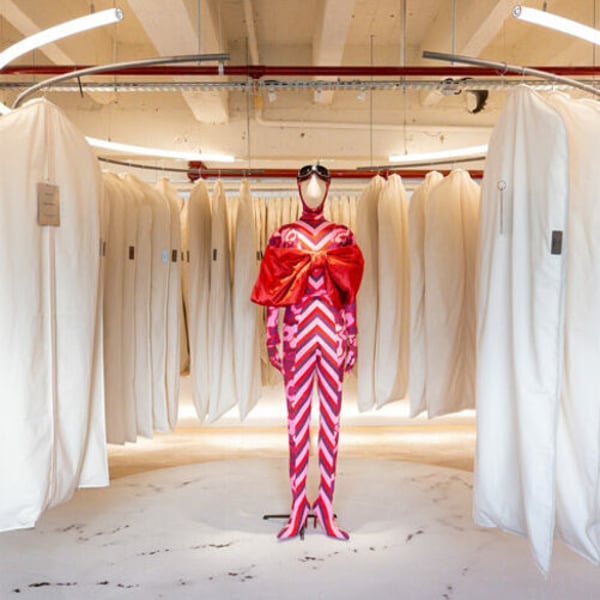
Head up to the very top of Galeries Lafayette Haussmann to discover its treasure: its archives! Dating from 1894 to the present day, they have shaped the identity of the Galeries Lafayette group throughout its history. The youngest of the Parisian department stores, now present in many international cities, remains rooted in the French capital, where it has become both a museum custodian and an active cultural player.
This is the work of Cécile Larrigaldie, the group’s director of cultural engagement. She works across three pillars: archives, alongside Bastien Salva; patronage, with Mathilde Gleyo; and artistic initiatives, supported by Pauline Toulouzou. With a background in contemporary art, she describes a “somewhat fortuitous” yet successful encounter with the world of archives. While working on the Galeries Lafayette Foundation project alongside François Quintin and Guillaume Houzé in 2013, she took the helm of the newly created Artistic Actions department, which later expanded to include patronage and heritage.
A 1920s dress and an imaginary museum…
The historical collection is extensive and comprises various elements: 350 items of furniture (period counters, cash registers, racks, hangers, objects linked to in-house craftsmanship such as vases…) and around 150 fashion and ready-to-wear pieces (from 1900 to the present day), housed on the store’s ninth floor. On a visit, guests might discover, for example, a dress from the 1920s, carefully preserved and accompanied by a photo from the wedding at which it was worn.

At the same time, the collection includes hundreds of linear metres of paper archives: minutes of Galeries Lafayette’s first board meetings, company filings, legal reports, sales records, employee-related documents spanning key historical periods, as well as Galeries Lafayette’s architectural projects, whether or not they were realised (Cécile Larrigaldie speaks of an imaginary museum), catalogues… “Employees very often got into the habit of keeping them. As a result, we have the first Galeries Lafayette catalogue, dated 1926,” she points out.
A “notion of transmission” within the company
The Haussmann store houses all the ready-to-wear archives, as well as three quarters of the paper collections. As for the objects and furniture department, the store only accommodates the most fragile pieces, kept under controlled humidity and constant temperatures. The larger pieces, such as the counters or the Majorelle staircase, are stored in a warehouse in the Île-de-France region.

This archiving effort is recent: it began in 2008, when Guillaume Houzé created the Heritage Department. There was already a “notion of transmission” within the department store, which had welcomed several generations of employees, according to Cécile Larrigaldie. “At each farewell gathering, employees archived their entire careers and gave them to us,” she explains.
Inventory and cataloguing
Faced with the influx of archives, the group decided in 2010 to adopt a rigorous policy, keeping only items that could be preserved and used. A selection had to be made from the existing collection, because “not all of them met inventory standards,” explains the director of cultural engagement.

From 2008 to 2020, Galeries Lafayette focused on setting up an inventory and cataloguing process. As part of this ongoing effort, the group acquires items through donations from employees and customers, and buys them from private individuals or at auction. In the coming months, Cécile Larrigaldie and Bastien Salva will take part in a sale of pieces created by Ghislaine de Polignac, Galeries Lafayette’s long-serving artistic director.
Creating the archives of tomorrow
“The principle is to acquire pieces that are missing and that allow us to illustrate a whole part of history that we haven’t been able to cover,” emphasises the director. A strategy has been put in place to avoid unnecessary acquisitions, particularly for the ready-to-wear collection: the team relies on Galeries Lafayette’s historical catalogues and tries to find the pieces illustrated in them, using a “mise en abyme” approach.

And, “from 2020 to the present day, now that we’ve got the first steps of the staircase clean and stable, we’ve added another very important mission: creating the archives of tomorrow, by showcasing the collection,” explains Cécile Larrigaldie. This new phase mainly involves lending pieces. Last year, 500 were lent to the Musée des Arts Décoratifs, with nearly 300 objects and documents (postcards, promotional items, garment components), and to the Cité de l’Architecture, including a section of the handrail from the Majorelle staircase.
Galeries Lafayette, a “status at the scale of society”
With the archive rooms almost emptied during exhibitions, Cécile Larrigaldie and Bastien Salva realised that this is no mere collection of a private company. “When our national museums tackle the subject of the decorative arts, the construction of Paris, or Baron Haussmann’s breakthroughs in Paris, the department store comes up straight away,” says the director of cultural engagement. “It has a status at the scale of the city, at the scale of society, and bears witness to the evolution of consumption.”

This is the idea on which the director guides her teams: “I want you to have in mind the loans we’ll be making in 2100 for the Musée des Arts Décoratifs,” she repeats. “It can’t be exclusively pieces from the 1970s.” And for good reason, she has already included current pieces in the collection: a chair by Benoît Maire, a multi-socket power strip by Marion Verboom in enamelled lava stone, and a coat hook by Pascale Marthine Tayou in turned and lacquered wood- objects at the crossroads of art and everyday life made as part of Galeries Lafayette’s Savoir Faire Savoir programme. “They testify to the company’s links with the creators of its time and to the principle of commissioning, which is inherent in the department store, since the first commission was placed by Théophile Bader with Jacques Gruber for the dome,” adds Cécile Larrigaldie.
1939–45: the scarred period
Witness to the history of France since being founded in 1893, Galeries Lafayette’s archives remain disparate from one era to the next. The large number of catalogues from the early 20th century contrasts with those of today, which are less frequent and slimmer. Archiving also depends on periods of crisis. For example, there is a serious lack of items from the Second World War period, due to their destruction. This shortfall is not unique to Galeries Lafayette, and the department store exchanges extensively with its counterparts (Samaritaine, BHV, Bon Marché, Printemps).

“There’s a lot of work involved in understanding and deciphering this period. We often ask each other whether we can find archives that were destined for us,” explains the director of cultural engagement. “Of course, the national archives also enable us to broaden the scope, as do municipal archives and warehouse archives.” For this period, then, it is less a hunt for surviving documents than an effort to reconstruct context and knowledge about the era.
A picture of French history
It’s worth noting that, in the post-war period, many objects were not suited to collecting. Furniture was inflatable, collapsible… People needed that; they needed lightness; they went on holiday, they went camping,” notes Larrigaldie. “In store, there were inflatable display stands. These are typically objects we don’t collect because they degrade quickly in everyday use. It’s an evolution in consumer trends and products. Everything is much more functional and rational.”

Slowly but surely, Galeries Lafayette’s immense archiving work is making it possible to take in the department store’s full historical panorama. Through its collection of posters, suits, and administrative documents, the department store reveals itself as an active player, rather than a mere witness, in the history of commerce in France.
This article is an automatic translation.
Click here to read the original article.
Copyright © 2025 FashionNetwork.com All rights reserved.
Published
January 21, 2026
Louis Vuitton has always been about hyper-savvy brand connections, all the way to its latest show whose centerpoint was a beautiful modernist architectural set.
From Bauhaus to Drophaus, the term Vuitton’s menswear creative director Pharrell Williams used to describe this elegant apartment, made in collaboration with the architectural firm Not A Hotel: a prefabricated house concept envisioned as a timeless space for future living. Think a blend of midcentury modern-meets-Joseph Dirand.
An ideal setting for this expression of modernist mode by Williams, which opened Paris Fashion Week Men’s at the Louis Vuitton Foundation on a wet Tuesday night in Paris. And don’t be surprised if some of the furniture Pharrell designed for this model home turns up in the hotel Louis Vuitton is said to be building on the Champs-Élysées.
A raised model home built inside a plywood crate the size of a small stadium, on which was stencilled in half-meter high letters “Louis Vuitton Fall-Winter 26 Men’s Collection”.
An ideal Instagram backdrop for hundreds of guests, or micro and mega influencers. Many of whom where sat front row wearing the hand-made, caramel-colored Babouche slippers Williams kindly sent as a gift with his formal invitation.
A huge show backed up by a gospel choir attired in black professors’ gowns at one end, facing a full orchestra at the other.

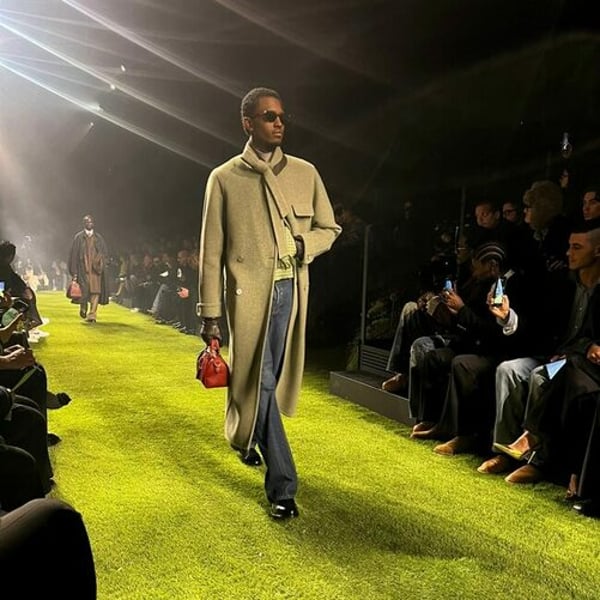
Without question, the most commercially minded yet also timeless of Pharrell’s five shows so far for the house, focused on crisp, cohesive tailoring. Opening with classic six-button jackets and the flared pants that Pharrell favors, many composed in new LV technical fabrics reflective under light.
Though the heart of the matter was the travel-wear: natty crinkly jerkins so one never needs to fear coming off a long-haul flight with a crumpled look. Padded urban ski jackets with fur-trimmed hood, or chambray shell jackets for a little dash.
One also had to love the splendid ankle-brazing gents coats, finished with matching woollen bows, or vicuna zippered and pocketed sweatshirts. Above all, the American designer toned way down the streetwear, and concentrated on contemporary tailoring, and casual chic, albeit never too quiet but rippling with panache.
In accessories, a fab’ new series of monogram backpacks, elongated and finished with extra micro pockets should be huge hits. Many boasting cuddly fox companions that looked like must-have ornaments.
And, of course, it would not be a Pharrell Vuitton show without a few mammoth trunks. Two standouts this season were an uncanny light-filled, stained-glass-window version of a Tiffany lamp, followed by a beautifully made intarsia vista of Pont Alexandre III and the Eiffel Tower.

All of which won Pharrell a huge ovation – led by a powerhouse front row that included First Lady Brigitte Macron; “Adolescence” protagonist Stephen Graham; it-guy Djo; and crooner, John Legend.
Williams took a leisurely bow, backed up by a soundtrack he produced at the Louis Vuitton in-house recording studios. It included compositions like Pray For Ya by John Legend; Sex God by Jackson Wang (feat. Pusha T); Disturbing The P by A$AP Rocky (feat. Pharrell Williams); and The One by Voices of Fire (feat. Pharrell Williams) and Hit-A-Lik by Quavo.
In a word, another hit show, and collection, by Williams. Not bad going for what is technically his night job.
Copyright © 2026 FashionNetwork.com All rights reserved.
Published
January 20, 2026
High-end menswear brand Canali recorded a slight decline in turnover in the 2025 financial year, to 205 million euros from 210 million in 2024; a decrease “linked to contingencies in certain international markets,” according to president and CEO Stefano Canali, who nonetheless describes himself as “very optimistic” about business in 2026.
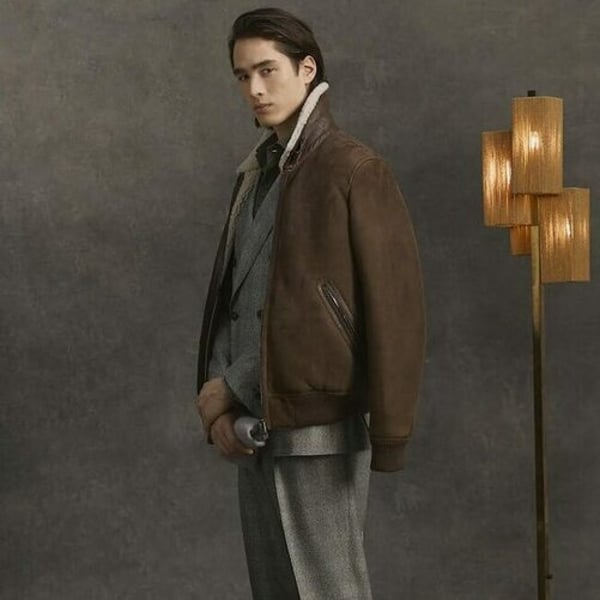
“Right now, I think we have a kind of alignment of the stars: the right collection, backed by a credible brand that has been around for 91 years and offers top-quality products at a fair price. This is our formula for success in 2026,” the manager tells FashionNetwork.com. “The Autumn-Winter 2026/27 collection presented in Milan marks a further evolutionary step in the wake of the changes we set in motion about four years ago, designed to ensure that our offering is increasingly lifestyle-oriented while remaining consistent with our sartorial DNA, from which we will never depart, and to reflect, in a credible, authentic and recognisable way, the evolution of customers’ tastes around the world. Our DNA, tied to the highest-quality canvassed suit, therefore permeates every element of the collection, from outerwear to shoes and knitwear.”
“We are talking about the very highest quality of materials,” Canali continues, “exceptional construction quality, a unified colour palette, and a collection that can be easily mixed and matched, creating a clear and distinctive identity for the Canali brand. The ultimate goal, which we believe we have further achieved with this collection, is an elevated and sophisticated offer that is, at the same time, genuinely easy to buy and to mix and match throughout the week according to the customer’s needs. It offers the functionality and versatility in garments that people are looking for.”

The market was almost shocked to see certain price rises applied by fashion and luxury brands. What are your thoughts on this? “Price rises are not an issue for Canali,” the CEO responds unequivocally. “Our brand has always maintained a very fair pricing position, which matters even more today, because customers out there- as they have been telling us, obsessively, for some time- no longer accept certain price points, which we, moreover, have never charged.”
Stefano Canali aims to ensure that in 2026 the overall message of the collection is increasingly amplified across all distribution channels- wholesale, directly operated retail, and online, launched in-house 10 years ago and considered “a service complement to the physical channel.” The executive signals upcoming store openings (50 directly operated Canali mono-brand stores, over 1,000 wholesale accounts worldwide), but declines to disclose details, remaining focused on healthy, credible growth in all countries.

The North American market accounts for 50% of the brand’s sales. Any issues with US-imposed tariffs, and with the strengthening of the euro against the dollar? “Clearly, exchange-rate fluctuations affect prices; however, it is an issue we have always dealt with throughout my time at this company,” says Stefano Canali. “Let’s remember that over two decades the euro went from being worth $0.82 to $1.60, and everyone is still here. The market clearly adapts; and of course all brands have to make their own assessments of the most appropriate price to charge in each area, but that will never be a problem.”
This article is an automatic translation.
Click here to read the original article.
Copyright © 2026 FashionNetwork.com All rights reserved.



Hillsborough College Trustees OK first step in Tampa Bay Rays stadium talks

Selling America is a ‘dangerous bet,’ UBS CEO warns as markets panic

Fernando Mendoza Serenaded by Teammates At E11even Nightclub After Championship Win
-

 Politics8 years ago
Congress rolls out ‘Better Deal,’ new economic agenda
-
Entertainment9 years ago
New Season 8 Walking Dead trailer flashes forward in time
-
Politics9 years ago
Poll: Virginia governor’s race in dead heat
-
Politics8 years ago
Illinois’ financial crisis could bring the state to a halt
-
Entertainment8 years ago
The final 6 ‘Game of Thrones’ episodes might feel like a full season
-
Entertainment9 years ago
Meet Superman’s grandfather in new trailer for Krypton
-
Business9 years ago
6 Stunning new co-working spaces around the globe
-
Tech8 years ago
Hulu hires Google marketing veteran Kelly Campbell as CMO