
Fashion
Fashion, archives and creation: how Galeries Lafayette is crafting its living heritage
Published
November 28, 2025
Head up to the very top of Galeries Lafayette Haussmann to discover its treasure: its archives! Dating from 1894 to the present day, they have shaped the identity of the Galeries Lafayette group throughout its history. The youngest of the Parisian department stores, now present in many international cities, remains rooted in the French capital, where it has become both a museum custodian and an active cultural player.
This is the work of Cécile Larrigaldie, the group’s director of cultural engagement. She works across three pillars: archives, alongside Bastien Salva; patronage, with Mathilde Gleyo; and artistic initiatives, supported by Pauline Toulouzou. With a background in contemporary art, she describes a “somewhat fortuitous” yet successful encounter with the world of archives. While working on the Galeries Lafayette Foundation project alongside François Quintin and Guillaume Houzé in 2013, she took the helm of the newly created Artistic Actions department, which later expanded to include patronage and heritage.
A 1920s dress and an imaginary museum…
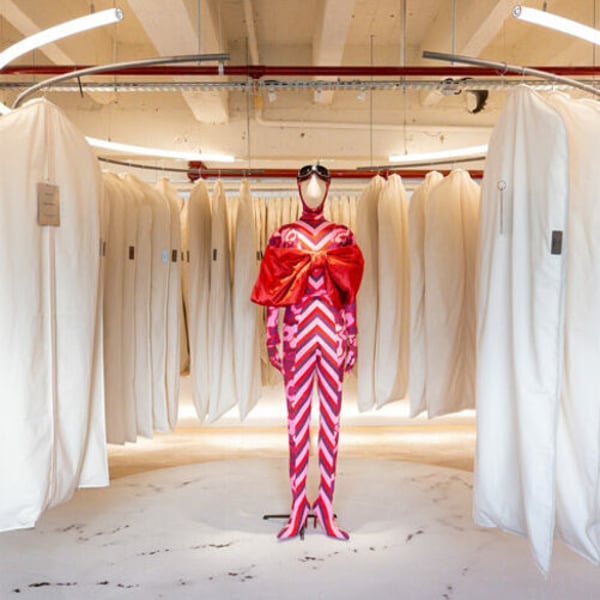
The historical collection is extensive and comprises various elements: 350 items of furniture (period counters, cash registers, racks, hangers, objects linked to in-house craftsmanship such as vases…) and around 150 fashion and ready-to-wear pieces (from 1900 to the present day), housed on the store’s ninth floor. On a visit, guests might discover, for example, a dress from the 1920s, carefully preserved and accompanied by a photo from the wedding at which it was worn.

At the same time, the collection includes hundreds of linear metres of paper archives: minutes of Galeries Lafayette’s first board meetings, company filings, legal reports, sales records, employee-related documents spanning key historical periods, as well as Galeries Lafayette’s architectural projects, whether or not they were realised (Cécile Larrigaldie speaks of an imaginary museum), catalogues… “Employees very often got into the habit of keeping them. As a result, we have the first Galeries Lafayette catalogue, dated 1926,” she points out.
A “notion of transmission” within the company
The Haussmann store houses all the ready-to-wear archives, as well as three quarters of the paper collections. As for the objects and furniture department, the store only accommodates the most fragile pieces, kept under controlled humidity and constant temperatures. The larger pieces, such as the counters or the Majorelle staircase, are stored in a warehouse in the Île-de-France region.

This archiving effort is recent: it began in 2008, when Guillaume Houzé created the Heritage Department. There was already a “notion of transmission” within the department store, which had welcomed several generations of employees, according to Cécile Larrigaldie. “At each farewell gathering, employees archived their entire careers and gave them to us,” she explains.
Inventory and cataloguing
Faced with the influx of archives, the group decided in 2010 to adopt a rigorous policy, keeping only items that could be preserved and used. A selection had to be made from the existing collection, because “not all of them met inventory standards,” explains the director of cultural engagement.

From 2008 to 2020, Galeries Lafayette focused on setting up an inventory and cataloguing process. As part of this ongoing effort, the group acquires items through donations from employees and customers, and buys them from private individuals or at auction. In the coming months, Cécile Larrigaldie and Bastien Salva will take part in a sale of pieces created by Ghislaine de Polignac, Galeries Lafayette’s long-serving artistic director.
Creating the archives of tomorrow
“The principle is to acquire pieces that are missing and that allow us to illustrate a whole part of history that we haven’t been able to cover,” emphasises the director. A strategy has been put in place to avoid unnecessary acquisitions, particularly for the ready-to-wear collection: the team relies on Galeries Lafayette’s historical catalogues and tries to find the pieces illustrated in them, using a “mise en abyme” approach.

And, “from 2020 to the present day, now that we’ve got the first steps of the staircase clean and stable, we’ve added another very important mission: creating the archives of tomorrow, by showcasing the collection,” explains Cécile Larrigaldie. This new phase mainly involves lending pieces. Last year, 500 were lent to the Musée des Arts Décoratifs, with nearly 300 objects and documents (postcards, promotional items, garment components), and to the Cité de l’Architecture, including a section of the handrail from the Majorelle staircase.
Galeries Lafayette, a “status at the scale of society”
With the archive rooms almost emptied during exhibitions, Cécile Larrigaldie and Bastien Salva realised that this is no mere collection of a private company. “When our national museums tackle the subject of the decorative arts, the construction of Paris, or Baron Haussmann’s breakthroughs in Paris, the department store comes up straight away,” says the director of cultural engagement. “It has a status at the scale of the city, at the scale of society, and bears witness to the evolution of consumption.”

This is the idea on which the director guides her teams: “I want you to have in mind the loans we’ll be making in 2100 for the Musée des Arts Décoratifs,” she repeats. “It can’t be exclusively pieces from the 1970s.” And for good reason, she has already included current pieces in the collection: a chair by Benoît Maire, a multi-socket power strip by Marion Verboom in enamelled lava stone, and a coat hook by Pascale Marthine Tayou in turned and lacquered wood- objects at the crossroads of art and everyday life made as part of Galeries Lafayette’s Savoir Faire Savoir programme. “They testify to the company’s links with the creators of its time and to the principle of commissioning, which is inherent in the department store, since the first commission was placed by Théophile Bader with Jacques Gruber for the dome,” adds Cécile Larrigaldie.
1939–45: the scarred period
Witness to the history of France since being founded in 1893, Galeries Lafayette’s archives remain disparate from one era to the next. The large number of catalogues from the early 20th century contrasts with those of today, which are less frequent and slimmer. Archiving also depends on periods of crisis. For example, there is a serious lack of items from the Second World War period, due to their destruction. This shortfall is not unique to Galeries Lafayette, and the department store exchanges extensively with its counterparts (Samaritaine, BHV, Bon Marché, Printemps).

“There’s a lot of work involved in understanding and deciphering this period. We often ask each other whether we can find archives that were destined for us,” explains the director of cultural engagement. “Of course, the national archives also enable us to broaden the scope, as do municipal archives and warehouse archives.” For this period, then, it is less a hunt for surviving documents than an effort to reconstruct context and knowledge about the era.
A picture of French history
It’s worth noting that, in the post-war period, many objects were not suited to collecting. Furniture was inflatable, collapsible… People needed that; they needed lightness; they went on holiday, they went camping,” notes Larrigaldie. “In store, there were inflatable display stands. These are typically objects we don’t collect because they degrade quickly in everyday use. It’s an evolution in consumer trends and products. Everything is much more functional and rational.”

Slowly but surely, Galeries Lafayette’s immense archiving work is making it possible to take in the department store’s full historical panorama. Through its collection of posters, suits, and administrative documents, the department store reveals itself as an active player, rather than a mere witness, in the history of commerce in France.
This article is an automatic translation.
Click here to read the original article.
Copyright © 2025 FashionNetwork.com All rights reserved.