Connect with us

Business

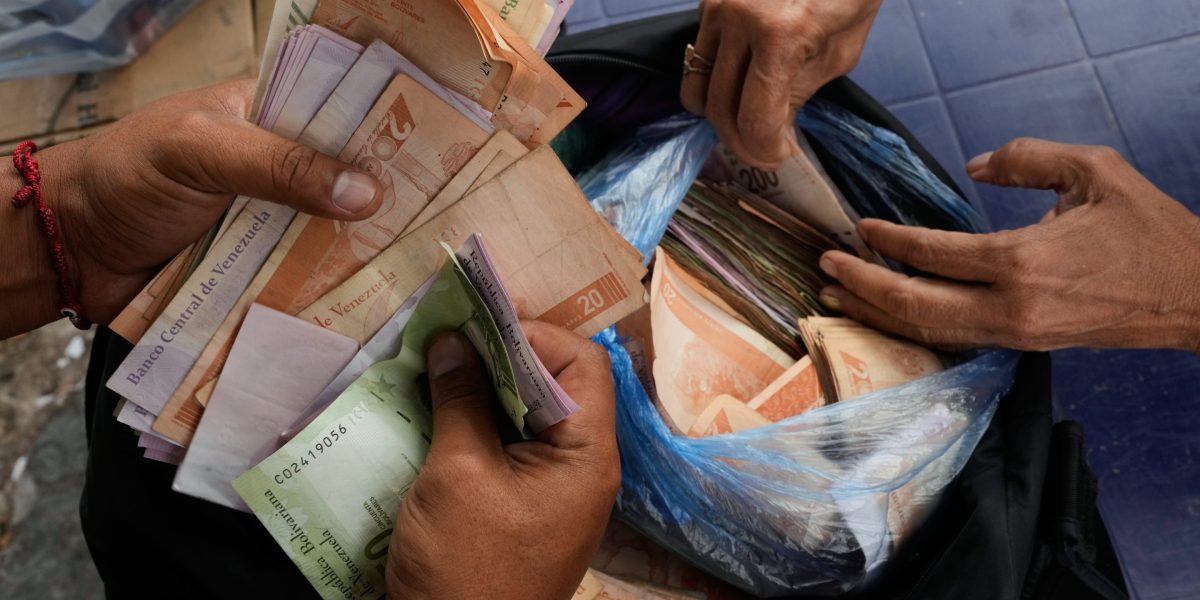
Facing 682% inflation, Venezuelans work three or more jobs and still can barely afford any food

Published

on


At the White House, President Donald Trump vows American intervention in Venezuela will pour billions of dollars into the country’s infrastructure, revive its once-thriving oil industry and eventually deliver a new age of prosperity to the Latin American nation.

Here at a sprawling street market in the capital, though, utility worker Ana Calderón simply wishes she could afford the ingredients to make a pot of soup.

“Food is incredibly expensive,” says Calderón, noting rapidly rising prices that have celery selling for twice as much as just a few weeks ago and a kilogram (2 pounds) of meat going for more than $10, or 25 times the country’s monthly minimum wage. “Everything is so expensive.”

Venezuelans digesting news of the United States’ brazen capture of former President Nicolás Maduro are hearing grandiose promises of future economic prowess even as they live through the crippling economic realities of today.

“They know that the outlook has significantly changed but they don’t see it yet on the ground. What they’re seeing is repression. They’re seeing a lot of confusion,” says Luisa Palacios, a Venezuelan-born economist and former oil executive who is a research scholar at the Center on Global Energy Policy at Columbia University. “People are hopeful and expecting that things are going to change but that doesn’t mean that things are going to change right now.”

Whatever hope exists over the possibility of U.S. involvement improving Venezuela’s economy is paired with the crushing daily truths most here live. People typically work two, three or more jobs just to survive, and still cupboards and refrigerators are nearly bare. Children go to bed early to avoid the pang of hunger; parents choose between filling a prescription and buying groceries. An estimated eight in 10 people live in poverty.

It has led millions to flee the country for elsewhere.

Those who remain are concentrated in Venezuela’s cities, including its capital, Caracas, where the street market in the Catia neighborhood once was so busy that shoppers bumped into one another and dodged oncoming traffic. But as prices have climbed in recent days, locals have increasingly stayed away from the market stalls, reducing the chaos to a relative hush.

Neila Roa, carrying her 5-month-old baby, sells packs of cigarettes to passersby, having to monitor daily fluctuations in currency to adjust the price.

“Inflation and more inflation and devaluation,” Roa says. “It’s out of control.”

Roa could not believe the news of Maduro’s capture. Now, she wonders what will come of it. She thinks it would take “a miracle” to fix Venezuela’s economy.

“What we don’t know is whether the change is for better or for worse,” she says. “We’re in a state of uncertainty. We have to see how good it can be, and how much it can contribute to our lives.”

Trump has said the U.S. will distribute some of the proceeds from the sale of Venezuelan oil back to its population. But that commitment so far largely appears to be focused on America’s interests in extracting more oil from Venezuela, selling more U.S.-made goods to the country and repairing the electricity grid.

The White House is hosting a meeting Friday with U.S. oil company executives to discuss Venezuela, which the Trump administration has been pressuring to open its vast-but-struggling oil industry more widely to American investment and know-how. In an interview with The New York Times, Trump acknowledged that reviving the country’s oil industry would take years.

“The oil will take a while,” he said.

Venezuela has the world’s largest proven oil reserves. The country’s economy depends on them.

Maduro’s predecessor, the fiery Hugo Chávez, elected in 1998, expanded social services, including housing and education, thanks to the country’s oil bonanza, which generated revenues estimated at some $981 billion between 1999 and 2011 as crude prices soared. But corruption, a decline in oil production and economic policies led to a crisis that became evident in 2012.

Chávez appointed Maduro as his successor before dying of cancer in 2013. The country’s political, social and economic crisis, entangled with plummeting oil production and prices, marked the entirety of Maduro’s presidency. Millions were pushed into poverty. The middle class virtually disappeared. And more than 7.7 million people left their homeland.

Albert Williams, an economist at Nova Southeastern University, says returning the energy sector to its heyday would have a dramatic spillover effect in a country in which oil is the dominant industry, sparking the opening of restaurants, stores and other businesses. What’s unknown, he says, is whether such a revitalization happens, how long it would take and how a government built by Maduro will adjust to the change in power.

“That’s the billion-dollar question,” Williams says. “But if you improve the oil industry, you improve the country.”

The International Monetary Fund estimates Venezuela’s inflation rate is a staggering 682%, the highest of any country for which it has data. That has sent the cost of food beyond what many can afford.

Many public sector workers survive on roughly $160 per month, while the average private sector employee earned about $237 last year. Venezuela’s monthly minimum wage of 130 bolivars, or $0.40, has not increased since 2022, putting it well below the United Nations’ measure of extreme poverty of $2.15 a day.

The currency crisis led Maduro to declare an “economic emergency” in April.

Usha Haley, a Wichita State University economist who studies emerging markets, says for those hurting the most, there is no immediate sign of change.

“Short-term, most Venezuelans will probably not feel any economic relief,” she says. “A single oil sale will not fix the country’s rampant inflation and currency collapse. Jobs, prices, and exchange rates will probably not shift quickly.”

In a country that has seen as much strife as Venezuela has in recent years, locals are accustomed to doing what they have to in order to get through the day, so much so that many utter the same expression

“Resolver,” they say in Spanish, or “figure it out,” shorthand for the jury-rigged nature of life here, in which every transaction, from boarding a bus to buying a child’s medicine, involves a delicate calculation.

Here at the market, the smell of fish, fresh onions and car exhaust combine. Calderon, making her way through, faces freshly skyrocketing prices, saying “the difference is huge,” as the country’s official currency has rapidly declined against its unofficial one, the U.S. dollar.

Unable to afford all the ingredients for her soup, she left with a bunch of celery but no meat.


Source link

Continue Reading

Business

A major factor in Gen Z and millennial divorce is ‘financial future faking’

Published

on


Many of us have experienced that gut-wrenching feeling when we realize the relationship we’re in and thought was “the one” turns out to be a total wash.

Sometimes the eventual severance comes down to a difference of morals or plain-old lost feelings. And sometimes it happens when dishonestly, like catfishing, is revealed.

But many people in the younger generations are navigating a new kind of deception: financial future faking. It’s when people make big promises to each other about sharing a home, lifestyle, or long-term financial security early in a relationship without any real intention or follow-through. This phenomenon is an offshoot of “future faking,” a psychological manipulation tactic recognized by major health care and psychological organizations. 

Financial future faking is becoming a major factor in Gen Z and millennial divorces—and perhaps a reason why these younger generations marry less often or much later in life.

“I often see a lack of financial intimacy, transparency, and alignment as central factors in divorce,” celebrity divorce attorney Jackie Combs told Fortune. “When money becomes a source of leverage, or when expectations are never clearly articulated, it fractures communication, creates misalignment, and erodes trust.”

Combs, who is a family and matrimonial law attorney and partner at Los Angeles-based firm BlankRome, has represented many Gen Z and millennial celebrities including Emily Ratajkowski, Chris Appleton, and Ines de Ramon. She also represents other high net-worth clients and has been recognized both as a top family lawyer as well as an “Entertainment Business Visionary” by the Los Angeles Times

The financial future faking trend is especially disheartening for Gen Z and millennials because they’re facing an inflationary period, soft job market, and a housing affordability crisis. So when those in relationships aren’t honest about money and shared goals, the entire lifestyle they’ve dreamed of could all come crashing down. 

“Gen Z and millennials are particularly vulnerable to future financial faking for several reasons,” Combs warned. “They are dating in an era of unprecedented financial instability, defined by student debt, housing unaffordability, and delayed economic security.”

Beware of the dream wedding

Combs says another reason younger generations are so susceptible to this is because they were raised in households where money was rarely openly discussed, leaving them ill-equipped to ask direct financial questions or understand whether they’re financially aligned with their partner early on. 

“This vulnerability is compounded by consumer culture and social media, which glamorizes aspirational lifestyles such as luxury weddings, ‘soft life’ aesthetics, and trad-wife narratives, without addressing the financial infrastructure required to support them,” she added. 

The illusion of a dream wedding can also be a culprit. The wedding services market alone was valued at about $218 billion in 2024, according to BRC Wedding Service Global Market Report 2025, and is expected to grow to a whopping $362 billion by 2029. This underscores “how fantasy often outpaces financial reality,” Combs said. 

To put it in perspective, the average cost of a wedding is an eye-popping $33,000, according to The Knot, or roughly half the average American salary. And that’s a relatively conservative average, considering weddings in certain markets—and for certain demographics and aesthetics—can cost hundreds of thousands of dollars. 

Still, it’s comforting and exciting to daydream about a luxurious wedding and lifestyle with your partner—although it can often lead to a trap.

“When someone offers hope through vague financial promises about the future, it can feel reassuring rather than deceptive, making financial future faking particularly effective,” Combs said.

How to spot financial future faking—and when to talk about money

Some of the common signs of financial future faking include making grand, but nonspecific financial promises, a lack of transparency about income, debt, or spending, and repeated delays in financial accountability or tangible process toward a financial goal, Combs said. 

“Future promises sound like commitment, but are never structured in reality or a future partnership” is what financial future faking sounds like, she added. 

But it’s difficult, and can sometimes feel confrontational, to question a partner—especially in a new relationship—about finances. 

“Sincerity is reflected in alignment between words and behavior,” Combs said. “Vague optimism without structure, or a willingness to learn, is a red flag.”

Combs said it’s important to have financial discussions early on before significant emotional or financial commitments are made. That entails having discussions about money before moving in together, signing a lease, or sharing expenses. 

Still, “that doesn’t mean sharing your 401k balance on the first date,” she explained. “It means asking thoughtful, value-based questions like, ‘if you won the [lottery] today, what would you do with the winnings?’ ‘What does financial security mean to you?’ or “What’s your biggest financial fear?’”

To get the most out of your conversation, Combs recommended “leading with curiosity and not judgment” because it can help show emotional vulnerability and build trust. And it’s also critical to have these conversations before any discussions about marriage or long-term commitment, because the former can often mean relinquishing financial autonomy.

Basically, if one person in a relationship doesn’t fully understand the financial or legal implications of marriage, they “give up control over their financial future,” Combs said.

“These conversations aren’t about forcing commitment,” she emphasized. “They’re about risk assessment and determining long-term compatibility.”


Source link

Continue Reading

Business

Ryan Serhant used to hand modeling for $150 an hour—now he sells 9-figure penthouses to billionaires

Published

on


You might recognize the 41-year-old from his nine seasons on Million Dollar Listing New York, his own Netflix series Owning Manhattan, or a for-sale sign bearing his name as his real estate empire expands across more than a dozen states.

But none of it happened overnight.

When Serhant graduated from college, his ambitions were modest. He didn’t have a clear career path or a master plan. Instead, he had just one goal: move to New York City and figure the rest out later.

“It wasn’t about finding happiness. It wasn’t about chasing success,” Serhant told Fortune. “At least initially, it was, if you can make it in New York, you can make it anywhere.”

To get there, he used what little money he had saved working on a ranch in Colorado and took on whatever jobs he could to stay afloat. That included becoming a hand model for $150 an hour—money he later used to help fund his first real estate ventures—and handing out as many as 500 Equinox gym flyers a day. 

The flyer job wasn’t about a paycheck. In exchange, Serhant gained free access to the gym and, more importantly, its affluent clientele.

It was an early lesson in the networking strategy he still swears by today. Serhant follows what he calls the “two Cs”: always offer a compliment and find something in common.

And that mindset extended well beyond gyms and casting calls. “I never wanted to be beholden to anyone else,” Serhant said. “I never wanted a boss who could hire me on one day, fire me on another day. I wanted to build something for myself.”

And build something for himself he did. Today, Serhant is the CEO of SERHANT, a brokerage and media company that closed more than $6 billion in sales last year and regularly markets nine-figure penthouses to billionaire buyers.

Serhant’s secret to build a national brand—while never forgetting his roots

Breaking into real estate is notoriously difficult. Thousands of agents enter the industry every year, and many leave within just a few years, citing inconsistent pay, brutal competition, and burnout.

Serhant knew that simply selling apartments wouldn’t be enough.

“I believed even early on, the brand was never going to be about the property, but was going to be about the person,” he said.

That philosophy shaped everything from his social media presence to his television career to the way he structured his brokerage. While many CEOs distance themselves from hands-on work once they reach the top, Serhant insists on staying close to the grind that made him successful in the first place. That’s why he personally still sells properties—even when he has hundreds of agents working for him, too.

“I think it’s really important for CEOs to never let go of the thing that got them there in the first place,” he added.

Just in the last year, Serhant has represented Andy Cohen in the sale of his $12 million West Village apartment, Dave Portnoy in his purchase of a $27.75 million Florida Keys home, and a British investor’s sale of a $72 million Palm Beach mansion.

Still, not every day is as easy as it may seem to his millions of TV show viewers or social media followers

“I have tough days all the time. Every day is tough,” Serhant said. “I would not wish ‘CEO’ on anyone.”

What keeps him going isn’t all about money, which he called a “moving target,” but realizing tomorrow is the next opportunity to make change and tackle goals. Without the latter in particular, work can become endless: “Otherwise I feel like I wake up running a marathon with no end in sight.”

In 2026, Serhant is focused on pushing into new creative territory while scaling SERHANT as an AI-first brokerage. With plans to more than triple its state footprint, he’s still making the same bet on momentum that took him from handing out gym flyers to securing nine-figure deals.


Source link

Continue Reading

Business

1 in 3 college grads admit their degrees weren’t financially worth it

Published

on


Most people go into their degrees, hoping it’ll be the golden ticket to well-paid office jobs after graduation day—especially given the sheer amount of hours and thousands of dollars (or pounds, in my case) they’ve committed to getting the qualification. But past college grads have a brutal reality check for bright-eyed Gen Z: It wasn’t worth it. At least, from a financial standpoint. 

A staggering 30% of graduates across all generations have admitted that they’re not better off financially thanks to their degrees. In fact, the Nexford University report highlights that many are actually worse off. 

The majority of graduates say they took out $25,000 to $49,999 in student loans, but a quarter owe more than $50,000—and they’re still paying for it years and years after tossing their graduation caps into the air. 

A third of grads are drowning so much in debt that they’re having to delay saving for their first home, and even retirement for a decade on average. 

Instead of their degree being the launch pad for a successful life and career, some 14% admit they had to delay moving out of their parents’ house and starting a family because of hefty student loads. 

Graduates thought their paychecks would make the debt worth it

The majority of graduates enter university knowing they’ll take on some level of debt. But it’s usually shrugged off with the promise of higher-paying, stable careers that only a degree can unlock.

While at the time, the grads surveyed expected they’d land an entry-level role paying around the $52,000 mark after graduating, the reality was stark: Most started out on around $35,000. 

Those who studied law saw a $30,000 drop between their desired salaries and what they actually got offered after graduation. Those who studied education landed roles paying around $25,000 less than they’d imagined. And arts and humanities students thought they’d land $50,000 roles straight out of college, but actually got entry-level job offers at $30,000.

For many, the disappointment didn’t end there. Nearly half of grads had to fork out more money after graduating for further training and other more specialised qualifications to stand out in their desired field. 

To add more salt to the wound, just 8% said that college diplomas matter most in today’s job market. In hindsight, the majority think that networking and having demonstrable skills for the role hold more weight in the current economy.

Degrees just aren’t paying off the way graduates were promised

With college costing students an average of $36,436 per year, the next generation of workers is already questioning the return on investment they’ll get from the qualification. The number of Gen Zers signing up for vocational programs and trade schools instead of higher education is at a record high. 

But for those already embarking on a degree, or recently graduated, the bad news just keeps coming. In 2023, LinkedIn data showed that job ads that didn’t require one were up 90%. At the time, it was because employers were turning their attentions to skills-first hiring. But the situation has since become even more dire. 

Now, not only are employers calling degrees “irrelevant” and even hiring for personality above credentials, but the number of entry-level roles available for fresh-faced grads is significantly shrinking. 

In the U.K. alone, more than 1.2 million applications were submitted for fewer than 17,000 graduate roles last year. Meanwhile, Americans report that the probability of finding a job right now has hit a record low

Thanks to AI, many early-career jobs are being automated. One of the scientists who helped create the technology, Professor Yoshua Bengio, has even warned that the days of all office jobs are numbered.  

The experts’ advice now, for the swath of young unemployed grads, is to turn their backs on the subjects they studied, and instead apply for non-degree retail and hospitality jobs that they could have just nabbed straight out of school without the debt.


Source link

Continue Reading

Trending

Copyright © Miami Select.