Connect with us

Business

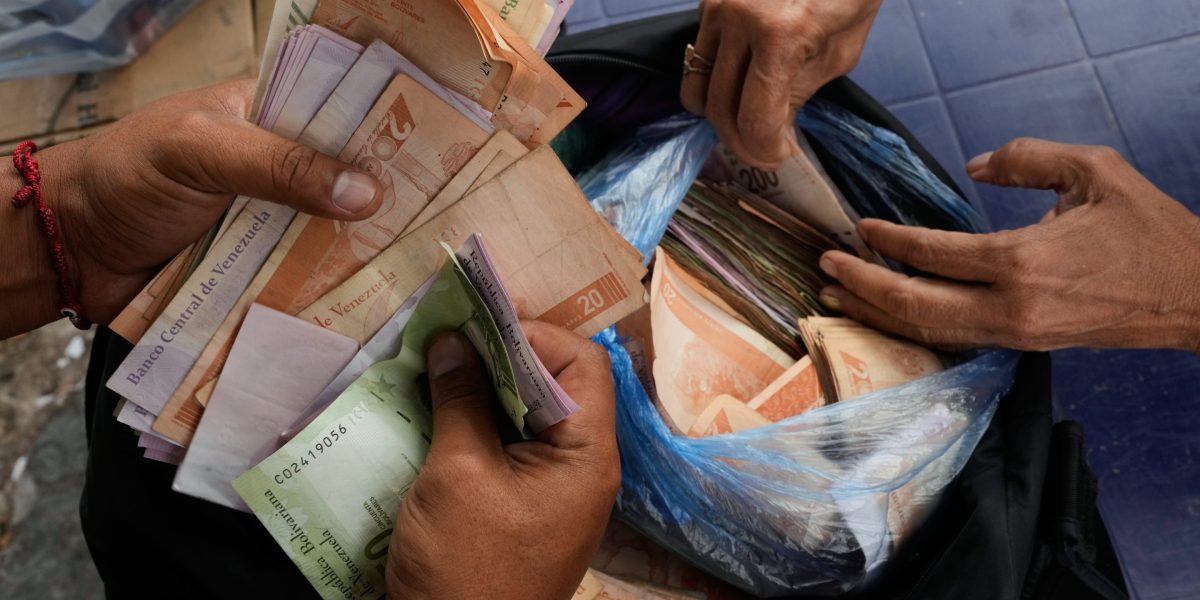
Facing 682% inflation, Venezuelans work three or more jobs and still can barely afford any food

Published

on


At the White House, President Donald Trump vows American intervention in Venezuela will pour billions of dollars into the country’s infrastructure, revive its once-thriving oil industry and eventually deliver a new age of prosperity to the Latin American nation.

Here at a sprawling street market in the capital, though, utility worker Ana Calderón simply wishes she could afford the ingredients to make a pot of soup.

“Food is incredibly expensive,” says Calderón, noting rapidly rising prices that have celery selling for twice as much as just a few weeks ago and a kilogram (2 pounds) of meat going for more than $10, or 25 times the country’s monthly minimum wage. “Everything is so expensive.”

Venezuelans digesting news of the United States’ brazen capture of former President Nicolás Maduro are hearing grandiose promises of future economic prowess even as they live through the crippling economic realities of today.

“They know that the outlook has significantly changed but they don’t see it yet on the ground. What they’re seeing is repression. They’re seeing a lot of confusion,” says Luisa Palacios, a Venezuelan-born economist and former oil executive who is a research scholar at the Center on Global Energy Policy at Columbia University. “People are hopeful and expecting that things are going to change but that doesn’t mean that things are going to change right now.”

Whatever hope exists over the possibility of U.S. involvement improving Venezuela’s economy is paired with the crushing daily truths most here live. People typically work two, three or more jobs just to survive, and still cupboards and refrigerators are nearly bare. Children go to bed early to avoid the pang of hunger; parents choose between filling a prescription and buying groceries. An estimated eight in 10 people live in poverty.

It has led millions to flee the country for elsewhere.

Those who remain are concentrated in Venezuela’s cities, including its capital, Caracas, where the street market in the Catia neighborhood once was so busy that shoppers bumped into one another and dodged oncoming traffic. But as prices have climbed in recent days, locals have increasingly stayed away from the market stalls, reducing the chaos to a relative hush.

Neila Roa, carrying her 5-month-old baby, sells packs of cigarettes to passersby, having to monitor daily fluctuations in currency to adjust the price.

“Inflation and more inflation and devaluation,” Roa says. “It’s out of control.”

Roa could not believe the news of Maduro’s capture. Now, she wonders what will come of it. She thinks it would take “a miracle” to fix Venezuela’s economy.

“What we don’t know is whether the change is for better or for worse,” she says. “We’re in a state of uncertainty. We have to see how good it can be, and how much it can contribute to our lives.”

Trump has said the U.S. will distribute some of the proceeds from the sale of Venezuelan oil back to its population. But that commitment so far largely appears to be focused on America’s interests in extracting more oil from Venezuela, selling more U.S.-made goods to the country and repairing the electricity grid.

The White House is hosting a meeting Friday with U.S. oil company executives to discuss Venezuela, which the Trump administration has been pressuring to open its vast-but-struggling oil industry more widely to American investment and know-how. In an interview with The New York Times, Trump acknowledged that reviving the country’s oil industry would take years.

“The oil will take a while,” he said.

Venezuela has the world’s largest proven oil reserves. The country’s economy depends on them.

Maduro’s predecessor, the fiery Hugo Chávez, elected in 1998, expanded social services, including housing and education, thanks to the country’s oil bonanza, which generated revenues estimated at some $981 billion between 1999 and 2011 as crude prices soared. But corruption, a decline in oil production and economic policies led to a crisis that became evident in 2012.

Chávez appointed Maduro as his successor before dying of cancer in 2013. The country’s political, social and economic crisis, entangled with plummeting oil production and prices, marked the entirety of Maduro’s presidency. Millions were pushed into poverty. The middle class virtually disappeared. And more than 7.7 million people left their homeland.

Albert Williams, an economist at Nova Southeastern University, says returning the energy sector to its heyday would have a dramatic spillover effect in a country in which oil is the dominant industry, sparking the opening of restaurants, stores and other businesses. What’s unknown, he says, is whether such a revitalization happens, how long it would take and how a government built by Maduro will adjust to the change in power.

“That’s the billion-dollar question,” Williams says. “But if you improve the oil industry, you improve the country.”

The International Monetary Fund estimates Venezuela’s inflation rate is a staggering 682%, the highest of any country for which it has data. That has sent the cost of food beyond what many can afford.

Many public sector workers survive on roughly $160 per month, while the average private sector employee earned about $237 last year. Venezuela’s monthly minimum wage of 130 bolivars, or $0.40, has not increased since 2022, putting it well below the United Nations’ measure of extreme poverty of $2.15 a day.

The currency crisis led Maduro to declare an “economic emergency” in April.

Usha Haley, a Wichita State University economist who studies emerging markets, says for those hurting the most, there is no immediate sign of change.

“Short-term, most Venezuelans will probably not feel any economic relief,” she says. “A single oil sale will not fix the country’s rampant inflation and currency collapse. Jobs, prices, and exchange rates will probably not shift quickly.”

In a country that has seen as much strife as Venezuela has in recent years, locals are accustomed to doing what they have to in order to get through the day, so much so that many utter the same expression

“Resolver,” they say in Spanish, or “figure it out,” shorthand for the jury-rigged nature of life here, in which every transaction, from boarding a bus to buying a child’s medicine, involves a delicate calculation.

Here at the market, the smell of fish, fresh onions and car exhaust combine. Calderon, making her way through, faces freshly skyrocketing prices, saying “the difference is huge,” as the country’s official currency has rapidly declined against its unofficial one, the U.S. dollar.

Unable to afford all the ingredients for her soup, she left with a bunch of celery but no meat.


Source link

Continue Reading

Business

Down Arrow Button Icon

Published

on


The mayor of Minneapolis said Sunday that sending active duty soldiers into Minnesota to help with an immigration crackdown is a ridiculous and unconstitutional idea as he urged protesters to remain peaceful so the president won’t see a need to send in the U.S. military.

Daily protests have been ongoing throughout January since the Department of Homeland Security ramped up immigration enforcement in the Twin Cities of Minneapolis and St. Paul by bringing in more than 2,000 federal officers.

Three hotels where protesters have said Immigration and Customs Enforcement officers were staying in the area stopped taking reservations Sunday.

In a diverse neighborhood where immigration officers have been seen frequently, U.S. postal workers marched through on Sunday, chanting: “Protect our routes. Get ICE out.”

Soldiers specialized in arctic duty told to be ready

The Pentagon has ordered about 1,500 active-duty soldiers based in Alaska who specialize in operating in arctic conditions to be ready in case of a possible deployment to Minnesota, two defense officials said Sunday.

The officials, who spoke on condition of anonymity to discuss sensitive military plans, said two infantry battalions of the Army’s 11th Airborne Division have been given prepare-to-deploy orders.

One defense official said the troops are standing by to deploy to Minnesota should President Donald Trump invoke the Insurrection Act.

The rarely used 19th century law would allow the president to send military troops into Minnesota, where protesters have been confronting federal immigration agents for weeks. He has since backed off the threat, at least for now.

“It’s ridiculous, but we will not be intimidated by the actions of this federal government,” Minneapolis Mayor Jacob Frey told CNN’s State of the Union on Sunday. “It is not fair, it’s not just, and it’s completely unconstitutional.”

Thousands of Minneapolis citizens are exercising their First Amendment rights and the protests have been peaceful, Frey said.

“We are not going to take the bait. We will not counter Donald Trump’s chaos with our own brand of chaos here,” Frey said.

Gov. Tim Walz has mobilized the Minnesota National Guard, although no units have been deployed to the streets.

Some hotels close or stop accepting reservations amid protests

At least three hotels in Minneapolis-St. Paul that protesters said housed officers in the immigrant crackdown were not accepting reservations Sunday. Rooms could not be booked online before early February at the Hilton DoubleTree and IHG InterContinental hotels in downtown St. Paul and at the Hilton Canopy hotel in Minneapolis.

Over the phone, an InterContinental hotel front desk employee said it was closing for the safety of the staff, but declined to comment on the specific concerns. The DoubleTree and InterContinental hotels had empty lobbies with signs out front saying they were “temporarily closed for business until further notice.” The Canopy hotel was open, but not accepting reservations.

The Canopy has been the site of noisy protests by anti-ICE demonstrators aimed to prevent agents from sleeping.

“The owner of the independently owned and operated InterContinental St. Paul has decided to temporarily close their hotels to prioritize the safety of guests and team members given ongoing safety concerns in the area,” IHG Hotels & Resorts spokesperson Taylor Solomon said in a statement Sunday. “All guests with existing reservations can contact the hotel team for assistance with alternative accommodations.”

Earlier this month, Hilton and the local operator of the Hampton Inn Lakeville hotel near Minneapolis apologized after the property wouldn’t allow federal immigration agents to stay there. Hampton Inn locations are under the Hilton brand, but the Lakeville hotel is independently operated by Everpeak Hospitality. Everpeak said the cancelation was inconsistent with their policy.

US postal workers march and protest

Peter Noble joined dozens of other U.S. Post Office workers Sunday on their only day off from their mail routes to march against the immigration crackdown. They passed by the place where an immigration officer shot and killed Renee Good, a U.S. citizen and mother of three, during a Jan. 7 confrontation.

“I’ve seen them driving recklessly around the streets while I am on my route, putting lives in danger,” Noble said.

Letter carrier Susan Becker said she came out to march on the coldest day since the crackdown started because it’s important to keep telling the federal government she thinks what it is doing is wrong. She said people on her route have reported ICE breaking into apartment buildings and tackling people in the parking lot of shopping centers.

“These people are by and large citizens and immigrants. But they’re citizens, and they deserve to be here; they’ve earned their place and they are good people,” Becker said.

Republican congressman asks governor to tone down comments

A Republican U.S. House member called for Walz to tone down his comments about fighting the federal government and instead start to help law enforcement.

Many of the officers in Minnesota are neighbors just doing the jobs they were sent to do, House Majority Whip Tom Emmer told WCCO-AM in Minneapolis.

“These are not mean spirited people. But right now, they feel like they’re under attack. They don’t know where the next attack is going to come from and who it is. So people need to keep in mind this starts at the top,” Emmer said.

Across social media, videos have been posted of federal officers spraying protesters with pepper spray, knocking down doors and forcibly taking people into custody. On Friday, a federal judge ruled that immigration officers can’t detain or tear gas peaceful protesters who aren’t obstructing authorities, including when they’re observing the officers during the Minnesota crackdown.

___

Contributing were Associated Press writers Konstantin Toropin in Washington; Steve Karnowski in Minneapolis; Edith M. Lederer at the United Nations; Jeffrey Collins in Columbia, South Carolina; and Christopher Weber in Los Angeles.


Source link

Continue Reading

Business

Trump is charging world leaders $1 billion each for their countries to permanently join Gaza ‘Board of Peace’

Published

on


At least eight more countries say the United States has invited them to join President Donald Trump’s Board of Peace, a new body of world leaders meant to oversee next steps in Gaza that shows ambitions for a broader mandate in global affairs. Two of the countries, Hungary and Vietnam, said they have accepted.

A $1 billion contribution secures permanent membership on the Trump-led board instead of a three-year appointment, which has no contribution requirement, according to a U.S. official who spoke on condition of anonymity about the charter, which hasn’t been made public. The official said the money raised would go to rebuilding Gaza.

Hungarian Prime Minister Viktor Orbán has accepted an invitation to join the board, Foreign Minister Péter Szijjártó told state radio Sunday. Orbán is one of Trump’s most ardent supporters in Europe.

Vietnam’s Communist Party chief, To Lam, also has accepted, a foreign ministry statement said.

India has received an invitation, a senior government official with knowledge of the matter said, speaking on condition of anonymity as the information hadn’t been made public by authorities.

Australia has been invited and will talk it through with the U.S. “to properly understand what this means and what’s involved,” Deputy Prime Minister Richard Marles told Australian Broadcasting Corp. on Monday.

Jordan, Greece, Cyprus and Pakistan said Sunday they had received invitations. Canada, Turkey, Egypt, Paraguay, Argentina and Albania have already said they were invited. It was not clear how many have been invited in all.

The U.S. is expected to announce its official list of members in the coming days, likely during the World Economic Forum meeting in Davos, Switzerland.

Those on the board will oversee next steps in Gaza as the ceasefire that took effect on Oct. 10 moves into its challenging second phase. It includes a new Palestinian committee in Gaza, the deployment of an international security force, disarmament of Hamas and reconstruction of the war-battered territory.

In letters sent Friday to world leaders inviting them to be “founding members,” Trump said the Board of Peace would “embark on a bold new approach to resolving global conflict.”

That could become a potential rival to the U.N. Security Council, the most powerful body of the global entity created in the wake of World War II. The 15-seat council has been blocked by U.S. vetoes from taking action to end the war in Gaza, while the U.N.’s clout has been diminished by major funding cuts by the Trump administration and other donors.

Trump’s invitation letters for the Board of Peace noted that the Security Council had endorsed the U.S. 20-point Gaza ceasefire plan, which includes the board’s creation. The letters were posted on social media by some invitees.

The White House last week also announced an executive committee of leaders who will carry out the Board of Peace’s vision, but Israel on Saturday objected that the committee “was not coordinated with Israel and is contrary to its policy,” without details. The statement by Prime Minister Benjamin Netanyahu’s office was rare criticism of its close ally in Washington.

The executive committee’s members include U.S. Secretary of State Rubio, Trump envoy Steve Witkoff, Trump’s son-in-law Jared Kushner, former British Prime Minister Tony Blair, World Bank President Ajay Banga and Trump’s deputy national security adviser Robert Gabriel, along with an Israeli business owner, billionaire Yakir Gabay.

Members also include representatives of ceasefire monitors Qatar, Egypt and Turkey. Turkey has a strained relationship with Israel but good relations with Hamas and could play an important role in persuading the group to yield power in Gaza and disarm.

___

Boak reported from West Palm Beach, Florida. Associated Press writers Justin Spike in Budapest, Hungary, Rajesh Roy in New Delhi and Rod McGuirk in Canberra, Australia, contributed to this report.


Source link

Continue Reading

Business

Dollar sinks as Trump’s new tariffs raise fears about U.S. debt and reserve currency status

Published

on


The greenback dropped while precious metals rallied Sunday as financial markets started reacting to President Donald Trump’s new tariff threats.

The dollar sank 0.31% against the euro to $1.16 and tumbled 0.32% against the yen to 157.58. Meanwhile, gold rose 1.95% to a fresh record of $4,684.30 per ounce. Silver jumped 5.66% to $93.53, also a new high.

Due to the Martin Luther King Jr. Day holiday on Monday, U.S. stock and bond futures were inactive.

On Saturday, Trump said Denmark, Norway, Sweden, France, Germany, the United Kingdom, the Netherlands, and Finland will be hit with a 10% tariff starting on Feb. 1 that will rise to 25% on June 1, until a “Deal is reached for the Complete and Total purchase of Greenland.”

The announcement came after those countries sent troops to Greenland this past week, ostensibly for training purposes, at the request of Denmark.

Trump has refused to back down from taking over Greenland, even keeping military options on the table, while the administration has also left open the possibility of buying the island.

At the same time, the European Union is weighing options for retaliation, including the bloc’s anti-coercion instrument that has been described as a “trade bazooka” for its scope and severity.

Not only do Trump’s latest tariffs pose an existential threat to the trans-Atlantic alliance, the fallout could threaten the dollar’s dominance and so-called exorbitant privilege.

“The dollar’s reserve-currency status allows us to live beyond our means. Soaring debt, tariffs, and military threats jeopardize that status,” Peter Schiff, chief economist and global strategist at Euro Pacific Asset Management, warned on X. “When it’s lost, economic collapse will follow.”

And the EU holds significant leverage over Trump as European countries own $8 trillion of U.S. bonds and equities, almost twice as much as the rest of the world combined, according to George Saravelos, head of FX research at Deutsche Bank.

America’s vulnerability in global financial markets was not lost on Rep. Thomas Massie, R-Ky., who reacted to Schiff’s post.

“As the dollar’s reserve currency status diminishes, so does our ability to tax the world by creating more money,” he wrote. “When reserve status is lost, maintaining current spending levels and servicing the debt will be even more painful for Americans who will bear the full inflation tax.”


Source link

Continue Reading

Trending

Copyright © Miami Select.