
Politics
Fabián Basabe accuses Laura Dominguez of backroom ‘grift.’ She calls it a ‘baseless smear’
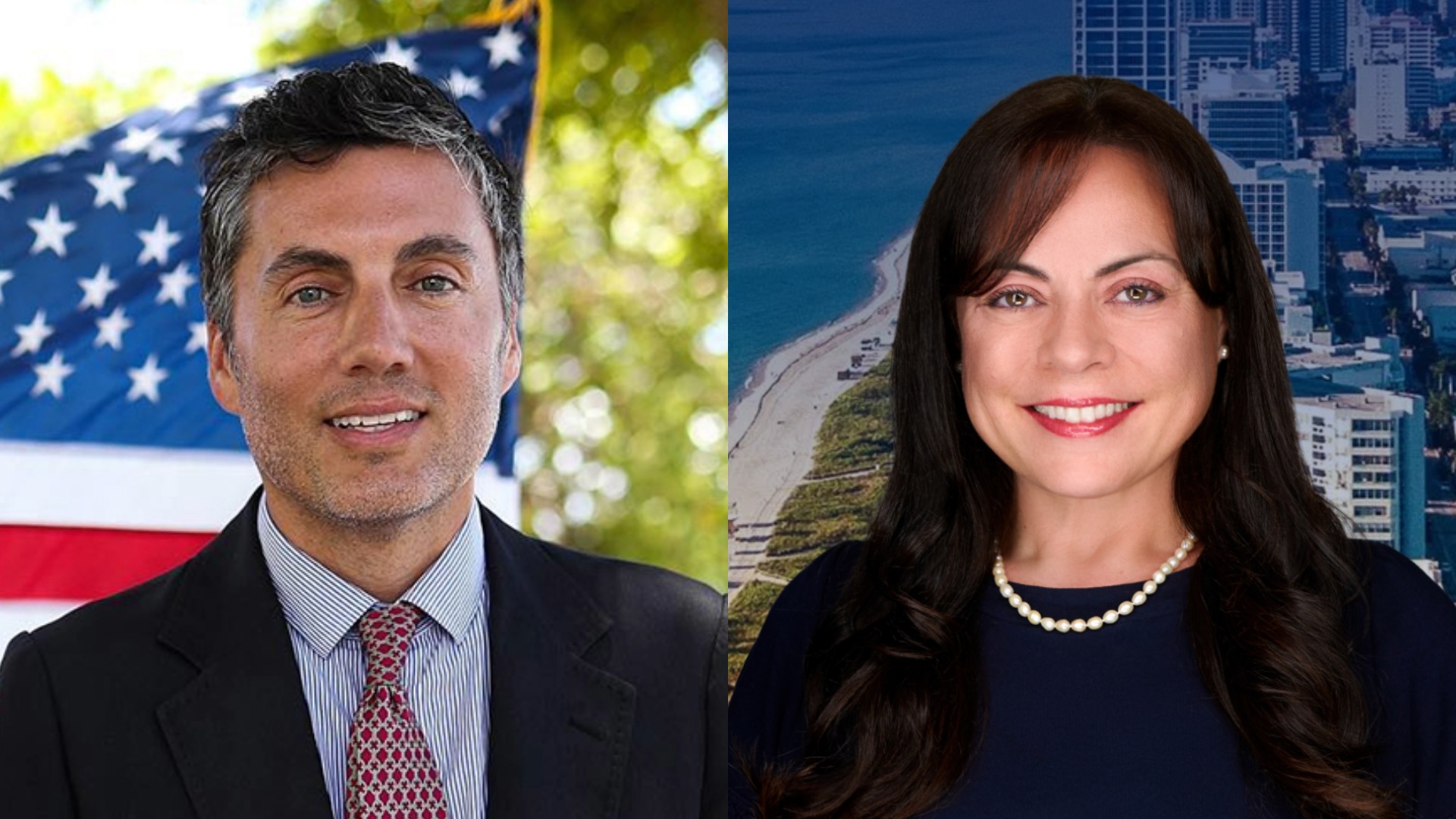
Last week, Republican Rep. Fabián Basabe sent a short video to a dozen South Florida media outlets that he alleged depicted Miami Beach Commissioner Laura Dominguez, a Democrat, engaging in a backroom deal to manipulate voters.
He sold it as something of a smoking gun. She said it’s more of a misfire.
Without additional context, the blurry, 28-second clip might seem troublesome.
In it, Dominguez can be heard saying to several people, including two Miami Beach employees who oversee economic development, that builders seeking project approval should pay for political mailers ahead of the city’s Nov. 4 election.
“This recording shows how residents are being played. It should be investigated criminally and in civil court,” Basabe said in a statement, adding that voters should “clean house and replace” Dominguez and other “establishment” officials as a probe gets underway.
Dominguez’s re-election campaign said the full recording of the meeting in question, which the 41st Street Business Improvement District (BID) held Dec. 10, 2024, shows her comments were much more innocuous than Basabe suggested.
And he should know, Dominguez’s campaign said, since he was in the room with her when she made them.
Dominguez’s comments came about 58 minutes into the meeting after Alex Fryd, the BID Treasurer and principal of property management and development firm Fryd Properties, brought up the nearby Jefferson Plaza as a “preferred” site for redevelopment.
Fryd noted that before any construction could happen there, the alleyway behind it needs to be vacated. Asked by member Michael Goldberg, a banking executive and former Chair of the Miami Beach Chamber of Commerce, who would purchase the alleyway from the city, Fryd said, “We would.”
Fryd said Monday that by “we,” he didn’t mean the BID or his company, which manages the Jefferson Plaza property. He added that nothing ever came of the idea.
“I was just spit-balling ideas,” he told Florida Politics. “There was never any discussion about that idea before I went in the room that day, and there hasn’t been since that meeting ended.”
But the comment sparked a brief exchange about how such a project would get approved. BID President Ira Giller, who runs an architecture and construction management firm, said acquiring the property would require voter approval, citing an opinion by Miami Beach City Attorney Rafael Paz.
He said he had seen reporting on how similar referendums pass when voters were informed about the issue at hand. Discussion then arose about whether this November’s election would be the best time to ask voters about the issue, since turnout is expected to be lower than in even-numbered years.
Dominguez then chimed in.
“The next election is a municipal election, which is a low-turnout election, and what developers have done in the past, when they want to have their cause go through, (is) they do a couple mailings,” she said. “Because there’s really not going to be (a similar push) on the opposing side.”
Giller said they had 11 months to “make a good, strong case for the street as a whole” and “rally the people who use 41st Street as their local shopping area to support it as well.” The project to replace Jefferson Plaza would be “reasonable,” he said, and something voters would support, not a giant high-rise.
Dominguez said shortly after that she thought it was “great” the BID was talking about the project. “If there’s anything I can do to help you get things over the finish line,” she said, “please reach out.”
Basabe, who like Dominguez was off-camera during the meeting, said he disapproved of “the notion of waiting for a lesser-busy election so we can slip something by” voters.
“We’ve got to believe in the electorate,” Basabe said. “Talk like that is what’s made us have the problems that we have today. If this is a great opportunity to create an actual public-private partnership where the city gets out of the way, understands they own a road that’s useless to them, (then) we need to properly package something, transparently present it to the community and make them understand with this partnership (that) we can start doing something that’s long overdue.”
More discussion followed about how to best position the referendum to pass, including recommendations from Basabe about potentially drawing up a bill locally that he could take to Tallahassee to spur the process, which he said has stagnated.
Giller disagreed with that assessment.
“That’s part of what we have to dispel. There is progress,” he said, pointing out the window of First Horizon Bank at 400 W 41st St. to a new development. “I’m looking at it right behind you.”
Asked by Basabe how long that project took, Giller acknowledged it had “taken a lot longer” than he would have liked.
Basabe said he wants to see things happen quicker and that the recently updated Live Local Act provides routes to do so.
Notably, the city’s November election this year was the soonest in which voters could be asked for approval of the project the BID discussed. A question about the issue was not added to the ballot.
In a lengthy statement Friday, Basabe blasted Dominguez as one of several “professional politicians” in South Florida “backed by greedy consultants” who have turned Miami Beach “into a racket.”
“It is a grift designed to keep power locked down,” he said. “Every distraction is meant to hide the truth: land giveaways, sweetheart deals, protected private contracts, shady nonprofits, and corrupt CRAs.”
A CRA, or community redevelopment agency, is a government-created district that combats “slum and blight” by using tax-increment funding — revenue from local property taxes, above a certain cap, that is captured and reinvested locally on infrastructure, affordable housing and other public improvements.
It is similar to a BID, which is a district created by property owners, usually through petition and ordinance, to provide extra services and enhancements like security, cleaning, landscaping, events or marketing beyond what the city normally provides.
BIDs are funded by a special assessment paid by property owners within the district.
Basabe, in his statement, appears to conflate the two.
“Residents have been overtaxed for decades, and that money did not go to where it was supposed to go,” he said. “At the same time, private contracts are protected by local ordinances, seniors are priced out, and even federally subsidized housing is managed by local nonprofits with boards tied to establishment politicians.”
Dominguez, who successfully sued to remove a former aide of Basabe’s from the ballot this month due to residency requirements, called the sophomore lawmaker’s comments “unfortunate” and a “baseless smear” meant to distract voters.
“Unlike those who prefer to keep residents in the dark or mislead them, I have always encouraged developers and business leaders to communicate openly and directly with the public about important community issues — something I will never apologize for,” she said.
“I believe that the people of Miami Beach deserve transparency, honesty, and a full understanding of the challenges and opportunities before us. I have always maintained that the cost of communication and outreach must be borne by developers, not by taxpayers. My record makes clear that I will continue fighting for a government that is open, accountable, and puts residents first.”
Other attendees of the Dec. 10 meeting included 41st Street BID Executive Director Amy Mehu, BID Vice President Ricki London, BID Secretary Andrew Resnick, BID members Seth Gadinsky and Judy Schottenstein, and two Miami Beach employees: Heather Shaw, Assistant Director of Economic Development, and Economic Development Manager Justin Karr.
This isn’t the first time Basabe shared a clip of what he portrayed as a surreptitious meeting in which elected Miami Beach officials courted support from developers. In October 2021, he shared what he described as a “private meeting” then-Mayor Dan Gelber had with former Mayor Philip Levine, City Manager Alina Hudak and dozens of developers.
Gelber, a former federal prosecutor and state lawmaker, noted at the time that there were “60 people on the Zoom,” quipping, “I’m assuming that’s not a secret meeting.” He characterized the conversation, which briefly veered into talk of raising and spending money to elect officials supportive of changing the notoriously hard-partying Ocean Drive area into a more family-friendly environment, as just further discussion of a plan he made public six months before.
Dominguez, 54, won a race in 2022 to finish the elected term of her late partner, Mark Samuelian, on the seven-seat City Commission.
Through June 30, she raised more than $261,000 through her campaign account so far, including a $100,000 self-loan.
She faces one challenger: Fred Karlton, a 65-year-old real estate investor registered with the Independent Party of Florida.
Basabe’s former legislative aid, Democrat Robert Novo, also filed to run against Dominguez, but dropped out last week. Prior to working for Meiner, Novo was a Chief of Staff to Miami Beach Mayor Steven Meiner, but resigned following his arrest in late 2023 after a dispute with an ex-girlfriend turned physical.
Basabe, who is representing himself as a defendant in a slander/libel lawsuit filed by two other former government employees who previously accused him of sexual harassment and battery, hired Novo shortly after.
Two House investigations into those allegations found “no evidence” and “inconclusive” evidence of wrongdoing by Basabe.
Other races on the ballot include a two-way contest between Meiner and City Commissioner Kristen Rosen Gonzalez for Mayor, a seven-way contest for Rosen Gonzalez’s Group 1 seat and a head-to-head matchup between Group 3 Commissioner Alex Fernandez and his lone challenger, Luidgi Mary.
Meiner has no party affiliation. Gonzalez and Fernandez are Democrats. Mary is a Republican.
The city’s elections are nonpartisan.
Post Views: 0